Field Guide
Emperor Penguin
In June, in total darkness at the bottom of the world, some 250,000 male Aptenodytes forsteri are standing still - roughly one male for every breeding pair in a global population estimated at around 600,000 adults in total.
Each one holds a single egg on his feet, tucked beneath a fold of warm abdominal skin called the brood patch. The temperature around them can reach minus 60 degrees Celsius. The wind can reach 200 kilometres per hour. The males have not eaten since March. They will not eat until their partner walks back from the sea, which could be another six to eight weeks away. During that fast - which can last more than 100 days in total - a male Emperor Penguin loses approximately 40 to 45 per cent of his body weight. He survives on fat reserves alone. If his partner does not return before the egg hatches, he can produce a secretion from his oesophagus - a crop milk of sorts - to feed the newborn chick for a few days. After that, if she is still absent, the chick dies.
This is the thesis of the Emperor Penguin: the species exists because of an act of sustained physiological sacrifice that has no close parallel in the bird world. Every Emperor alive today is there because a male stood still in the dark and waited.
Identification
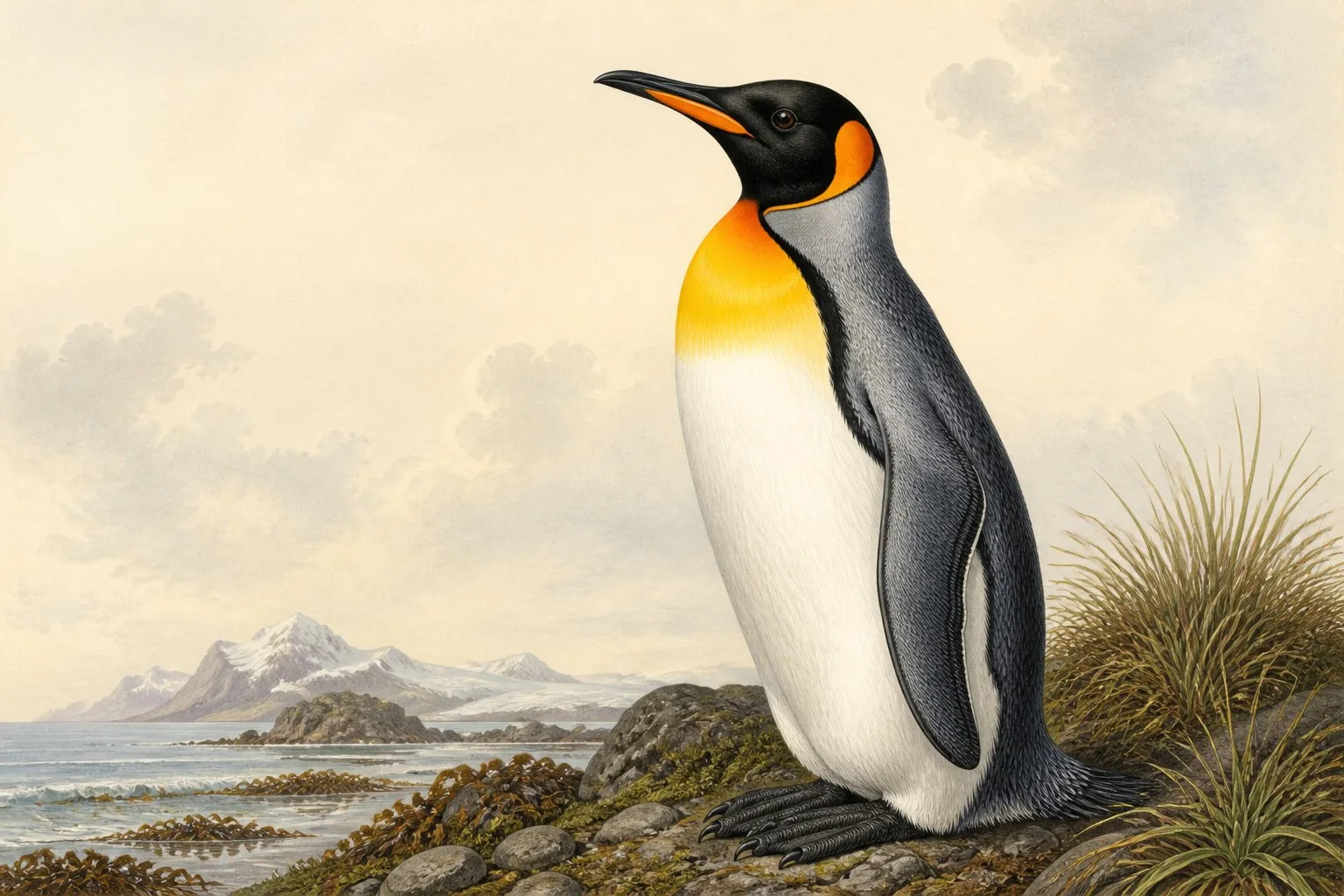
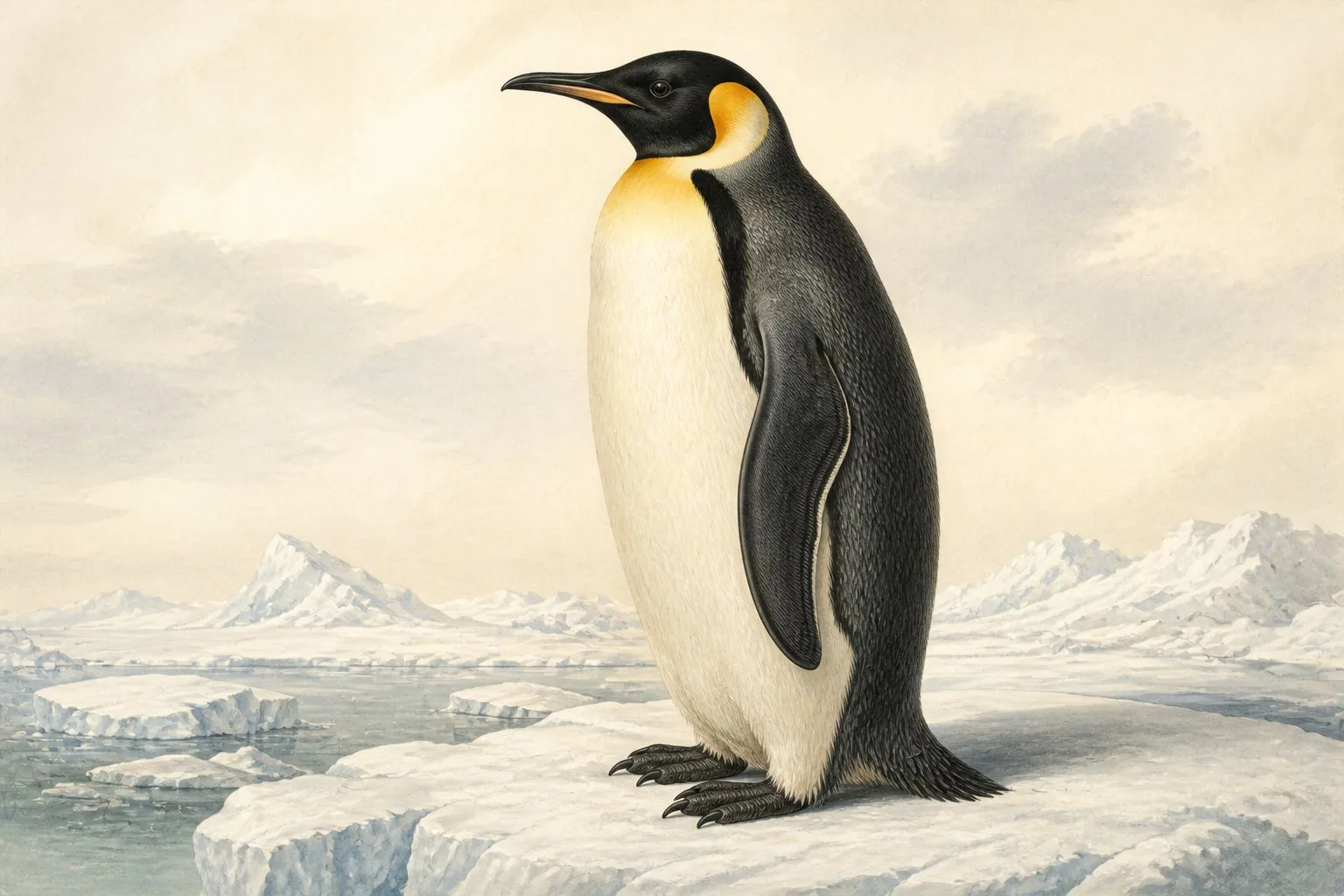
The Emperor is the largest penguin on earth, standing up to 130 centimetres tall and weighing between 22 and 45 kilograms, with males at the heavier end of that range. At distance on sea ice it reads as black and white: a black head, back, and tail, white underparts and belly. Up close, the colours resolve. The upper breast carries a pale wash of yellow that deepens to gold at the sides of the neck. The cheek patches - wide, comma-shaped - are bright yellow, grading to white beneath the chin. These patches are the Emperor’s most distinctive field mark, setting it apart from its closest relative the King Penguin, which shares the yellow-and-orange colouration but is noticeably smaller and breeds on sub-Antarctic islands rather than the continental ice.
The wings of the Emperor are not wings in any conventional sense. They are stiffened, flattened flippers, the bones fused and dense - an adaptation that eliminates the buoyancy problems that hollow bones would create at depth. At the surface the Emperor is awkward, waddling at roughly 2.8 kilometres per hour, occasionally dropping onto its belly and tobogganing across flat ice. In the water it is something else entirely: a torpedo capable of 14 kilometres per hour, diving to at least 535 metres and staying submerged for nearly 22 minutes. Cornell’s Birds of the World records the Emperor as the deepest-diving bird on record. Its haemoglobin is structurally adapted to bind and release oxygen efficiently at low concentrations - a biochemical trait the species carries in its blood for the benefit of deep-sea hunting.
Voice
Emperor Penguins are not silent. They communicate through individually distinct calls, and individual recognition by voice is central to how they function as a species. In a colony of tens of thousands of birds on featureless white ice, a returning female finds her mate, and both parents later locate their chick among thousands of identical-looking chicks, purely by call. The calls are rolling, nasal, and carry well in wind. Each individual’s call carries a signature that the bird’s partner and offspring learn and retain. Without this acoustic precision the colony system would collapse.
Range and habitat
The Emperor is strictly Antarctic. Its 66 known breeding colonies (a 2022 satellite survey found that number, up from earlier estimates) are distributed around the continent between 66 and 77 degrees south latitude. Outside breeding season, birds range freely across the Southern Ocean, sometimes appearing as vagrants as far north as New Zealand, South Georgia, and the southern tip of Australia - but these are outliers. The species depends on stable fast ice - sea ice attached to the coastline - for breeding, moulting, and as a platform from which to dive. The choice of winter for breeding is not perverse. It is calculated. Chicks hatch in spring, when the sea ice is at its maximum extent and the open water - with its fish and krill - is close enough to support the massive increase in food the parents must now bring.
Diet
The primary prey is the Antarctic silverfish (Pleuragramma antarcticum), a small nototheniid fish that is the ecological keystone of the under-ice food web. The Emperor also takes squid - glacial squid and hooked squid - and Antarctic krill. The exceptional diving depth is a function of following silverfish into the water column below the ice shelf, where competitors cannot reach. No other seabird in the Southern Ocean hunts at these depths.
Breeding
The breeding cycle begins in March, when adults march inland from the sea ice to traditional colony sites - journeys that can exceed 100 kilometres on foot. Pairs form or reunite through courtship calls and displays. A single egg is laid in May or June; the female immediately transfers it to the male and departs for the sea. The male incubates alone for 65 to 75 days through the full Antarctic winter. When the chick hatches, the female - ideally - has already returned and relieves the male, who now walks to the sea to feed. The chick is brooded by one parent at a time through its early weeks, then joins a creche: a dense huddle of chicks that reduces heat loss and provides some protection against skuas and giant petrels. Both parents then make repeated foraging trips to the sea, returning to feed the chick on regurgitated fish. Fledging occurs in December or January.
First-year survival is low - only around 19 per cent of chicks reach adulthood, according to available survival data. Adults that reach breeding age typically live 20 to 25 years, with some individuals surviving considerably longer.
The huddle
One behaviour demands more than a footnote. During the male incubation period, the colony does not simply stand and endure. The males form a tight, rotating huddle - a biological heat-exchange system in which individuals on the cold perimeter continually shuffle inward as those inside push outward, so that no single bird bears the worst of the wind for long. The huddle can reduce heat loss by 50 per cent compared to a solitary bird. It is a collective thermoregulation strategy with no parallel in comparable scale among birds. The huddle is not leadership. It has no centre. It is a property that emerges from individual birds each doing one simple thing: moving toward warmth.
Conservation
The IUCN Red List uplisted the Emperor Penguin from Near Threatened to Endangered in April 2026, citing human-induced climate change as the primary driver. The mechanism is specific: early break-up of fast sea ice in spring is collapsing breeding cycles at multiple colonies. Chicks that have not yet moulted their downy feathers cannot survive in the sea; if the ice beneath them breaks up before they are ready, they drown. Satellite data from the British Antarctic Survey indicates that roughly 10 per cent of the monitored breeding population - more than 20,000 adults - was lost between 2009 and 2018. Current projections suggest the population could halve by the 2080s under emissions scenarios that do not involve rapid reduction.
The Emperor Penguin is a species built around ice. It breeds on ice, hunts from ice, and times every stage of its annual cycle to the rhythms of ice formation and retreat. When that rhythm breaks, the biology built around it breaks too. The male standing in the dark with an egg on his feet is executing a strategy that has worked for hundreds of thousands of years. The question the IUCN is now asking is whether the ice will hold long enough for him to keep doing it.