Field Guide
Altamira Oriole
In the thorn forest of the Lower Rio Grande Valley, where the United States runs out and Mexico begins, a bird the size of a small thrush hangs upside down at the tip of an ebony branch, threading plant fibre through a loop with its bill. The structure taking shape beneath it is not a cup or a basket. It is a woven sleeve, deep as a forearm, swinging clear of the trunk on a single anchor. By the time it is finished it may be two feet long. Nothing else nesting in North America builds anything close.
The Altamira Oriole is the largest oriole in the genus Icterus, and in the United States it lives almost nowhere but this last warm corner of South Texas. It is a tropical bird that crossed the river and stayed.
What it looks like
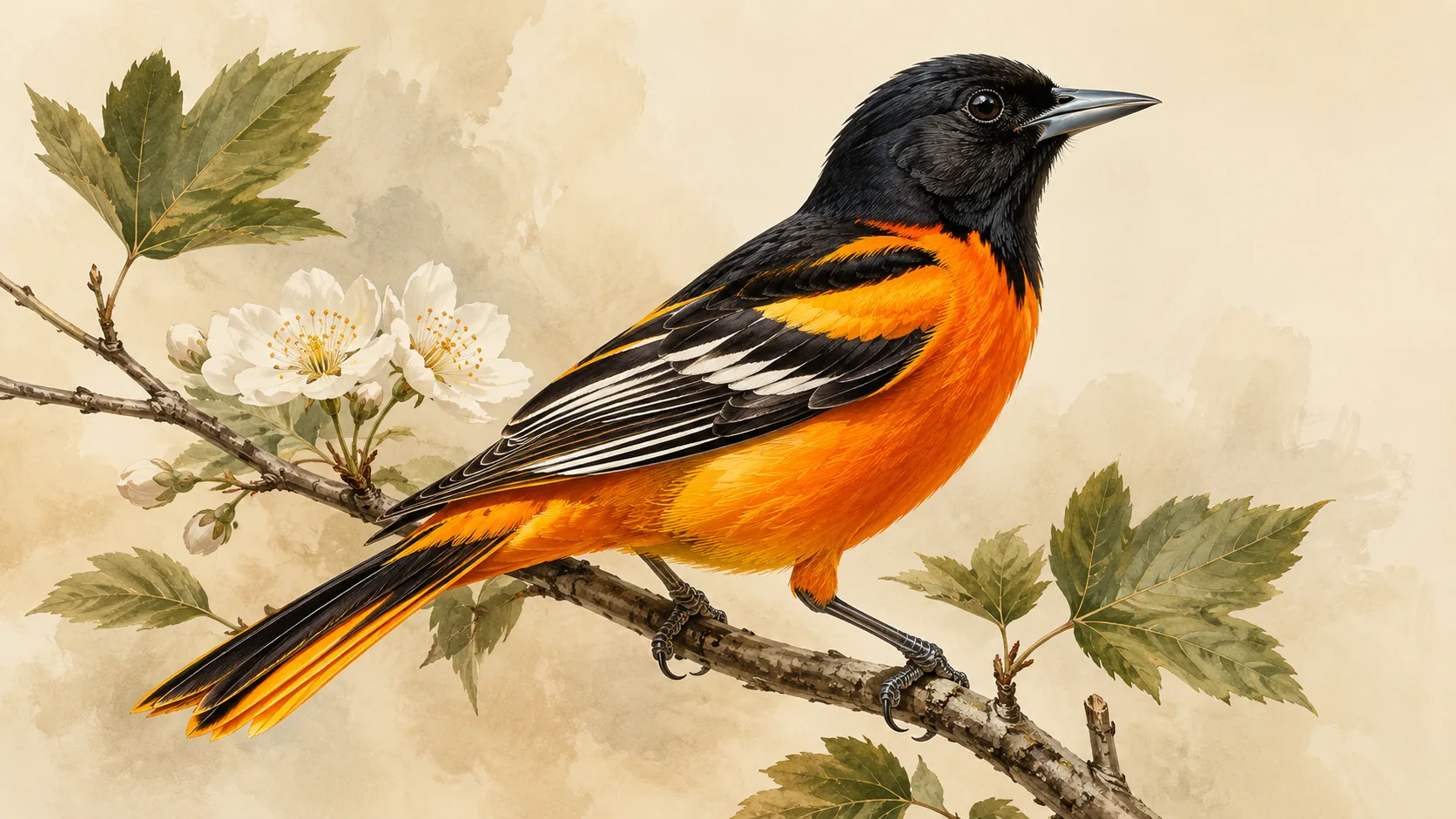
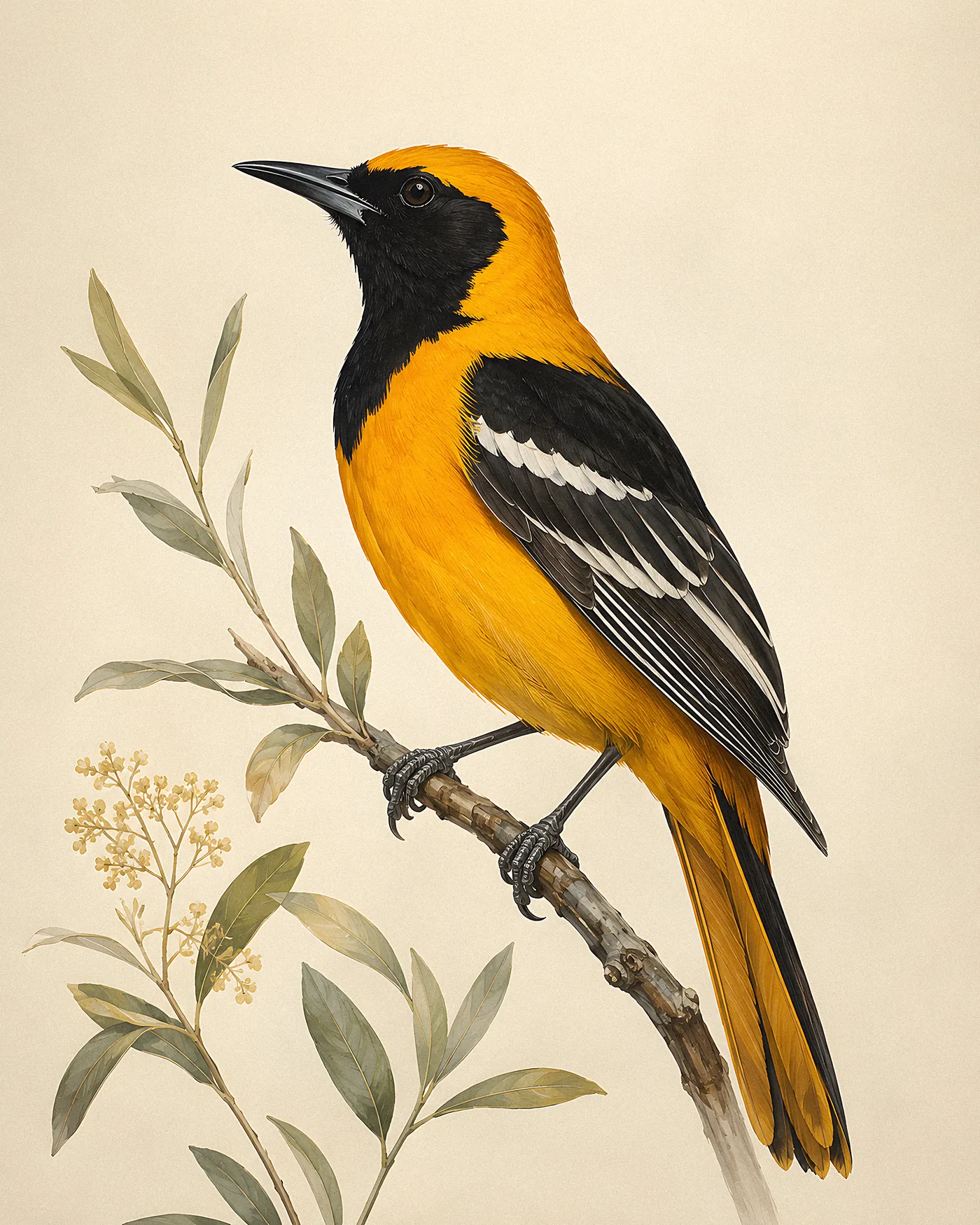
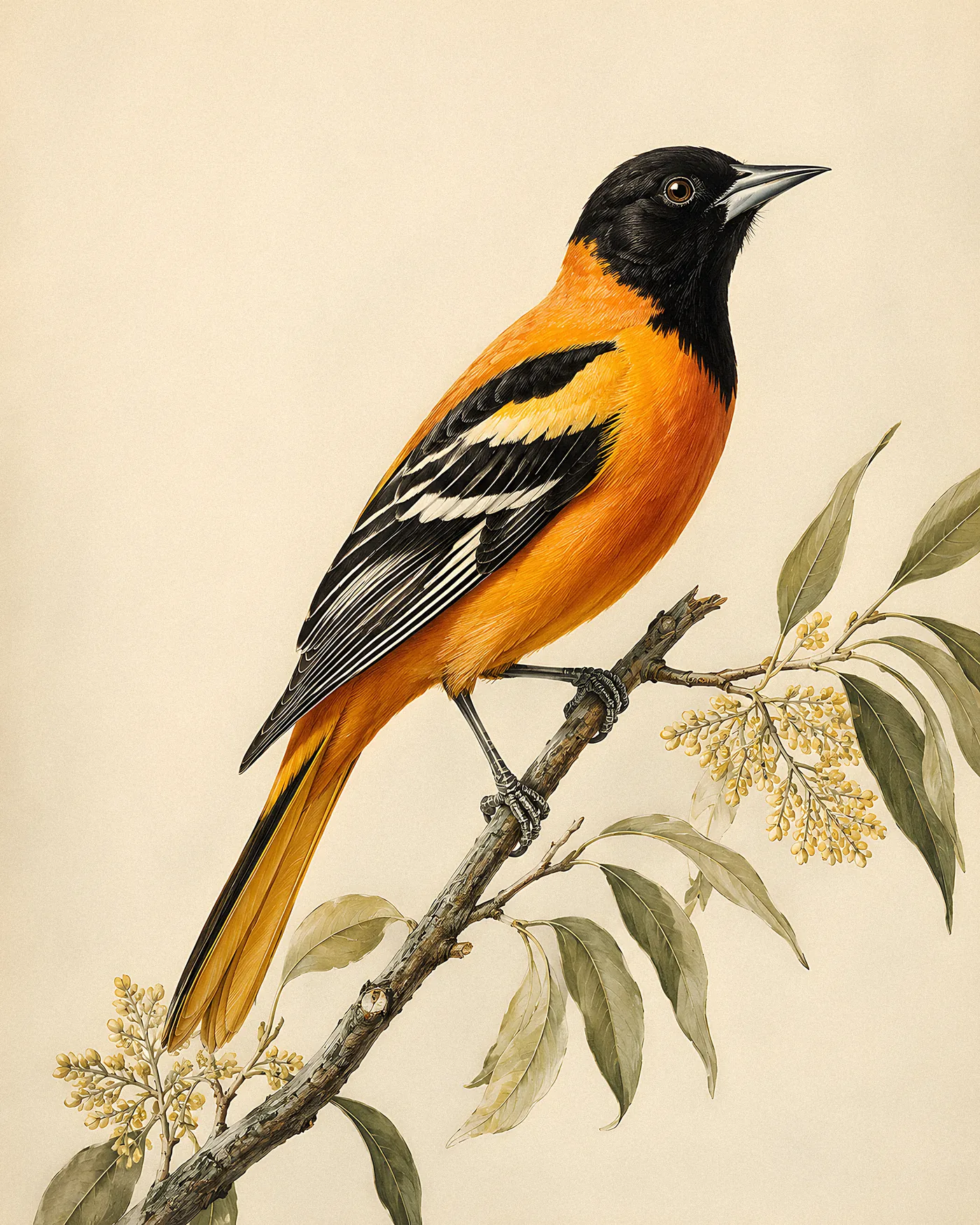
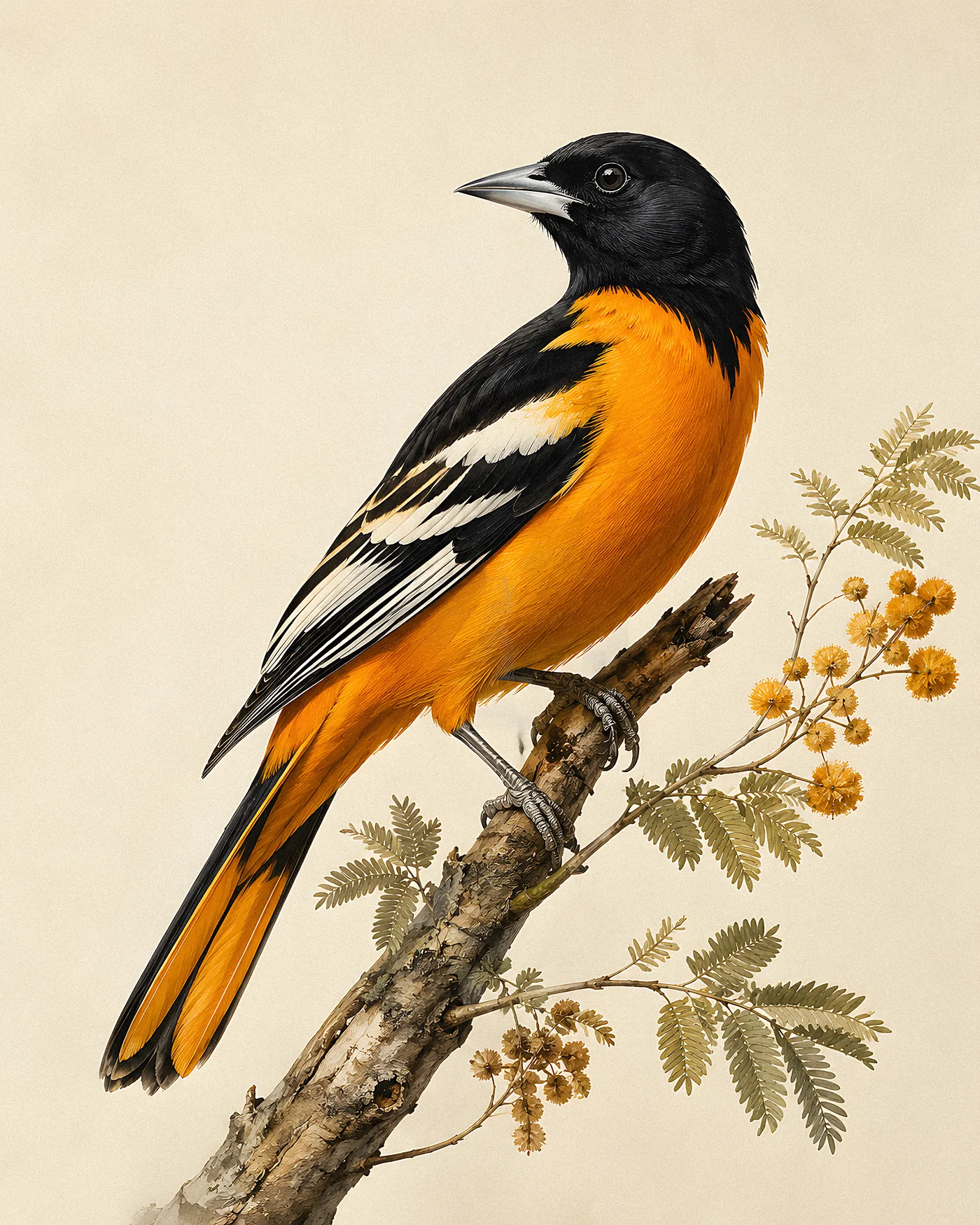
This is where the Altamira parts company with its relatives. Most orioles are sexually dimorphic, the male bright and the female muted. The Altamira is not. Both sexes wear the same flame-orange and black, so the bird on the nest looks exactly like the bird singing above it. Adults are a deep, glowing orange across the head, breast, belly and rump, with a black mask running from the bill through the throat, a black back, and black wings.
The field mark that settles it is the shoulder. The Altamira carries a solid orange patch on the upper wing, the lesser coverts, set above a white wing bar and a white edge to the flight feathers. The bill is heavier and thicker at the base than the slender tools of the smaller orioles, suited to a bird that prises and tears as much as it probes. Young birds are a duller yellow-orange with an olive-toned back, taking time to reach the full adult fire.
What it sounds like
The song is a series of clear, slow, whistled notes, less hurried than the chatter of the smaller orioles and lower in pitch, a deliberate phrase repeated from a high perch. Both sexes give it. The everyday voice is a nasal, scolding ike and a low, rolling rattle used near the nest. Cornell Lab notes that the species is vocal year round in its resident range, which fits a bird that does not migrate and holds its territory through the seasons.
Range and habitat
Icterus gularis is a permanent resident, not a migrant. Its range runs from the Lower Rio Grande Valley of Texas south through eastern and central Mexico into Central America. In the United States it is confined to a thin band of riparian woodland, thorn forest, wooded parks and well treed suburbs along the Rio Grande, where it favours tall trees beside water.
Cornell Lab records that the Altamira has become more common in Texas over the last half century, and that south of the border it remains widespread and common. It is one of the prize birds of the Valley refuges, a tropical species that birders from the rest of the country travel specifically to see. It does not stray far. A bird hatched in a Texas thorn forest will likely live and breed within a few miles of it.
Diet
The Altamira is an omnivore that leans heavily on insects. It takes caterpillars, beetles, grasshoppers and other large insects, gleaned and torn from foliage and bark with that heavy bill, and supplements them with fruit and nectar. It is a known seed disperser in its tropical range, swallowing fruit and carrying the seeds, and an important predator of insects in the same woods.
It forages deliberately, working along branches and through the canopy, prising into curled leaves and bark crevices. At feeders within its range it will take orange halves and sugar water in the manner of the family, but it is less of a feeder regular than the more suburban Hooded Oriole that shares its Texas range.
Breeding and nesting
The nest is the headline. The Altamira builds the longest woven nest of any bird in North America, a pendant pouch of fine plant fibres that hangs from the very tip of a branch or, with apparent indifference, from a telephone or power line. Cornell Lab gives a length range from about one foot to just over two, with the widest point around six inches. It is assumed to be built mainly by the female, though how long construction takes is not well documented.
The reason for the extravagant length is defence. A nest hanging at the end of a thin branch tip, well below its anchor, is hard for a climbing snake or a raiding grackle to reach. The bird trades effort for safety. The clutch is four to six eggs. A study cited by Cornell put incubation at around twelve and a half days and the nestling period at roughly fifteen and a half, with both parents feeding the young, in keeping with a species where both sexes look and behave alike.
The longest woven nest on the continent is not built for beauty. It is a two foot drop of plant fibre engineered to keep a snake from ever reaching the eggs.
The bird worth crossing the river for
Most of the orioles in this guide are birds of passage, here for a northern summer and gone to the tropics by autumn. The Altamira is the opposite. It is a tropical resident that the United States borrowed at its southern edge, a bird that stays put, holds a territory year round, and looks the same whether male or female.
For the birder, that constancy is the gift. There is no narrow spring window, no scramble to catch it before it leaves. In the Valley it can be found in any month, blazing orange in a thorn tree, often beside the absurd long sleeve of last year’s nest still swinging from a branch. The IUCN lists Icterus gularis as Least Concern, with populations broadly stable and the Texas range slowly expanding.
It is the southernmost flame in this gallery, and the one that does not fly away.