Symbolism
The Tower of London Ravens Are a Victorian Invention
The earliest known illustration of a raven at the Tower of London appeared in a special edition of The Pictorial World newspaper in July 1883.
Not in the Middle Ages. Not under Charles II. July 1883.
The Tower’s own official historian has stated on the record that the entire mythology is “likely to be a Victorian flight of fancy.” The story that Charles II issued a royal warrant requiring ravens at the Tower at all times - on pain of the kingdom falling - has no documented primary source. No court record. No royal decree. Nothing. The ravens were almost certainly supplied to the Tower in the 1880s by the 4th Earl of Dunraven, whose family had druidic connections and an interest in Welsh mythology. The “kingdom will fall” prophecy was reverse-engineered from a Welsh legend about a god named Bran, whose name means raven, and whose severed head was supposedly buried under the Tower as a protective talisman.
The most famous ancient bird legend in the English-speaking world is roughly 140 years old.
This is where raven symbolism actually starts: with the fact that humans have been building elaborate stories around this bird for a very long time, and not all of them are what they claim to be.
The Biology Comes First
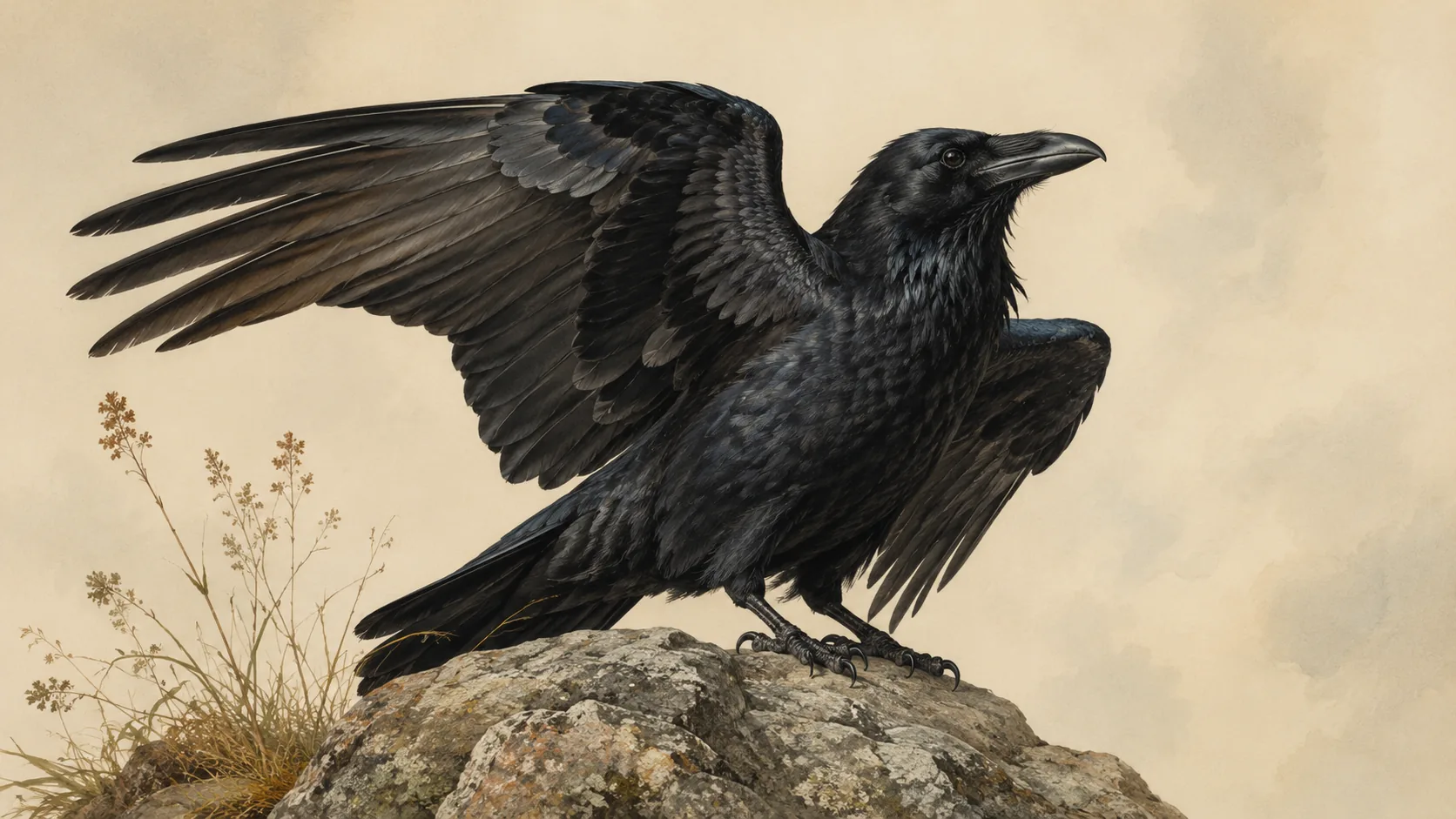
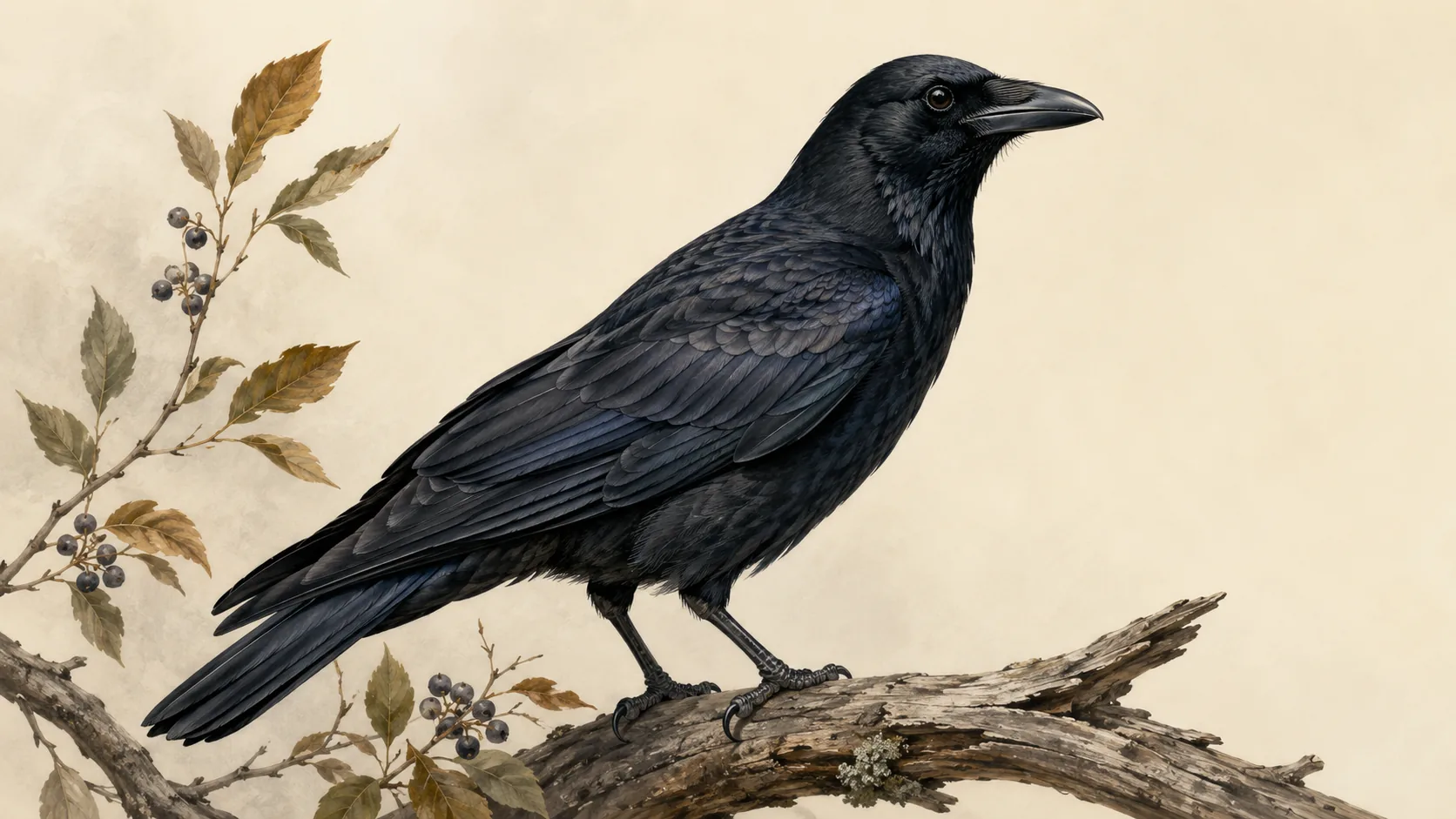
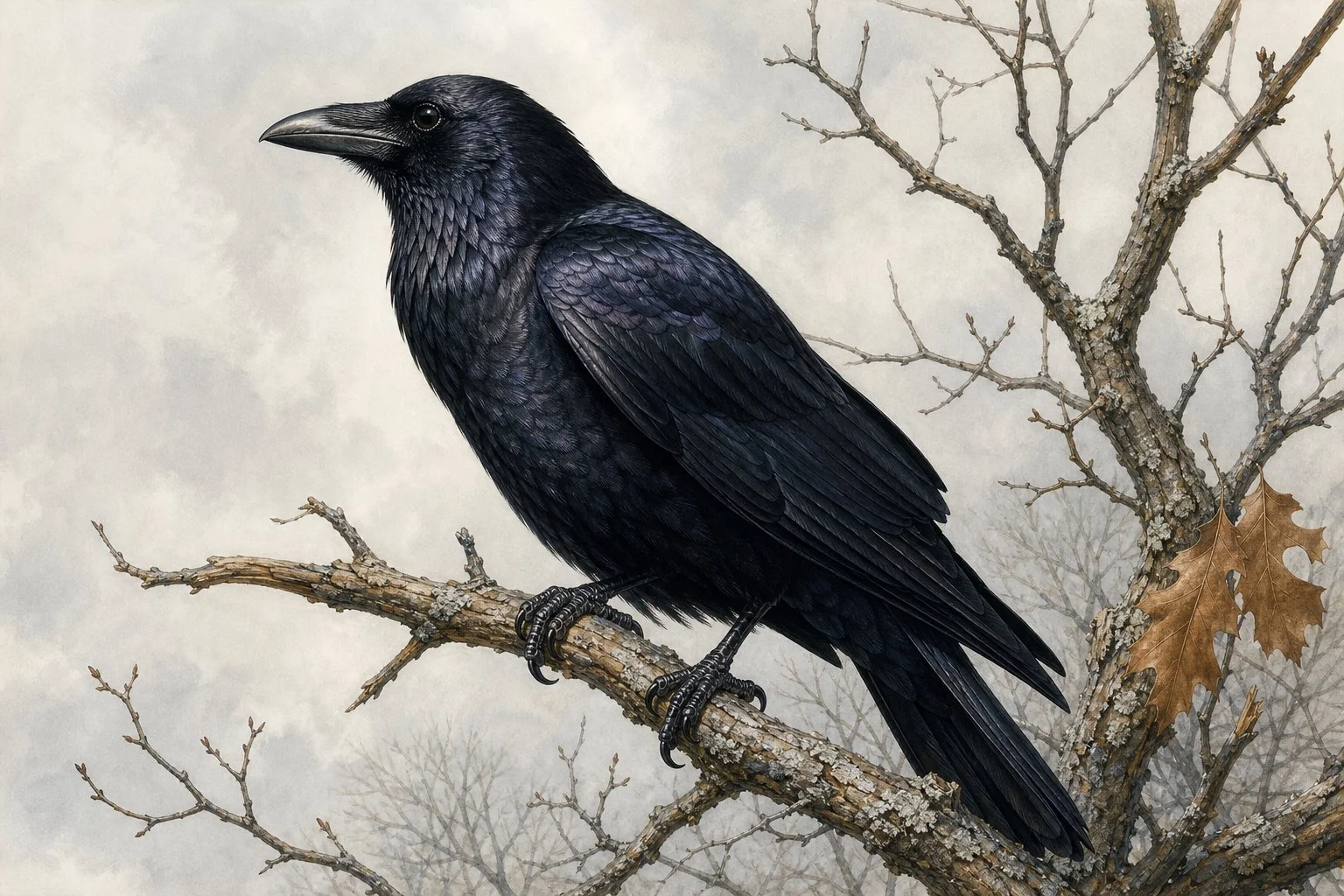
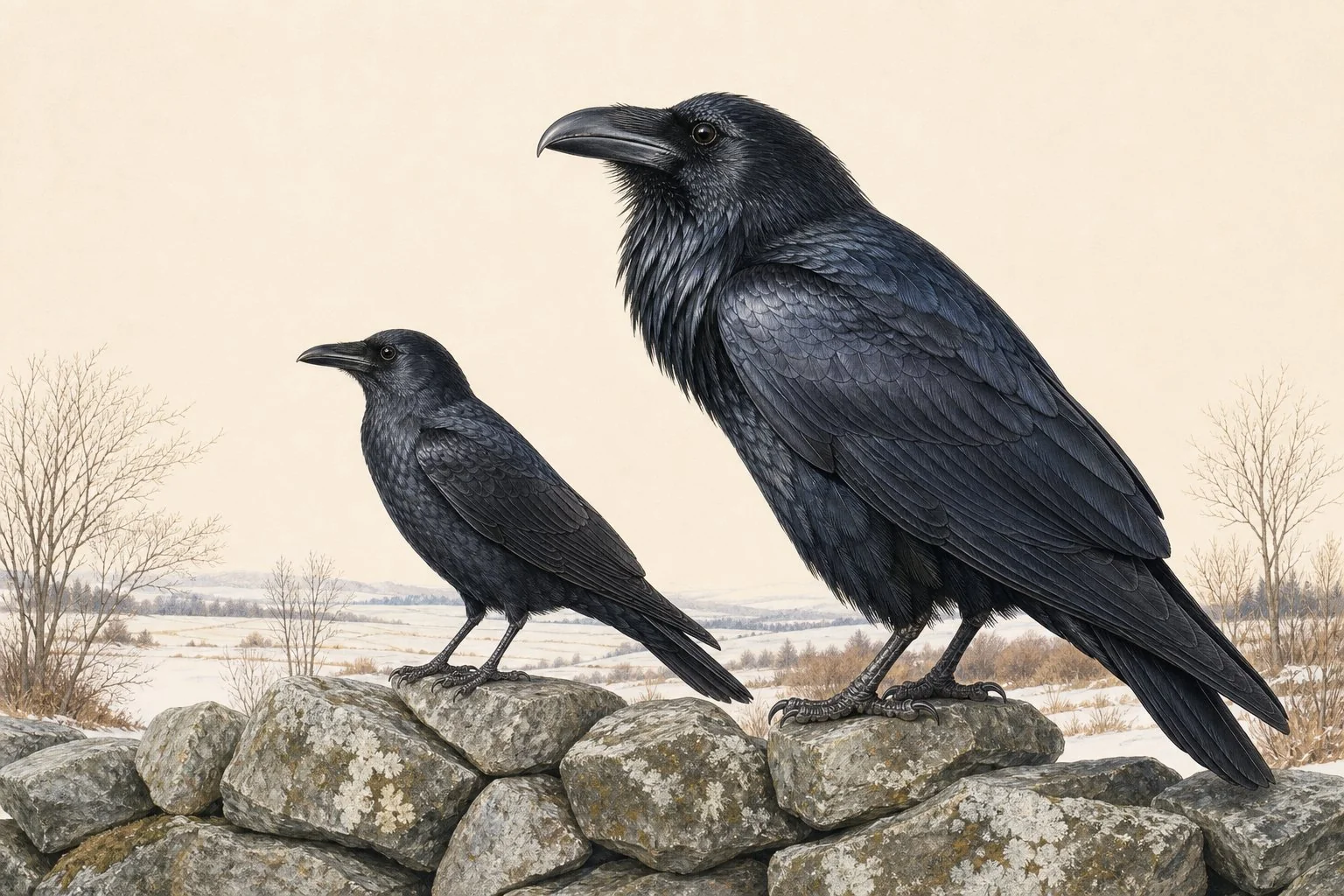
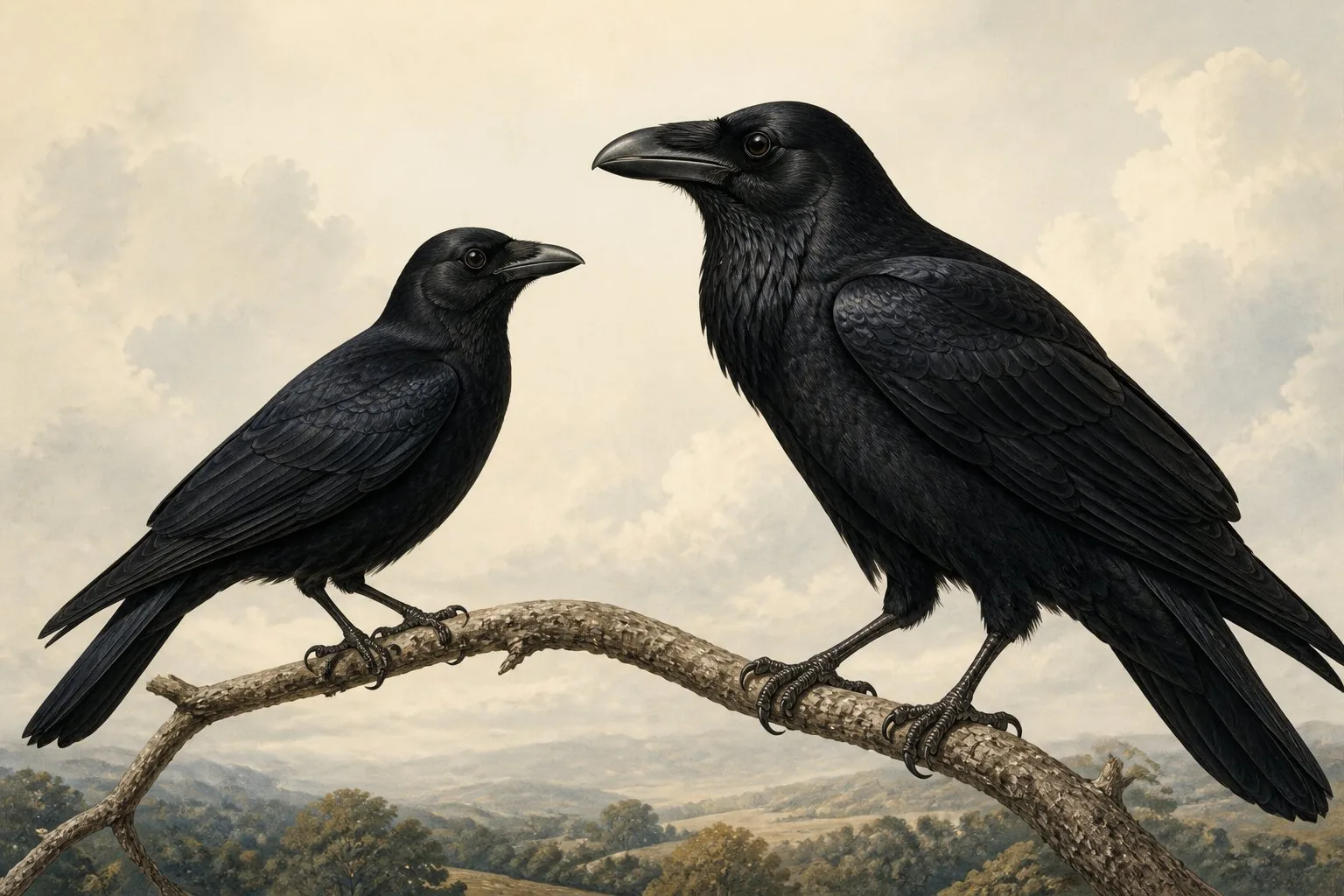
The common raven (Corvus corax) is the largest member of the corvid family and one of the most cognitively sophisticated birds on earth. It weighs up to 1.5 kg, has a wingspan up to 150 cm, and lives in the wild for 10 to 15 years - with captive individuals reaching 40 years or more. A single raven can accumulate more than a decade of detailed social memory: who helped whom, who cheated whom, which human feeds and which does not. The same cognitive machinery runs in its smaller relative the American crow, which is why the two birds get folded together so often in folklore.
That social memory is documented. A 2016 study in Nature Communications showed ravens adjust their food-caching behavior based on whether they believe they are being watched, including through a closed window with a small peephole. When the peephole was open, they took steps to conceal their caches. When it was closed, they did not bother. Ravens understand that other individuals have knowledge states different from their own. They run tactical deception: pretending to cache food in one spot while hiding it elsewhere when observed.
A 2017 study in Science by Kabadayi and Osvath at Lund University found that ravens plan for future contingencies after delays of up to 17 hours. They outperformed orangutans and bonobos in the same task. They also outperformed 4-year-old human children in comparable conditions.
Ravens play into adulthood. They slide down snowy slopes. They drop objects in flight and catch them. They hold grudges against specific humans for years. Pairs bond for life and maintain year-round territories together.
This is the animal that every culture on earth has noticed and built stories around. The stories are not arbitrary projections. They are responses to a bird that genuinely appears to know things, remember things, and behave with something that looks uncomfortably like intent.
Norse: The God Who Was Afraid to Lose His Mind
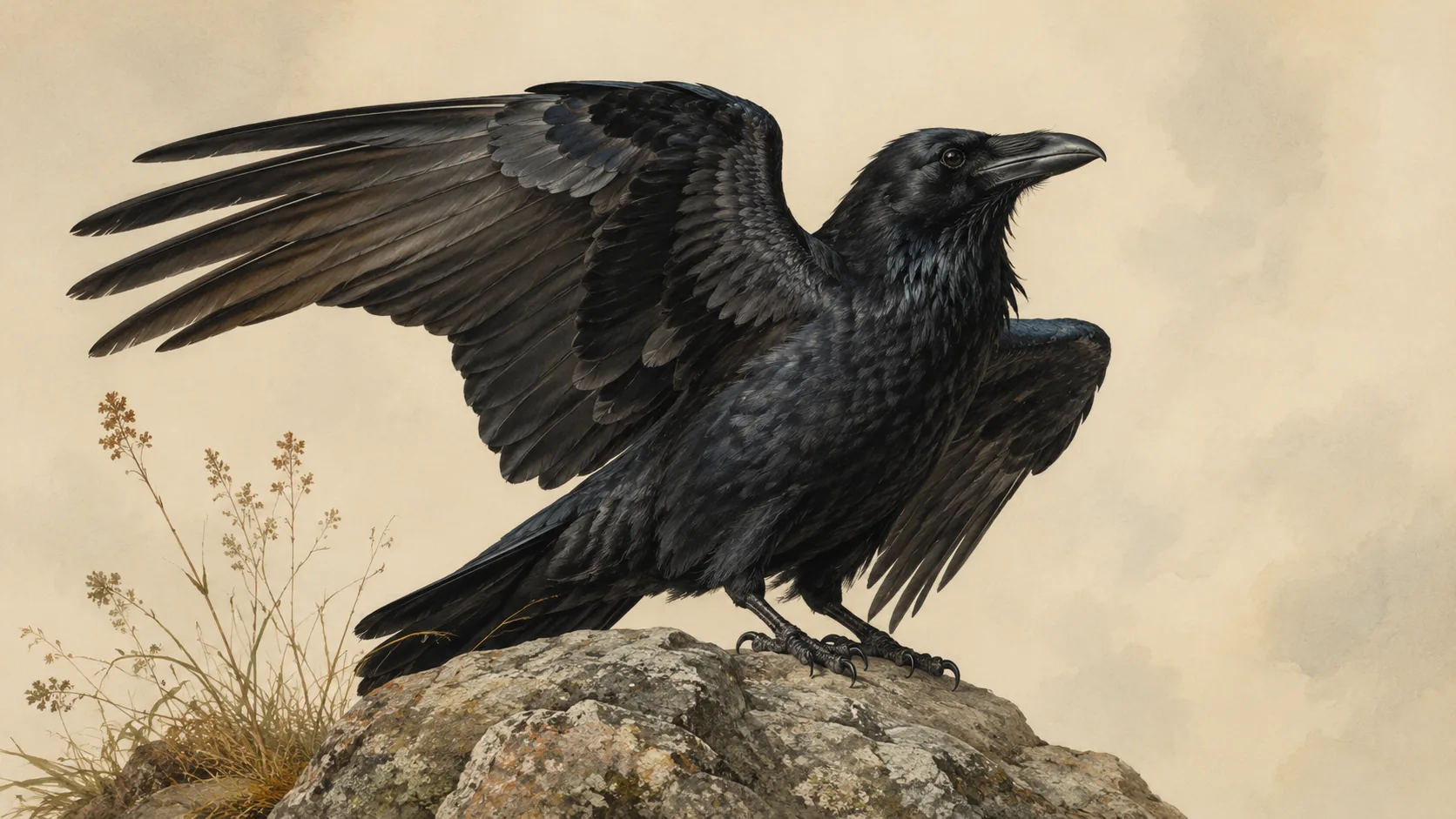
Odin kept two ravens. Their names are recorded in Grímnismál, stanza 20, part of the Poetic Edda - composed orally before the Viking Age and written down in Iceland in the 13th century.
The Old Norse original: Huginn ok Muninn fljúga hverjan dag Jörmungrund yfir; óumk ek of Hugin, at hann aftr né komi-t, þó sjámk meir of Munin.
Translation: “Huginn and Muninn fly every day over the vast earth; I fear for Huginn that he won’t come back, though I fear more for Muninn.”
The standard English gloss is that Huginn means “thought” and Muninn means “memory.” This is a simplification. Huginn tracks reasonably well from Old Norse hugr, meaning thought or mind. Muninn is harder: munr encompasses thought, desire, emotion, and memory as a tangle. Old Norse cognition did not cleanly separate these things. Muninn may be better understood as the total accumulated weight of experience and attachment - everything that makes a self a self. The “-inn” suffix indicates mastery of the quality, so Huginn is roughly “he who is master of thought-projection” and Muninn is “he who holds the totality of what has been lived.”
Odin sends both ravens out at dawn. They fly over all the world. They return at breakfast and whisper into his ears everything they have seen and heard. This is how the god of wisdom achieves omniscience: not through divine built-in knowledge, but through daily reports assembled from the world.
The Prose Edda adds that Odin does not eat. He gives all food from his table to his wolves, Gere and Freke. Wine serves him as both food and drink. He has transcended bodily need. What sustains him is knowledge.
And yet the stanza says he fears. Not for thought, which he can perhaps recover. For memory - for Muninn - he fears more. The all-knowing god is afraid of forgetting. Without Muninn, without accumulated experience and care, there is no Odin. There is only an empty container.
The raven banner extended this logic into war. The Anglo-Saxon Chronicle records a raven battle standard captured from a Viking force in Devonshire, Wessex, in 878 CE - the earliest documented historical reference. The banner was triangular, depicting a raven with outstretched wings. To fight under it was to announce yourself as operating under Odin’s observation.
At the Battle of Clontarf on April 23, 1014, Sigurðr the Stout, Jarl of Orkney, carried the raven banner into the last major Viking military operation in Ireland. The Orkneyinga Saga records that his mother, a völva (seeress), wove the banner with this property: it would bring victory to its lord and death to whoever carried it. Three successive standard-bearers died. Sigurðr had to carry it himself and was killed. The saga also records that on the night before the battle, Sigurðr’s ally Bróðir’s men saw ravens with iron beaks and claws attack them in a vision. Odin’s birds attended the slaughter in both directions.
Biblical: The Unclean Bird That Fed the Prophet
Genesis 8:7. Noah opens the window of the ark and releases a raven first, before the dove. The raven “went to and fro until the waters were dried up from the earth.” It does not return.
This is almost never the part people remember.
The dove returned with the olive branch. The olive branch became the universal symbol of peace, passed directly into Christian iconography, became the dominant visual of that story. The raven flew out, found adequate conditions on floating debris - carrion would have been plentiful - and simply did not come back. No memorable object. No narrative payoff. Just absence.
Early Christian theologians in the patristic period, roughly the 2nd through 5th centuries CE, found the raven’s non-return theologically useful in a negative direction. The raven, black, associated with carrion and uncleanness, became an allegory for those who wander among the dead rather than returning to God. The dove, white, represented the soul that returns to the divine. This reading required ignoring the practical function of Noah’s raven - it was doing exactly what it was released to do - in favor of a moral reading imposed on animal behavior.
The problem is 1 Kings 17:4-6.
God tells Elijah to hide at the brook Cherith. “I have commanded the ravens to feed you there.” Ravens bring him bread and meat morning and evening.
Ravens are listed as ritually unclean in Leviticus 11:15 and Deuteronomy 14:14. Forbidden to eat. Unsuitable for temple sacrifice. Their diet of carrion is the practical reason. And God chose precisely these birds as his instruments of provision for his prophet. The text does not flag this as remarkable or explain it. It is stated flatly. Theologians who read the Genesis raven as a symbol of spiritual failure then have to explain why the same bird type was personally commissioned by God to sustain Elijah for months.
Jesus used the raven to the same end in Luke 12:24: “Consider the ravens - they do not sow or reap, they have no storeroom or barn; yet God feeds them.” The unclean scavenger is offered as evidence of divine providence. The theological tradition that condemned the raven as a symbol of sin produced a God who kept using it as his example of care.
Haida: The One Who Made Light by Accident
The Haida Gwaii peoples of British Columbia divided their society into two moieties: Raven and Eagle. Membership is matrilineal. A Raven must marry an Eagle; a Raven cannot marry a Raven. This is not metaphor. It is the structural principle of Haida kinship, operational for centuries before European contact. More than 20 named lineages fall under the Raven moiety. The raven crest appears at the tops of totem poles marking clan identity. Raven is not a symbol in Haida culture. Raven is a social category people belong to.
The Haida Raven, Xhuuya, is the trickster who made the world habitable - not through intention, but through maneuvering.
Before creation, the world was dark. Raven discovered that an old chief kept the sun, moon, and stars locked in a series of nested boxes. Raven transformed himself into a hemlock needle and fell into the chief’s daughter’s drinking water. She swallowed him. He was born as a human child. He cried and cried until the chief, unable to endure it, gave him the boxes to play with. Raven opened them and released the light - first the stars, then the moon, then the sun. Then he fled.
Raven did not intend to illuminate the world. He wanted the boxes because he wanted them. Light was a side effect of escape.
The Raven and the clamshell story follows the same logic. Raven, wandering a beach after the great flood, heard a strange sound from a giant clamshell. Inside were tiny figures - the first humans. He coaxed them out with curiosity and blandishments, interested in them the way he was interested in novel objects. Gradually they emerged and became the Haida people.
Bill Reid’s sculpture “Raven and the First Men,” completed April 1, 1980, and commissioned for the Museum of Anthropology at UBC, captures this moment. Carved from a 4.5-ton block of laminated yellow cedar, it shows a massive Raven standing on the open clamshell. Around the rim, tiny human figures are emerging - some crouching, some already stretching upward. The Raven looks down at them. Museum materials describe the expression as neither benevolent nor threatening. Ambiguous interest. The curiosity of a being confronting something unexpected and not yet decided what to make of it.
That is the Haida Raven. Not an omen. The accidental author of the conditions for life, looking at what he stumbled into.
Edgar Allan Poe Knew the Raven Was Not Doing Anything
“The Raven” was published January 29, 1845, in the New York Evening Mirror. Poe was identified by name - unusual for him at the time.
In 1846, Poe published “The Philosophy of Composition,” claiming to describe his compositional method step by step. He had already determined the poem’s emotional register - beauty through sadness, which he argued was the most poetic mode. He had already selected the refrain word “Nevermore” for its sonorous combination of o and r sounds. The problem was: what creature would repeat this word mechanically, without understanding it, while the narrator projected meaning onto the repetition?
Poe’s documented contenders were a parrot and a raven. He writes: “Here, then, immediately arose the idea of a non-reasoning creature capable of speech; and, very naturally, a parrot, in the first instance, suggested itself, but was superseded forthwith by a Raven, as equally capable of speech, and infinitely more in keeping with the intended tone.”
The owl sometimes mentioned as a contender in internet sources did not appear in Poe’s documented account. The choice was parrot versus raven. The parrot could say the word but was comic. The raven, already associated with ill-omen in the post-medieval European tradition Poe was working in, matched the tonal register of grief and inevitability.
The direct line from Poe’s choice to Dickens: Poe reviewed Barnaby Rudge in Graham’s Magazine in 1842, the year Dickens finished the novel. Dickens had a pet raven named Grip while writing it - a real bird, described by Dickens’ daughter Mamie as mischievous and impudent, given to biting the children and dominating the family mastiff. Grip’s favorite phrase was variations on “Polly Put the Kettle On.” He died in March 1841 from eating lead paint chips and was taxidermied. He is currently on display at the Free Library of Philadelphia. Poe wrote of Grip in his review: “The raven, too, intensely amusing as it is, might have been made more than we now see it.”
Three years later, he made it more.
But Poe was explicit about what the poem actually described. The narrator asks the raven questions he knows will be answered “Nevermore.” He escalates deliberately, from whether the raven will leave, to whether he will see his dead Lenore again in paradise. The raven is a non-reasoning creature. It was trained to say one word. The horror is entirely the narrator’s own projection - grief as self-inflicted suffering, the human mind torturing itself by asking questions it has already answered.
The poem that gave the raven its dominant modern symbolism in the English-speaking world is, structurally, an argument that the raven means nothing and humans cannot stop making it mean everything.
Celtic: The Raven Did Not Wait to Be Named
Early Irish tradition did not cleanly distinguish raven from hooded crow. The Morrigan - the war-goddess central to the Ulster Cycle, the great body of Irish mythology written down in the 12th century from oral traditions of the Iron Age - shape-shifts into a raven or hooded crow over battlefields, selecting the slain. The Irish fiach dubh covers both birds.
Raven augury was formalized. P.W. Joyce’s compilation of early Irish sources records that divination from ravens was practiced by Irish druids, and “the very syllables they utter, and their interpretation, are given in the old books.” Specific croaking patterns had specific meanings, recorded systematically. These texts have not survived intact, but the practice is referenced across multiple sources.
The Irish concept of fios an fhiaich - raven’s knowledge, raven’s wisdom - meant prophetic or supernatural insight. To have a raven’s knowledge was to know things you could not have been told.
The Welsh Mabinogion’s Brân the Blessed complicates things. Brân, whose name means raven or crow in Welsh, was mortally wounded by a poisoned spear and ordered his followers to cut off his head and bury it under the White Hill in London, facing France, as a protective talisman for Britain. The White Hill is identified with the site of the Tower of London. This is the Welsh legend the Victorian druidic revival used to backfill the Tower raven tradition with false medieval depth. The Mabinogion does not mention ravens as guards at that site. Brân’s head is the talisman. The conflation of Brân’s legend with ravens at the Tower was done in the 1880s, not the 1100s.
The Battle of Clontarf sits at the intersection of Irish and Norse raven mythology: the last great Viking military operation in Ireland, fought on Good Friday 1014, under Odin’s raven banner by Sigurðr of Orkney. Irish annals record the battle. The raven banner detail comes from the Norse sagas. Two mythological traditions running into each other on an actual field.
What the Symbolism Adds Up To
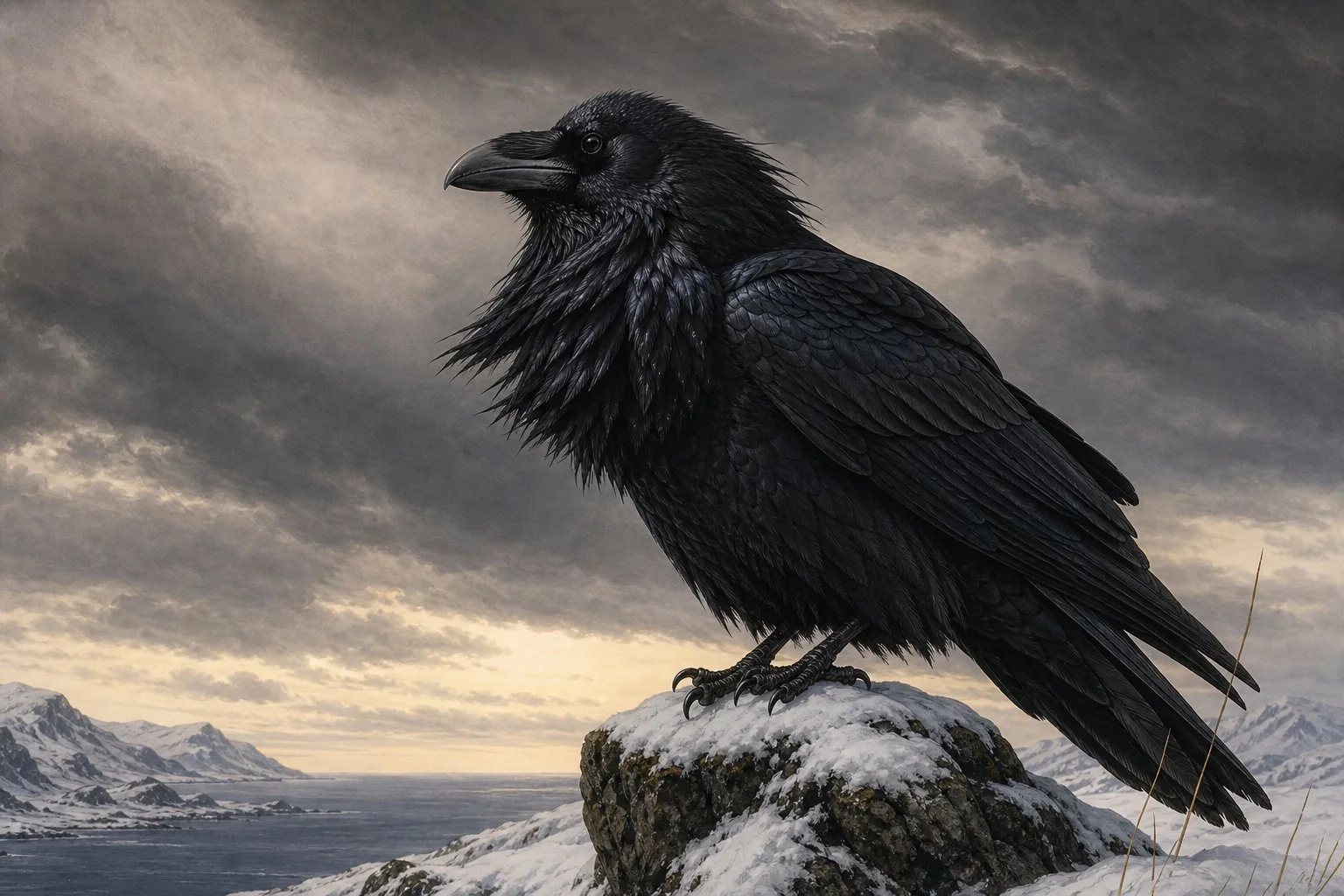
The raven appears across traditions that had no contact with each other, in roles that share one common feature: the raven knows something you don’t.
In Norse mythology, the ravens are Odin’s access to information the god of wisdom cannot have without sending his mind out into the world. In Haida oral tradition, Raven knows where the light is locked away. In Celtic divination, the raven’s croaking encodes knowledge of the future. In Poe, the raven knows only one word, and the narrator cannot stop treating that word as revelation.
The biology explains the reputation. A bird that remembers specific human faces for years, runs deception, plans for contingencies days in advance, and lives for decades accumulating experience - this bird will, in close proximity to humans, appear to know things. It will appear to have been watching. It will appear to have opinions about what it sees.
The Grímnismál stanza returns to this. Odin fears losing Muninn - memory, desire, the accumulation of experience - more than he fears losing thought. The poem positions memory as more fundamental to identity than reason. A creature that has been watching you for a decade and remembers everything is, in practical terms, closer to the Muninn end of that equation than anything else in the natural world.
The Tower of London birds, maintained by Yeoman Warder Barney Chandler since March 2024, are named Jubilee, Harris, Poppy, Georgie, Edgar, Branwen, Rex, and two chicks hatched in May 2025 named Henry and Poe. The tradition they enact is 140 years old and was invented by a Victorian aristocrat with druidic interests.
It is still, measurably, a better tradition than most. The ravens themselves have been watching the fortress for some of them longer than anyone on staff. Whatever the Victorians believed they were doing by placing them there, the birds showed up and stayed and built their knowledge.
That is what ravens do.