Field Guide
House Martin
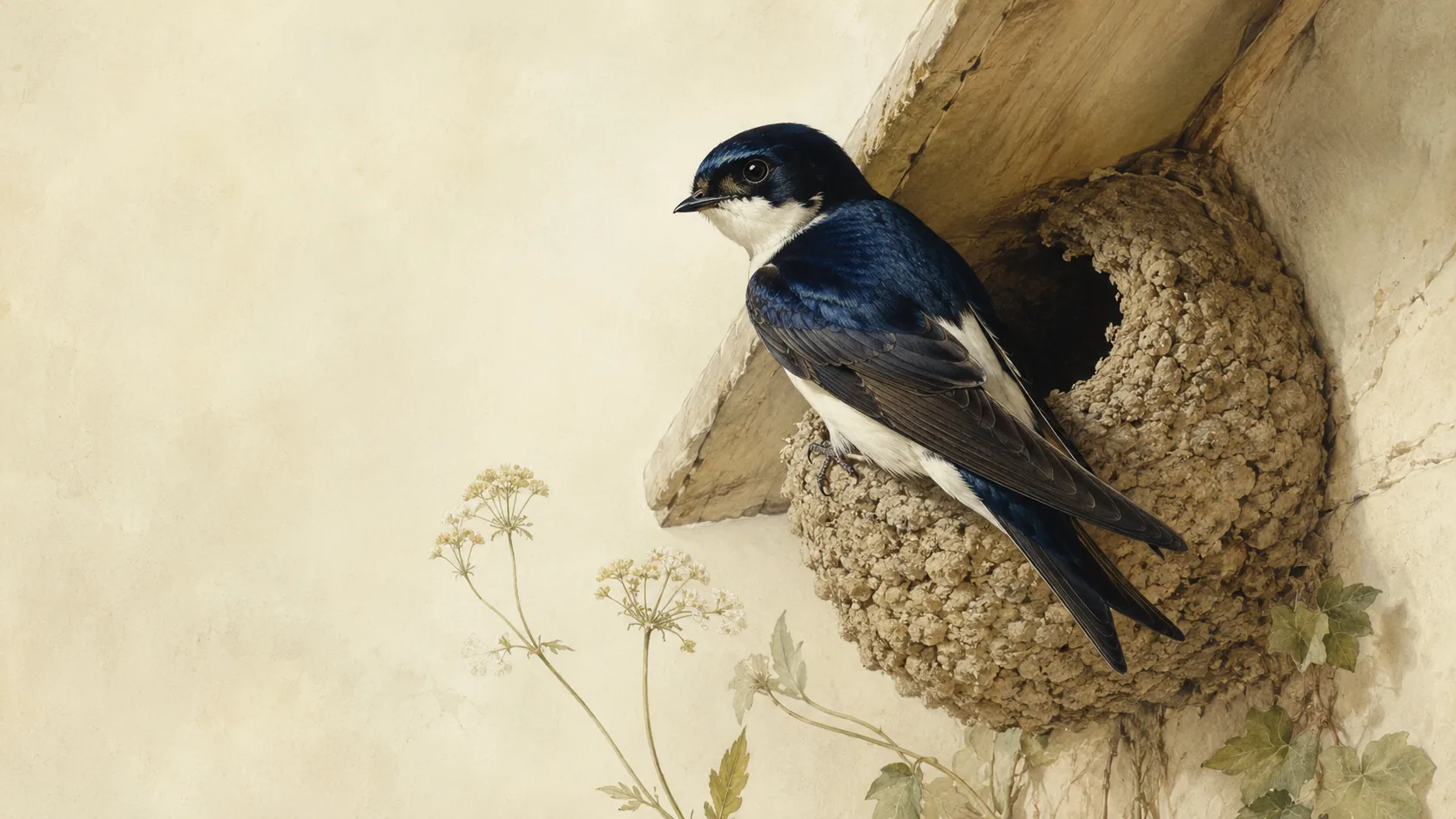
On a south-facing eave in Oxfordshire in early May, a pair of House Martins is carrying mud. They fly low over a puddle, skim the surface with their bills, and return to a half-built cup pressed into the angle between wall and soffit. A thousand pellets of mud, give or take, is what the RSPB estimates it takes to complete a single nest. The birds make the trip dozens of times a day. The nest dries hard in a week.
This is one of the most studied nesting behaviours in British ornithology, and it contains a fact that the tidy picture of a devoted pair in a mud cup does not quite accommodate: the BTO’s long-term ringing and genetic work has established that approximately 75 per cent of chicks in a typical colony were fathered by a male other than the attending male at the nest. The House Martin is, socially at least, monogamous. Genetically, it is something else entirely.
That tension - between the apparent and the actual - is what makes Delichon urbicum worth paying attention to. It is also declining at a rate that should concern anyone who watches British skies. The BTO recorded a 42 per cent decrease in the UK population between 1995 and 2023. The species now sits on the UK Red List. Globally, the IUCN lists it as Least Concern, but the trajectory in Britain points the other way.
What she looks like
The House Martin is a compact hirundine, 13 to 15 centimetres long, weighing between 15 and 23 grams. The wingspan runs 26 to 29 centimetres. She is smaller and plumper than the Barn Swallow, with shorter and straighter wings than either the swallow or the Common Swift she shares British summer skies with.
The diagnostic mark is the white rump. Seen from below or behind in flight, the contrast between the glossy blue-black upperparts and the bright white rump is unmistakable. The underparts are clean white. The tail is short and forked, without the long streamers of the Barn Swallow. The legs and feet - visible when the bird clings to its nest - are covered in white feathers, a characteristic that no comparable species shares. Males and females look alike.
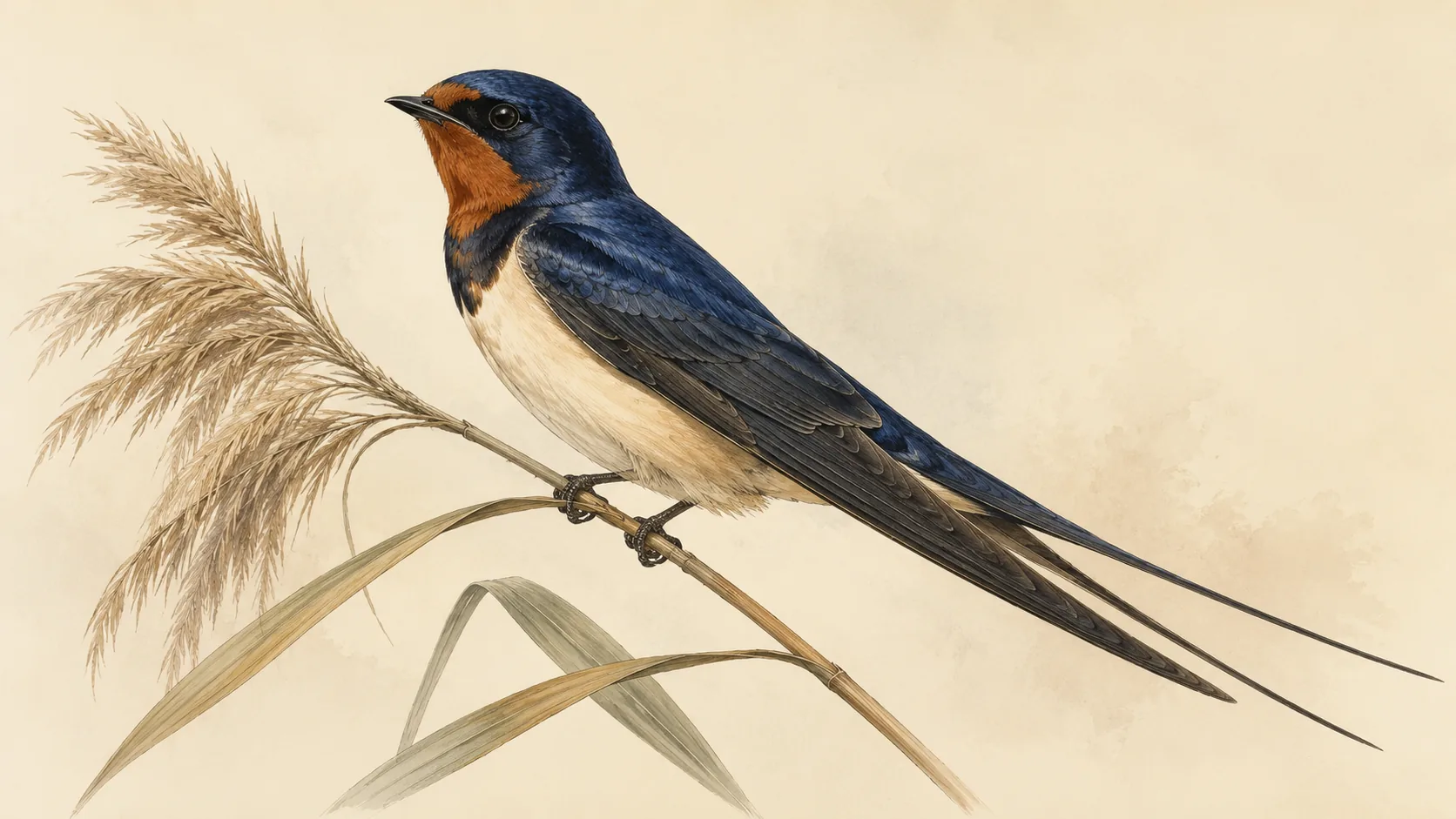
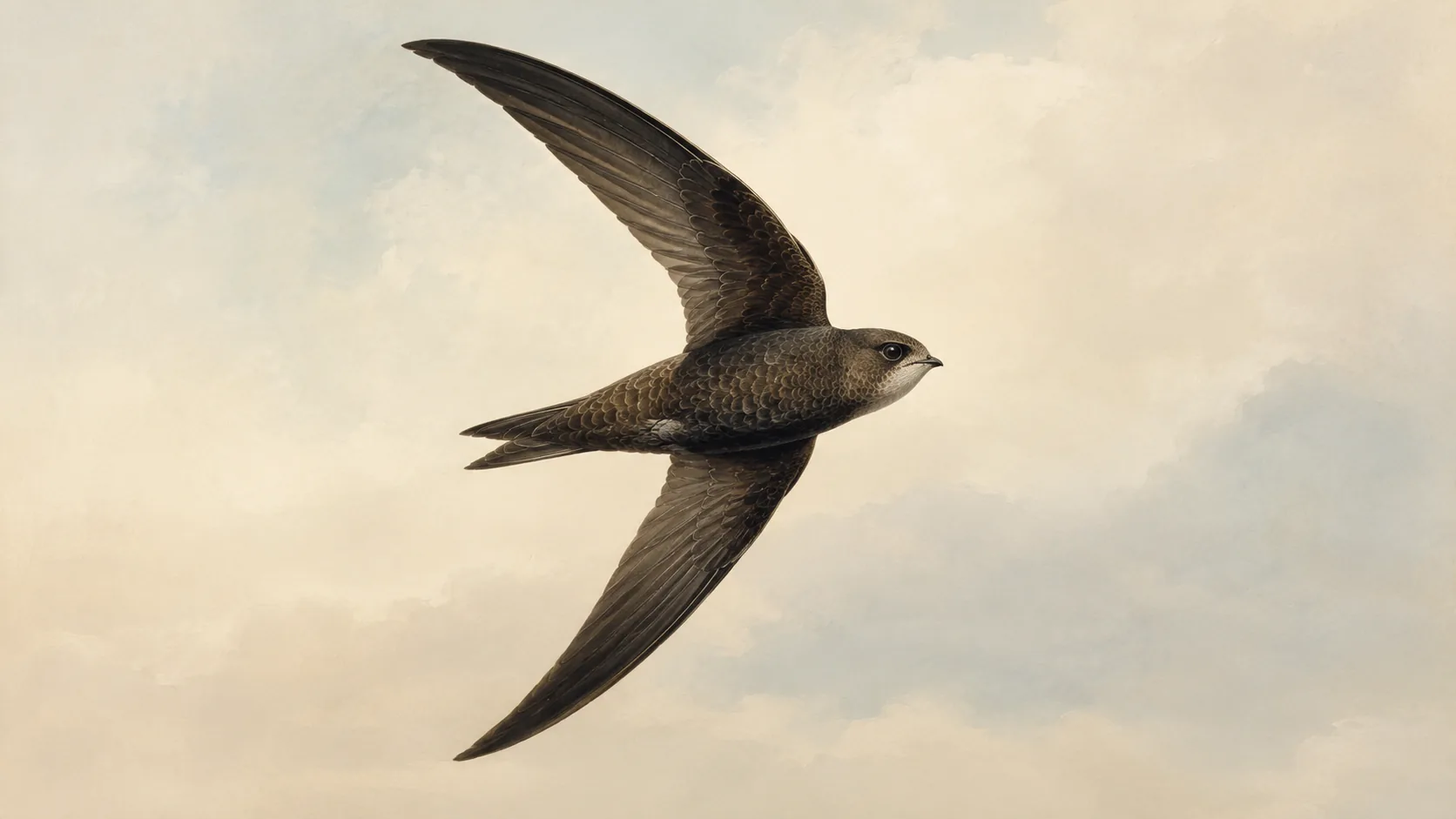
At a distance, the main confusion species is the Barn Swallow, which has rusty-orange on the face and much longer tail streamers. The Common Swift is larger, all dark, and flies on stiff, scythe-shaped wings with a very different action. Once you have the white rump fixed in memory, a House Martin is not a difficult identification.
What it sounds like
The call is a soft, dry prrit - a short note that carries through the chatter of a colony without cutting sharply across it. The song is a quiet, twittering warble delivered in flight or from the nest. Neither is as distinctive as the call of the Swift or the liquid chatter of the Barn Swallow, and the House Martin tends to recede into background noise rather than announce itself.
At a busy colony under the eaves of a village church or a terrace of old brick houses, the sound is continuous: a dry murmuring that rises and falls with the activity at each nest cup. It is the sound, in many parts of rural Britain, of late spring.
Range and habitat across the year
The House Martin breeds across the UK - the BTO notes it as widespread except in the highest parts of the Scottish Highlands, Shetland, the Outer Hebrides, and some exposed western coasts. The breeding population was estimated at 480,000 pairs in 2016. It favours villages, towns, farmsteads, and any building that offers a sheltered eave or overhang. Bridges and cliffs serve equally well where buildings are absent.
It arrives from April, with the main pulse in May. It departs in September and October, heading south to sub-Saharan Africa for the winter. Here is the striking fact: despite being one of the best-studied aerial migrants in Europe, and despite decades of ringing work by the BTO, the precise wintering range in Africa remains largely unknown. Radar tracking and geolocator studies have confirmed that birds cross the Sahara, but where the majority of the British population spends the winter is still, as the BTO puts it, not fully established.
That is not a failure of science. It is a reminder of how much of a bird’s life happens elsewhere, in skies that no one is watching.
Diet
The House Martin is an obligate aerial insectivore. It feeds entirely on flying insects - small flies, aphids, beetles - caught on the wing at heights that typically exceed those used by the Barn Swallow. On cold or wet days, when insects are forced down by low pressure, House Martins descend to hunt near the ground or over water, and this is often when observers get their best prolonged views.
The diet does not vary seasonally in any meaningful sense: it is insects in April and insects in September. What changes is altitude and the density of prey. A colony raising two broods in a British summer - which is the typical pattern, with clutches of four to five eggs each - requires sustained aerial hunting through July and August, often the most productive months for flying insects in the UK.
Breeding and nesting
Pairs nest in colonies, often reoccupying nests from previous years. A reused nest saves roughly ten days of mud-collecting labour, which is a significant advantage in a short breeding season. Both sexes build and repair the nest, carrying mud in the bill from the edges of puddles, streams, and pond margins - sometimes from surprisingly far away.
Clutch size runs four to five eggs, occasionally two to six. Incubation lasts 13 to 19 days, shared between both adults. Chicks fledge after 19 to 25 days. Two broods per season is standard; three is possible in a good summer. The typical life expectancy at breeding age is two years, though the maximum recorded age from a ringed bird - documented by the BTO from a bird ringed in 2002 - was seven years and one month.
The genetic picture underneath this domestic routine is, as noted, more complicated. Extra-pair paternity is unusually high even by the standards of socially monogamous passerines, and the colony structure - with many birds in close proximity at predictable locations - appears to facilitate it. The RSPB has reported the 75 per cent figure in its species account. Whether this has any fitness consequence for the attending males, or for the colony as a whole, is still an open question.
The mud-nest problem
The decline of the House Martin in Britain is linked, in part, to a change in building materials. The BTO’s breeding survey data shows that nests built on PVC fascias and soffits - now standard on new housing - have significantly lower success rates than those built on brick, stone, concrete, or timber. PVC does not provide sufficient grip. Nests are more likely to collapse mid-brood.
This is a documented, practical problem with a documented, practical solution: artificial nest cups, fixed to the wall under a sheltered eave, are accepted by House Martins and produce fledgling rates comparable to natural nests on suitable substrates. The supply of insects - depleted by changes in agricultural practice and the loss of rough grassland - is a harder problem to fix from the ground up.
The House Martin builds its nest from the mud of a particular place and returns to it, year after year, across a journey of thousands of kilometres whose route we do not fully understand.
How it shares the sky
The three species most often seen together in British summer skies - the House Martin, the Barn Swallow, and the Common Swift - occupy different niches in the same airspace. The Swift hunts highest and fastest, often above 100 metres. The Barn Swallow tends to fly low, often below four metres over fields and water. The House Martin occupies the middle band, typically 20 to 50 metres up, and is the one most often seen circling over rooftops.
This separation is not absolute, and on warm afternoons all three can be found at the same altitude, sometimes in loose mixed flocks over water. But the default is a layered sky, each species tuned to a slightly different slice of it. The House Martin’s white rump, catching the light as it banks and turns, is often what marks it out from above in those flocks.
The bird is disappearing from the layer of sky it has always occupied above British towns and villages. The colony that has been under a particular eave for thirty years is sometimes simply gone one spring, without announcement. Whether it returns the following year depends on whether enough of the birds that built it survived the crossing of the Sahara, and found their way back to a place whose mud supply, insect density, and nesting substrate held together long enough for them to try again.