Field Guide
Blue Tit
Some time in the third week of April, on an oak in almost any British wood, a Blue Tit begins to incubate. She has not laid early or late by accident. She has read the tree.
Cyanistes caeruleus is, among other things, a precision instrument. The hen lays her clutch - eight to ten eggs, occasionally more - so that the 13-day incubation period ends at the moment winter moth caterpillars peak on the oak canopy above the nest hole. The caterpillars are the richest food available to nestlings. They appear for roughly three weeks. The chicks fledge in 18 to 21 days. The window is tight and the coordination is not accidental. Long-term field studies on Wytham Woods and Boars Hill in Oxfordshire, led by ornithologist Chris Perrins at Oxford University, showed that nest boxes occupied by Blue Tits in years when caterpillar emergence runs late or early produce noticeably fewer fledglings. The bird’s survival depends on phenological alignment that climate disruption is now beginning to uncouple.
That is the Blue Tit’s hidden story. The bright crown and the feeder acrobatics are easier to see, and most people stop there. They should not stop there.
What she looks like
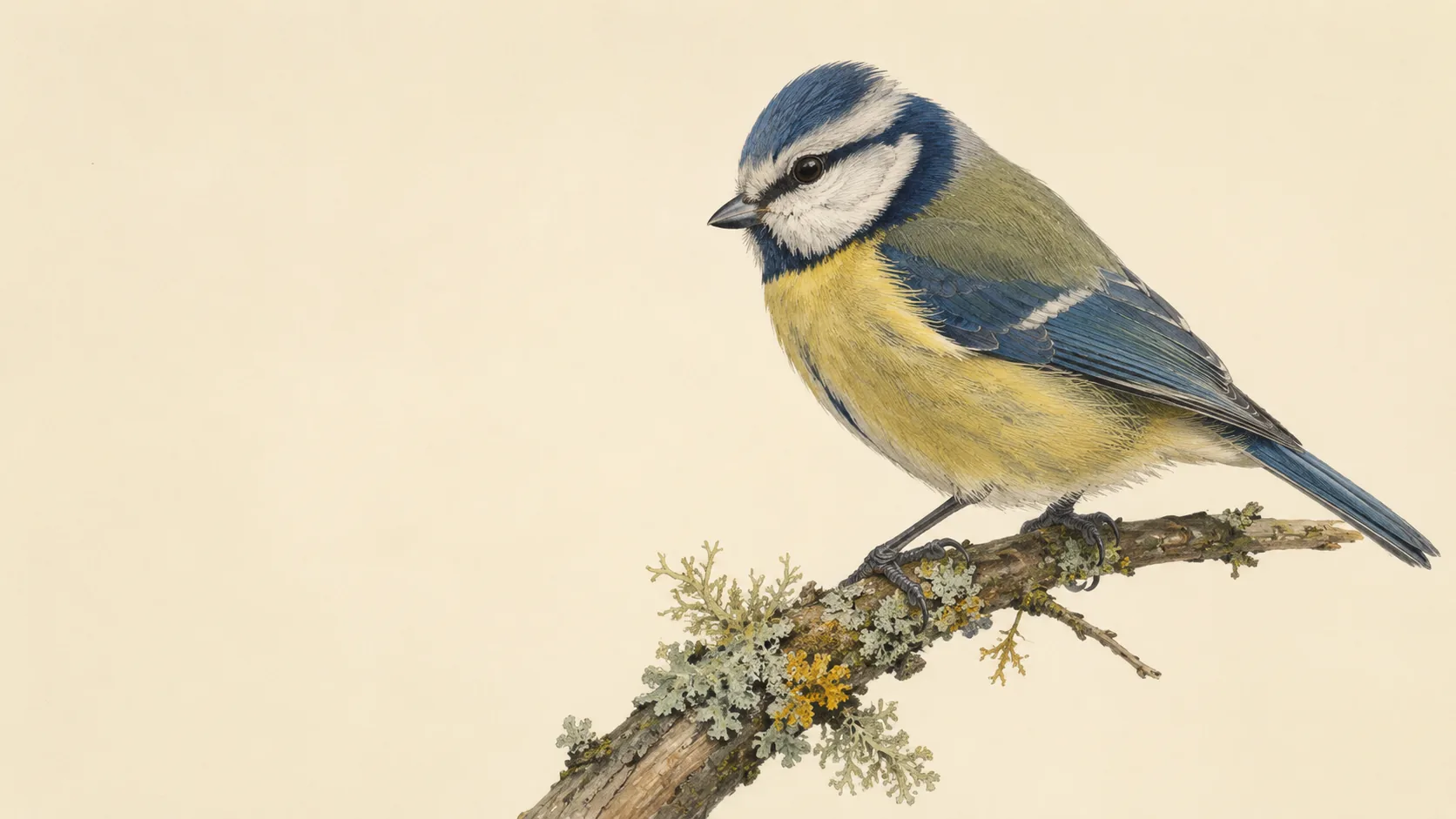
The Blue Tit is small, weighing 10 to 12 grams - roughly half the weight of a robin - with a body length of 10.5 to 12 centimetres and a wingspan of 17.5 to 20 centimetres. She is one of the most patterned birds in Britain for her size: a blue crown, white cheeks framed by a dark eye-stripe and narrow dark collar, bright yellow underparts, a greenish-blue back, and blue-green wings with a single white wingbar. The bill is short, fine, and dark.
Males carry a slightly brighter blue crown than females, though the two sexes look nearly identical to a human observer. Under ultraviolet light, the difference is stark. The male’s crown reflects UV strongly. The BTO notes that female Blue Tits can perceive UV wavelengths that humans cannot, which means they have access to information about a mate’s condition that is entirely invisible to us. What we call a uniform blue cap is, to a female Blue Tit, a graded signal.
Juveniles are duller across the board: yellowish cheeks rather than white, a greenish wash on the crown, less contrast overall. They are recognisable as Blue Tits but wear the look of something unfinished.
Voice
The song is a two- or three-note descending whistle followed by a fast trill: tsee-tsee-tsee-turrr. The alarm call is a sharp tsee. Contact calls between flock members in winter are softer and more conversational. The full repertoire is larger than casual observation suggests. Birds in winter roost flocks use a suite of low-amplitude calls that ornithologists classify as contact rather than song, functioning to keep a flock cohesive as it moves through hedgerows and mixed woodland. A walk through a British wood in January with ears rather than eyes produces a different picture of the species than a summer feeder.
Range and habitat
The Blue Tit is a year-round resident across almost all of Britain and Ireland, absent only from the highest ground in Scotland and from most of the Northern Isles. Beyond Britain, the species breeds from the Canary Islands north through continental Europe to Scandinavia and east into western Asia. BirdLife International estimated the European breeding population at between 59 and 95 million mature individuals in a 2020 assessment.
The core habitat is deciduous and mixed woodland, with oak, beech, hazel, and birch all supporting high densities. The species adapts readily to gardens, parks, hedgerows, and farmland with mature trees. In winter, birds from woodland roosts will travel to garden feeders within a kilometre or two of the nesting wood, and BTO ringing data suggests a single active feeder in late January may serve 20 or more individual Blue Tits in rotation, far more than the four or five visible at any one moment.
The UK population has grown by roughly 23 per cent between 1967 and 2023, according to BTO long-term monitoring. The winter feeder network is credited as a significant factor.
Diet
Outside the breeding season, the Blue Tit is an opportunist: seeds, berries, insects, spiders, and whatever a garden feeder offers - peanuts, sunflower hearts, fat balls. The beak is too fine for hard seeds without assistance and too small to compete with Great Tits on larger items, which is why the two species, while often seen together, partition resources by size more than is obvious.
In breeding season, the diet shifts almost entirely to invertebrates. The caterpillar timing that Perrins’s work documented is not unique to one location; similar patterns have been found in woodland populations across northern Europe. The chick-food requirement during the 18-day nestling period is prodigious: a clutch of 10 chicks needs roughly 100 caterpillars an hour. Both parents forage, working the oak canopy in the predawn light before most garden observers are watching.
Breeding and nesting
The female builds the nest alone, in a tree hole, a woodpecker excavation, a wall crevice, or a nest box. She constructs a deep cup of moss, grass, and wool, lined with hair or feathers, typically in late March or early April. Egg-laying begins in April, averaging around 26 April in UK populations tracked by the BTO, with the exact date varying by region and year.
Clutch size ranges from seven to 16 eggs, with an average around nine. Incubation lasts 13 to 14 days and is carried out by the female alone. Both parents feed the chicks after hatching. Fledging follows at 18 to 21 days. Most pairs raise a single brood per year, occasionally two if the first fails early.
The milk bottle chapter
For a short period in the twentieth century, the Blue Tit entered recorded history in an unusual way. Beginning in the 1920s, birds in parts of Britain began piercing the foil tops of doorstep milk bottles to drink the cream. By the 1940s and 1950s the behaviour had spread through Blue Tit populations across the country. It was studied as an early documented case of social learning in birds - individuals observing and copying a novel foraging technique - and became one of the textbook examples of culturally transmitted behaviour before the term was in wide use.
The behaviour is now largely gone, the glass milk bottle having mostly gone with it. What the episode demonstrated is that Blue Tits, within the constraints of a very small brain in a very small bird, are capable of local cultural innovation. The behaviour moved through populations in a pattern that matched neither random discovery nor genetic transmission. It moved like a rumour.
The weight of the thing
A Blue Tit is not a bird people generally theorise about. She is the bird at the feeder between the sparrows and the great tit, recognisable, common, reliably present. The IUCN lists the species as Least Concern, the population is stable and growing, and she poses no conservation puzzle.
And yet she is timing her reproduction against a phenological calendar that humans are now altering, reading oak trees the way a physician reads a pulse, and doing it at the scale of tens of millions of pairs across an entire continent. The precision of what she is doing, repeated across every decided woodland in Europe every April, is the thing worth taking away from this page.
The caterpillars are late this year. She has already adjusted.
The Blue Tit’s real achievement is not the blue cap or the acrobatics at the feeder. It is the quiet, accurate coordination of her entire reproductive cycle with the lifespan of a caterpillar on a single tree.