Field Guide
Brown-headed Nuthatch
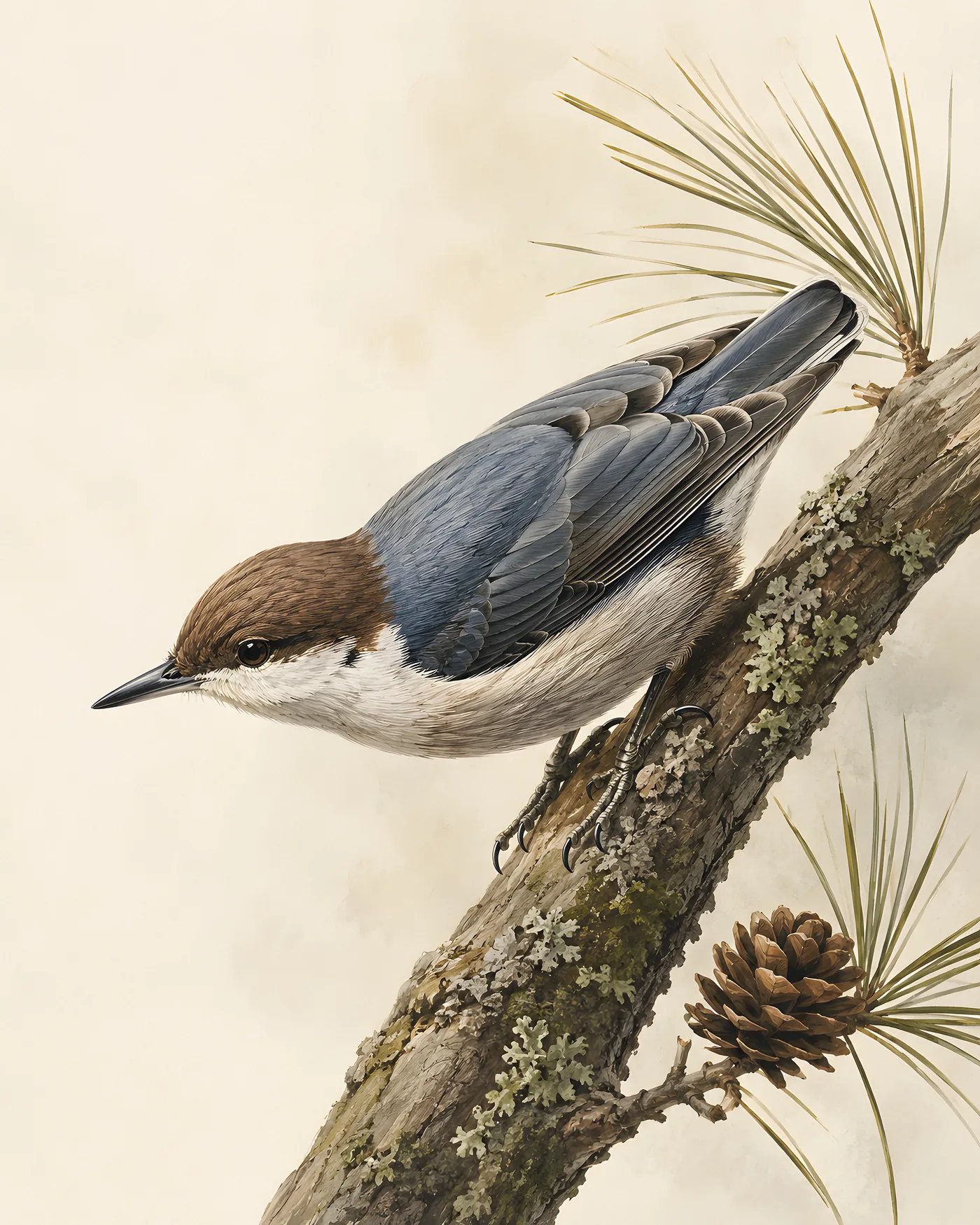
Watch a longleaf pine long enough and you will see it. A small, brown-capped bird drops to a patch of loose bark, pauses, and then picks up a chip of pine bark roughly the size of a shirt button. It holds the chip in its bill, works it under the edge of a second piece of bark, and levers the scale away to expose the insects underneath. When the cavity is emptied the bird may carry the tool to the next tree and use it again. It may cache a seed under the chip before flying off. This is Sitta pusilla, the Brown-headed Nuthatch - a bird of the pine flatwoods that happens to be doing something almost no bird on earth does.
What it looks like
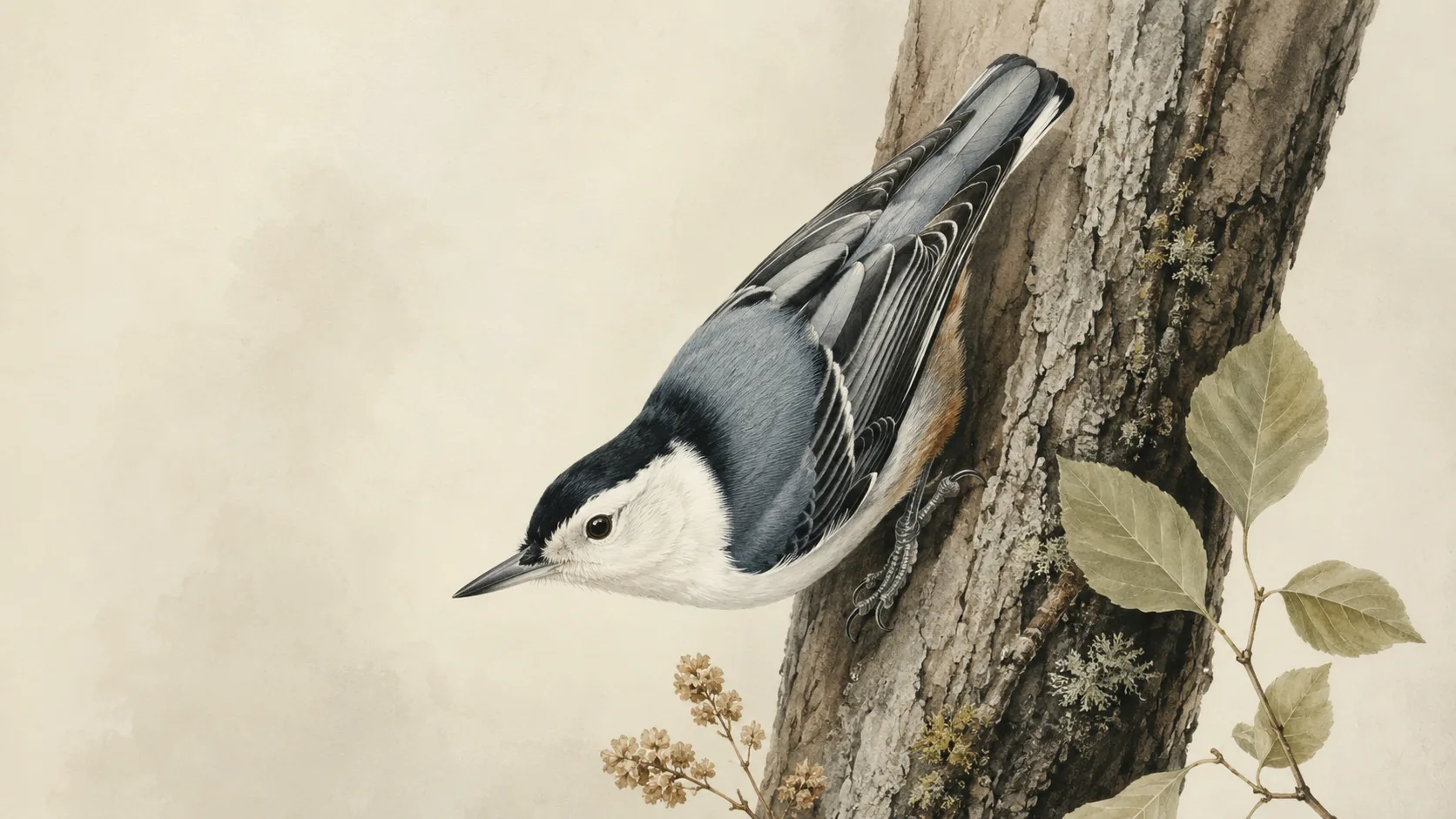
The Brown-headed Nuthatch is small and compact, nine to eleven centimetres long and barely eleven grams - lighter than a 50 cent coin. The posture is characteristic of the family: nearly neckless, with a large flat head and a long, straight bill. It walks tree trunks in any direction, including head-down, without using its tail for balance, gripping with both feet independently.
The field marks are simple. The cap is warm chocolate-brown, running from the base of the bill down to eye level. The back and wings are blue-grey. The underparts are pale buff to whitish. A small white spot sits at the nape - look for it as the bird faces away. The cheeks are white, and there is a narrow dark eyeline, though this is much less defined than on the Red-breasted Nuthatch. The tail is short and squared.
| Feature | Brown-headed Nuthatch | White-breasted Nuthatch |
|---|---|---|
| Cap colour | Chocolate brown | Glossy black (male) / grey (female) |
| Face | White cheek, faint eyeline | Clean white, no eyeline |
| Size | 9-11 cm | 13-14 cm |
| Range | Southeastern US pines | Deciduous woodland, most of US |
| Tool use | Documented | Not recorded |
The Brown-headed Nuthatch is almost identical to the Pygmy Nuthatch of western mountain pines, but the two do not share range. In the southeastern United States, a small brown-capped nuthatch is this species.
The tool
Downey Morse documented the behaviour in the Wilson Bulletin in 1968, one of the earliest accounts of tool use by a North American bird. What Morse described, and what subsequent observers have confirmed, is deliberate object manipulation: the bird selects a bark fragment, positions it as a prying implement, and applies mechanical force to achieve a result it could not achieve with its bill alone.
The behaviour is not rare or accidental. Gray, Schunke, and Cox, writing in the Southeastern Naturalist in 2016, recorded juveniles using tools, which suggests the skill is not purely learned from adults - it may have a strong innate basis. The tool is usually a loose flake of pine bark. The bird grips it crosswise in the bill, wedges it into a seam, and levers upward. A bark scale that would resist the bill alone lifts away under the mechanical advantage of the flake.
This places the Brown-headed Nuthatch in thin company. Among birds, genuine tool use in the wild is documented in only a handful of species: New Caledonian Crows, Egyptian Vultures, certain woodpecker finches of the Galapagos, and this small nuthatch of the southeastern pine belt. It is the only member of the family Sittidae - the nuthatches, worldwide - known to use a tool.
The Brown-headed Nuthatch does not just find food. It builds an instrument to reach food that would otherwise stay hidden. That distinction matters.
What it sounds like
The call is the easiest way to know the bird is present. It is a rapid, insistent squeaking - almost everyone who hears it for the first time reaches for the same comparison: a rubber duck being squeezed. The ornithologist Barbour and DeGange described it in 1982 as tyah-dah or chee-da, repeated quickly and often. It carries through open pine woodland at a distance that surprises first-time listeners.
The bird is sociable and vocal through the year. Family parties and loose foraging groups keep up a constant chatter of high-pitched notes as they work through the canopy. The squeaky rubber-duck call is the main alarm and contact sound. A softer pit-pit-pit is used in flight. Unlike the white-breasted nuthatch, which has a deep, nasal yank, the Brown-headed Nuthatch stays in a higher register throughout its vocal range.
Range and habitat
Sitta pusilla is a permanent resident of the southeastern United States. Its range runs from the Delmarva Peninsula in Virginia south through the Carolinas, Georgia, Florida and west to Arkansas and eastern Texas. A small, declining population persists in the Bahamas. The bird does not migrate. The pair working a stand of pines in January is the same pair that nested there in April.
This is a pine specialist. Loblolly, longleaf, slash and pond pine are the trees it requires. The pine flatwoods of Alabama and the longleaf savannas of Georgia and North Carolina are its stronghold. What it needs specifically is open pine stand with a sparse understory - the landscape shaped by fire - and an abundance of dead and dying trees, the snags it nests in and the loose-barked surfaces it forages on. Dense, closed-canopy plantations with no snags are largely useless to it.
This dependence on open, fire-maintained pine is the reason the species is declining across parts of its range. Fire suppression closes the understory. Logging removes the old snags it nests in. The longleaf pine ecosystem, once covering 90 million acres across the Southeast, now covers roughly three percent of its original range. The nuthatch follows the longleaf.
Diet
The diet divides cleanly by season. Through the warmer months the bird is almost entirely insectivorous, working the bark of pines for cockroaches, beetle larvae, ants, moths, spiders, and their egg cases. The Cornell Lab records the species as eating bark-dwelling insects primarily, foraging from the upper canopy down through the mid-trunk in quick, acrobatic bursts.
In autumn and winter, pine seeds become important. The bird caches seeds under flakes of bark and retrieves them through the lean months. It also brings its tool use to bear on seed storage, covering cached seeds with a bark chip before leaving - whether this is deliberate concealment is not established, but the behaviour has been observed in the wild.
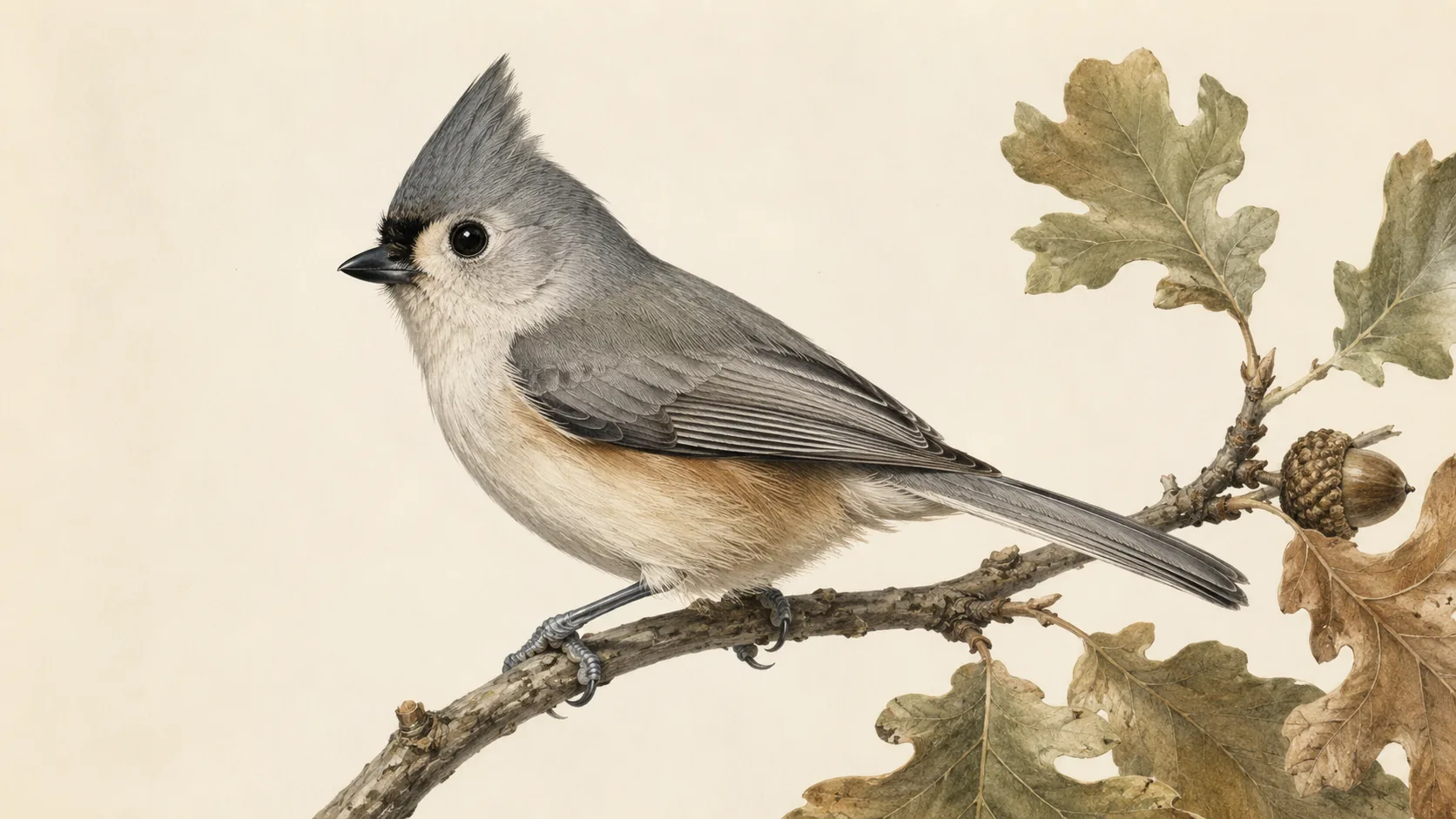
The species often forages in small family parties, and sometimes attaches itself to mixed flocks alongside Carolina Chickadees and Tufted Titmice in winter, working the pine bark while the other species take the foliage and branch tips.
Breeding
The Brown-headed Nuthatch is a cooperative breeder, and the structure of that cooperation is more complex than it first looks. Han, Cox, and Kimball, publishing in the Wilson Journal of Ornithology in 2015, found that approximately 23 percent of the population consisted of cooperative groups, typically a breeding pair plus one helper male. These helpers are usually young males from the previous breeding season - they help with nest building, feeding the incubating female, and provisioning nestlings. Cooperative groups show measurably higher nesting success than pairs breeding alone: success rates rise from around 45 percent to around 60 percent with a helper present.
Nesting begins in March. The pair excavates a cavity in a dead pine snag, typically less than three metres off the ground, though they will use old woodpecker holes and nest boxes. The female lays four to eight eggs, white with reddish-brown markings, and incubates for around 14 days. Fledglings leave the nest 18 to 19 days after hatching. One brood per year.
The longest reliably documented lifespan for this species is nine years, based on banding records. An individual banded in Alabama in 1954 was recaptured in 1960, establishing a minimum age of five years and nine months.
Conservation
The IUCN lists Sitta pusilla as Least Concern globally, with an estimated population of around 1.6 million birds. However, that designation masks a real pressure on the species within its range. The National Wildlife Federation notes the bird is probably the least numerous nuthatch in North America, and surveys suggest populations have declined across much of the range since the mid-20th century.
The driver is habitat. Open, fire-maintained pine savanna with standing dead timber is a shrinking landscape. Fire suppression, industrial forestry, and urban expansion all work against it. Conservation of the Brown-headed Nuthatch and conservation of the longleaf pine ecosystem are effectively the same cause.
The bird’s tool use, its cooperative breeding, its absolute fidelity to a single plant community - none of these things insulate it from a shrinking world. What may matter most is not intelligence but acreage. A bark flake is an extraordinary instrument. It cannot substitute for the forest.