



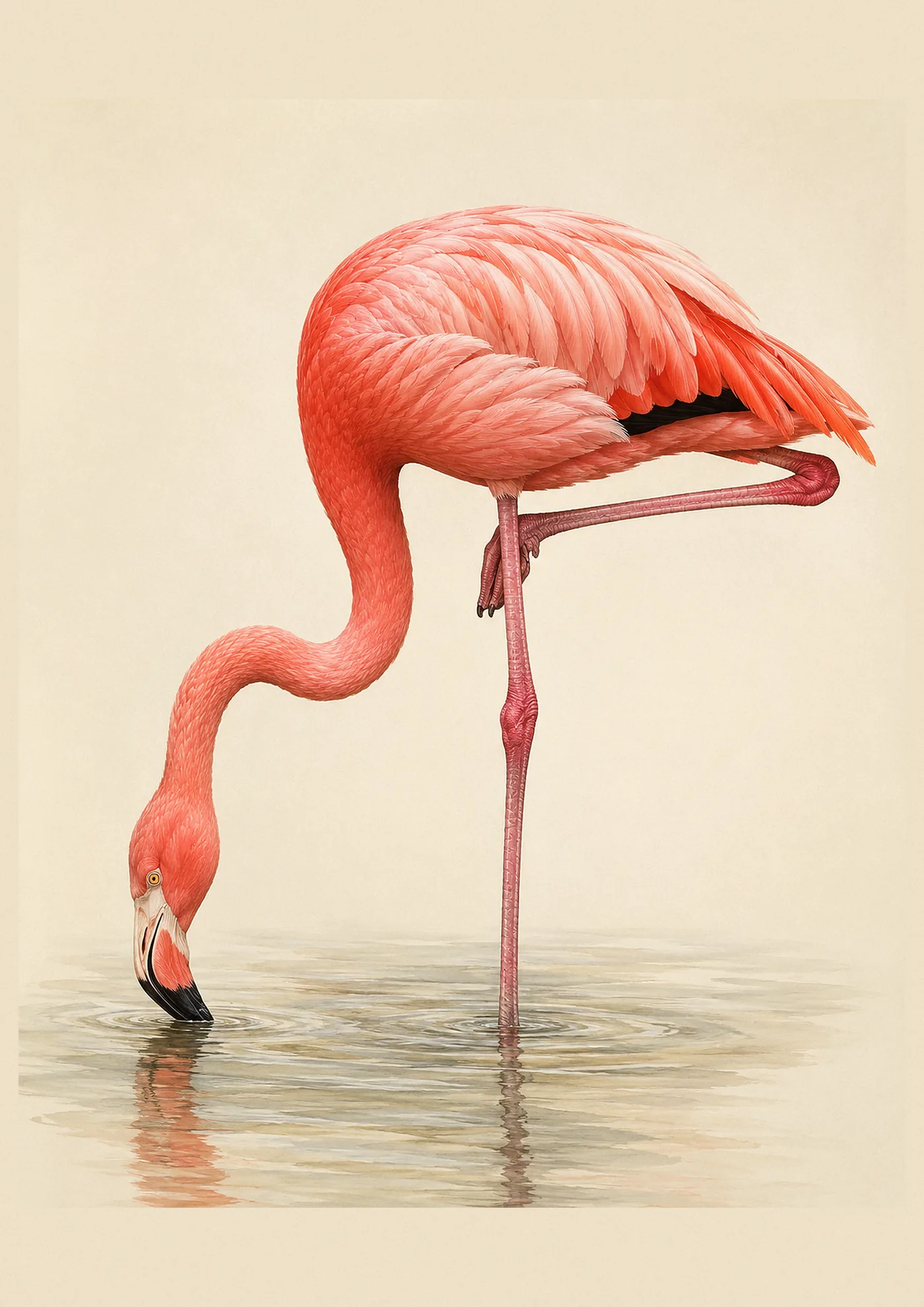

A chick of Phoenicopterus ruber, the American Flamingo, hatches from its single white egg already calling. It vocalises from inside the shell, and its parents learn the voice before the bird is even visible. In a colony numbering thousands of identical pink birds on a flat Caribbean mudflat, that prenatal acoustic signature is how a parent will find its own chick - from up to 100 metres away - when it returns from foraging. The colony looks chaotic. It is not.
The thesis here is worth stating plainly: the American Flamingo is not an exotic curiosity or a zoo novelty. It is one of the more precisely calibrated birds on the planet, a species that has solved, over millions of years, a set of problems that most birds never face: how to eat in water that would kill most organisms, how to find your single offspring in a crowd of thousands, and how to make your own colour from scratch.
Identification
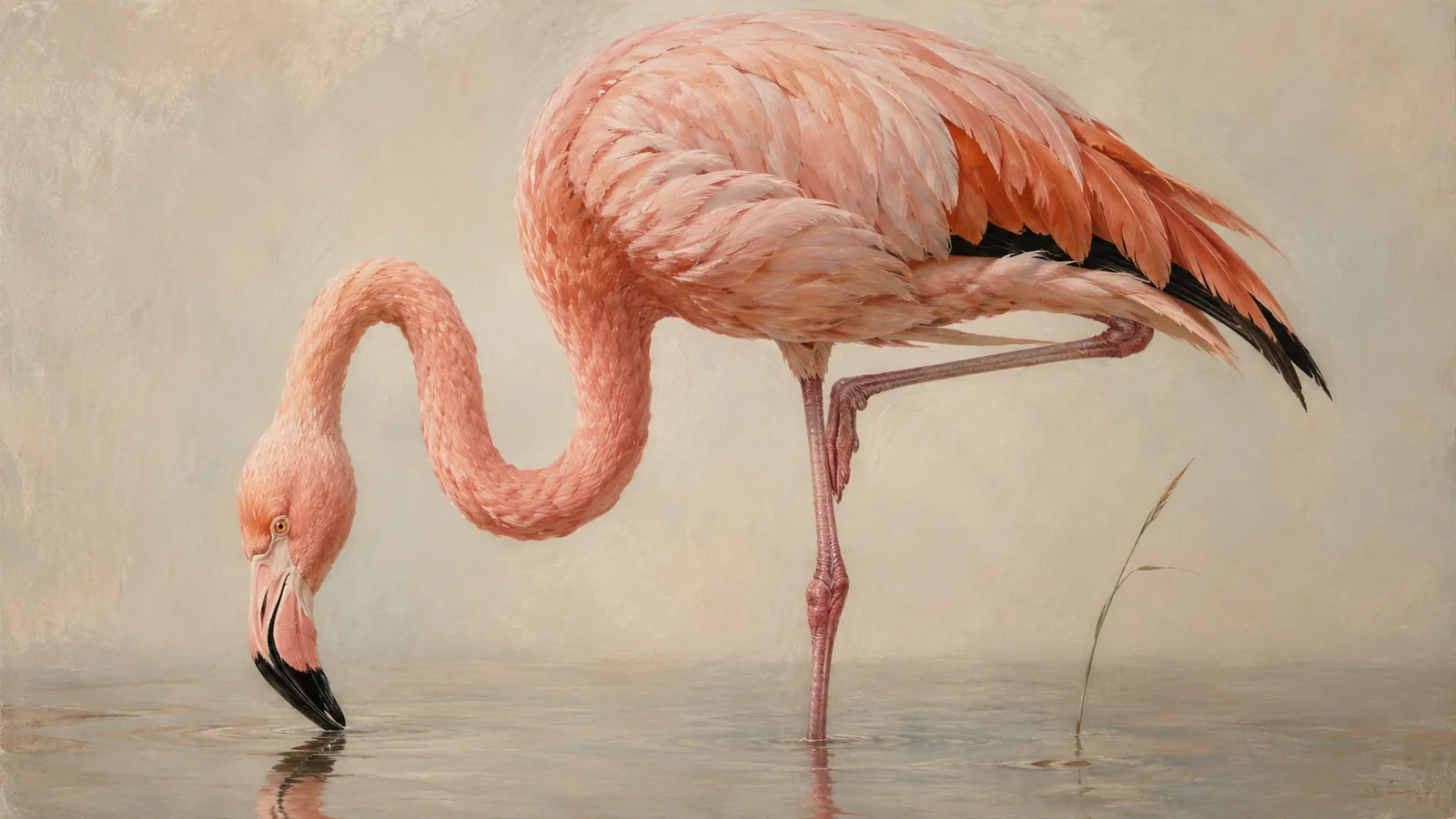
Standing 120 to 145 centimetres tall and weighing between 2.1 and 4.1 kilograms, the American Flamingo is the most deeply coloured of the world’s six flamingo species - the Greater Flamingo exceeds it in height but carries far paler plumage. The Audubon field guide describes adults as “bright pink all over,” which understates the intensity: in strong Caribbean light, a roosting flock reads as almost orange-red. The flight feathers are black, visible only when the wings open, and the bill is pale pink with a sharp black tip, bent sharply downward at mid-length in a profile unlike any other North American bird.
Males are slightly larger than females, though the plumage is identical between sexes. Juveniles are grey-white with a dark-streaked neck and a duller bill. According to Animal Diversity Web’s account of the species, young birds take approximately three years to acquire full adult colouration. The pinkness is not pigment in the conventional sense - it is dietary. Carotenoid compounds absorbed from brine shrimp and other small crustaceans accumulate in the feathers. Birds fed a carotenoid-free diet in captivity lose their colour within a single moult cycle. The flamingo builds its own palette from the chemistry of hypersaline water.
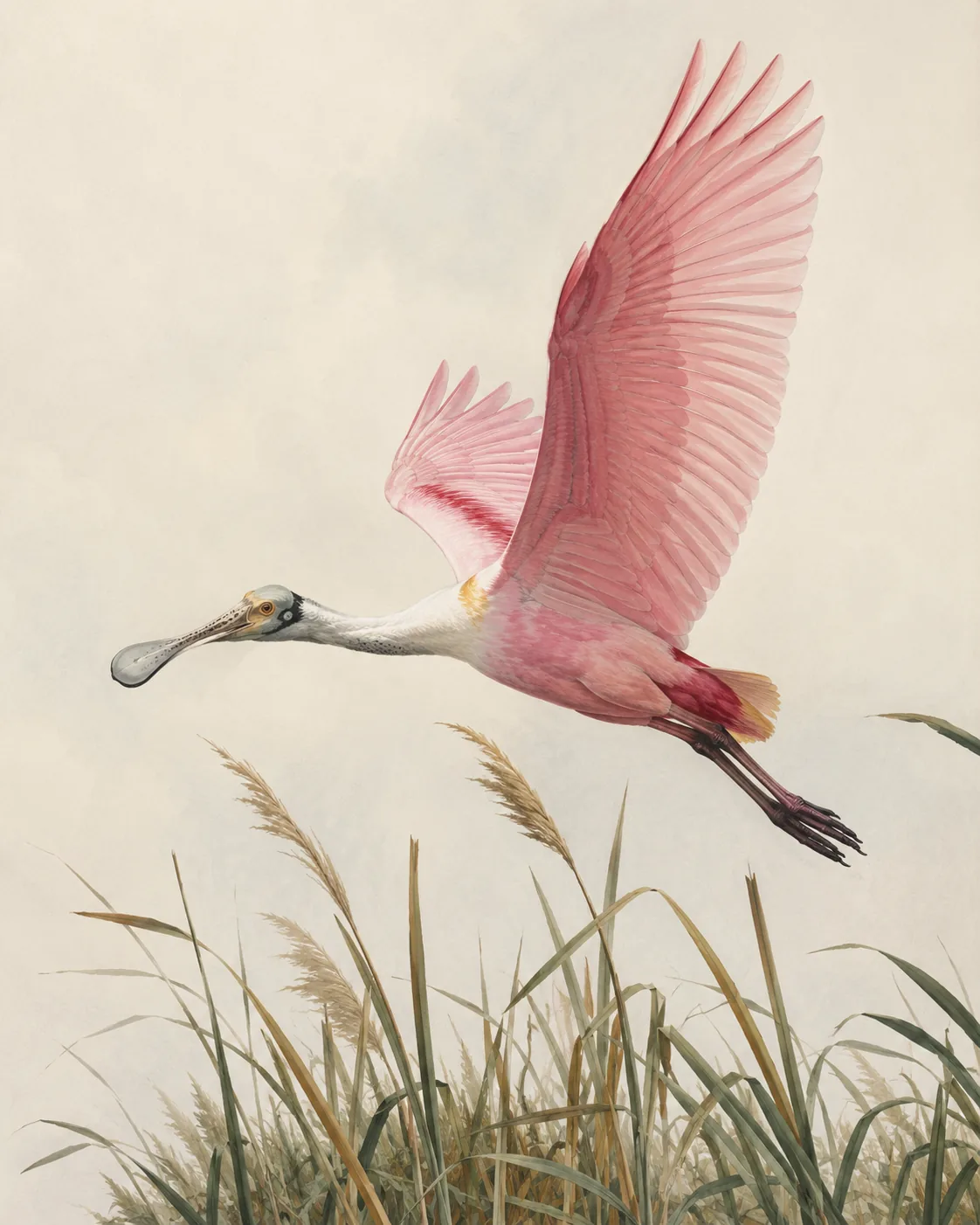
At distance on open water, the only realistic confusion species in North American range is the Roseate Spoonbill - also pink, also long-legged. The differences settle quickly: the spoonbill has a spatulate pale bill held horizontally, a white neck, and flies with its neck extended. The flamingo’s neck curves in a distinctive S-shape, and in flight the neck and legs both trail behind the body in a single improbable horizontal line.
Voice
The flamingo is a loud bird in a loud colony. The primary call is a low, goose-like honking, used both in flight and on the ground. Within the colony, softer contact calls maintain the bond between paired adults and between parents and chick. The chick’s call is individual and fixed - Animal Diversity Web notes that chicks begin vocalising inside the egg, and that parental recognition of the individual call is established before hatching. This system appears to be reliable at colony scales of tens of thousands of birds.
Range and Habitat
The American Flamingo’s range is primarily Caribbean: the Bahamas, Cuba, Hispaniola, the Yucatan coast of Mexico, and scattered colonies on the northern coast of South America from Venezuela to Colombia. A resident population holds on in the Galapagos Islands, where, Cornell’s field records note, birds nest unusually on piles of stones rather than mud mounds - an adaptation to the volcanic substrate.
Florida has a complicated relationship with the species. Flamingos nested historically in Florida Bay and the Everglades until hunting pressure and habitat disturbance eliminated them in the early twentieth century. For decades, any flamingo seen in Florida was assumed to be a zoo escapee. That assumption has recently been challenged. Following Hurricane Idalia in 2023, flocks of American Flamingos appeared across Florida and adjacent Gulf Coast states, and growing evidence - including leg-band data from Yucatan colonies - supports the conclusion that at least some Florida birds are genuine natural vagrants navigating an ancient flyway.
The preferred habitat, wherever the range, is hypersaline or saline coastal lagoons with extensive shallow mudflats. The Audubon guide specifies coasts and shorelines. What the species requires in practice is water shallow enough to wade, saline enough to be rich in the invertebrates it eats, and remote enough to buffer a nesting colony from ground predators.
Diet
The flamingo’s bill is an inversion. When the bird lowers its head to feed, the bill enters the water upside down, and it is the upper mandible - not the lower - that moves. The tongue acts as a pump, drawing water in and forcing it through rows of fine bony lamellae that filter out the target organisms: brine shrimp, algae, small molluscs, aquatic insect larvae, and the microscopic cyanobacteria that bloom in hypersaline conditions. Animal Diversity Web’s account of the species describes the filtration mechanism in precise detail, noting that the muscular tongue generates the pumping force while the lamellae do the sorting.
This is why flamingos congregate where they do. The same salinity that keeps most birds and mammals away concentrates the organisms the flamingo needs. It has, in effect, monopolised a food source by evolving the only tool suited to harvest it.
Breeding and Nesting
The breeding season is not fixed to a calendar. Colonies breed when local conditions - food abundance, water level, and the availability of suitable mudflats - align. When conditions are right, the display begins. Hundreds or thousands of birds participate simultaneously in what ornithologists describe as synchronised courtship: “head flagging,” in which the neck stretches vertically and the head sweeps side to side; “wing salutes,” with wings spread to show the black flight feathers; “march displays,” where a tight group moves in lock-step across the mudflat. The synchrony appears to function as a collective hormonal trigger, bringing the colony to breeding condition together.
Each pair builds a single mud mound, roughly 30 centimetres high, with a shallow depression at the top. One egg. Both parents incubate for 28 to 32 days, taking shifts while the other forages. At hatching, the chick is semiprecocial - eyes open, covered in white down, capable of standing within a day or two. Within five to eight days it joins a creche: a group nursery of hundreds or thousands of chicks supervised loosely by a small number of adults. The parents continue to return to feed only their own chick, identified by call, until the young bird fledges at 65 to 90 days old.
One Leg
The question every observer eventually asks is why flamingos stand on one leg. The answer, based on research cited by Animal Diversity Web, is thermal. When wading in cold water, a flamingo standing on one leg loses heat through only one limb at a time, tucking the other against the body. The posture appears more often in cooler conditions and in water, rather than on dry ground. It is not display, and it is not rest. It is regulation.
A Final Note on Colour
The American Flamingo is born grey and becomes pink. The pink is not who it is - it is what it has been eating. Stop the diet, and the colour goes. This is a biological fact, but it is also a reasonable description of any organism shaped by its environment over time. The flamingo did not invent its colour. It assembled it, season by season, from the chemistry of the places it chose to live. That is either a limitation or a kind of freedom, depending on how you read it.