Symbolism
Why the barn owl screams
The barn owl does not hoot.
This is the fact that unravels almost everything written about barn owl symbolism, because the hoot is what people picture when they picture an owl at night. The tawny owl hoots. Tyto alba - the barn owl - produces a sustained, raspy shriek lasting about two seconds. It hisses. It rasps. It screams.
That scream is the source. Every death omen, every banshee, every corpse bird crying at the window of the sick - the origin sound is not “hoo” but something that sounds, heard from a dark barn at night, like a human being in extremity.
The face is a weapon
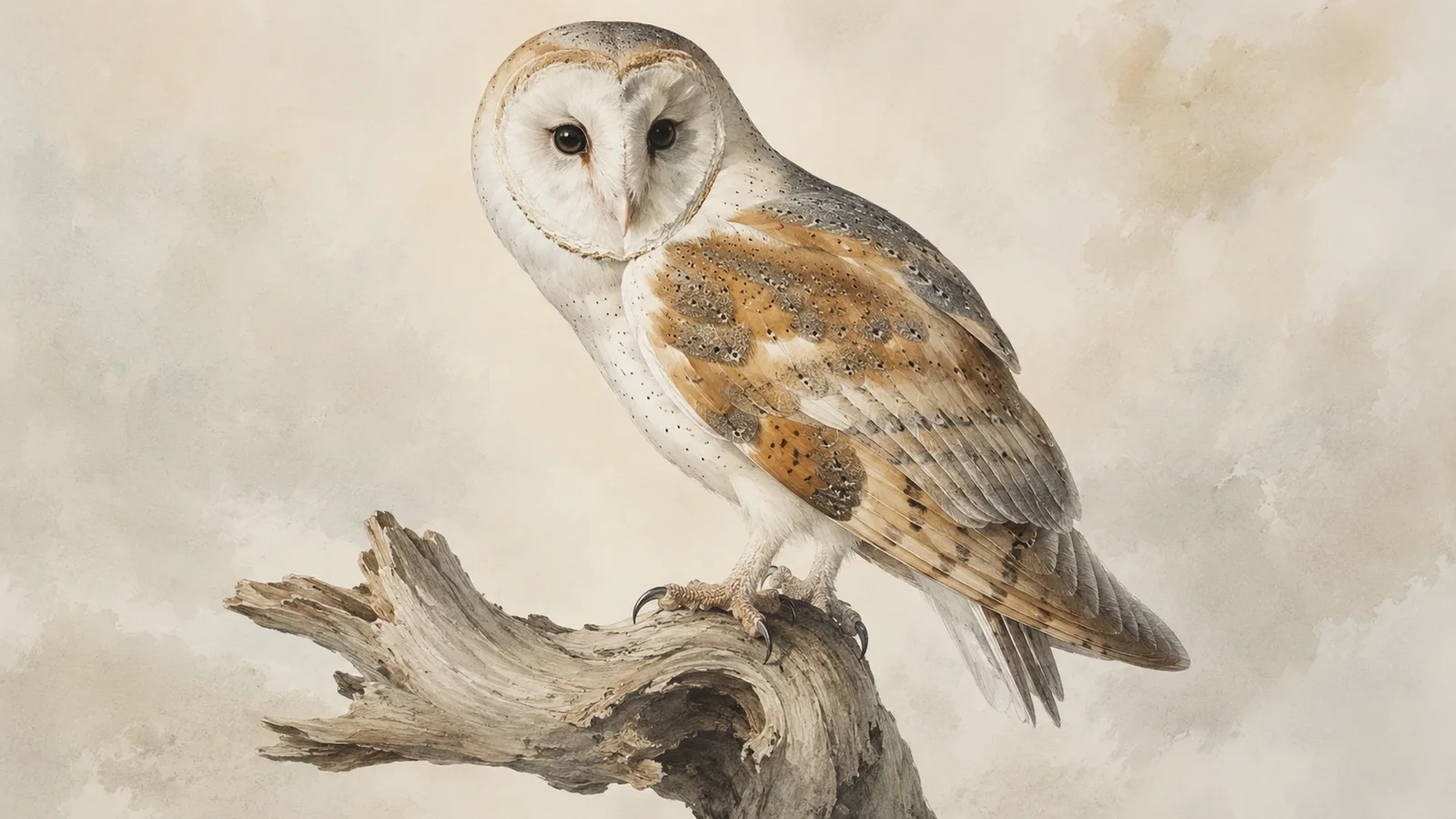
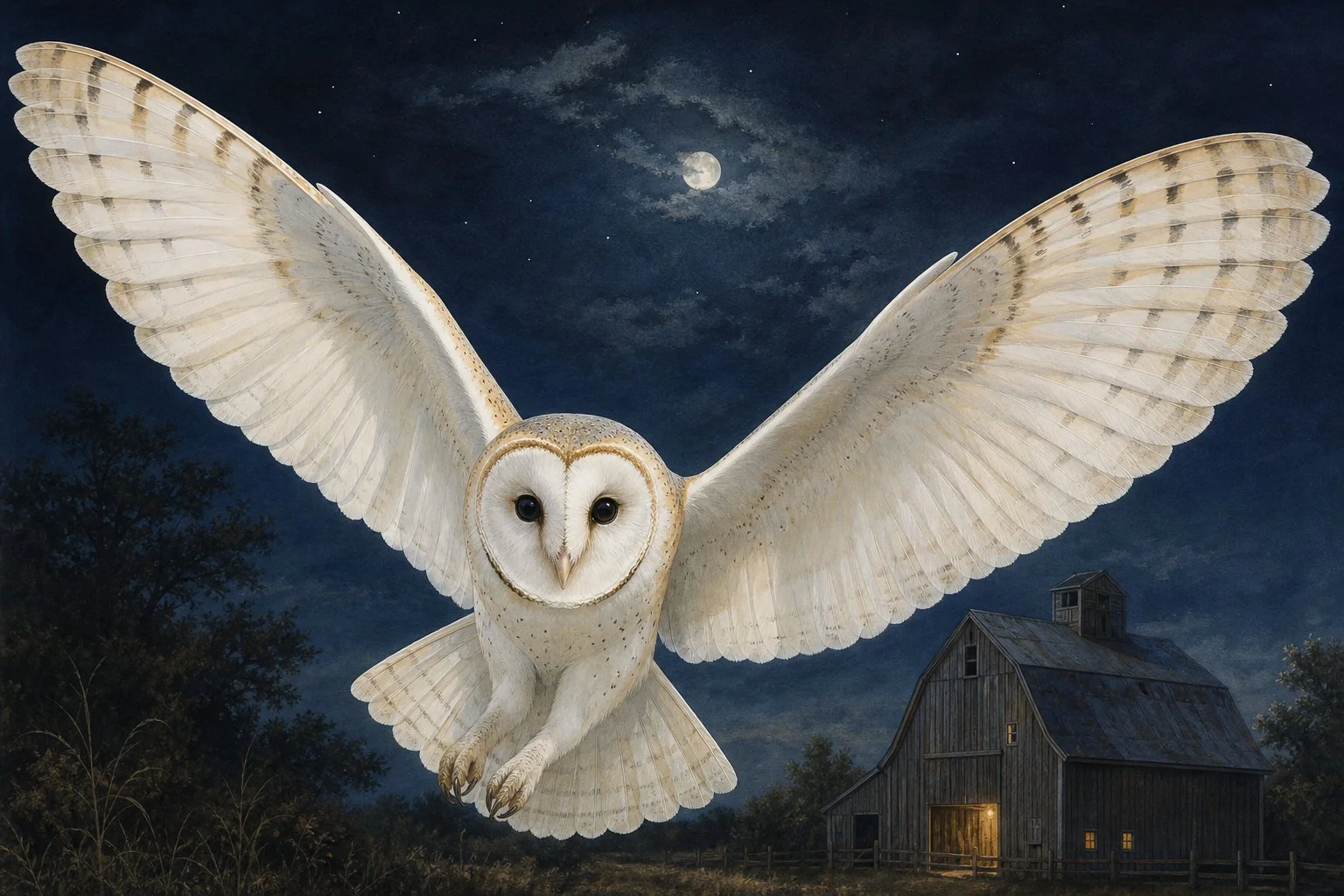
The heart-shaped facial disc is the barn owl’s defining visual feature and its most misread one. The disc is not decorative. It consists of stiff, concave feathers arranged in a parabolic curve - a satellite dish made of keratin. The two wings of the heart funnel sound from different vertical angles toward ear openings that are asymmetrically placed: one pointing up, one pointing down. This vertical asymmetry allows three-dimensional acoustic triangulation.
In 1961, Roger Payne - then completing his PhD at Cornell - placed a barn owl in a completely darkened room, released a live mouse into rustling leaves, and watched the owl catch it by sound alone. When the mouse paused and went silent, the owl still located it. When Payne dragged a wad of paper through leaves, the owl caught that too. When cotton blocked one ear, the owl missed its target by about eighteen inches. The heart-shaped face that looks like a valentine is a precision acoustic instrument. The barn owl detects prey at 75 feet using hearing alone. It builds a real-time three-dimensional sound map of its environment and flies through darkness to a precise coordinate.
Why it glows
White barn owls appear to glow. This is not medieval imagination. Research published in Nature Ecology and Evolution confirmed the mechanism: white feathers have superior light reflectance, and under full moon conditions, voles exposed to a taxidermied white barn owl froze for up to five seconds longer than those exposed to a red-coloured barn owl. When white feathers were coated with wax to eliminate reflectance, the freezing response disappeared. The barn owl evolved whiteness as a hunting weapon. It uses moonlight against its prey.
The Latin name Tyto alba means “white owl” in both directions - Ancient Greek tytō (owl, onomatopoeic) plus Latin alba (white). Named 1769 by G.A. Scopoli. The pallor that terrified European peasants for two thousand years is not incidental. It is adaptation.
Egypt and the letter M
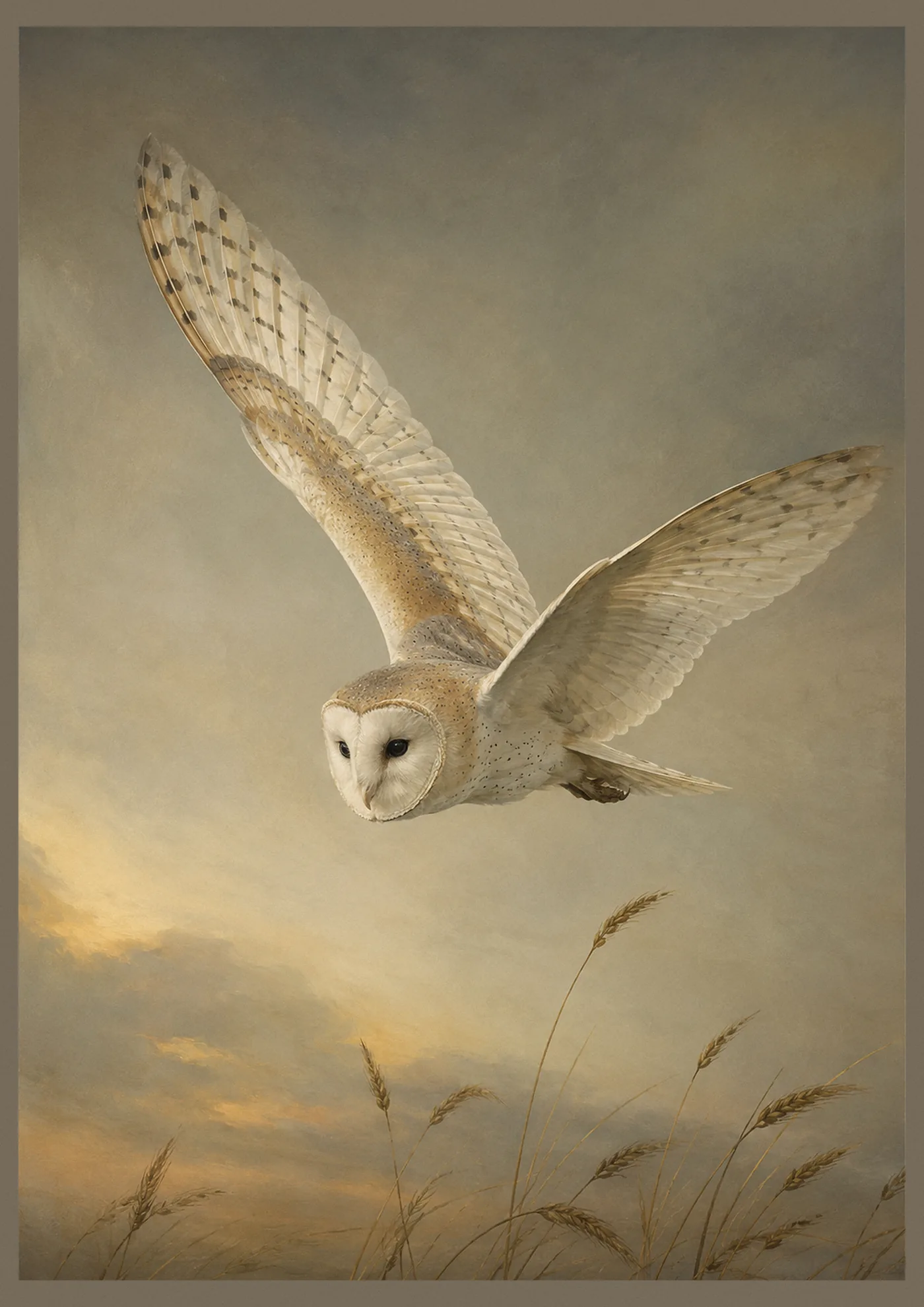
The oldest documented barn owl symbolism is not symbolic at all. From Dynasty III onward (approximately 2670 BCE), the Egyptian hieroglyph for the phoneme “M” is the barn owl. Egyptologists are confident in the identification: the hieroglyph shows a heart-shaped face, yellow-tawny wings, white underbelly, and small chest spots matching Tyto alba precisely. The barn owl appears in Egyptian writing as a sound, not a god. It entered the system for the same reason it enters everything: it was there. Barn owls nested in grain stores, granaries, and temples throughout the Nile valley. A barn owl sculpture from Saqqara, dated to the Late Period between 664 and 150 BCE, is held at the Oriental Institute in Chicago.
The screech owl of the Hebrew Bible
The Hebrew kos appears in Leviticus 11:17, Deuteronomy 14:16, and Psalm 102:6. The Biblical Cyclopedia identifies it as “perhaps most applicable to the white or barn owl, Strix flammea.” The NIV places “barn owl” at Leviticus 11:18. But these identifications are contested - yanshuf has been translated as heron, eagle-owl, or great owl depending on the translation, and tinshemeth has been rendered as swan, horned owl, or chameleon. No single owl name in the Hebrew Bible has an uncontested species identification. What is clear is the context: the owl appears in lists of unclean birds and in passages of desolation. Psalm 102:6 reads “I am like a desert owl, like an owl among the ruins.” Isaiah 34 and Zephaniah 2 both place owls in the abandoned cities of God’s judgment - the bird that fills the spaces where human habitation has collapsed.
The Hebrew word lilith in Isaiah 34:14 - rendered “screech owl” in the King James Version, “night hag” in the RSV - connects through scholarship to the Greek strix (a blood-sucking screech owl believed to attack infants), to the Babylonian lilitu night demon, and to the later Hebrew Lilith tradition. The strix chain is documented in scholarship. But the figure flanked by owls in the Burney Relief (dated approximately 1800-1750 BCE, now in the British Museum) is not Lilith. Most current scholars identify that figure as Inanna or Ereshkigal. Lilith is a Hebrew tradition, not Mesopotamian. The Lilith-barn owl equation is popular on the internet because it collapses several distinct traditions into a single appealing narrative.
Rome: when an owl entered the Capitolium
Pliny the Elder called the owl “a funereal bird, a monster of the night and the very abomination of human kind.” He records that when an owl entered the Capitolium, Rome underwent a full lustration - the ritual purification ceremony normally performed only once every five years after the census. The bar for civic terror was high. A barn owl in the Senate building cleared it.
The deaths of Julius Caesar, Augustus, and Agrippa were retrospectively attributed to owl omens in later Roman tradition. Virgil places the owl’s death-howl before Dido’s death in the Aeneid. Ovid records owl-presence as evil portent throughout his work. The Roman strix was specifically believed to attack and drain infants - the screaming barn owl near a sickhouse mapped directly onto the unexplained deaths of newborns and the weak.
The Roman augury tradition made a practical distinction: an owl appearing where it belonged (forests, ruins, the countryside) was unremarkable. An owl appearing in the city, in a temple, in a public building - that was the omen. The barn owl’s tendency to roost in human structures meant this line was crossed regularly.
Shakespeare’s fatal bellman
The barn owl appears across Shakespeare’s work in consistent context. In Macbeth (2.2.4), Lady Macbeth hears the owl shriek as Duncan is being murdered upstairs: “It was the owl that shrieked, the fatal bellman, / Which gives the stern’st good-night.” The fatal bellman requires context. In Elizabethan England, a bellman was the night watchman who rang a bell outside the cell of a condemned prisoner the night before execution - the final announcement before death. Lady Macbeth hears the barn owl scream and identifies it as nature performing this office. The scream is the key. Shakespeare’s audience heard a barn owl’s shriek, not a hoot. It sounds like someone announcing something terrible.
In Henry VI Part 3 (5.6.36), Henry says to the future Richard III: “The owl shrieked at thy birth, an evil sign.” The scream at birth marks a life. In Macbeth Act 2, Lennox describes the night of the murder: “the obscure bird / Clamoured the livelong night.” Not hooting. Clamouring.
The Welsh corpse bird
The Aderyn y Corff - corpse bird - is documented in Welsh folklore from at least 1858, in D.S. Evans’s English and Welsh Dictionary. Wirt Sikes wrote in British Goblins (1880): “This corpse bird may properly be associated with the superstition regarding the screech-owl, whose cry near a sickbed inevitably portends death.” Elias Owen’s Welsh Folk-Lore (1896) describes the Deryn Corph flapping against the window of a dying person, shrieking, and flying away. In its pure folkloric form the creature has no feathers or wings - it exists in the land of illusion except when announcing deaths. Its cry sounds like the Welsh word dewch: come.
The Welsh name for barn owl is Tylluan Wen. Wen means white. The name encodes the visual quality that made the bird terrifying, not its hunting habits or its sound. In Cwmcarvan, 19th-century tradition held that a large white owl appeared over an ancient battlefield and was considered magical. A visitor who shot it reportedly died within hours. The practice of nailing dead owls to barn doors to ward off evil and storms persisted in Wales into the 1950s.
The Gaelic name
In Scottish Gaelic the barn owl is the Cailleach-oidhche gheal: “white old woman of the night.” The Cailleach is the goddess of death, associated with winter, storms, and the transition from Samhain onward. The barn owl’s connection to this figure is not arbitrary. It is white as bone. It screams in a female register. It appears at windows where the dying lie. Its feminisation across traditions - the Welsh Night Hag, the Cailleach, the strix, the lilith - tracks its sound and appearance precisely. A bird that produces what sounds like a female scream, white as old snow, appearing at the windows of the sick, accrues female supernatural identity across independent traditions.
The London writer Dutton Cook stated in 1868 that the barn owl’s cry was the likely origin of the banshee legend. The banshee - the Irish and Scottish screaming female death spirit - is, in this reading, a barn owl heard from the darkness outside a house where someone is dying.
The Newuk and the problem of “Native American symbolism”
The most commonly written phrase about barn owls and Indigenous American traditions is “in many Native American cultures, owls represent death.” This collapses hundreds of distinct nations into a single invented tradition. The documented, specific belief worth stating: the Newuk people of California held that brave and virtuous people became Great Horned Owls after death, and wicked people became barn owls. This is a precise moral taxonomy applied to specific owl species. It is not the same as a generalised death association. It is a specific afterlife belief about who becomes which owl.
James Mooney’s anthropological documentation of Cherokee owl beliefs focuses on screech owls as the embodiment of ghosts or disguised witches. It does not specify barn owls. Aggregating these as a single “Native American” tradition is internet mythography, not documented oral tradition.
The irony the barn association built
The barn was the site of maximum life-and-death density in pre-industrial European farming. Stored grain meant survival through winter. Livestock gave birth there. Slaughter happened there. The grain attracted rodents; the rodents attracted barn owls; the barn owls screamed in the dark barn at night, where animals were born and where men came with lanterns to find dying stock.
A pair of barn owls raises between 2,000 and 6,000 rodents per year. Farmers understood this value well enough that they built owl windows - small openings in barn walls specifically designed to attract nesting pairs. They believed a barn owl in the rafters brought farm prosperity. The same farmers nailed dead owls to barn doors against evil and lightning.
The bird that kills rodents and saves the grain store is the death omen of European tradition. The barn owl earned its terror by being present at every threshold moment of agricultural life - at every birth, every death, every long night of illness, every grain store that meant the difference between eating and not eating. It screamed from those spaces and was heard from those spaces across every generation of European farming until sealed grain silos and rodenticides eliminated the barn owl’s reason to be in barns at all. The British barn owl population fell approximately 70% between 1932 and 1985. The bird that gave the barn its most significant nocturnal presence largely vacated those buildings within living memory.
What the medieval bestiary did with the contradiction
Medieval bestiaries identified the screech owl as a morally failed creature: “a dirty bird that prefers darkness to light.” Hrabanus Maurus, writing in the 9th century, made the barn owl represent the Jews who rejected Christ, preferring darkness to light. This interpretation recurs through the 12th and 13th century bestiary tradition. But the Aberdeen Bestiary provides the contradictory reading: the night-owl signifies Christ himself, who chose to dwell among sinners and remain hidden from the world. The Aberdeen Bestiary gives both interpretations without resolving them. A medieval scholar reading owl symbolism encountered a creature simultaneously representing those who reject God and the God who moves through darkness. Church carvings of barn owls symbolised wisdom and vigilance. The same bird screaming in the churchyard guided souls to the next world. The barn owl’s ambiguity was not a failure of medieval thinking. It was an accurate reading of a genuinely ambiguous animal.
Athena’s owl is not this owl
The owl of Athena is the Little Owl, Athene noctua, named for the goddess in 1758. It inhabited the Acropolis in numbers and appeared on Athenian coinage. The screech owl, which in the classical tradition could be the barn owl, was sacred to Hades. The wisdom-owl and the death-owl are different species in the classical tradition. Centuries of generalised “owl = wisdom” have collapsed a distinction that ancient Greek culture maintained clearly. The barn owl - the one that screams, haunts ruins, appears to glow - was connected to death and the underworld. Not wisdom. Not Athena. The wrong owl has been absorbing the wrong symbolism for a long time.