Symbolism
The Crow Was Apollo's Bird Before It Was a Death Omen
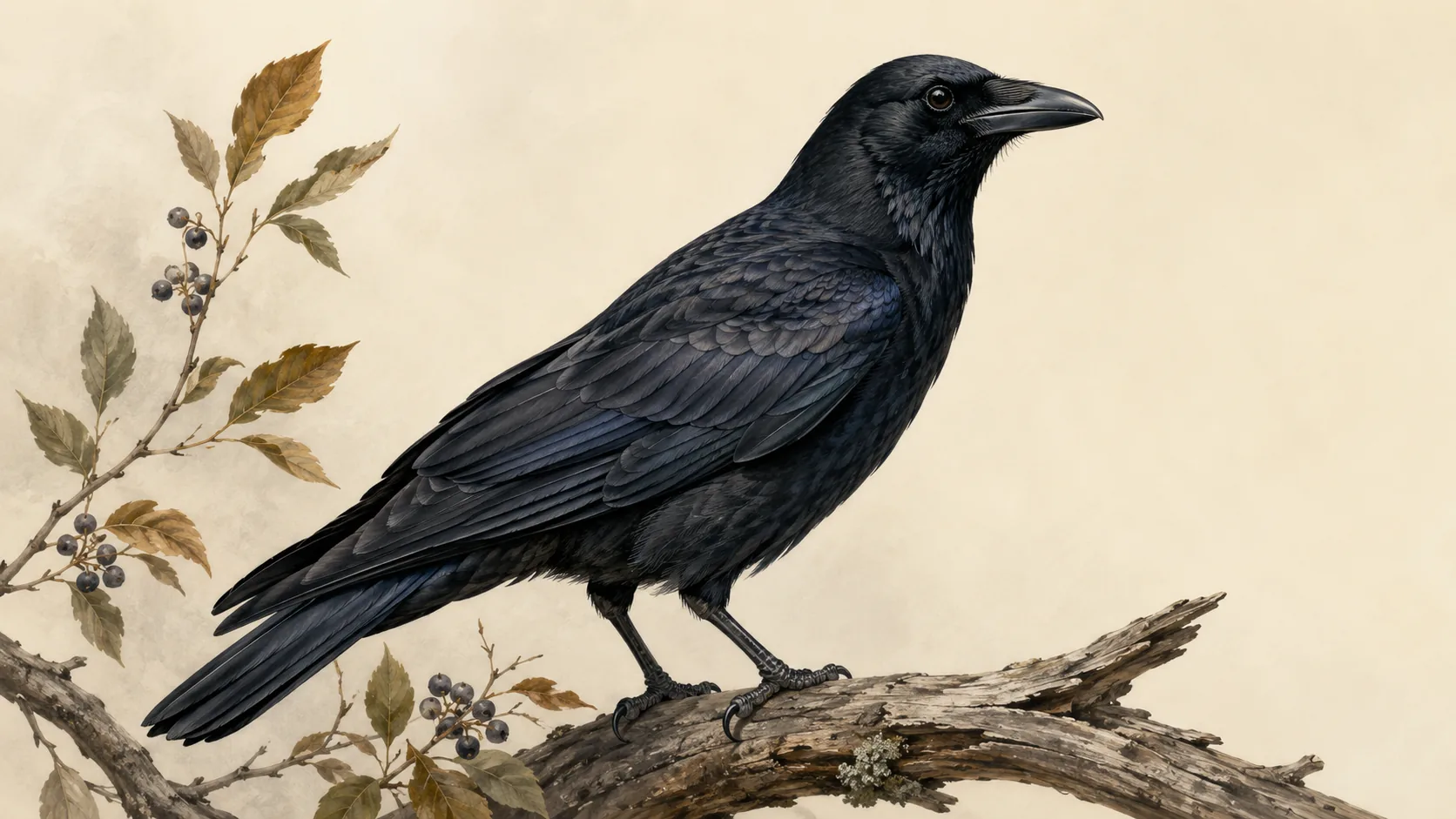
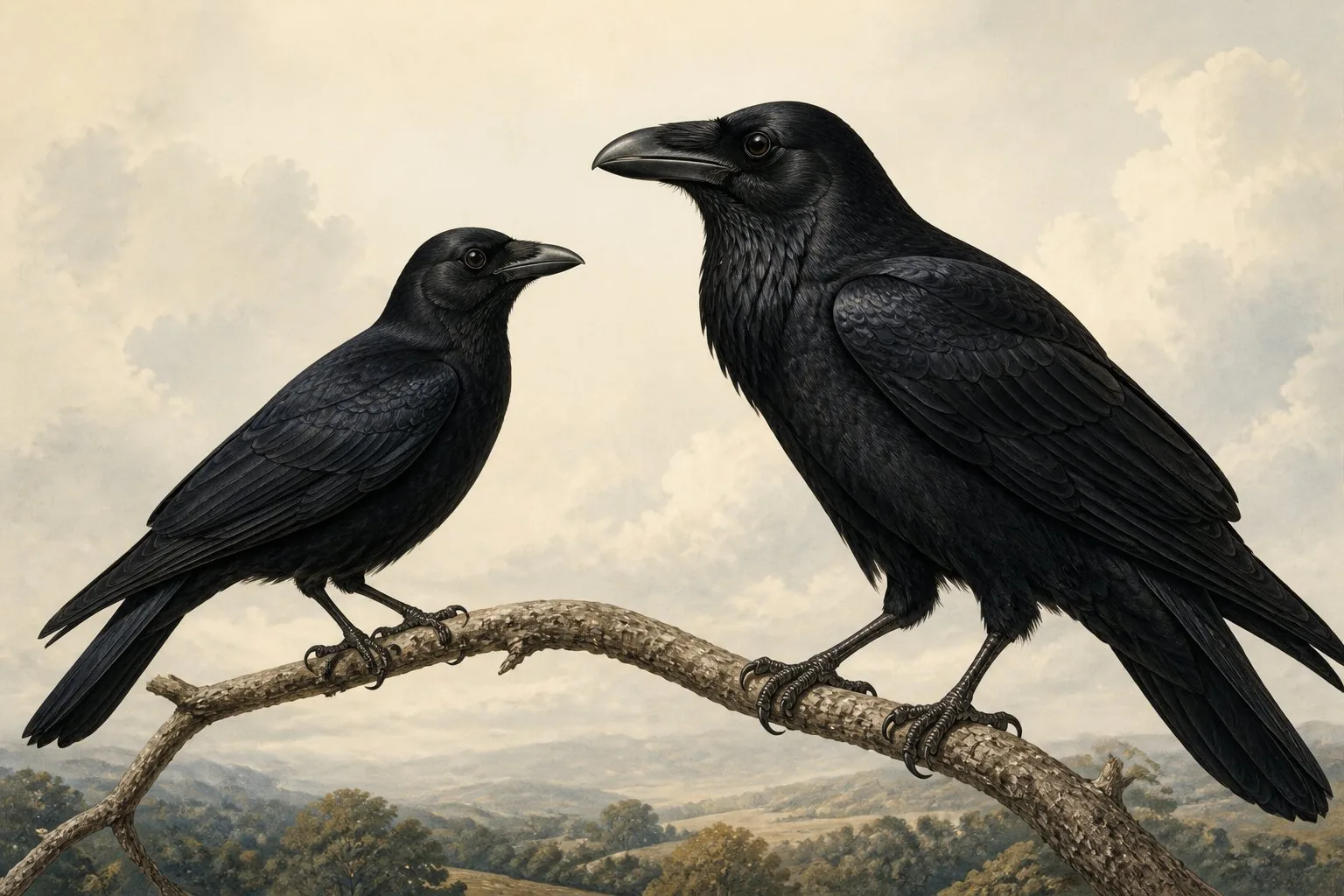
Apollo’s crow started white.
This is not a metaphor. In the myth as Ovid recorded it around 8 CE, drawing on Greek tradition considerably older, the crow was Apollo’s spy and companion - a white bird, set to guard his lover Coronis while he was away. The crow did its job. Coronis slept with a mortal man named Ischys, and the crow flew straight to Apollo with the news.
Apollo cursed it. Not for lying. For failing to act when it could have prevented the betrayal, choosing to report rather than intervene. The god of truth punished the bird for telling the truth, and the white feathers scorched black.
That is the crow’s origin in the Western symbolic tradition. Not death. Not darkness. A punishment for incomplete service to a god who valued action over information.
Everything else comes later.
The Biology First
Before any mythology, you need to know what observers were actually watching.
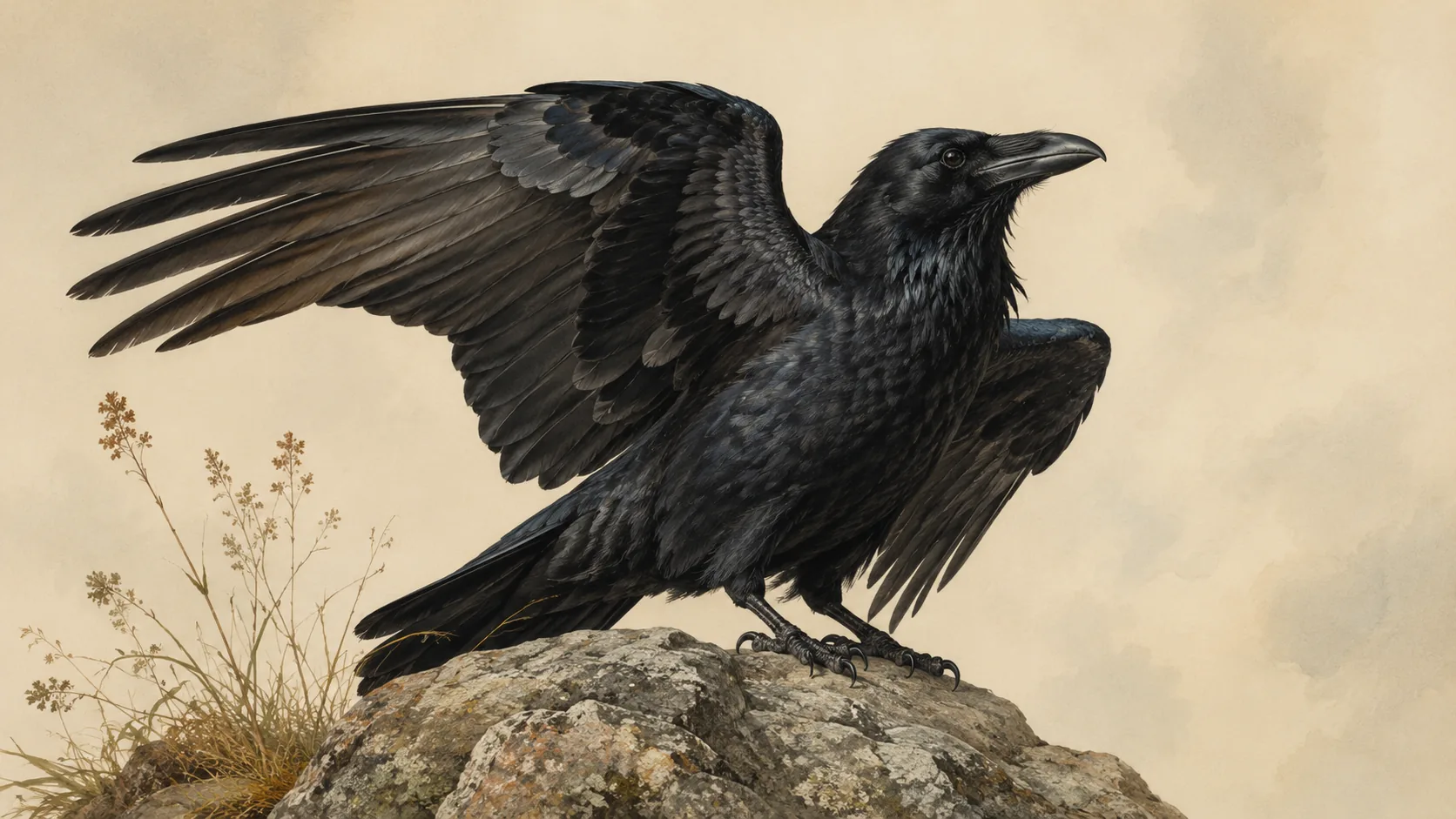
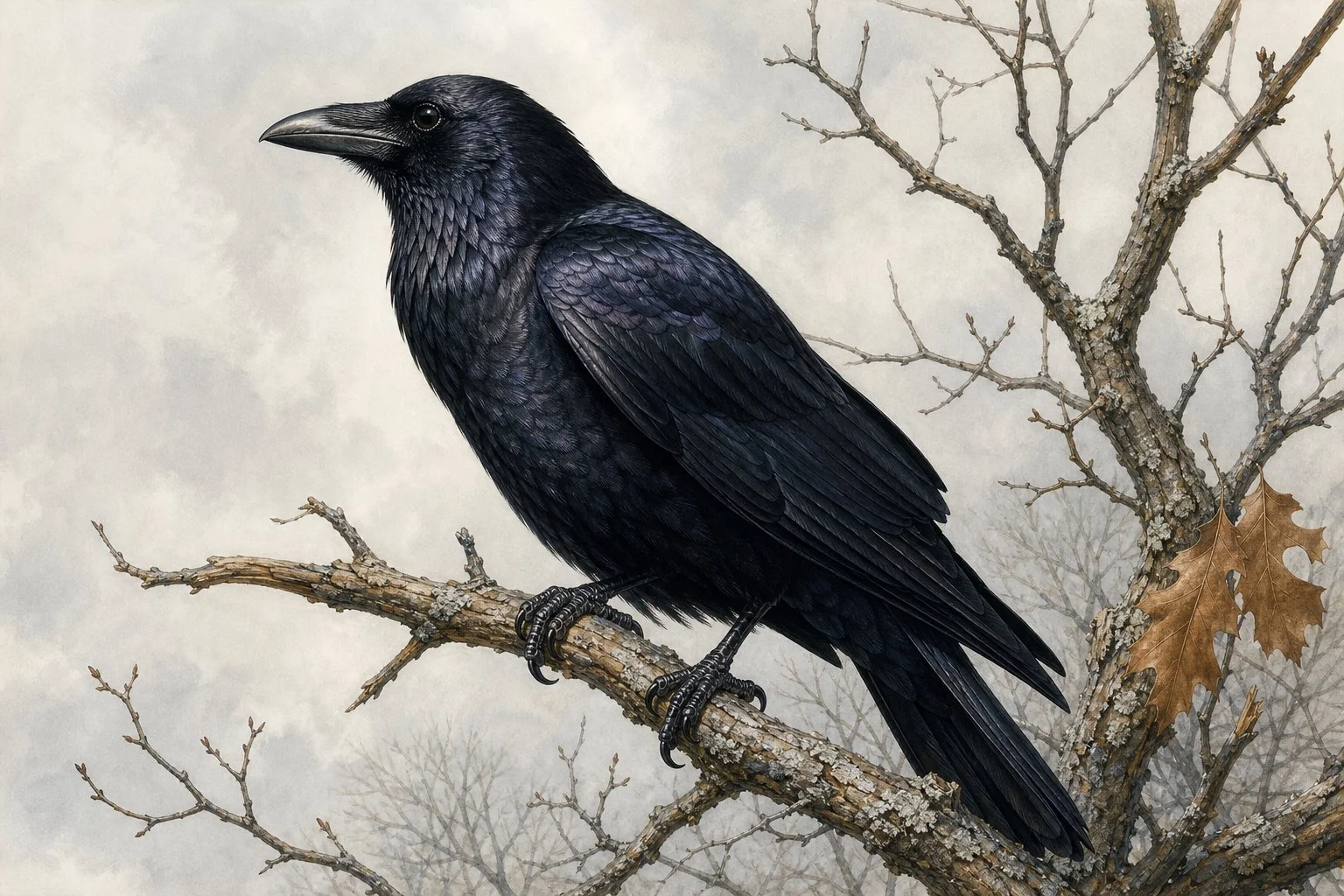
The American Crow (Corvus brachyrhynchos) has a brain constituting roughly 2% of its body weight. John Marzluff at the University of Washington documented that crows remember individual human faces and transmit that information culturally across generations. His research team wore rubber “dangerous” masks while trapping and banding wild crows. Within two weeks, 26% of wild crows encountered on campus scolded anyone wearing that mask. The scolding lasted at least 2.7 years. Crows that had never witnessed the original trapping also scolded the mask - they learned from other crows who told them.
When Marzluff wore the mask upside-down, crows still recognised it. Humans and sheep cannot reliably identify inverted faces. The crows processed facial geometry with more flexibility.
Kaeli Swift, also at the University of Washington, documented what happens when crows encounter a dead member of their species. They gather in large, noisy groups and mob-call. This is not mourning in the sentimental sense. The dead crow is a cue: something killed this bird, and we need to identify that threat. Crows retain memory of danger-associated stimuli from a single learning event for up to six weeks. Black birds, gathering noisily around death, transmitting information about what caused it.
That behaviour - precisely observed, across every culture that shared landscape with corvids - is the biological root of every death-omen tradition on this list. Pre-scientific observers accurately reported what they saw. They simply reversed the causality. Crows follow death. They do not cause it.
The Morrigan Is a Crow Goddess, Not a Raven Goddess
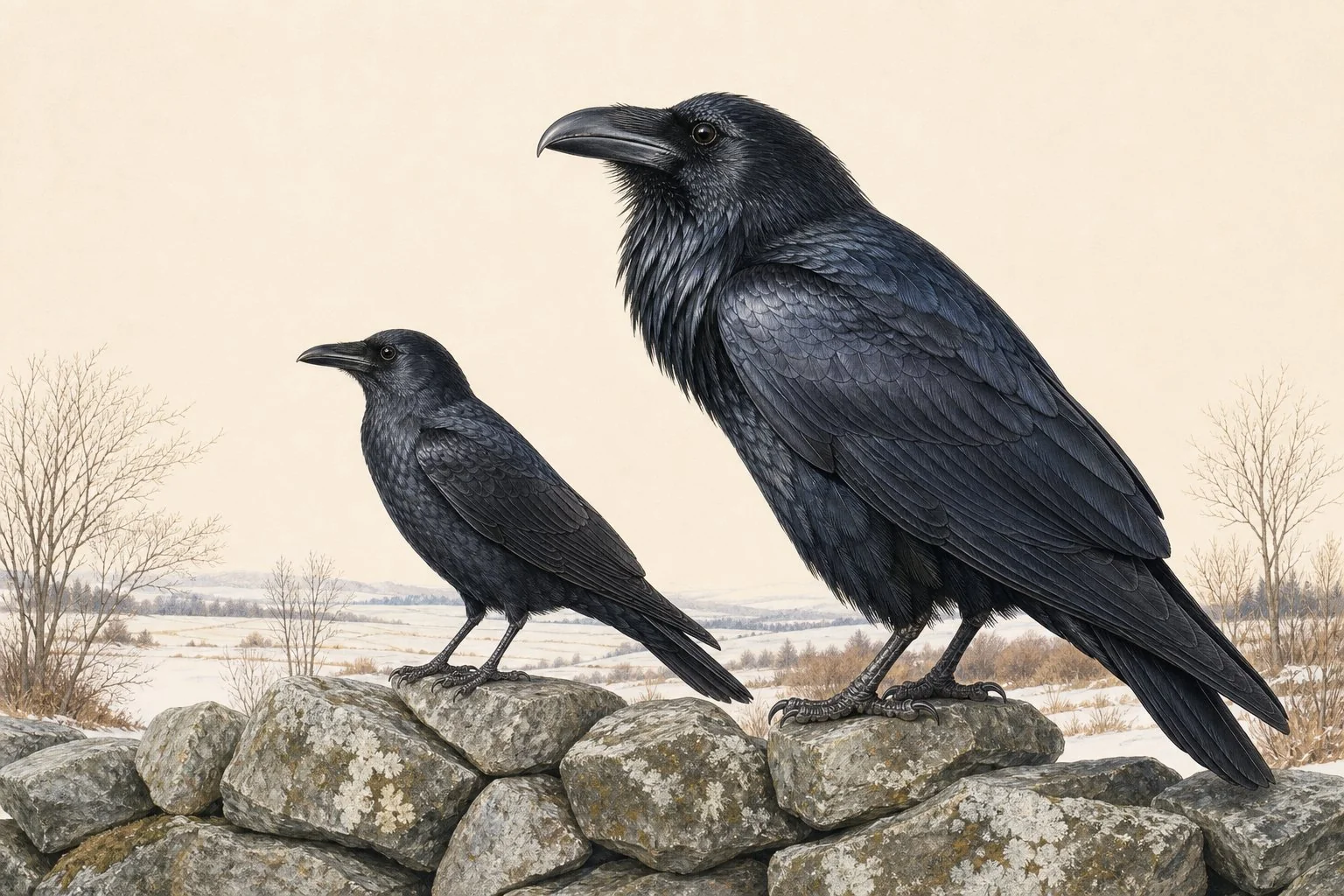
Most popular coverage gets this wrong. The conflation with raven mythology happens because ravens are larger and more dramatic, and because Norse tradition (which does centre on ravens) dominates Anglophone coverage of Northern European mythology.
The texts do not support this conflation.
The relevant Irish manuscripts are the Book of the Dun Cow (Lebor na hUidre, c.1100) and the Book of Leinster (c.1160), both transcribing oral traditions considerably older. The key text is the Cath Maige Tuired (Battle of Mag Tuired), an 11th-century compilation of earlier sources.
The Morrigan is not one figure but at minimum two, usually three - a triple goddess called the Morrígna. Her three aspects are most commonly given as Badb, Macha, and Nemain. The name likely derives from Old Irish meaning “great queen” or “phantom queen.”
Badb - her most explicitly corvid aspect - is defined in medieval Irish glossaries as a word for the hooded crow (Corvus cornix), the scald-crow, common throughout Ireland. Her full name, Badb Catha, means “Battle Crow.” Her function in the myths is causing panic and confusion in enemy ranks. She is the chaos of battle made bird-shaped. She appears before battles to predict carnage, and before notable deaths to foreshow them.
The Morrigan’s role in the Cath Maige Tuired is precise. Before the second battle against the Fomorians, she encounters the Dagda on Samhain. She then aids the Tuatha De Danann - not by fighting, but by causing confusion in the enemy. After the battle, she delivers three prophetic poems in the ancient rosc form. Her first poem announces victory. Her second blesses the land: fish in rivers, cattle well-fed, fertile soil. Her third is a doom prophecy: “I shall not see a world which will be dear to me: Summer without blossoms, cattle will be without milk, women without modesty, men without valour…”
A war goddess who enables survival while prophesying that survival is temporary. That is the Morrigan’s specific irony.
Cuchulainn and the Standing Stone
The death scene matters in detail.
In Aided Con Culainn, preserved in the Book of Leinster, Cuchulainn is mortally wounded by three magical spears. He knows he is dying. He ties himself to a standing stone with his belt so he can die upright rather than fall. The assembled enemy army gathers at a distance, afraid to approach while uncertain whether he still lives.
The Morrigan appears in crow form - three scald-crows, in some versions, settling on his shoulders. One version of the text describes a crow landing and tripping on his exposed innards. Cuchulainn laughs at this before dying.
It is the crow’s landing that signals his death to the army. Not killing him. Not defeating him. Marking the moment. His dying laugh at the crow’s stumble is the last action of the greatest warrior in Irish mythology. The crow, specifically the hooded crow, is both the witness and the announcement.
The Morrigan’s enmity with Cuchulainn runs through earlier texts. She approached him in human form offering her love. He rejected her. She attacked him during combat in animal forms - an eel, a wolf, a red heifer. He wounded her in each form. She came to him disguised as an old woman and tricked him into healing her. Her appearance at his death is not random. It is the completion of a story that begins with rejected love and ends with the crow confirming the death of the only man who ever truly tested her.
Wales: What the Mabinogion Actually Says
The second branch of the Mabinogion, “Branwen Daughter of Llyr,” features Bran the Blessed - Bendigeidfran - whose name, Brân, means crow or raven in Welsh. He is described as enormous, a king of impossible size.
Here is what Branwen actually did: she trained a starling to carry a message to Britain. Not a crow. Not a raven. A starling. The crow connection in the Branwen branch comes solely from Bran’s name.
Bran is mortally wounded in a disastrous war with Ireland. He commands his seven surviving followers to sever his head and carry it to the White Hill - where the Tower of London now stands - and bury it facing France as protection against invasion. The head remains alive, entertaining, and prophetic for decades during the journey.
This is the actual mythological basis for the Tower of London raven tradition. But note: the original mythology features a severed head, not birds. The leap from “bury the head of the man whose name means crow” to “keep live ravens at the Tower” does not appear in any pre-Victorian text.
Geoffrey Parnell, the Tower’s official historian, searched 1,000 years of records and found no evidence of captive ravens there before the late 19th century. The earliest known depiction of Tower ravens is an 1883 illustration. The tradition - including the prophecy that Britain falls if the ravens leave - appears to be a Victorian invention. One theory: Edgar Allan Poe’s “The Raven” (1845) generated a craze for raven mythology in Britain, and the birds were initially provided by the 4th Earl of Dunraven. A 2004 Guardian story ran the headline “Tower’s raven mythology may be a Victorian flight of fantasy.”
The Tower now employs an official Ravenmaster. The ravens are protected by decree. A 19th-century invention has been running for 140 years and now presents itself as ancient heritage.
Huginn and Muninn Are Ravens, Not Crows
This requires stating plainly because many crow symbolism articles co-opt Norse raven mythology wholesale.
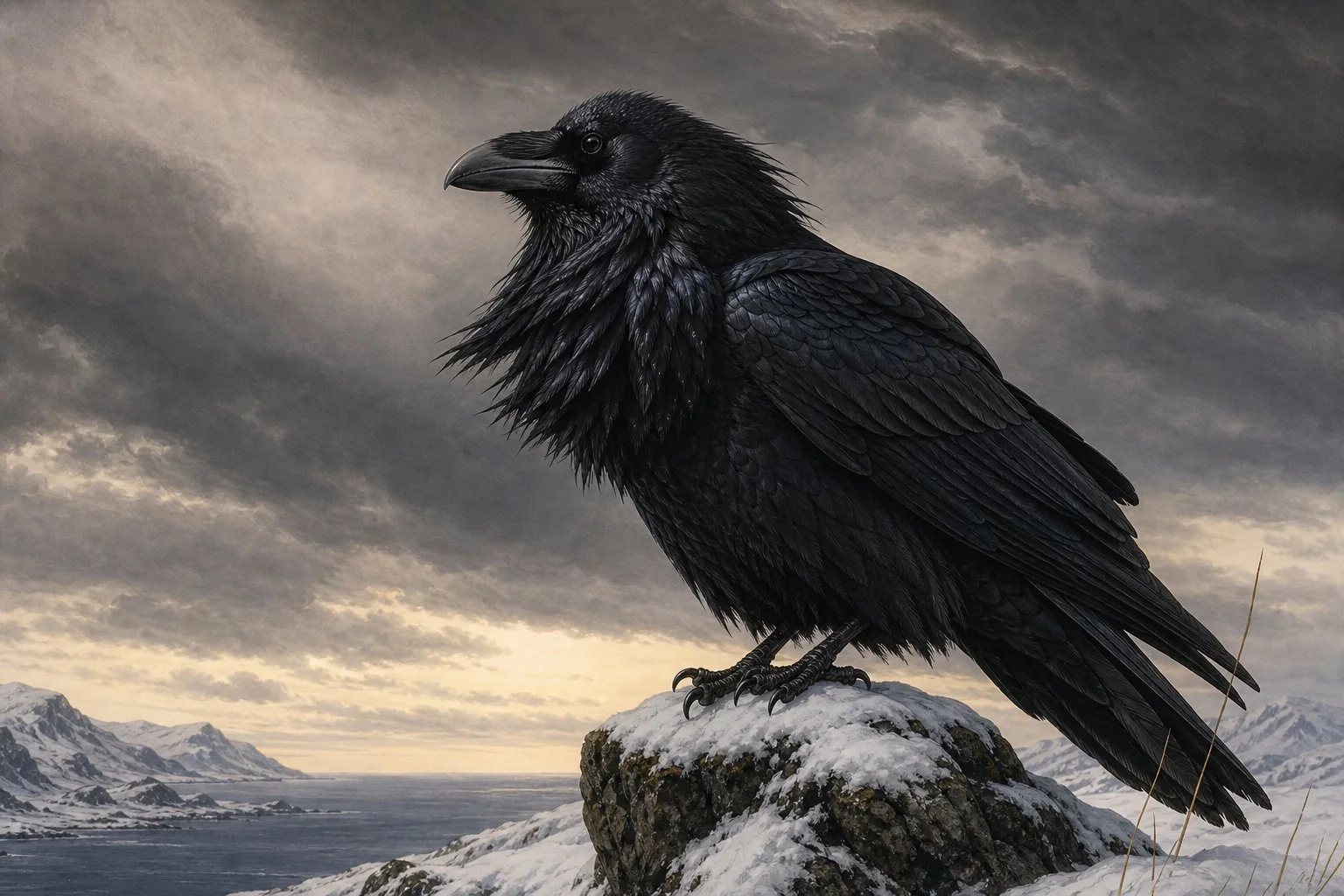
Snorri Sturluson’s Prose Edda (c.1220), drawing on older skaldic poetry and the Poetic Edda poem “Grimnismal,” is unambiguous: Odin’s two companions are ravens (hrafn in Old Norse). Huginn means Thought. Muninn means Memory. Each morning they fly across the nine worlds and return to whisper what they have seen in Odin’s ears. Snorri records Odin’s anxiety: he worries that Huginn won’t return, but worries more about Muninn. Memory is the more precious cargo.
The naming is the interesting thing. Odin’s ravens are named for the two cognitive functions that modern science has since confirmed corvids possess to an unusual degree. They cache food and adjust hiding behaviour based on who is watching. They pass social knowledge - which humans are dangerous, which locations hold threat - across generations. They plan ahead for tasks requiring sequential tool use.
Whether ancient Norse observers were commenting specifically on corvid intelligence or arrived at these names by other paths is not answerable. But Thought and Memory named as ravens, by a culture living alongside corvids sharp enough to deserve those names, is not an accident that deserves to pass without comment.
The crow plays essentially no documented role in Norse mythology as a distinct figure. Articles presenting Huginn and Muninn as “crow symbolism” are committing a species-level error in addition to the cultural one.
Japan: The Three-Legged Crow That Started as Two-Legged
Yatagarasu (八咫烏) means “eight-span crow” - the “eight span” establishing supernatural scale. The Nihon Shoki, compiled 720 CE, is the earliest text. In it, Amaterasu, the sun goddess, sends Yatagarasu to guide Emperor Jimmu on his conquest of Japan. The crow acts as divine messenger and pathfinder.
The original Yatagarasu had two legs like any normal crow.
The three-legged form did not appear until around 930 CE, when a text called the Wamyo Ruijusho merged the Japanese crow-messenger with the Chinese three-legged sun crow, the Sanzuwu. This is documented cultural transmission. The Japanese “ancient” solar crow is demonstrably the product of exchange with Chinese mythology.
The Chinese original, the Sanzuwu, appears in Han dynasty art (206 BCE - 220 CE) and is older still in oral tradition. The sun goddess Xihe was mother of ten child-suns. Each morning one child was bathed and placed on a crow’s back to fly up to the top of the mulberry tree Fusang, then into the sky to become that day’s sun. The three legs represent heaven, earth, and humanity unified through solar force. Korea has a parallel figure, the Samjokgo. All three likely derive from shared shamanic beliefs across early East Asia that understood the sun as a living winged being.
The Japan Football Association adopted Yatagarasu in 1931. The three-legged crow appears on every Japan national team jersey. A sun-crow from a 720 CE chronicle, whose three-legged form was borrowed from China in 930 CE, now guides the Samurai Blue at World Cups.
”Murder of Crows” Is a Joke That Landed on the Truth
The term first appears as “a morther of crowys” in 1475. The Book of Saint Albans (1486) formalises it. These were terms of venery - collective nouns invented by 15th-century English aristocrats as demonstrations of wit and learning, frequently morbid or ironic by design. A “murder of crows” sits in the same genre as “an unkindness of ravens” and “a parliament of owls.” The name reflects medieval death association and aristocratic wordplay. It was not scientific observation or folkloric tradition.
The accidental accuracy is the thing. Crows do gather at death. Kaeli Swift returned to a park where she had been feeding a crow population regularly. She came back wearing a mask and holding a taxidermied dead crow. The living crows mobbed her, scolded her, and continued scolding anyone wearing that mask for weeks - including crows that had not been present for the original event. A death in a parking lot became a community memory. The biological “murder” is real even though the term was made up.
The Apsaalooke and the Mistranslation
The Crow Nation - the Apsaalooke people of Montana and Wyoming, traditionally occupying the Yellowstone Valley - carry the crow in their very name. But the name is more complicated than English renders it.
Apsaalooke means “Children of the Large-Beaked Bird.” The components: apá (beak or nose), isáa (big), dooká (child). The exact identity of this large-beaked bird is disputed within the tradition itself. Some Apsaalooke elders say the bird in the original meaning was the mythical thunderbird, not the crow. French fur-traders heard the name, guessed crow, and that guess became the English ethnic label. An entire identity in the English-speaking world was built on a possible mistranslation.
The Apsaalooke connection to the actual crow (Corvus brachyrhynchos) is genuine. The crow’s characteristics - highly social, intelligent, community-oriented, vocal, persistent - mirror core Apsaalooke cultural values of collective responsibility and communal knowledge. But the name’s etymology is genuinely contested at its root, and anyone writing about it as settled fact is ahead of the evidence.
The Rhyme Is About Magpies
“One for sorrow, two for joy” appears in John Brand’s Observations on Popular Antiquities (1780), referencing magpies in Lincolnshire. The subject is Pica pica, the Eurasian Magpie - a corvid, but not a crow.
In America, where magpies are absent from most regions, the rhyme migrated to crows by cultural substitution. A crow-specific version (“One crow sorrow, two crows mirth”) circulates online and in folk collections, but it is an American adaptation, not a separate ancient tradition. Internet articles presenting it as ancient crow lore are compressing two distinct regional traditions into one, then adding the word “ancient” to conceal the compression.
What the Symbolism Is Actually Doing
Every tradition on this list is responding to observed crow behaviour and building meaning from it.
The Greek myth explains why crows are black (scorched as divine punishment) and why they cry out (forever thirsty in the Corvus constellation, unable to reach the water cup). These are aetiological myths - explanations of natural facts through narrative. They are working from the biology up.
The Celtic Badb is chaos-in-battle because crows are chaotic during battle - drawn to carrion, gathered at violence, crying out. The observation comes first. The goddess is the explanation.
The death omen tradition across European cultures responds to crows feeding on the slain. They are at battlefields because corpses are there. They arrive after death because that is when the food arrives. Pre-modern observers saw the crows and concluded that crows predict or accompany death. The crows were simply faster at finding dead things than the observers were at understanding why.
What Marzluff’s research made clear is that crows remember who endangered them, transmit that knowledge culturally, and update it across generations. What Swift’s research made clear is that crows study death actively - using the bodies of their dead as information about threat. The crow that seems to understand death is not mystically perceptive. It is cognitively sophisticated in ways that felt, to observers without biology, like something supernatural.
The crow was white before Apollo cursed it. It gathered at battlefields because bodies were there. It remembered the face of the person who trapped it. It bent a wire into a hook without being taught.
Every tradition built around it starts with accurate observation. The symbolism is the part humans added to explain what they could not yet measure.