Biology
The bird seven states claimed: why the cardinal won the state bird wars
In March 1943, North Carolina’s General Assembly had been without a state bird for a decade. Their first attempt, in 1933, had gone badly: lawmakers briefly adopted the Carolina Chickadee, then reversed the vote a week later when they realised the bird’s nickname - “Tomtit” - would saddle the state with a permanent indignity. So the matter sat. Then Senator Rivers Johnson of Duplin County introduced a new bill, backed by a public vote organised by the North Carolina Bird Club. Twenty-six species were nominated. The Northern Cardinal won by roughly 1,600 votes over the mourning dove. On March 4, 1943, North Carolina became the sixth state to claim Cardinalis cardinalis as its own.
That number is the thesis. Seven US states - Kentucky, Illinois, Indiana, Ohio, North Carolina, West Virginia, and Virginia - have adopted the same bird. No other species comes close. The Western Meadowlark holds second place with six states. What the cardinal has that the meadowlark lacks is not beauty, or rarity, or song. It is presence. The cardinal does not migrate. It stays.
A mid-century phenomenon
The seven adoptions happened within a 24-year window. Kentucky went first in 1926 - the state legislature citing the bird’s permanence and choosing it under the informal name “Kentucky Cardinal,” a designation that still appears in older field guides. Illinois followed in 1929, the result of a 1928 schoolchildren’s vote organised through the General Federation of Women’s Clubs, which had been running a campaign across the country to push states toward official birds. Indiana and Ohio both adopted the cardinal in 1933. West Virginia put the choice to a public school pupil vote and ratified it in March 1949. Virginia made it official on January 25, 1950.
Since Virginia acted, no additional state has adopted the cardinal. The designation map has been frozen for 76 years.
| State | Year adopted |
|---|---|
| Kentucky | 1926 |
| Illinois | 1929 |
| Indiana | 1933 |
| Ohio | 1933 |
| North Carolina | 1943 |
| West Virginia | 1949 |
| Virginia | 1950 |
The Women’s Clubs connection matters. The federation’s campaign framed state birds not as trophies for science or government, but as community choices - birds that people already knew, already fed, already had opinions about. The Illinois schoolchildren who voted in 1928 were choosing the bird at their window that morning, not a species they had read about in a field guide.
What the seven states share
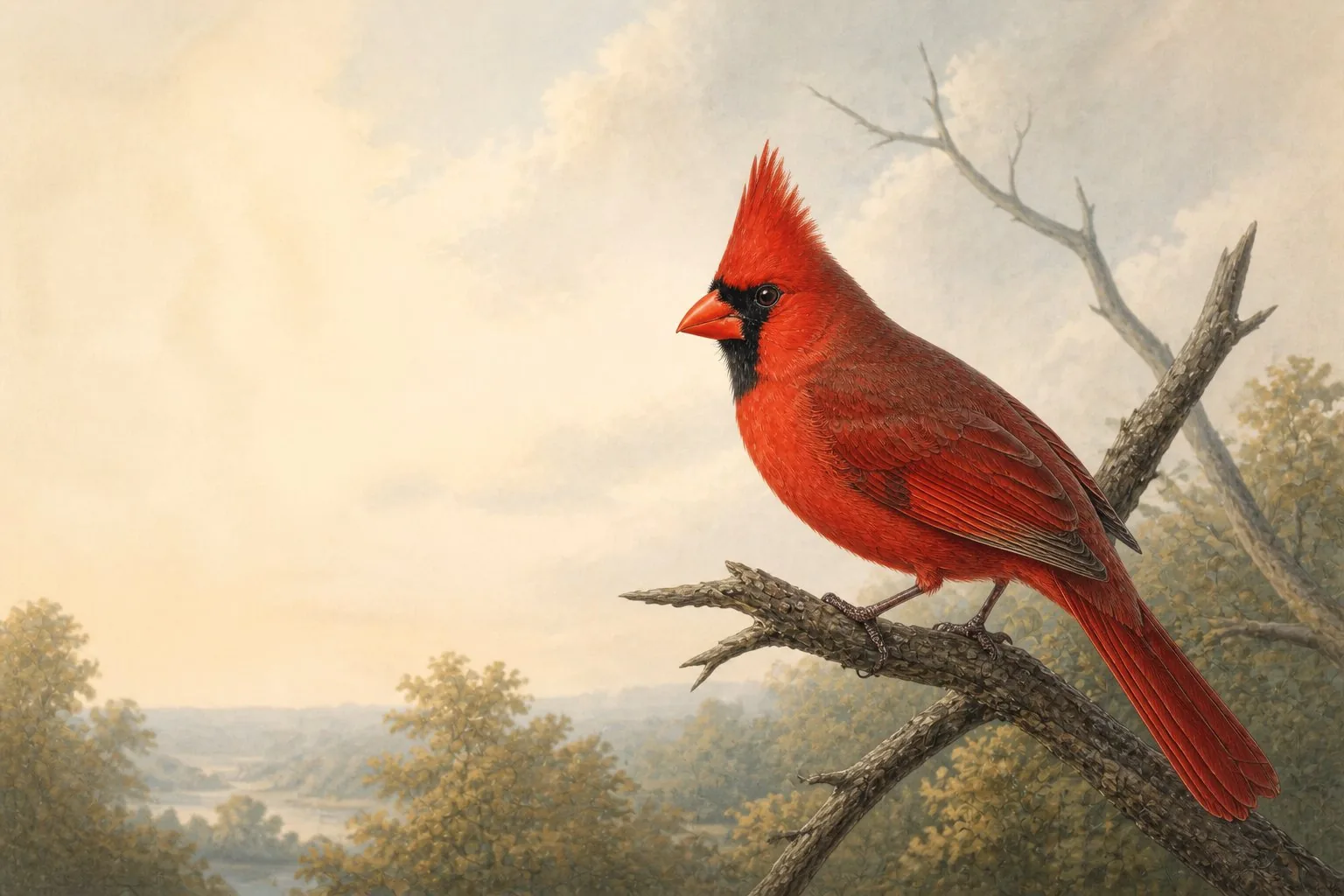
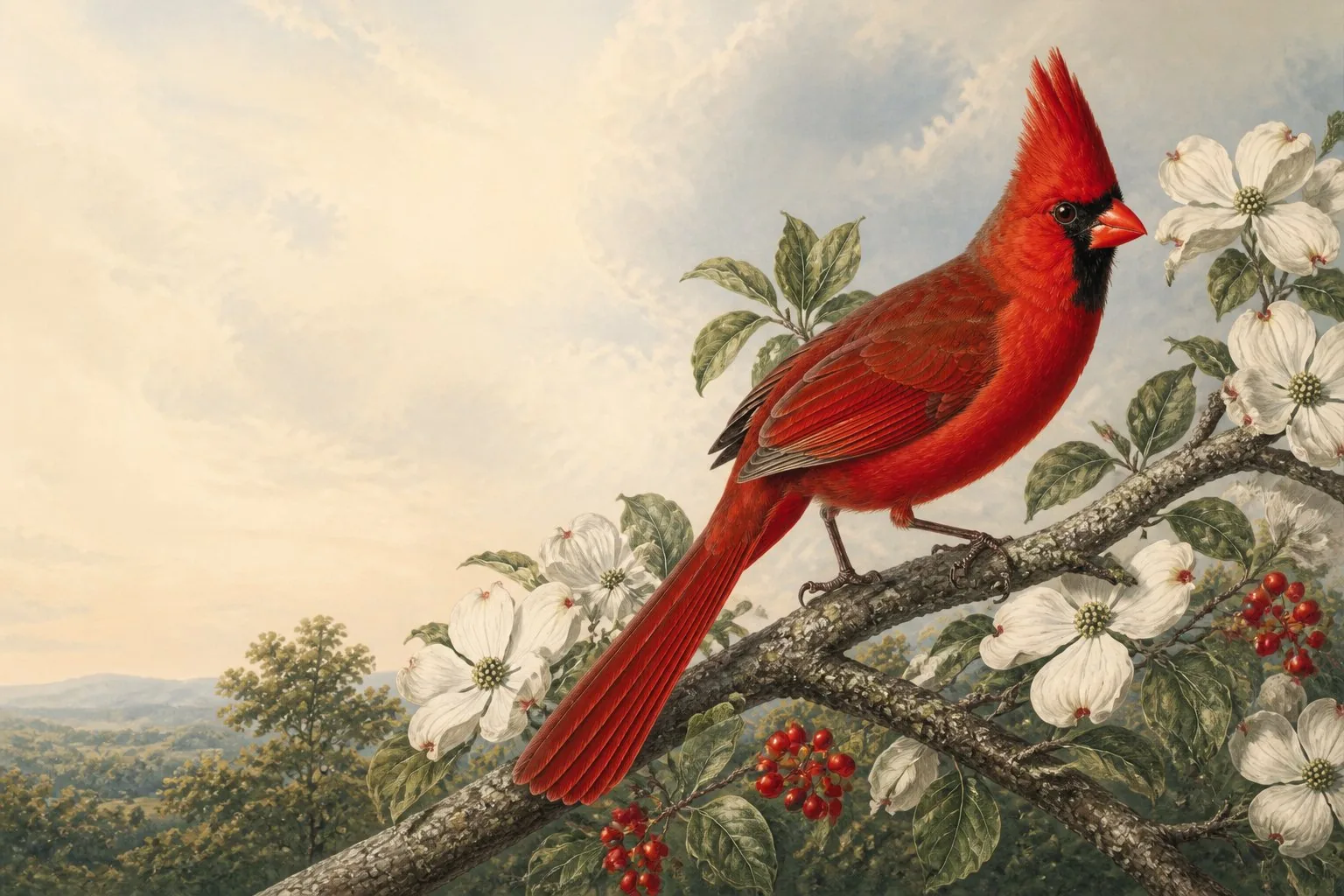
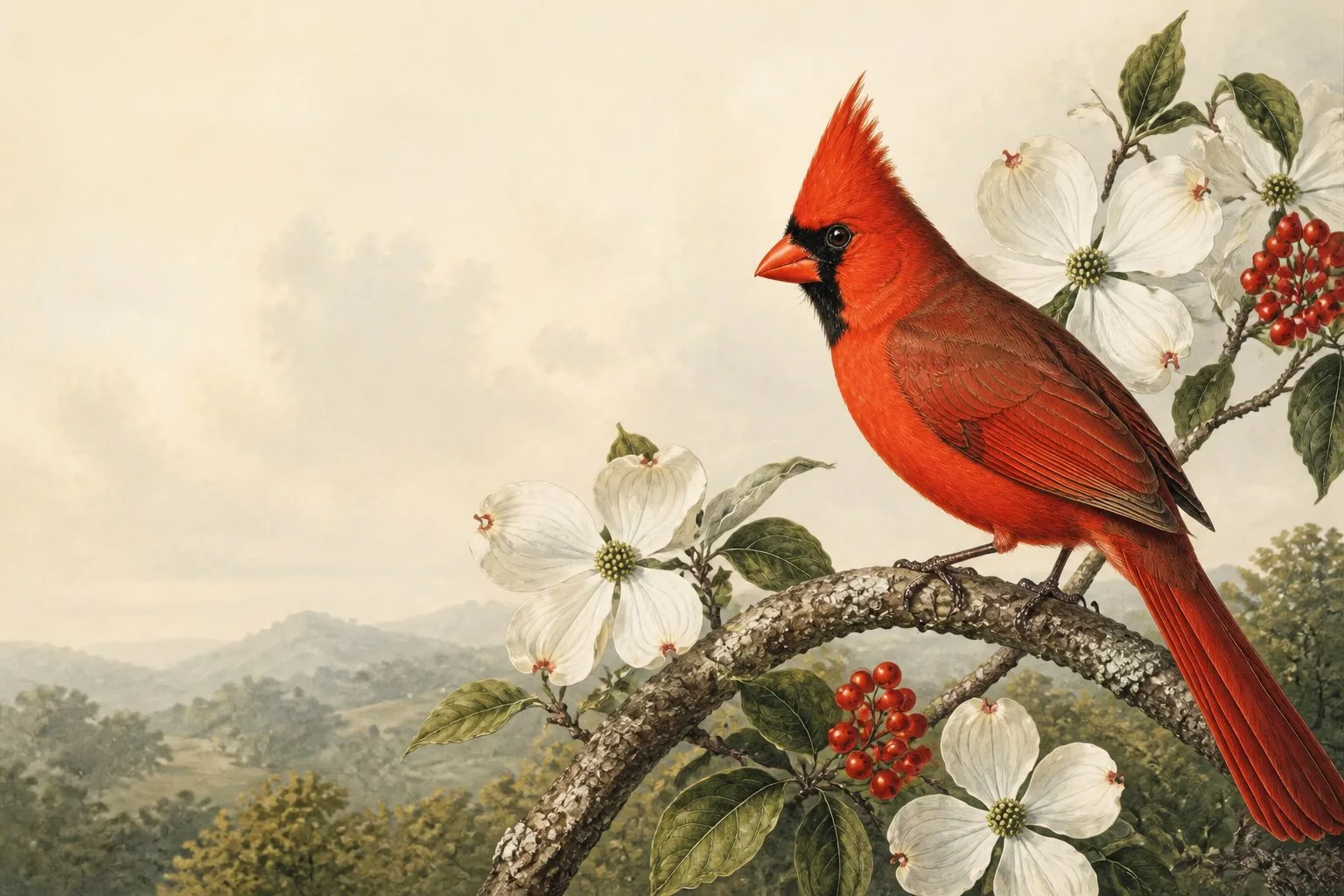
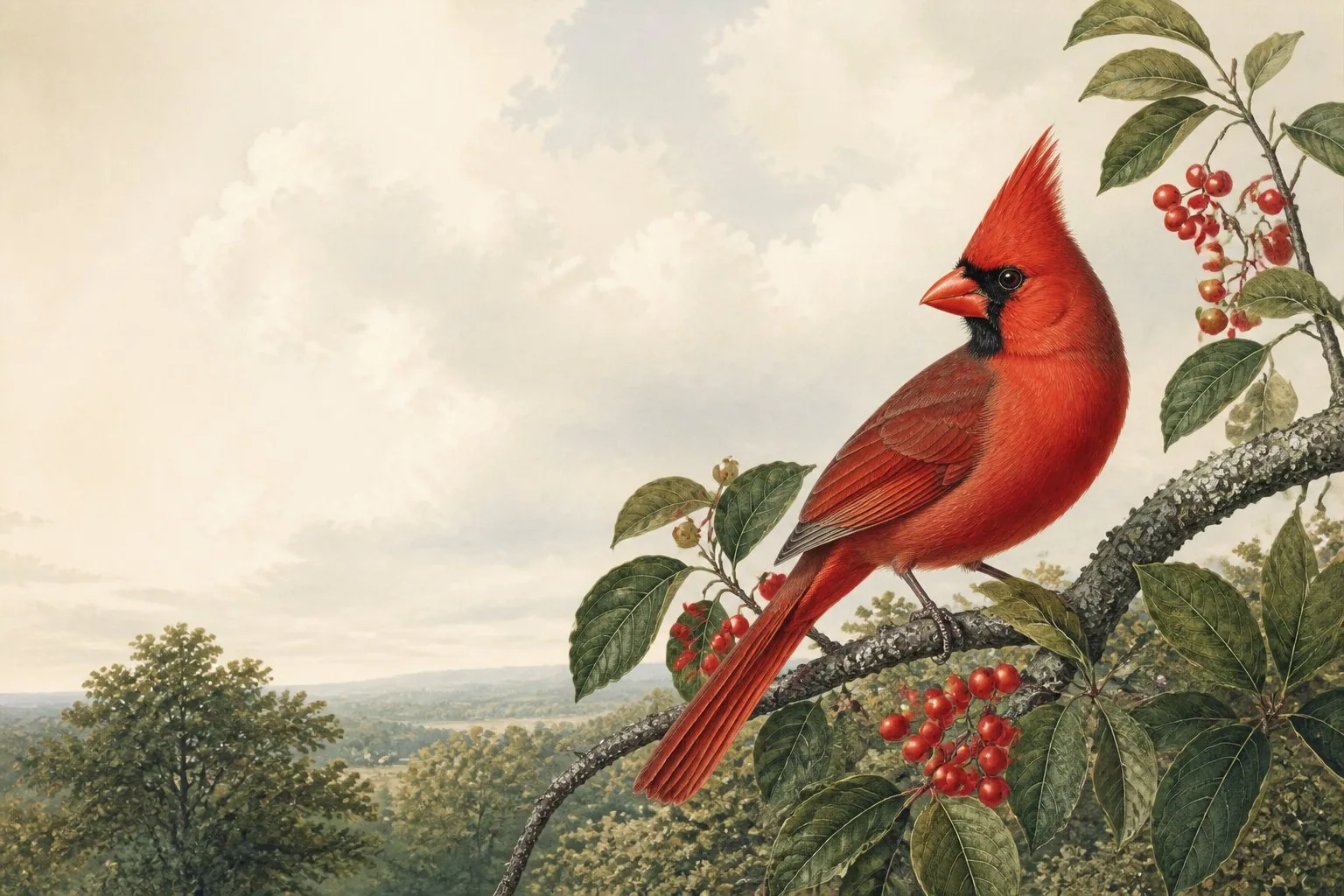
All seven states fall within the cardinal’s core eastern range. Audubon’s field guide records the bird at 8 to 9 inches long, wingspan 9 to 12 inches, weight 42 to 48 grams. The male’s entire head and body are vivid red, offset by a black mask running from eye to chin. The female is olive-brown with red washes on the crest, wings, and tail - duller, but no less distinct. Both sexes carry the same coral-pink bill and the same raised crest. The bill is large and conical, built for cracking sunflower seeds, and it is one of the most recognisable silhouettes in North American birdwatching.
Neither sex migrates. That was a genuine distinction in the 1920s and 1930s. A cardinal at the feeder on December 26 is the same individual that nested in your hedgerow in June. State symbols tend toward permanent residents over seasonal visitors, and the cardinal’s year-round fidelity made it feel less like a bird and more like a neighbour.
Both sexes also sing - uncommon among North American songbirds. The male’s clear, repetitive whistle (rendered in field notes as “cheer-cheer-cheer” or “what-cheer”) carries through bare winter branches. The female answers. The pair is audible before it is visible, two birds calling across a yard in a duet that most songbird species reserve for spring.
Seven states share a bird that has never needed to leave. Whatever it represents in official life, in biological life it is a statement about staying put.
The bird that kept moving north
By the time the seven adoptions were complete in 1950, Cardinalis cardinalis was already pushing past the boundaries those states had drawn around it. The range was once so closely associated with the southern and midland states that ornithologists used “Kentucky Cardinal” as an informal label. New England was largely cardinal-free.
Then suburbs spread, feeders multiplied, and edge habitats expanded. A 1960 research report cited by the Cornell Lab placed the first confirmed cardinal nesting in Connecticut in 1943 - the same year North Carolina adopted the bird. Massachusetts got confirmed breeding in 1958. In Maine, ornithologist Ralph Palmer’s 1949 “Maine Birds” described the species as “Probably a very rare visitant, most records referring to escaped captives.” Within two decades cardinals were nesting in Maine. The 2018 Maine Bird Atlas, based on eBird records, documented confirmed nesting east to Washington County and north to Aroostook County, near the Canadian border.
The Minnesota Bird Atlas traces the same pattern through the Midwest: first Minneapolis record in 1875, first confirmed nest in Steele County in 1925, steady northward push through the twentieth century toward the Canadian border, driven by warmer winters, forest fragmentation creating preferred edge habitats, and winter feeders providing reliable calories.
Audubon puts the current North American population at 130 million individuals, carrying a Least Concern status from the IUCN. The conservation picture for the Northern Cardinal is, in a word, stable.
No state has added the cardinal to its list since 1950. The seven who did were right about what they were claiming: not a rarity, but a presence. The bird was theirs because it was everywhere, and it was everywhere because it never left.
States in Minnesota, Maine, and southern Canada could now make the same case those seven legislatures made in the mid-century. Whether any of them will is a different question, and so far none of them has asked it. The group of cardinals at a Wisconsin feeder in January is as striking as the one that persuaded the Ohio General Assembly in 1933. The politics of official symbols, it turns out, do not keep pace with the birds.