Field Guide
White-winged Crossbill
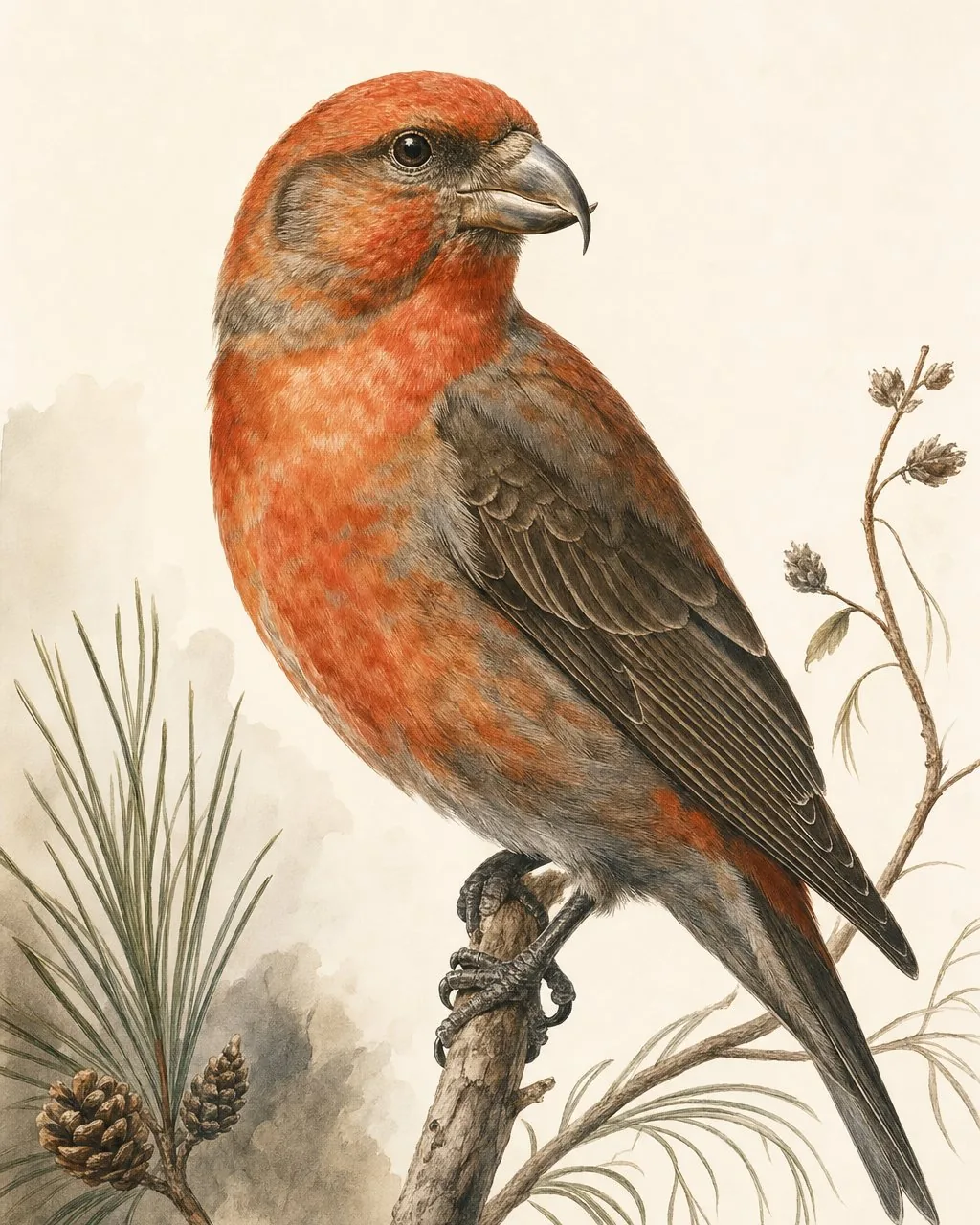
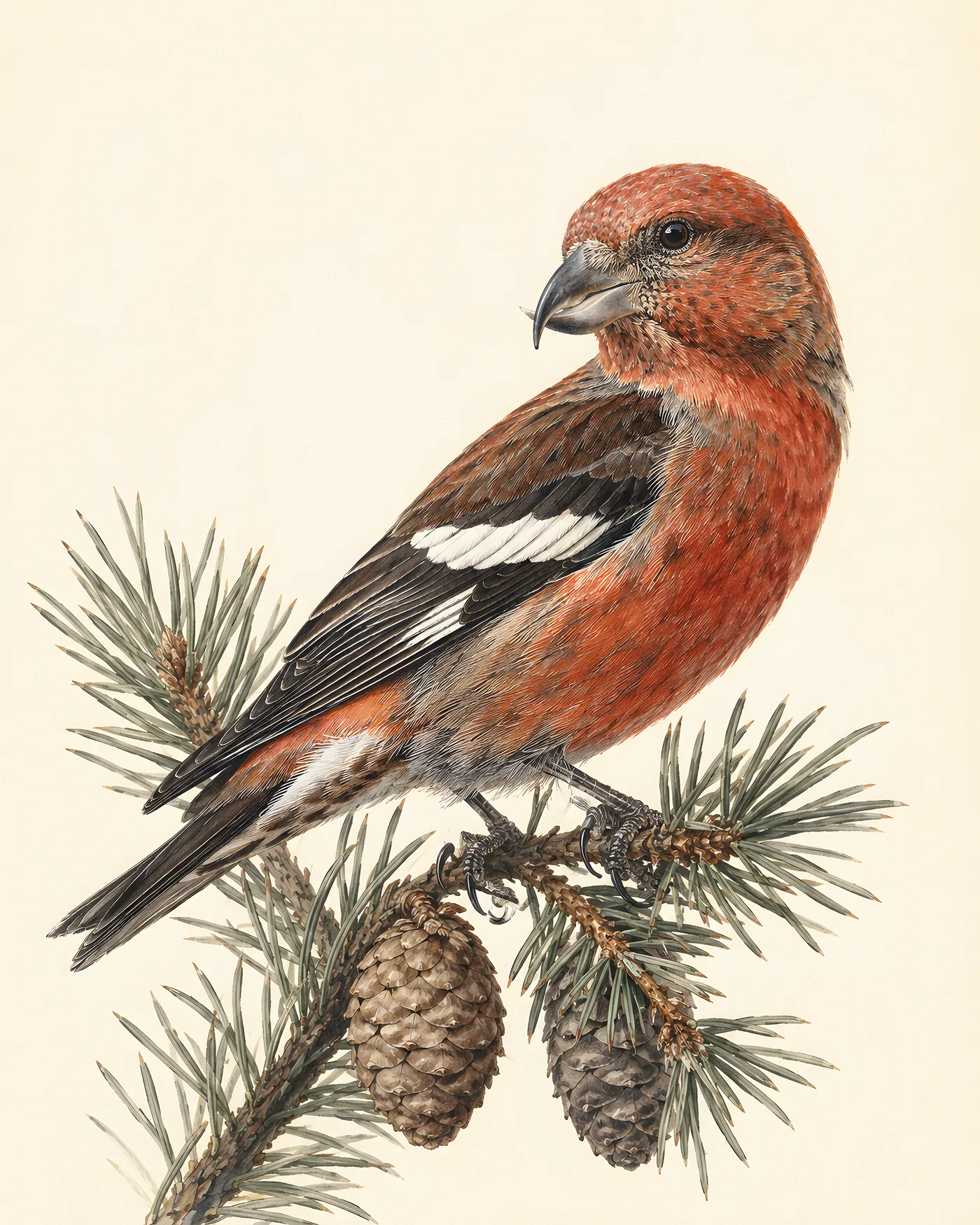
A White-winged Crossbill hangs sideways from a spruce cone in the boreal forest, holds it with one foot, and works the scales apart with a bill whose tips cross like a pair of scissors that will not close. It is one of the strangest tools in the bird world, and it does one job superbly: it levers open a closed conifer cone and lifts out the seed. Watch the bird feed and the crossed bill stops looking like a deformity and starts looking like exactly what it is, a key cut to fit a single lock.
This is the crossbill of the spruce. Where the Red Crossbill ranges across many conifers with bills of many sizes, the White-winged specialises in the smaller, softer cones of spruce, tamarack and hemlock. The two white wingbars that name it are the easiest mark in the field. The bill is the reason the bird exists at all.
What it looks like
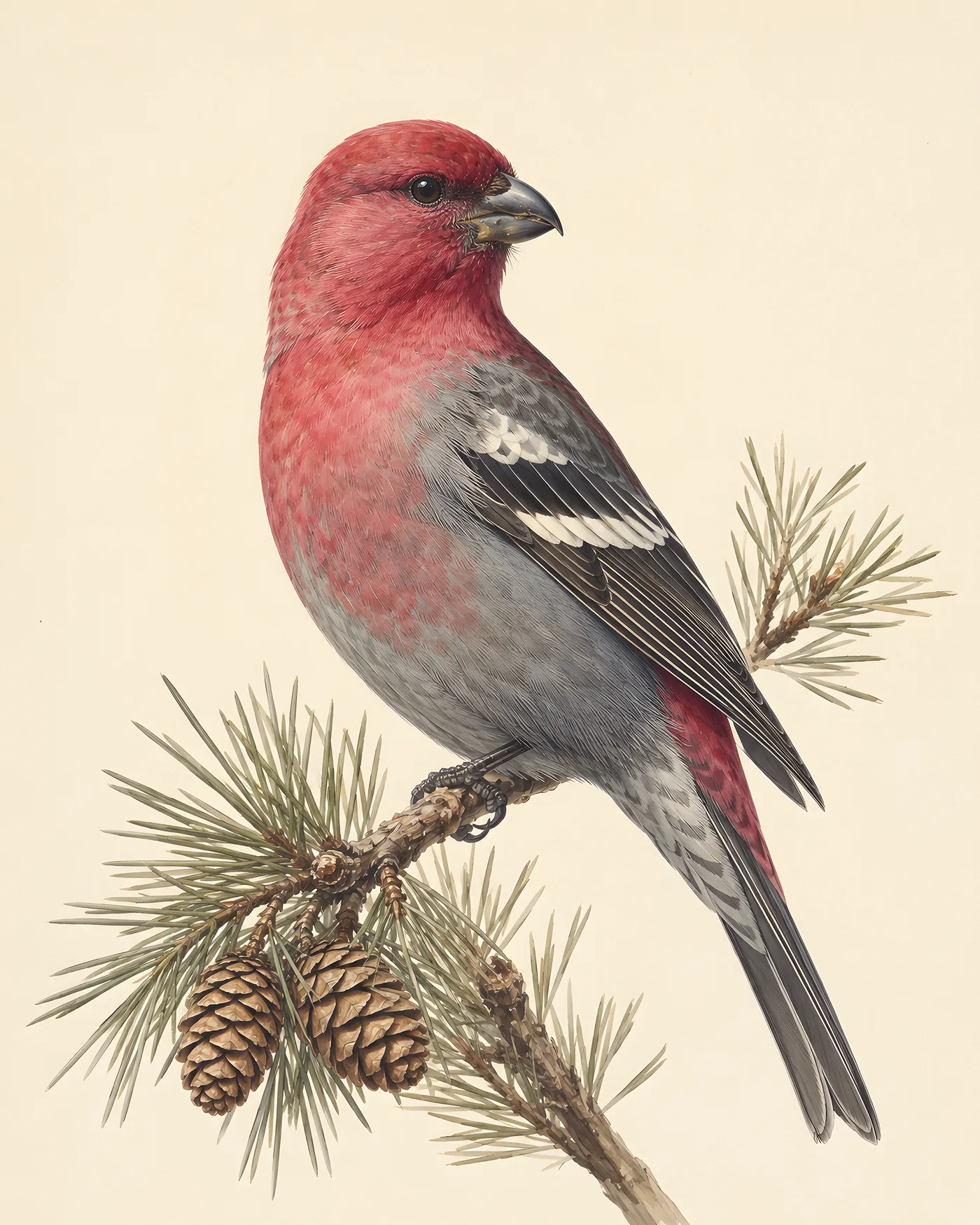
The adult male is a rose-pink bird, deepest on the head, breast and rump, with black wings and tail. Across each black wing run two broad, clean white wingbars, the field mark that separates this species at a glance from the Red Crossbill, which has none. The crossed bill is dark and slimmer than the Red Crossbill’s. The overall effect is a small, neat finch in raspberry and black with two white stripes.
The female is olive-yellow and grey where the male is pink, streaked on the back and flanks, but she carries the same two bold white wingbars on dark wings, and the same crossed bill. Young birds are streakier still. Cornell Lab notes that the wingbars and the slim crossed bill hold true across all the plumages, so even a drab streaked individual can be named with confidence once those two features are seen together.
What it sounds like
The White-winged Crossbill is a noisy, sociable bird, and its calls carry through the forest before the flock is seen. Cornell Lab describes a hard, dry, mechanical rattle, often likened to a machine-gun burst, given in flight and while feeding. Mixed in are higher, tooting whistles that listeners compare to a small toy truck.
The song, delivered from a spruce top, is a long, varied run of these trills, rattles, warbles and tooting notes, loud and sustained, often given on the wing as a male circles above the canopy. In a good cone year a singing male may be heard at almost any season, because for this bird the breeding calendar bends to the trees, not the months.
Range and habitat
Loxia leucoptera is a circumpolar bird of the northern coniferous forest, breeding through the boreal spruce and larch belt of Alaska, Canada, northern Europe and northern Asia. Its life is bound to the cone-bearing conifers, especially spruce and tamarack, and it goes wherever those trees are carrying seed.
That makes it one of the great wanderers. The species is nomadic and irruptive rather than a fixed migrant: flocks roam huge distances in search of heavy cone crops, and when the northern crop fails they push south into the northern United States, sometimes far beyond their usual range, appearing in numbers one winter and not at all the next. The IUCN lists the White-winged Crossbill as Least Concern, a status that matches its vast circumpolar range and its habit of simply following the food.
Diet
The diet is conifer seed, and very little else. Cornell Lab puts spruce seeds at the heart of it, with tamarack and hemlock favoured too and many other conifers taken when the preferred cones run short. The bird climbs through the cones like a small parrot, hanging at any angle, prising scales apart with the crossed bill and lifting the seed out with its tongue.
The volume is the remarkable part. Cornell Lab records that a single White-winged Crossbill can eat on the order of three thousand conifer seeds in a day. A bird that runs on a food source this small must process it almost without pause through the daylight, which is why a flock in a laden spruce stand seems never to stop moving or feeding.
Breeding and nesting
The White-winged Crossbill keeps the strangest breeding schedule of any North American songbird. It will nest in any month of the year, including the depth of winter, provided the cone crop is heavy enough to feed young. Cornell Lab records confirmed breeding in every month, with nesting triggered by the abundance of spruce cones rather than by the season or the length of the day.
The nest is an open cup of twigs, grasses, lichen and bark, built by the female out on the branch of a spruce. She lays two to five pale, dark-spotted eggs and incubates them alone for about twelve to fifteen days, fed on the nest by the male. The young fledge roughly two weeks after hatching. A pair feeding nestlings in January, in a frozen boreal forest, is one of the more astonishing sights in northern birding, and the crossed bill is what makes it possible.
A finch that runs entirely on conifer seed will raise young in the dead of winter, so long as the spruce cones hang heavy enough to feed them.
So much of this bird follows from the shape of its bill. The crossed tips set the diet, the diet sets the wandering life, and the wandering life and the cone crop together set a breeding season that ignores the calendar. The white wingbars will name the species for you in a moment. The crossed bill, given a longer look, explains nearly everything else about it.