Field Guide
California Thrasher
In the chaparral above Pasadena on a January morning, before most birds have thought about singing, a large brown shape works its way through the base of a manzanita thicket. It moves on foot, fast, head down, flicking leaf litter with a bill that curves like a scimitar. It does not flush. It does not pause. It simply vanishes into the next stand of scrub as efficiently as a cat.
The California Thrasher has lived in this exact kind of country for most of its evolutionary life, and everything about it reflects that fact.
What it looks like
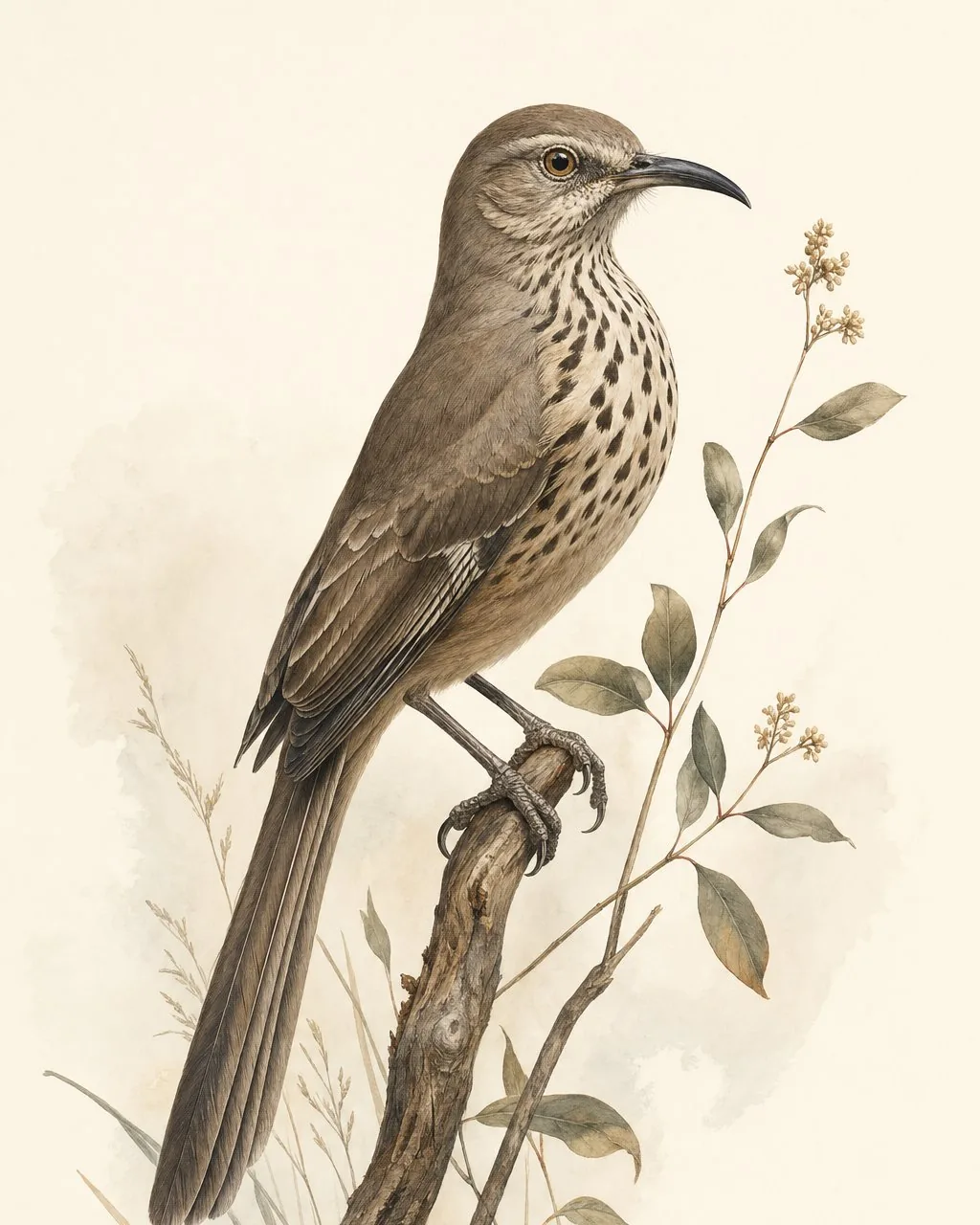
The largest thrasher in North America and one of the most distinctively shaped songbirds on the continent. The bill is the defining feature - long, strongly decurved, almost as long as the head, coming to a fine point. In profile the bird looks front-heavy, as if it is perpetually being pulled forward by its own bill.
The plumage is uncomplicated. The upperparts are plain warm brown, slightly darker on the wings and tail. The underparts are buffy, palest at the throat, darkening to cinnamon on the flanks and undertail. There is no bold pattern, no wing bar, no eye ring. A faint pale eyebrow is sometimes visible. The tail is long and often cocked. The eye is golden-yellow, which gives the bird a sharp expression.
On the ground the California Thrasher is a long-tailed, slightly hunched, purposeful bird. It rarely flies more than a short distance and when it does the flight is low and hurried, usually ending at the first available dense cover.
| Measurement | Range |
|---|---|
| Length | 29 - 33 cm |
| Weight | 72 - 100 g |
| Wingspan | 32 - 36 cm |
| Lifespan | 5 - 12 years |
“The species name redivivum means ‘restored’ or ‘revived’ in Latin - a name that may refer to the bird’s habit of skulking in the undergrowth and appearing suddenly, as if returned from hiding.”
Voice
A mimid and a fine one. The California Thrasher sings a long, rich, improvised sequence from a prominent perch - a fence post, a utility wire, the top of a ceanothus - with more persistence than most other members of its family. The song is slower than the Northern Mockingbird’s, less frantic, with more deliberate repetition of phrases before moving on. The quality is full and fluty.
It mimics other species but not as comprehensively as a mockingbird. Its own song has a character of its own - a rolling, organic quality that sounds like someone improvising on a familiar theme rather than running through a catalogue.
The call is a distinctive low chwirp or churp, lower-pitched and rougher than the calls of other California thrushes.
Singing peaks in January and February - one of the earliest singing birds in the chaparral community, often singing on cold mornings when little else has begun. A singing California Thrasher in January feels like proof that something is stirring in the plant world before any visual confirmation arrives.
Range and habitat
Entirely a California bird, with a small extension into Baja California. It does not occur outside the California Floristic Province - the mediterranean-climate shrubland region that runs from the Oregon border south through the Coast Ranges and into Baja.
Within that range it is a specialist of dense, low, dry shrubland: chaparral, coastal sage scrub, and the edges of oak woodland where shrubby understory is thick enough to provide cover at ground level. It does not use open grassland. It does not use dense forest. It needs the middle ground - impenetrable scrub you have to crawl through, where a large terrestrial bird can move quickly without being seen.
Diet
The bill shape tells the foraging story. The California Thrasher is a ground forager, and it uses that curved bill to sweep leaf litter aside in powerful side-to-side strokes, exposing insects, larvae, berries and seeds underneath. It also digs in soft soil and probes under bark. The diet shifts seasonally from invertebrates in wet months to berries and small fruits as summer dries out.
It is not a bird that visits feeders in the typical sense, though individuals with territories near suburban gardens will forage in leaf litter under shrubs and occasionally take mealworms.
Breeding
Nesting begins early - sometimes February, occasionally even January in mild coastal areas. The nest is a bulky cup of twigs and stems, lined with finer materials, placed in a dense shrub or cactus. Both parents build, incubate and feed young.
Two to three eggs per clutch, pale blue-green spotted with brown. Incubation is roughly two weeks. Two broods per season are common, occasionally three.
The pair bond is strong and long-lasting. California Thrashers appear to maintain territories year-round and may pair for multiple seasons. Territory defense is primarily by song rather than physical confrontation, and the early-season singing that marks January mornings in the chaparral is the bird staking its claim before competition intensifies.
California’s hidden bird
The California Thrasher appears on no one’s life list as an easy target. It is not rare, but it requires patience and the willingness to watch dense brush for extended periods. Birders who drive through chaparral looking for cooperating species often miss it entirely. Those who stop and sit quietly near a thicket on a February morning will eventually see one emerge, work a patch of bare soil, and vanish back into the manzanita as if it was never there.
The species has been affected by urban expansion in southern California, where chaparral conversion has reduced suitable habitat. The coastal sage scrub it also occupies has been listed among the most threatened habitat types in California. The thrasher itself is not under acute pressure, but it is embedded in a habitat community that is losing ground.
It is not a glamorous conservation story. No single crisis, no dramatic collapse, no particular public attention. Just a specialist bird in a shrinking habitat type, holding its ground for now, singing into the cold January air above the coastal hills.