Field Guide
Ruffed Grouse
You hear it before you see it, and often you never see it at all. A low, rhythmic thumping from somewhere in the maple understory - not mechanical, not a woodpecker, not footsteps. It begins slowly: thump. Thump. Thump. Then faster, the individual beats blurring into a rumble, a trembling acceleration that ends in a drum roll so rapid the air seems to vibrate. Then silence. A Ruffed Grouse, standing on a log you cannot see, beating the air with cupped wings.
This is one of the defining sounds of the northeastern North American forest, and yet most people who live in that forest have never tracked it down and found the bird that makes it.
What it looks like
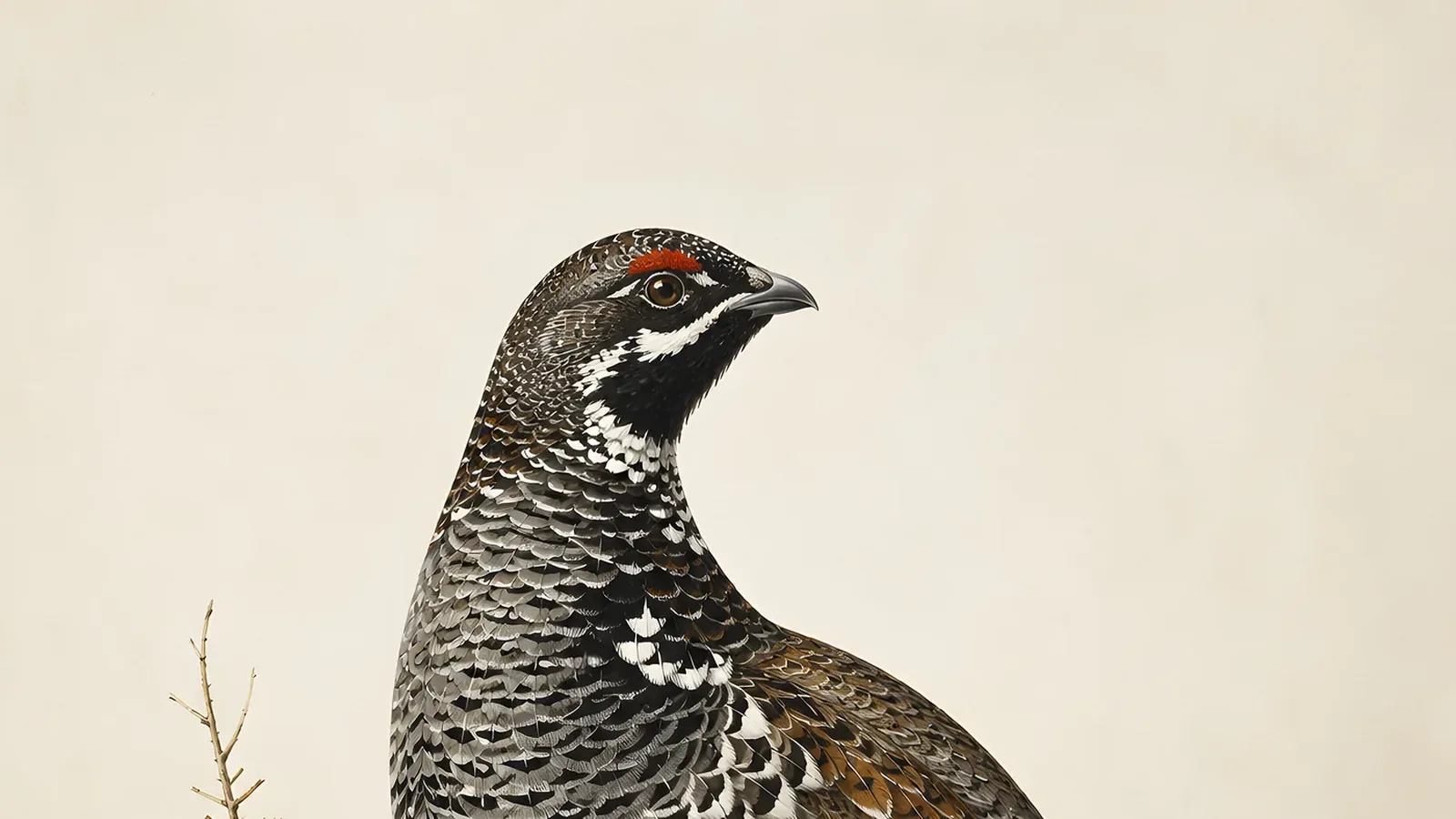
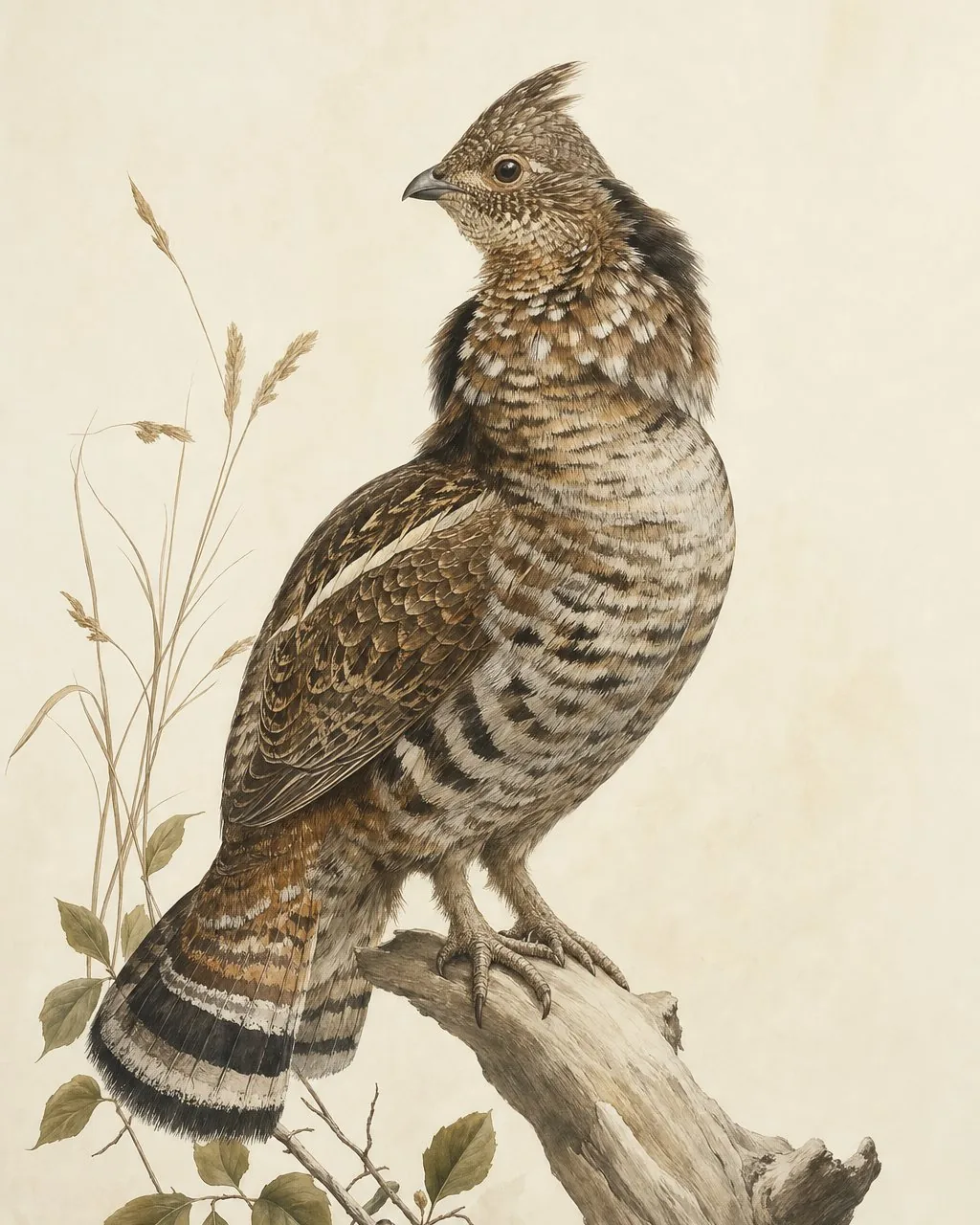
A plump, chicken-sized bird of the forest floor, cryptically patterned in brown, grey, rufous, and buff. The individual feathers are finely barred and edged - the overall effect is of dead leaves, bark, and duff assembled into a bird. Two color morphs exist: a brown morph and a grey morph, with the grey more common in the northern and western parts of the range and the brown more common in the South and East.
The tail is long and can be fanned in display: pale grey or brown with a single dark band near the tip. The ruff for which the species is named is a cluster of black feathers on either side of the neck, usually held flat, expanded dramatically in threat or display. The crest is short and often inconspicuous. The legs are feathered partway down.
In flight - usually burst from underfoot with an explosive wingbeat that is itself startling - the bird is compact and fast, weaving through the forest understory before dropping into cover again.
| Measurement | Range |
|---|---|
| Length | 40-50 cm |
| Weight | 450-750 g |
| Wingspan | 56-64 cm |
| Lifespan | 1-11 years |
Voice
The drumming is the primary display and the species’ most distinctive characteristic. It is not a vocalization. The male stands on a log, braces his tail against the wood, and beats the air with accelerating wingstrokes - the wings do not strike anything, they create a low-frequency pressure wave through rapid air displacement. The sound carries 100-400 metres through forest. It sounds, at close range, like a large engine starting.
Vocal calls include a low hiss, a soft whine, and a sharper alarm note. Females use a series of soft calls to communicate with chicks. The male’s drumming log is a fixed location, used repeatedly over years, and the accumulated droppings and bark scratching around a good log can identify it as a display site even when no bird is present.
“The drumming carries through the whole ridge. On a still April morning, I counted four birds from one position - overlapping drums from four different compass points. Each sounded a little different in tempo.” - field notes, Vermont
Range and habitat
Ruffed Grouse range across most of Canada and the northern United States, south through the Appalachians to Georgia and in the West through the Rockies. The core of the range is the mixed deciduous and deciduous-conifer forests of the Great Lakes states, New England, the Maritime provinces, Ontario, and Quebec.
Habitat is deciduous or mixed forest with a well-developed understory - young forest, forest edges, regenerating clearcuts, and stream-side thickets of alder are all good habitat. The bird needs three things: dense cover for nesting and escape, drumming logs for displaying males, and aspen where it is available, because aspen catkins and buds are among the most important winter foods.
In winter, Ruffed Grouse in the north develop comb-like projections on their toes - called pectinations - that function as snowshoes, and they will roost by diving into deep snow for insulation. A bird sleeping under a metre of snow is warmer than one sitting in a tree in -20°C air.
Diet
Varies dramatically by season. In summer: leaves, seeds, berries, insects, especially for growing chicks who need protein. In autumn: berries, seeds, acorns. In winter, in the northern parts of the range: almost exclusively the buds, catkins, and twigs of aspen, birch, and alder. This winter diet is low in nutrition and the birds must eat for long periods to get enough energy.
The reliance on aspen buds in winter means aspen availability is a key driver of Ruffed Grouse density across much of the range. Areas with abundant early-successional aspen support higher grouse densities than those without.
Breeding
Males begin drumming in March and continue through May, peaking in April. A male drums most intensively at dawn, on a log that may have been used by successive males for decades. He defends a territory of several hectares centered on his drumming log.
Females select males, visit their drumming territories, and then build and incubate their nests with no further male involvement. The nest is a shallow scrape at the base of a tree or stump, lined with leaves and feathers. Nine to fourteen eggs is typical - a large clutch for a bird of this size. Incubation takes about three weeks.
Chicks are precocial and leave the nest within hours of hatching, following the female and feeding themselves on insects from the start. They grow quickly and can fly short distances within two weeks. The female broods them at night under her wings for the first week or two.
Population cycles
The Ruffed Grouse is famous among wildlife biologists for its population cycles. In many parts of the range, particularly the boreal forest edge, grouse numbers peak and crash on an approximately ten-year cycle. These cycles align with similar cycles in Snowshoe Hare and are tied to the dynamics of the three-species predator-prey system: hare, grouse, and Northern Goshawk.
When hares are abundant, goshawk numbers build. When the hare cycle crashes - as it reliably does about every decade - the goshawks switch to grouse as an alternative prey base, intensifying predation pressure just as the grouse population may already be under stress from other factors. Grouse numbers crash. The goshawks then decline or disperse from lack of food. The cycle begins again.
The Ruffed Grouse’s role in this cycle - as a boom-and-crash prey species tied to a boom-and-crash landscape dynamic - is one of the best documented examples of multi-species population cycling in North American wildlife ecology. It makes the species not just a forest bird but a window into the way boreal and near-boreal ecosystems function.
The species also has a long history as the most popular upland game bird in North America, and the management of early-successional forest - particularly aspen - for grouse hunting has in many areas also benefited a wide suite of other wildlife species that use the same habitat structure.
Closing
April, before sunrise, in a maple forest with a foot of old snow still under the trees. The drum starts from the direction of the big log you found last fall. It runs through its full sequence - slow beats, then faster, then the blur at the end. Then nothing. Then again. The bird is standing 100 metres away, invisible in the understory, making a sound that carries to the ridge. You will not see him this morning. That is fine. The sound is enough.