State Guide
Red Birds in Missouri
Walk a Missouri oak-hickory ridge in late May and you can hear, within a few minutes of each other, three different red birds singing from three different heights in the same wood. A Northern Cardinal in the understory. A Summer Tanager in the mid-canopy. A Scarlet Tanager somewhere above both. Most of the continent has to choose one tanager or the other. Missouri gets both, and the line between them is drawn in geology, not accident.
That overlap is worth understanding. The two tanagers divide the state by latitude and tree preference in ways that make Missouri unusual on any range map. The Northern Cardinal - present everywhere, year-round - turns out to be more interesting once you know that his red is not fixed. It shifts seasonally, based on what he eats.
The year-round red bird
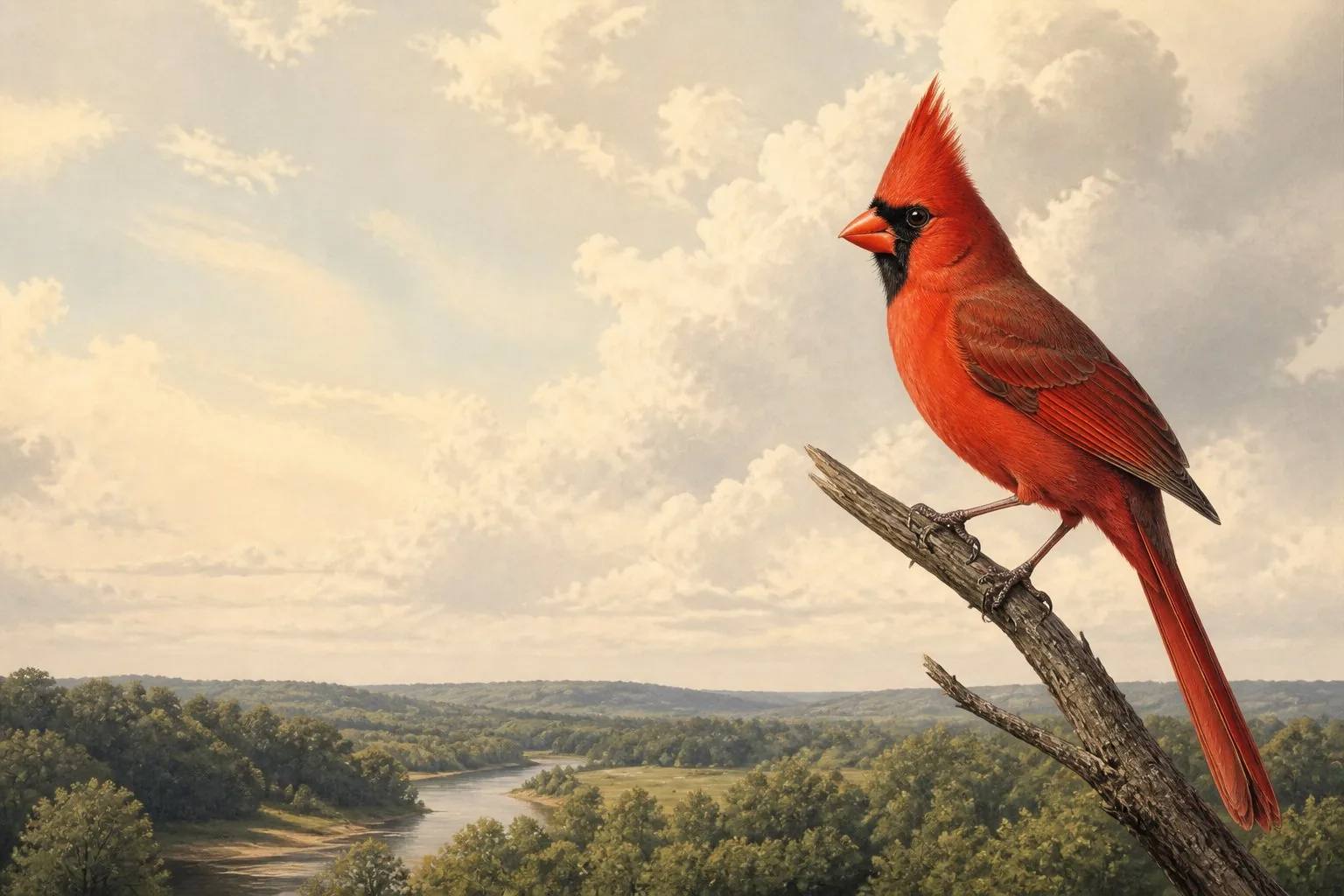
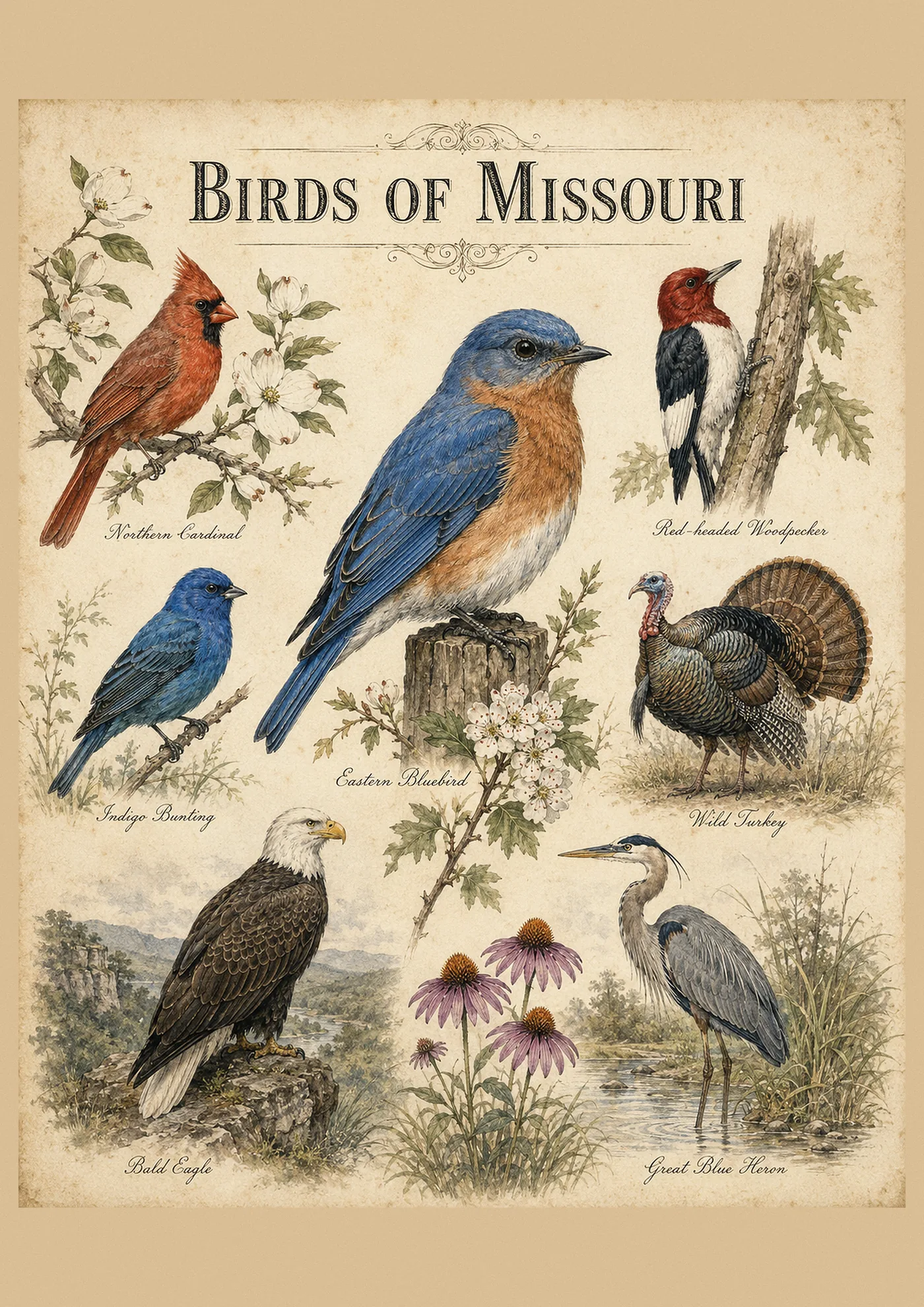
Cardinalis cardinalis needs no introduction in Missouri but benefits from one accurate fact. The male’s red plumage is carotenoid-based, which means it derives from his diet, not from pigments his body manufactures. He absorbs carotenoid compounds from seeds and fruit and routes them into feather barbs during his annual moult. According to Cornell Lab of Ornithology’s All About Birds, the species does not moult into a dull plumage after breeding - the red holds year-round - but its intensity still varies with diet and feather wear. A bird with access to native autumn fruit over winter goes into spring in better color than one feeding solely on feeder sunflower.
Audubon’s field guide records the cardinal at 8 to 9 inches in length, with a wingspan of 9 to 12 inches and a weight of 1.5 to 1.7 ounces - slightly larger than most people picture him. The female is brown with warm reddish tinges in the wings and crest, and a coral-pink bill identical to the male’s. Both sexes sing. Cornell Lab of Ornithology notes that the female sings from the nest to signal the male about feeding times, behavior that was underappreciated for decades because birdsong research focused historically on males.
Cardinals do not migrate. They hold loose winter territories centered on reliable food. In any Missouri yard with sunflower feeders and dense cover - a holly, a juniper, any tight-branched shrub - a mated pair will occupy the same patch through all four seasons. The nest is an open cup built by the female, placed 3 to 10 feet above ground. She incubates three to four eggs for 12 to 13 days. Two or three broods a year is standard.
A male Northern Cardinal’s color in February is partly the ledger of his autumn diet. The carotenoid pigments being routed into new feather barbs in August come from food - the brightest birds at the March feeder have been eating well since September.
For more on how the annual moult works, the cardinal molting piece covers what August’s bald-headed cardinal is actually doing and why it matters by spring.
The two tanagers
Piranga rubra, the Summer Tanager, is Missouri’s other all-red species. Adult males are entirely rose-red, deepening slightly on the wings and tail. The Missouri Department of Conservation classifies the species as a common summer resident in southern Missouri and uncommon further north, present from May through the first week of October. It inhabits pine-oak forests and bottomland deciduous woodlands, often near water. Mark Twain National Forest’s Current River corridor, where shortleaf pine and black oak grow on the dry Ozark plateau, is reliable Summer Tanager country. Audubon’s field guide records the species at 6.7 to 7.5 inches in length and up to 1.1 ounces in weight. It eats bees and wasps caught in flight, and will break into wasp nests for larvae.
Piranga olivacea, the Scarlet Tanager, is a different proposition. Males are scarlet with jet-black wings and tail - a contrast with no close rival in Missouri woodland. The Missouri Department of Conservation lists the Scarlet Tanager as a common transient and uncommon summer resident, arriving around mid-April and departing by mid-October. It breeds statewide in oak-hickory forest, particularly on upper slopes and ridges where the canopy is tallest and most closed. It measures 7 inches and produces one brood per year, with the female incubating three to five eggs for 12 to 14 days.
The practical split: if you are south of the Missouri River in June, in pine-oak country, and you see an all-red tanager, it is almost certainly a Summer Tanager. If you are on a north-facing hardwood ridge anywhere in the state in mid-May, singing high in the canopy, it is more likely a Scarlet Tanager. Both can appear in the same county during the peak migration window of mid-April to mid-May, which is when Missouri briefly becomes the most interesting state in the Midwest for anyone who cares about this family.
The winter finches
Two smaller red birds visit Missouri feeders and are worth separating. Haemorhous mexicanus, the House Finch, is year-round and common statewide. The male shows rosy red on the face, throat, and breast, with streaked brown flanks. His red, like the cardinal’s, is carotenoid-based and varies with diet - some males show orange or yellow instead of red when forage quality is poor. Audubon’s field guide records the species at 5 to 6 inches and under an ounce.
Haemorhous purpureus, the Purple Finch, visits Missouri in winter from breeding grounds in Canada and the northeastern United States. Audubon notes the species has declined in recent decades, in part due to competition from the expanding House Finch population. The male shows a more uniform raspberry wash across the head and breast, without the House Finch’s obvious dark flank streaking. The female Purple Finch is more cleanly patterned, with a bold white eyebrow stripe that female House Finches lack.
| Species | Red extent | Flanks | Season in Missouri |
|---|---|---|---|
| House Finch | Face, throat, breast | Streaked brown | Year-round |
| Purple Finch | Head and breast wash | Unstreaked | Winter only |
The timing
The Missouri Department of Conservation’s data on these species gives a usable seasonal frame. Summer and Scarlet Tanagers both arrive in April and leave by October. The Northern Cardinal is present every month, in every county. The Purple Finch arrives in autumn from the north and departs by spring. House Finches are at feeders year-round.
The overlap period - mid-April through mid-May - is the only window when all four red species are plausibly present in the same county. After that, the Scarlet Tanager moves into high summer canopy and becomes harder to spot than to hear. The Summer Tanager spreads from the Ozarks into southern bottomlands. The feeders revert to cardinals and finches.
If you are working through the Midwest’s red-bird geography, the comparison is instructive. The orange birds in Illinois and orange birds in Ohio posts show how the tanager balance shifts as forest composition changes east. Missouri sits at the hinge between Ozark pine country and the eastern hardwood belt - the point where both tanager ranges compress onto the same geological boundary.
The Scarlet Tanager’s wings are the detail that stays with you. The body is saturated scarlet. The wings are dead black, as if the color stopped at the shoulders. There is no gradation. It is, in full sun on a May morning, one of the sharpest contrasts in North American birds - and you have to walk into old-growth oak forest to see it. That is what makes the Ozark ridge in late May the right place to be.