Backyard
How to Attract Blackbirds to Your Yard
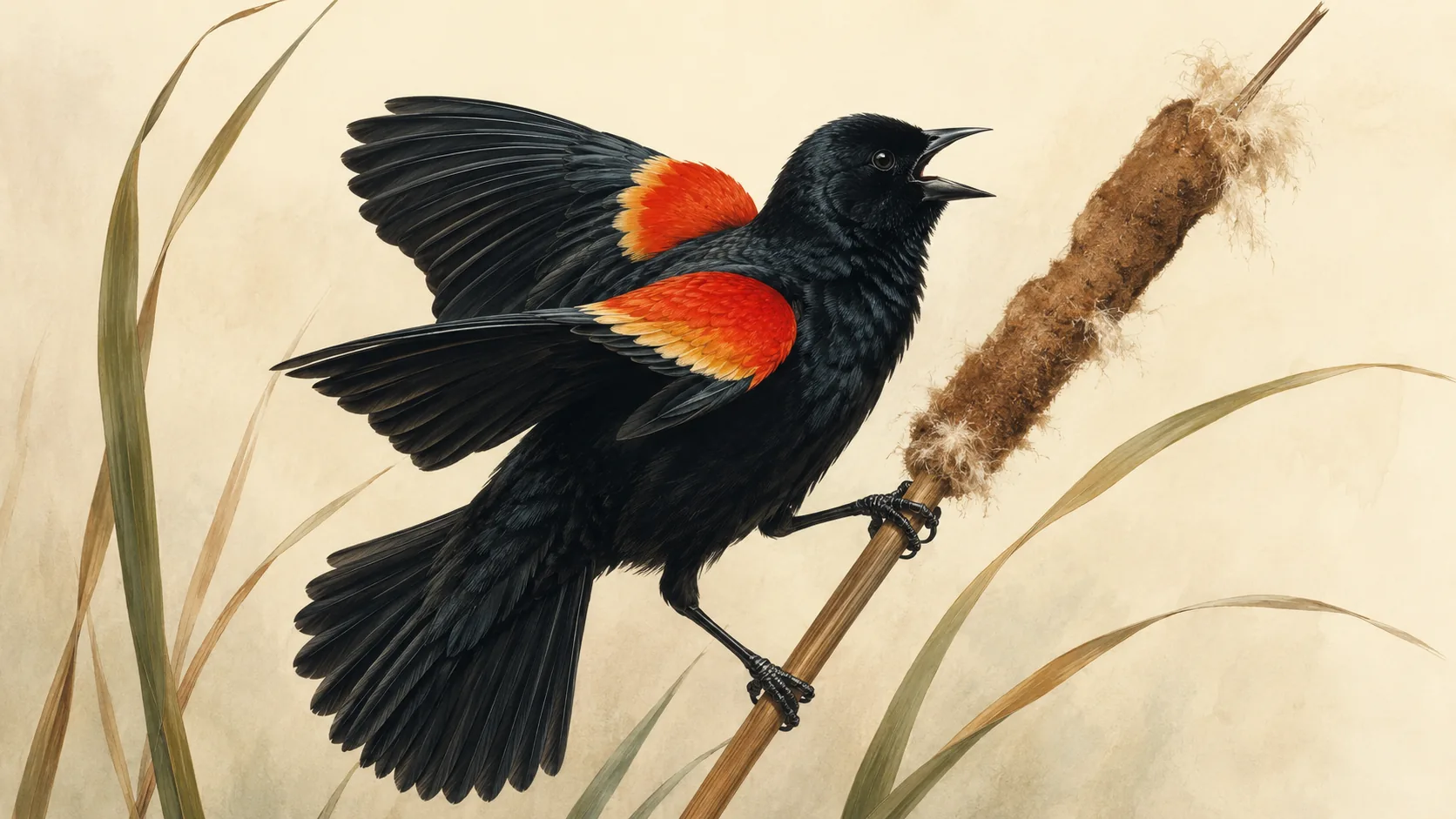
A male Red-winged Blackbird opens his wings on a cattail stem, fans those scarlet epaulets wide, and calls “conk-la-REE” across the marsh. If you have never stopped at a wetland edge to watch that display, you have missed one of the most dramatic shows in North American birdwatching.
These are not shy garden birds. Attracting them asks something different from you than a tube feeder full of sunflower seed.
Which blackbirds are we talking about?
North American “blackbirds” belong to the family Icteridae, a New World group that has nothing to do with the Eurasian Blackbird, which is a thrush (Turdus merula) and a completely different bird. If you landed here from Ireland or the UK expecting that familiar song-thrush relative, this is a different piece entirely.
The main Icterid blackbirds worth planning your yard for are three.
| Species | Range (breeding) | Key field mark |
|---|---|---|
| Red-winged Blackbird | Virtually all of the contiguous US, Canada, parts of Mexico | Scarlet and yellow epaulets on the male |
| Yellow-headed Blackbird | Western and central prairie wetlands only | Golden-yellow head and breast on the male |
| Common Grackle | East and central US, spreading west | Iridescent bronze-purple body, pale eye |
A note on geography. The Yellow-headed Blackbird breeds in western and prairie wetlands only. If you are in the eastern United States, it is not coming to your feeder, it simply does not breed there. The Red-winged Blackbird is one of the most abundant birds on the continent, with Partners in Flight estimating a global breeding population of around 180 million. The Common Grackle thrives almost anywhere humans have opened up the landscape: suburbs, city parks, fields, forest edges.
Why you might actually want them
The case for blackbirds is easy to make to the right reader. It is not about subtlety.
A male Red-winged Blackbird in full display spends more than a quarter of his daylight hours in active territory defense during the breeding season, according to the Cornell Lab of Ornithology. He hunches forward, fans his tail, and erects those epaulets to their full brilliance. The display repels rival males and signals fitness to females. Older males develop more intensely colored patches and hold better territories, quality advertising, honestly signaled.
There is a detail most field guides gloss over. Males only perform that full puffed display on their own territory. Off his turf, a male typically flattens the epaulets against his body, a documented suppression that reads as a kind of avoidance signal. The moment you see the full fan, you are watching a bird in his own kingdom.
In summer, both Red-winged Blackbirds and Common Grackles eat substantial quantities of insects. Grackles can draw roughly a quarter of their warm-season diet from insects and other small animals, per the Cornell Lab. They are doing real pest-control work in a weedy yard.
Food: what to put out and how
These are ground birds. That is the single most important thing to understand about feeding them.
Red-winged Blackbirds prefer to feed on the ground. In fall and winter they shift from insects to weedy seeds, native sunflowers, and waste grains, with cracked corn and wheat in particular. Grackles eat corn, sunflower seeds, acorns, and fruit, with the same preference for open ground over elevated perches.
The Cornell Lab of Ornithology and the National Audubon Society both identify cracked corn and white proso millet as the best offerings for these species. The setup that works:
- A low platform feeder or tray feeder, ideally at or near ground level
- Grain scattered directly on bare ground alongside the feeder
- Only as much as the birds can consume in a single day, since leftover grain sitting overnight attracts rodents
Tube feeders are the wrong tool here. They suit clinging birds: finches, nuthatches, chickadees. Blackbirds and grackles will make awkward, frustrated attempts at one and largely give up. If you want smaller songbirds on elevated tube feeders while blackbirds and grackles work the ground below, scattering grain on the ground achieves exactly that separation.
Habitat and water: the real attractor
Food will help, but the birds will not stay if the habitat does not suit them.
Red-winged Blackbirds breed wherever they find standing water and emergent vegetation: fresh or saltwater marshes, sedge meadows, wet roadsides, alfalfa fields, rice paddies. If your property borders a wetland, ditch, or pond, you are already most of the way there. If it does not, open water matters more than any feeder.
A shallow birdbath or ground-level basin with a slow dripper or mister draws blackbirds reliably. Place it in the open, not tucked under dense shrubs. These are birds of open marsh edges, not woodland interiors.
Tolerating weedy patches helps. Ragweed and cocklebur are exactly the kind of fall and winter seed sources the Cornell Lab lists for Red-winged Blackbirds. A managed weedy strip along a fence line or pond edge is better habitat than a manicured lawn.
For a deeper look at where to find marsh-edge species in the field, see where to see marsh birds.
The flock, and an honest note on tolerance
Blackbirds are flock birds outside the breeding season. In fall and winter, Red-winged Blackbirds form enormous mixed flocks with other blackbirds, starlings, and grackles, moving through agricultural land and weedy fields in their hundreds or thousands. If they find your ground feeder in that season, they may arrive all at once. The Yellow-headed Blackbird, restricted to western prairie wetlands for breeding, also gathers in huge flocks on open fields in winter. A male Yellow-headed in full display on a cattail is a strong argument for a wetland road trip if you are anywhere in the prairie states.
Common Grackles need little coaxing. They are loud, assertive, and iridescent in good light, shot through with bronze and purple that cheap binoculars miss entirely. And that loudness is the catch. A mixed flock of blackbirds and grackles is not quiet, and they do dominate feeders when they arrive in numbers, which is why most advice about feeding mixed species suggests deterring them.
This piece is for the reader who wants them anyway. If that is you, the strategy is simple: commit to ground feeding, offer the right grain, and situate the yard near open water. The birds will find you.
The way to attract North American blackbirds is not to mimic a woodland songbird setup, it is to make the edges of your yard look a little more like a marsh.
Population trends are worth knowing. The North American Breeding Bird Survey documents a cumulative decline of roughly 28% in Red-winged Blackbird numbers between 1966 and 2019, about 0.72% per year, even though the species remains one of the continent’s most abundant at around 180 million birds. Its Continental Concern Score sits at 8 out of 20, indicating low but real conservation concern. Welcoming them matters.