Free shipping to the US, Canada & Europe
Identification
Sunbirds, honeyeaters, and sphinx moths fill the hummingbird niche on every continent - but only one group can truly hover. Here is how to tell them apart.
March 29, 2023 4 min read
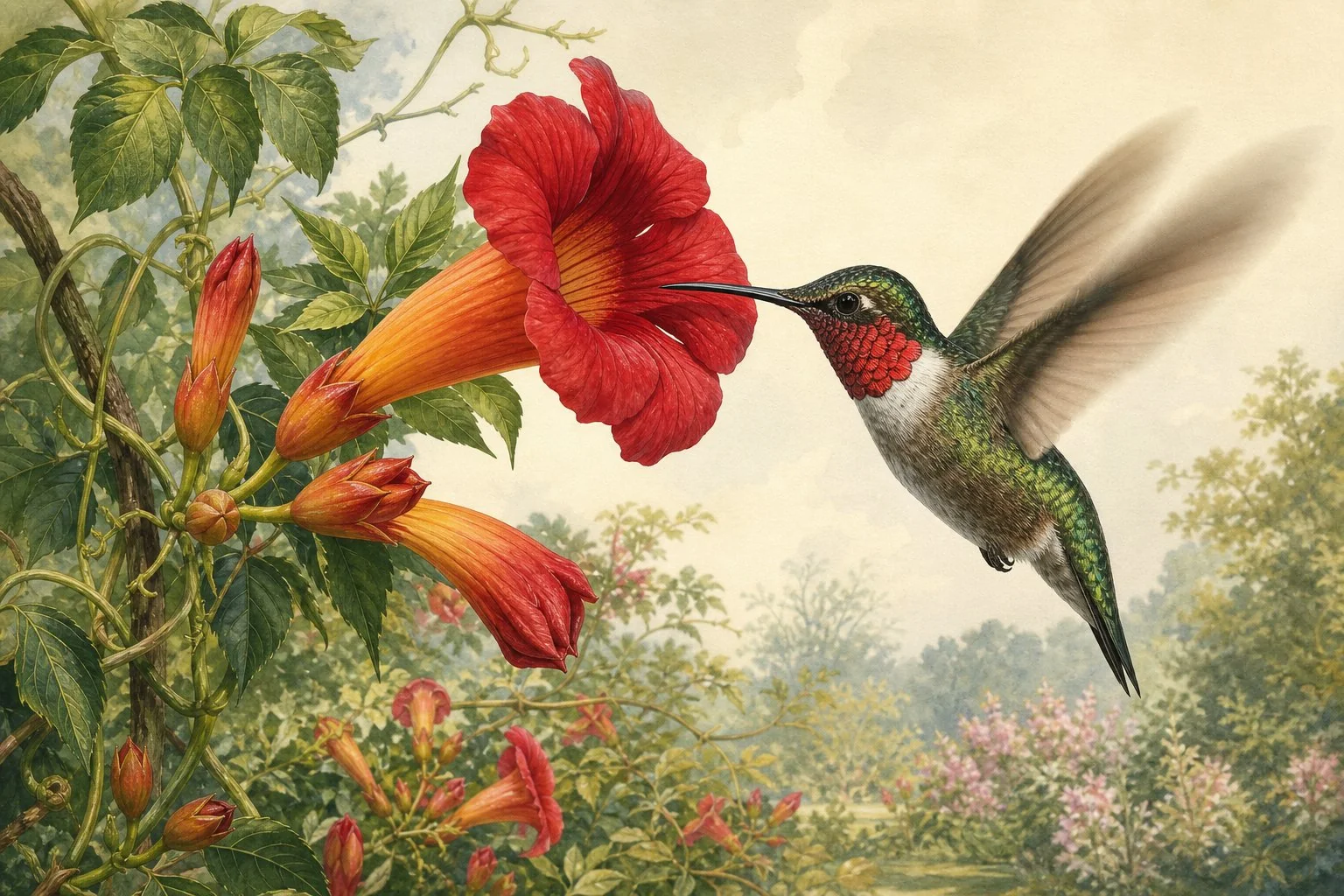
Stand at an eastern garden in late June and watch a creature the size of your thumb hover at a bee balm flower for thirty seconds, then vanish. The rational assumption is: hummingbird. The correct identification, in many cases across the eastern United States, is a Hummingbird Clearwing moth (Hemaris thysbe) - an insect so convincing that it is one of the most frequently reported hummingbird-confusion cases among North American naturalists.
That confusion is the easy case. The harder version plays out across Africa, Asia, and Australia, where entire families of birds fill the hummingbird niche, arrive in the same jewel colours, visit the same flowers, and are separated from the real thing by a single structural feature that is invisible at distance.
The one reliable field mark is hover time. A hummingbird holds a full hover at a flower for 20 or 30 seconds. Every lookalike - sunbird, honeyeater, flowerpecker, sphinx moth - either perches to feed or has no feathers at all. If it landed on the stem, it is not a hummingbird.
The Hummingbird Clearwing (Hemaris thysbe) ranges from Alaska to Oregon in the west and Newfoundland to Florida in the east, concentrating in the same gardens that attract Ruby-throated Hummingbirds (Archilochus colubris). Its wingspan reaches 4 to 5.5 centimetres - smaller than the hummingbird’s 8 to 11 centimetre span, but close enough that distance collapses the difference. The body is olive-green on the thorax and burgundy below. The wings start scaled and go clear as scales fall away during early flights, leaving transparent panels edged in reddish-brown. Unlike most sphinx moths, this one feeds in full daylight.
The tell, in good light, is the antennae and the legs. A clearwing moth has visible club-tipped antennae and pale yellow legs. A hummingbird has none. A hummingbird also fans and pumps its tail during direction changes; the moth holds a flat, tapered abdomen and steers with its whole body.
For silhouette confusions at dusk, see birds that look like bats.
A 2025 biogeographic comparison of the two families (Halloway et al., published in PLoS One and indexed on PubMed Central) found that hummingbirds extend far beyond sunbird ranges precisely because of structural differences: hummingbirds have enlarged breast muscles and a shoulder joint that enables sustained hovering, while sunbirds must perch to feed. The feeding mechanism differs just as sharply - sunbirds use intralingual suction rather than the hummingbird’s tongue micropump, as a separate 2026 study in Current Biology confirmed. These differences run through all roughly 150 species in Nectariniidae.
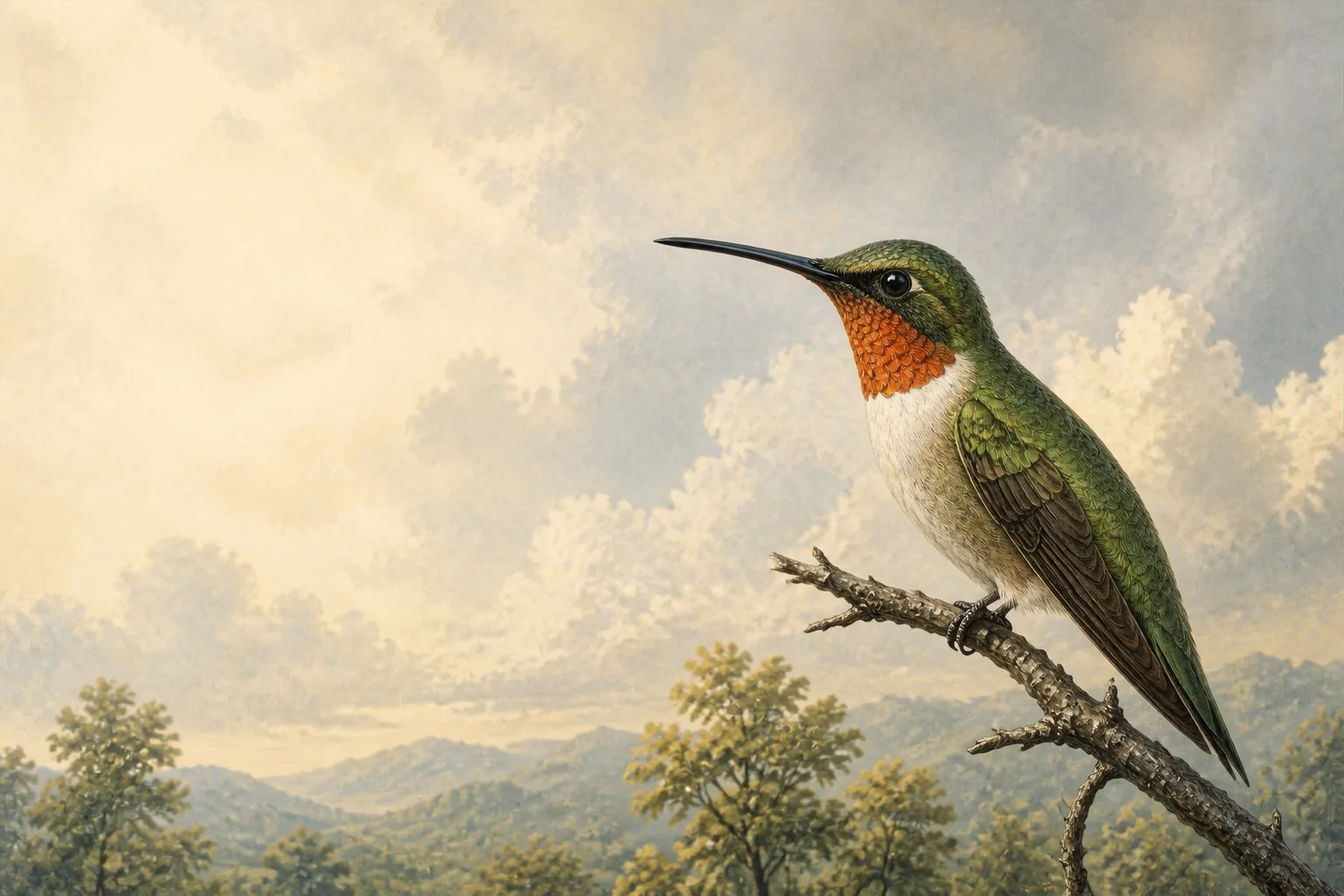
The males look like the brief. The Purple Sunbird (Cinnyris asiaticus) of South Asia reaches around 10 centimetres - nearly identical in length to a Ruby-throated Hummingbird - and carries the same metallic plumage that shifts colour under changing light. In non-breeding season the male turns dull olive with a single purple breast streak, which creates a different identification puzzle: the same bird in two seasons, neither one obviously named. The bill curves downward, an easy mark. Hummingbird bills run straight or nearly so.
The Olive-backed Sunbird (Cinnyris jugularis) of Southeast Asia and northern Australia has a metallic blue-black throat and attends the same tubular flowers a hummingbird would choose. Confusions are common in Thailand and the Philippines among birders trained on hummingbirds.
Australia has no hummingbirds. Its nectar specialist guild is filled by honeyeaters (Meliphagidae), a family unrelated to both hummingbirds and sunbirds. Most run olive and streaked, which distinguishes them easily enough. The exception is the Scarlet Honeyeater (Myzomela sanguinolenta): 10-11 centimetres, males bright scarlet and black, and capable of brief hovering. Its small size and vivid scarlet plumage make it the honeyeater most likely to prompt a hummingbird question from international visitors to eastern Australia.
Inside North America, the question is usually which hummingbird. West of the Rockies, Allen’s Hummingbird (Selasphorus sasin) and Rufous Hummingbird (Selasphorus rufus) are the persistent pair. Audubon’s field guide lists Allen’s at 3.3 to 3.5 inches with a bronze-green back, breeding along the California coast. Rufous is copper-backed, but some males show green backs - making colour alone unreliable. The diagnostic mark is the outer tail feather: narrow in Allen’s, wide in Rufous.
Ruby-crowned Kinglets (Regulus calendula) produce a different kind of double-take. At 8 to 11 centimetres they hover briefly at branch tips to glean insects. The hover lasts half a second. It catches the eye the same way, which is about all it has in common.
For other small-bird edge cases, see birds that look like chickadees and birds that look like blue jays. For colour-based lookalike problems, birds that look like bluebirds covers similar territory.
Hummingbirds rotate the wing at the shoulder joint in a figure-8 sweep that generates lift on both the forward and backward stroke. Halloway et al. (2025, PLoS One) confirmed this is exactly what sunbirds lack: their musculoskeletal architecture cannot replicate the hummingbird shoulder joint, so they use intralingual suction from a perch instead of hovering. Honeyeaters have not replicated it either. The kinglet’s half-second hover is a gleaning reflex, not the same thing.
The hover evolved once, in the Americas, and the organisms that keep arriving at hummingbird flowers on every other continent keep having to sit down.
As an Amazon Associate we earn from qualifying purchases. Linked products are ones we genuinely recommend.
 IdentificationBirds That Look Like Egrets
 IdentificationBirds that look like flamingos (most are not flamingos)
 IdentificationBirds that look like goldfinches (the bill rule)
 IdentificationBirds that look like hawks (a rule that ends the confusion)
 IdentificationBirds that look like herons (the neck rule)
 IdentificationPyrrhuloxia vs Northern Cardinal: How to Tell Them Apart
 March 29, 2023
 4 min read