Symbolism
Crow and Raven Are Not the Same Bird, and the Symbolism Is Not Interchangeable
The Tower of London’s famous raven tradition has no documented source before 1895.
The historian Geoff Parnell spent years searching records going back a millennium. He found an RSPCA journal article from 1895 and an illustration from 1883. The story attributing the tradition to Charles II - that he decreed ravens must stay or Britain would fall - has no documentary support from that era at all. Folklorist Boria Sax reached the same conclusion. The prophecy is Victorian-era invented folklore, dressed up as medieval legend.
This matters for corvid symbolism because that Tower tradition is cited constantly as evidence that ravens have been mystically significant to the British for centuries. They have been - but the Tower story is not that evidence.
Start there. Almost everything written about crows and ravens online is built on similar shakiness: confident claims, undocumented tradition, and a core confusion between two birds that are not the same animal.
They Are Not the Same Animal
The identification problem is worth solving before anything else, because it determines which symbolism belongs to which bird.
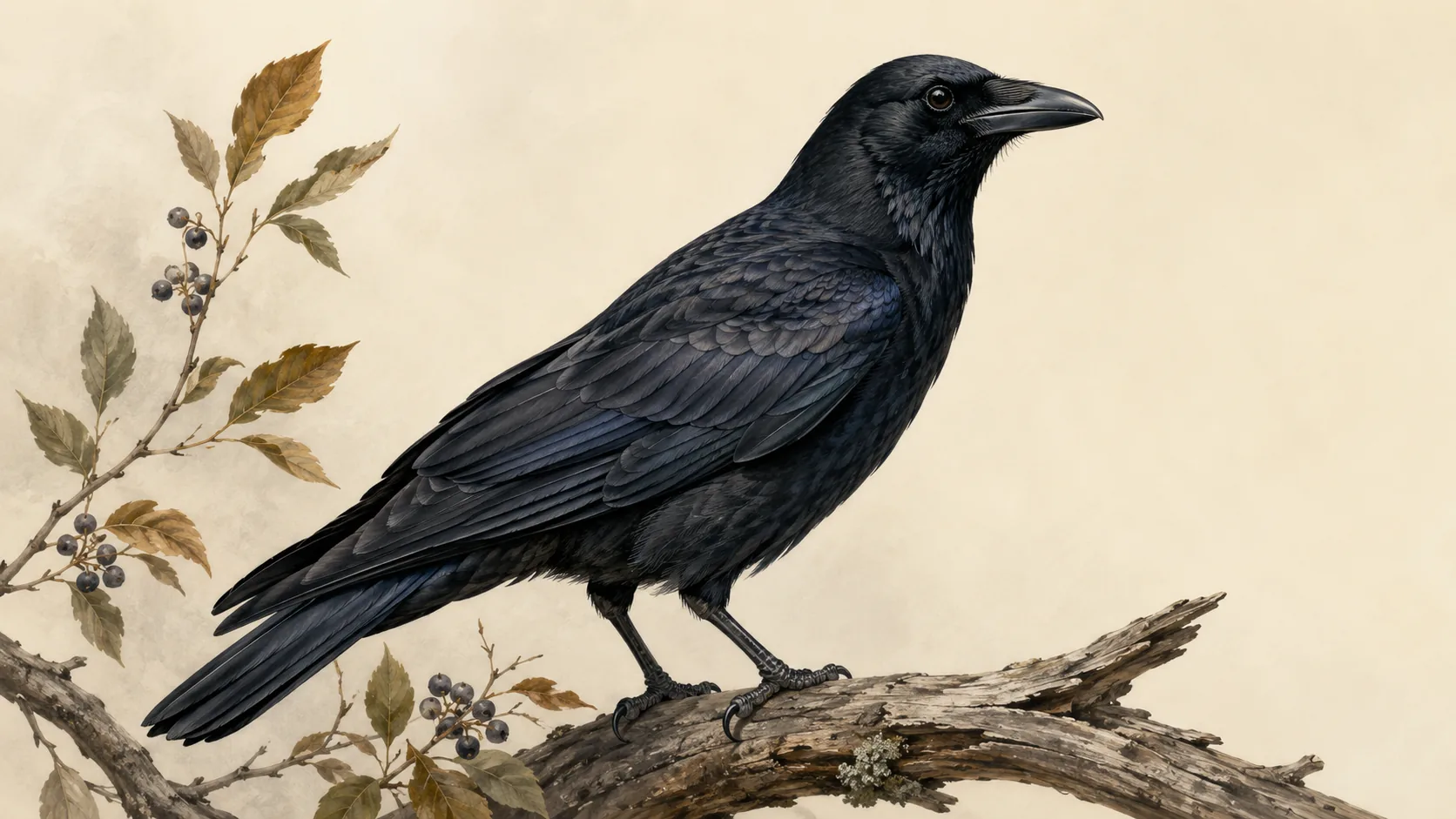
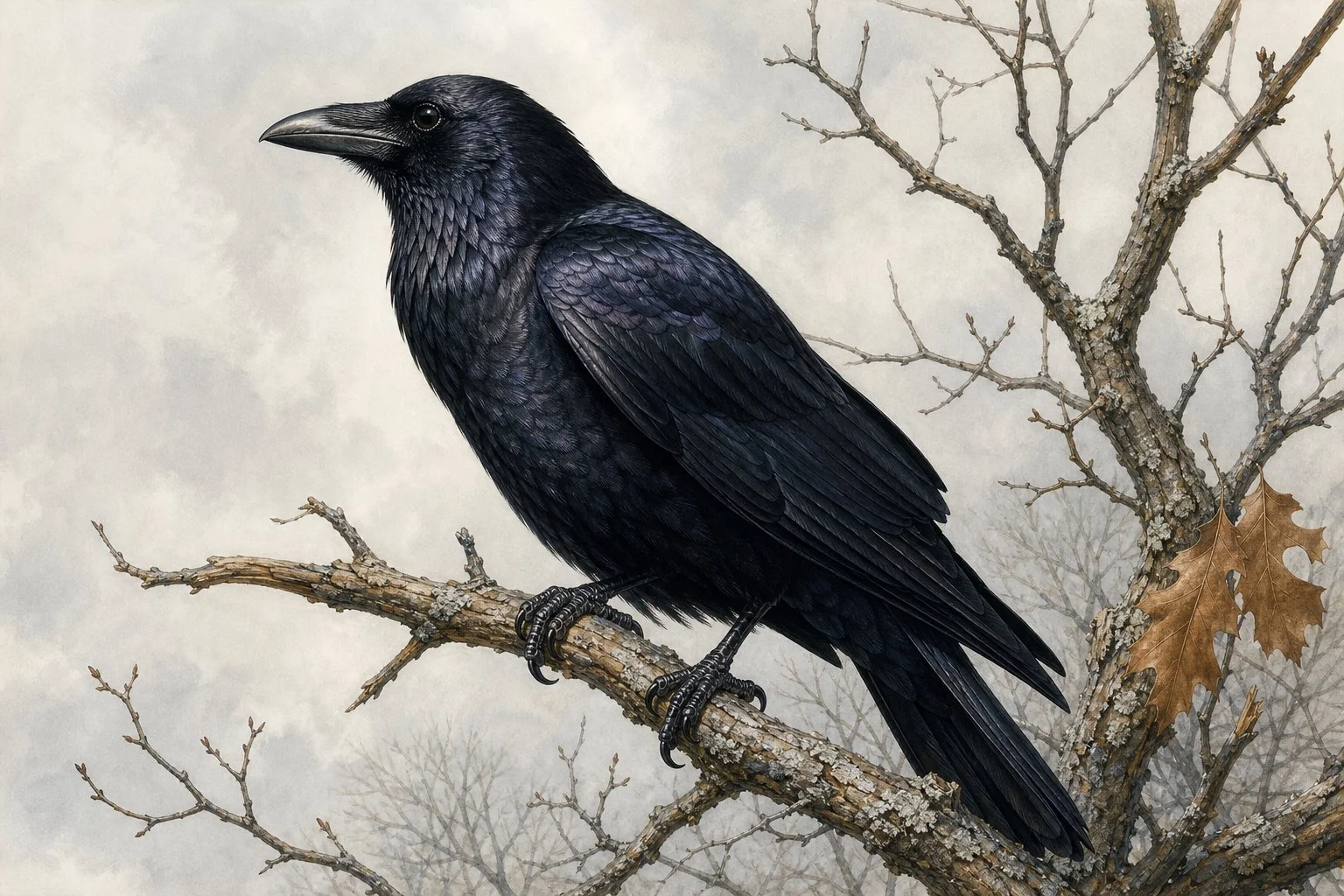
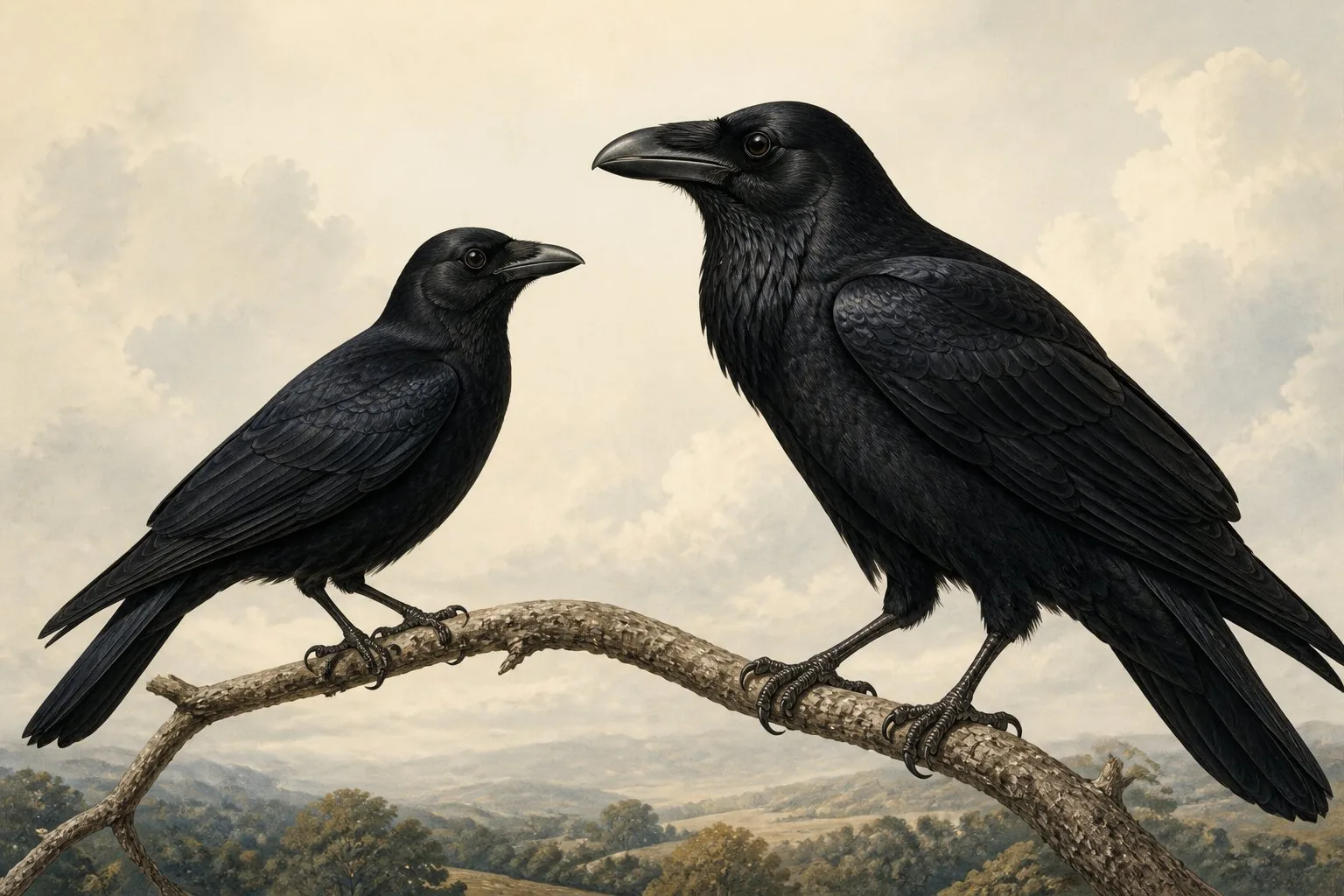
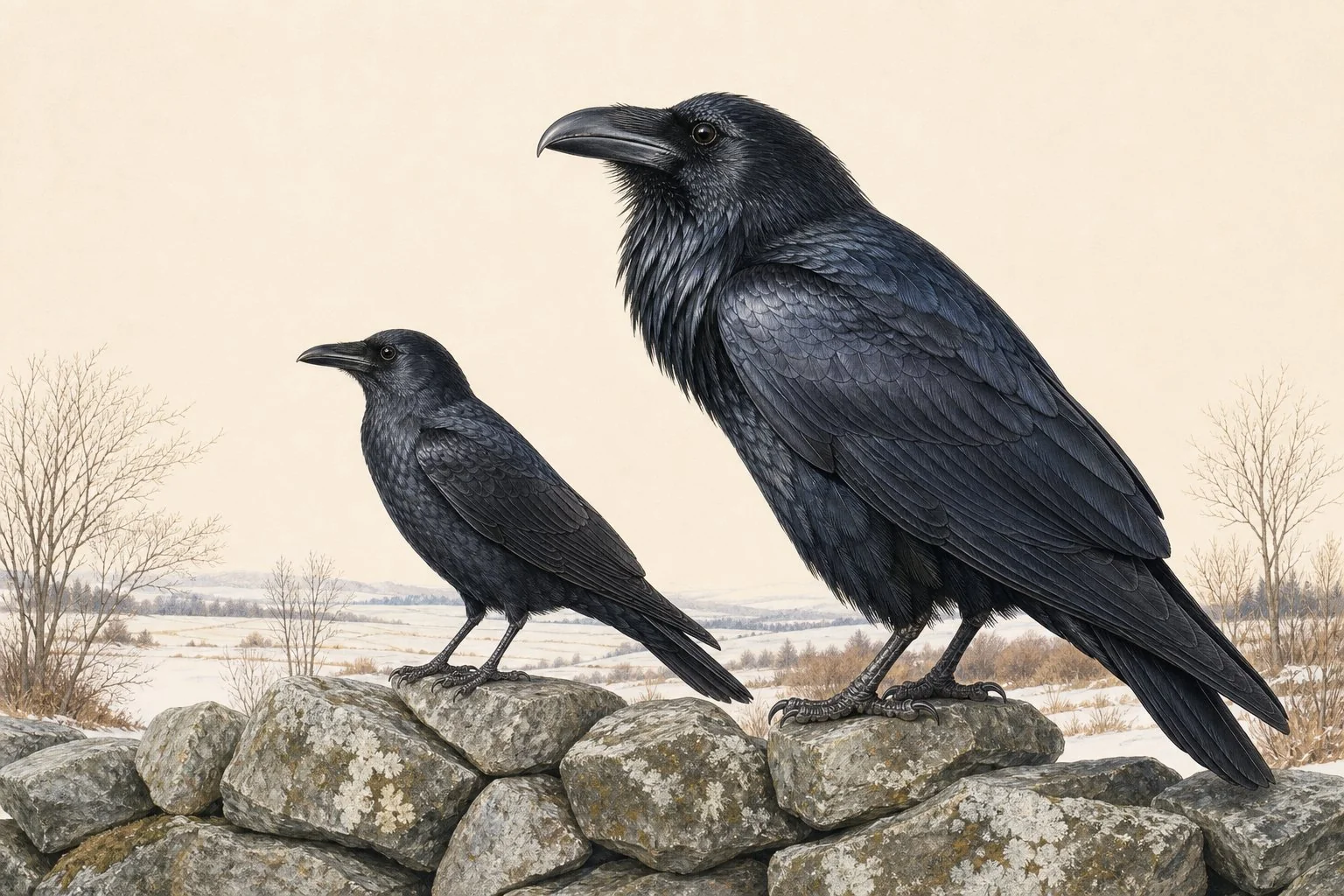
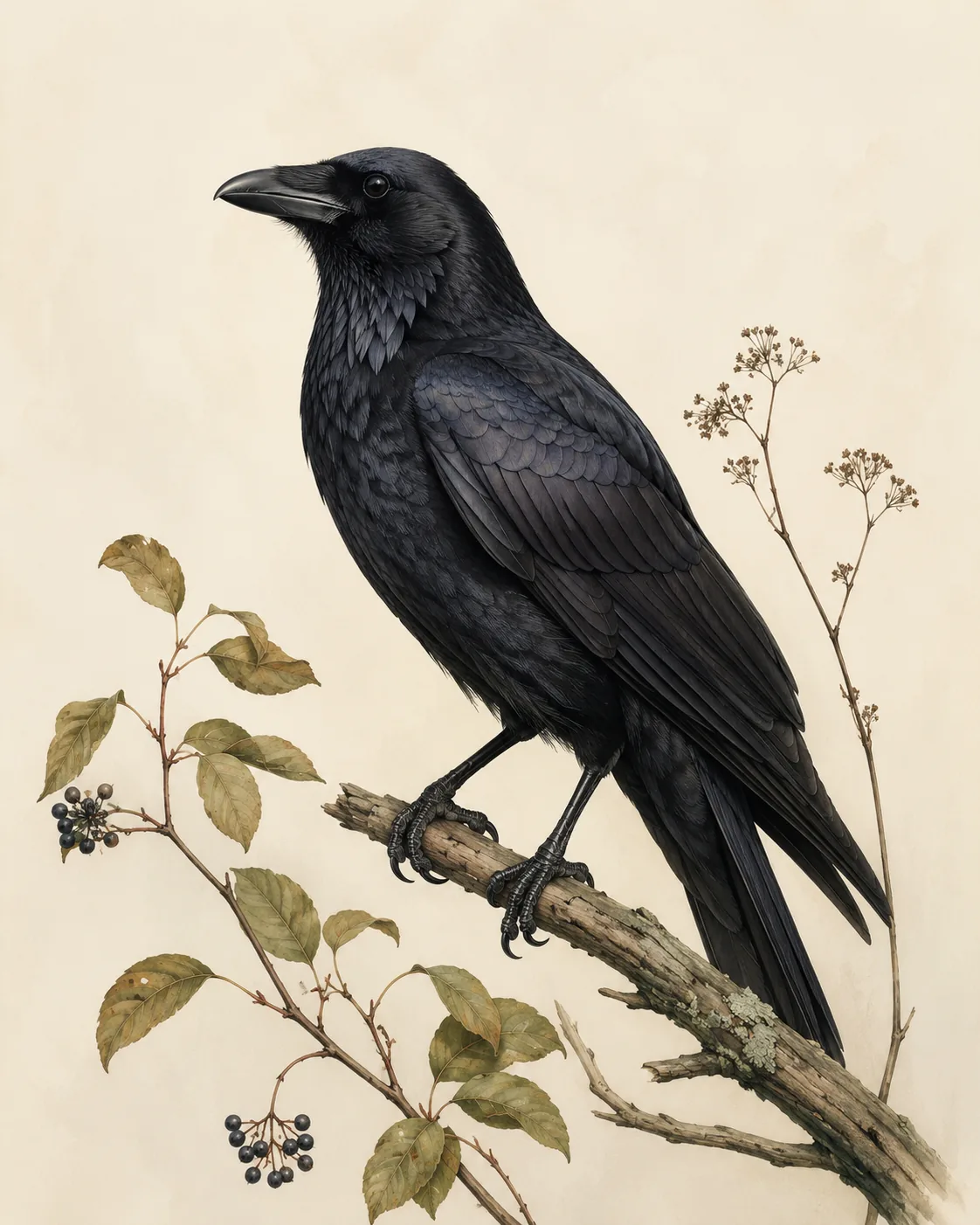
A common raven (Corvus corax) is hawk-sized. Body length up to 67 cm, wingspan up to 150 cm, weight up to 1,600 grams. An American crow (Corvus brachyrhynchos) is pigeon-to-small-hawk-sized. Body length up to 53 cm, wingspan up to 100 cm. Ravens are roughly two to three times heavier than crows.
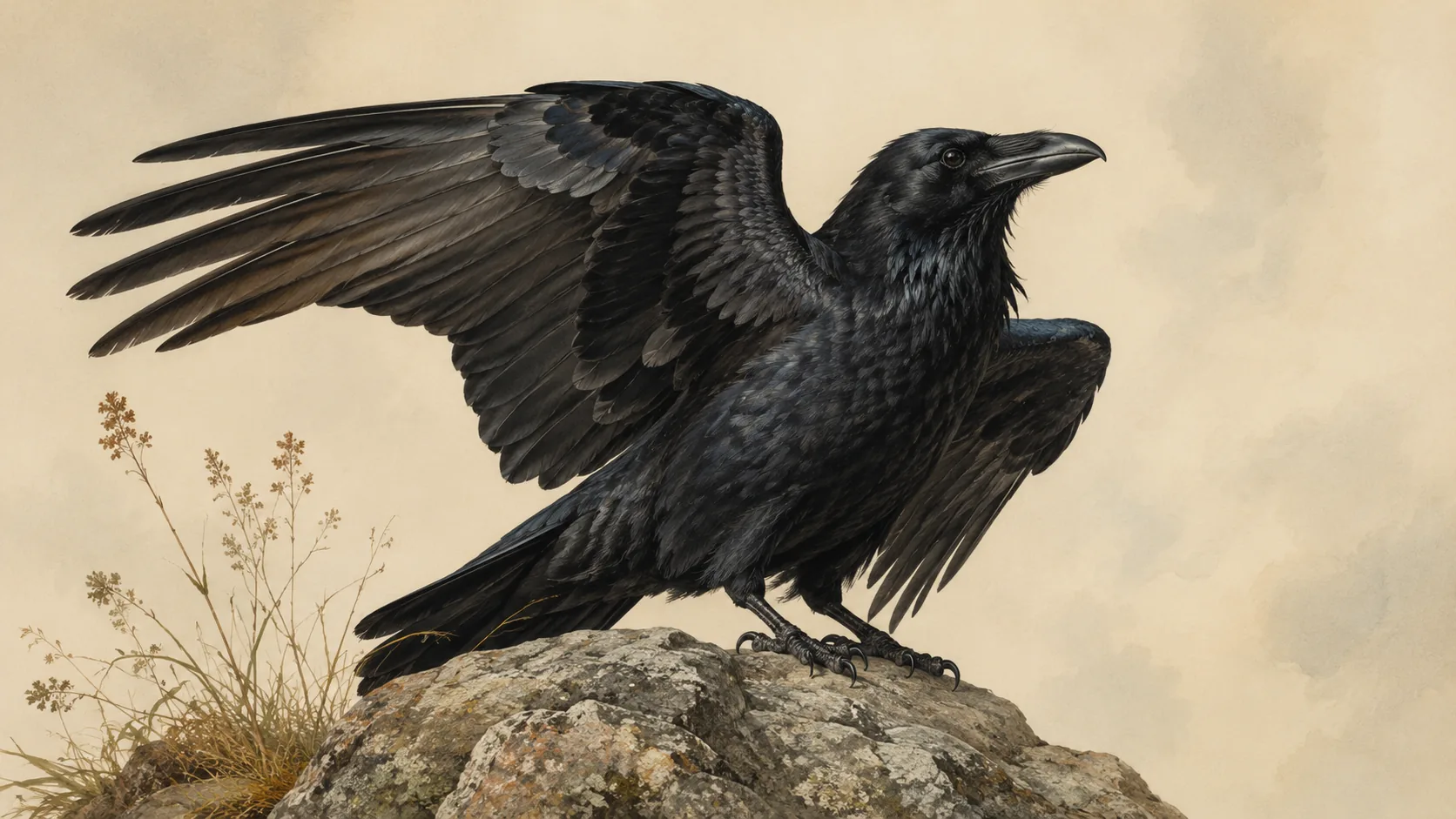
In flight, the raven’s tail fans into a wedge or diamond shape - the central feathers extend further and come to a point. The crow’s tail is rounded or slightly squared. This is the most reliable single field mark at distance. Ravens also soar and glide like hawks, using slow deep wingbeats between long effortless glides. Crows use rapid, businesslike wingbeats and almost never soar.
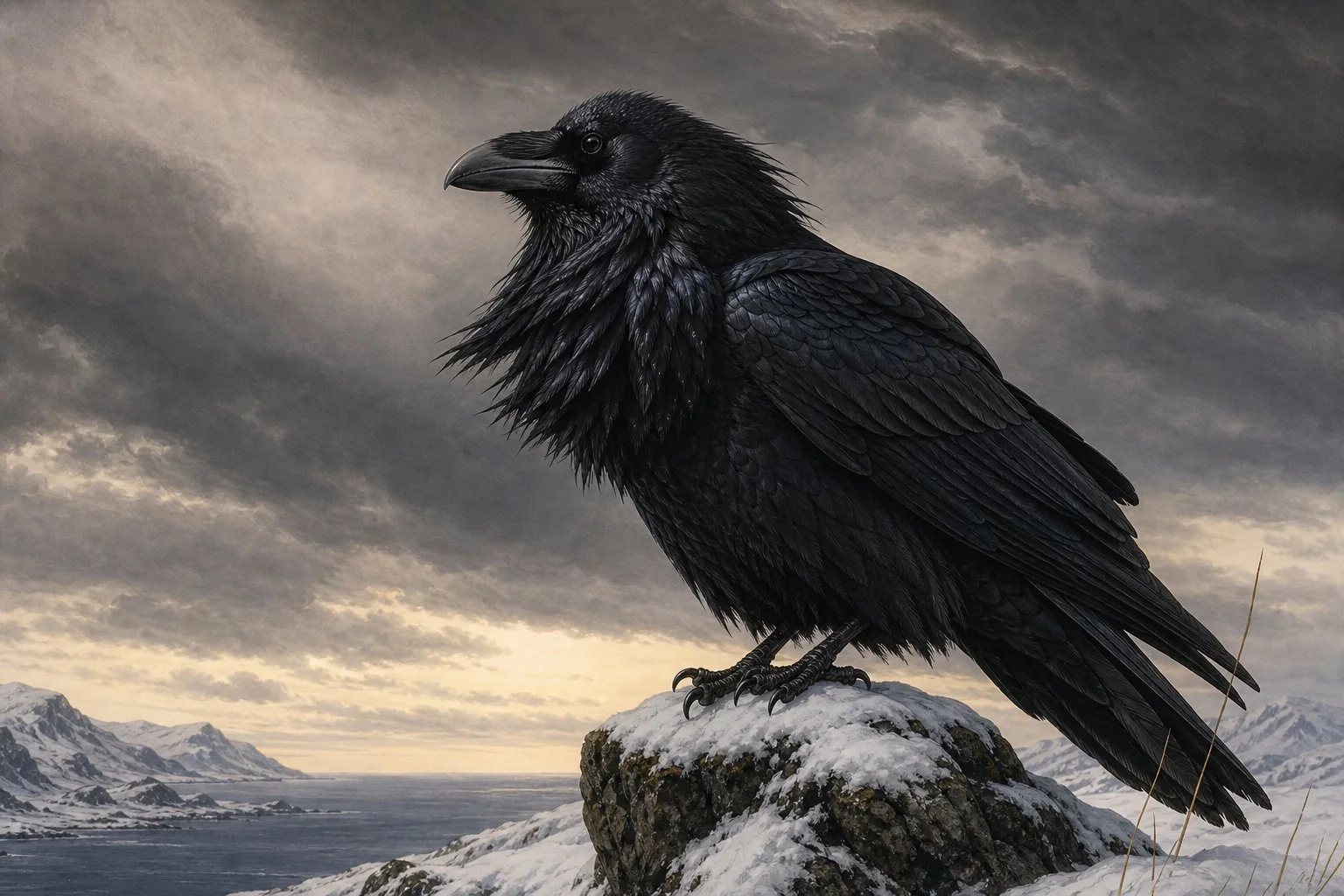
The raven’s bill is dramatically larger and curves at the tip. It carries shaggy throat hackles - elongated pointed feathers that ruffle visibly when the bird calls. The crow’s throat is smooth and the bill is slimmer and straighter.
Voice: the raven’s call is a deep hollow cronk or tok, resonant and bell-like. The crow’s call is the sharp familiar caw. Both can produce dozens of other sounds, but the default calls are unmistakable once you have heard them.
In cities, a large dark corvid is almost certainly an American crow. In wilderness and mountains, the large soaring corvid is almost certainly a common raven. This ecological difference - crow as urban adapter, raven as wilderness animal - shapes their separate symbolic histories more than any other factor.
Why the Languages Got Confused
The confusion is not modern carelessness. It goes back to the earliest written sources.
Latin had corvus (raven) and cornix (crow), but Roman writers applied corvus loosely. Greek had korax (raven) and korone (crow), but ancient authors used them inconsistently across versions of the same myths. The constellation Corvus - named with the Latin word for raven - is now called “the Crow” by astronomers. Ancient peoples did not maintain clean species-level distinctions either.
Old English had three words: hraefn (raven), crawe (crow), hroc (rook). Scholarship on Anglo-Saxon texts finds that ravens, rooks, and crows “were not distinguished on visual grounds” in surviving prose. The primary distinction was sound. The names themselves are onomatopoeic: hraefn echoes the cronk, crawe echoes the caw. Crows appear “not at all” in Old English prose outside glossaries and place-names.
Proto-Celtic had a single root word, branos, covering the whole genus without species distinction. Modern Welsh has bran (crow) and gigfran (raven), but the mythological figure Bran the Blessed carries a name that simply means large crow or raven - the ambiguity is baked in from the start.
Formal separation of the species dates to Linnaeus’s Systema Naturae in 1758. Before that, folk terminology dominated and was almost universally imprecise. When 19th and 20th century folklorists translated older texts into English, they consistently chose “raven” for impressive, mythologically significant birds and “crow” for incidental ones, regardless of what the original language actually specified. That translation habit is where much of the modern confusion was fixed in place.
Odin’s Birds Are Ravens. Specifically Ravens.
The Old Norse texts do not leave this ambiguous.
The Poetic Edda, in Grimnismal - attributed to 9th-10th century oral tradition and compiled in 13th century Iceland - uses hrafnar. The Prose Edda, written by Snorri Sturluson around 1220, uses hrafnar in Gylfaginning chapter 38. The word hrafn means raven. It is not a generic word for dark bird. Old Norse had a separate word for crow.
Huginn and Muninn - Thought and Memory - are ravens. They fly across the world each day and return to Odin’s shoulders at breakfast to report what they have seen. Their function as extensions of Odin’s cognition across space is the point. They are not pets. They are detached faculties of a god, given physical form and the ability to travel.
Odin’s title Hrafnagudr means Raven-God. The raven banner carried by Viking armies - documented in the Orkneyinga Saga and the Annals of St Neots for the Battle of Ashdown in 871 - uses the same word.
Websites that describe Odin’s birds as crows, or use Huginn and Muninn as evidence that crows are sacred in Norse tradition, have made a basic factual error. The error is common. It is still an error.
The Morrigan Is Not a Raven Goddess. Probably.
This one is genuinely contested, and the popular reading is almost certainly an oversimplification.
The Irish goddess Badb - one aspect of the triple figure called the Morrigan - has a name that etymologically means crow in Old Irish. Badb Catha means battle crow. Scholarly analysis identifies her specifically with the hooded crow (Corvus cornix), which is common in Ireland and which historically attended battlefields to feed on the dead. That is a specific ecological relationship, not a vague association with darkness.
The Old Irish word for raven is fiach. Modern Irish is an fiach dubh, the black raven. The texts do not use it consistently for the Morrigan’s corvid form.
In The Cattle Raid of Regamain, the figure does transform into a raven. But that is one text. The primary documentation - the name Badb, the epithet Badb Catha, the consistent battlefield crow function - points to crow.
The modern internet consensus that the Morrigan is definitively a raven goddess comes mainly from English-language neopagan writing from the 1970s and 1980s onward. The translation preference for “raven” when a dramatic bird appears in Celtic myth - and the higher cultural status of ravens in English literary tradition - did the rest. The scholarly debate is real and has not been resolved. The crow reading is more defensible from the primary Irish texts.
Pacific Northwest Raven Traditions: Specific Nations
The Pacific Northwest raven traditions are unambiguously about ravens. They are also specific to specific nations and should not be blended together.
Among the Tlingit of Southeast Alaska and British Columbia, Raven - Yéil in Tlingit - is both a primary clan crest and one of two fundamental moieties around which Tlingit society is organised. Yéil is the creator who brought light to the world by stealing the sun from a chief who hoarded it in a box. Tlingit oral literature distinguishes between two raven figures - creator raven and trickster raven - who are not always the same individual.
Among the Haida of Haida Gwaii and Southeast Alaska, the raven (x̱uuya in Haida) is the creator-trickster central to Haida cosmology. Bill Reid’s 1980 sculpture The Raven and the First Men at the Museum of Anthropology in Vancouver depicts a Haida story in which Raven discovers the first humans inside a clamshell on a beach and coaxes them out. Reid called it one of the world’s great creationist myths.
Among the Tsimshian of Northwest British Columbia and the Tahltan of Northern British Columbia, raven appears as mediator between human and spirit worlds and as culture hero.
These are raven traditions, and they belong to specific nations with specific oral traditions. They are not generic “Native American” crow symbolism.
The Apsaroke - the Crow Nation of the Great Plains - are a separate tradition entirely. Their name means children of the large-beaked bird and refers to the American crow. Plains crow symbolism is not the same as Pacific Northwest raven symbolism. Conflating them is like conflating Norse and Celtic mythology because both involve dark birds.
What Poe Actually Chose, and Why
Edgar Allan Poe published “The Raven” on January 29, 1845, in the New York Evening Mirror. In “The Philosophy of Composition” (Graham’s Magazine, April 1846), he explained the choice directly: he had originally considered a parrot as the talking bird, but switched to a raven as “equally capable of speech, and infinitely more in keeping with the intended tone.”
The immediate inspiration was Charles Dickens. Dickens kept a pet raven named Grip. Two ravens, actually, sequentially - both named Grip. Grip inspired the character of Grip the Raven in Barnaby Rudge (1841), where the talking raven serves as comic counterpoint to the intellectually disabled title character.
Poe reviewed Barnaby Rudge in 1841 and called Grip “intensely amusing.” In March 1842, Dickens visited Philadelphia. Poe and Dickens met in person. They corresponded afterwards. The poet James Russell Lowell noted in 1848: “There comes Poe with his raven, like Barnaby Rudge.” The connection was obvious to contemporaries.
When Grip died, Dickens wrote a famous comic letter eulogising him - noting that Grip’s last coherent utterance was “Halloa, old girl!” learned from a workman. Grip the raven is now taxidermied and on permanent display at the Free Library of Philadelphia. He is a Common Raven, not a crow.
Poe chose the raven specifically for its size, its deep black plumage, its established death-and-prophecy associations across multiple traditions, and its known capacity for speech in a deep hollow voice that a crow could not replicate with the same gothic effect. The choice was deliberate and documented.
And here is the irony: Poe’s poem probably contributed to the Victorian craze for keeping pet ravens that may have generated the Tower of London tradition. The solemnity of the Tower ravens - presented as an ancient mystic custom - may trace back through a chain to Dickens’s comedy bird, through Poe’s gothic poem, through Victorian fashion, to an invented tradition that is now taken as proof of the raven’s timeless significance.
Intelligence: What the Science Actually Shows
The claim that ravens are more intelligent than crows has no direct scientific support.
Researcher Dr. Kaeli Swift at the University of Washington is direct on this point: “Are ravens smarter than X?” is not a well-formed scientific question. Both species perform at or near the level of great apes on tested cognitive tasks. A 2020 study in Nature Scientific Reports tested ravens against apes and found no significant cognitive differences. A 2020 study published with coverage in StatNews showed crows exhibit metacognition - thinking about their own thinking - a capacity previously thought uniquely human or primate.
The problem is methodology. Raven research (primarily from the Vienna Konrad Lorenz Research Center) has focused on planning, episodic memory, and social cognition. Crow research (primarily at the University of Washington) has focused on facial recognition, urban adaptation, and social learning. New Caledonian crows - a separate species - are the tool-use specialists. These research programs do not set up a direct comparison tournament. Claiming one species is more intelligent based on these studies is like comparing a chess champion to a tennis champion and declaring one more athletic.
The “wise raven versus clever crow” hierarchy that appears throughout popular symbolism writing has no scientific basis. Both animals are genuinely extraordinary, in different ways, in different ecological contexts.
Ravens play. They roll in snow, slide down snowdrifts repeatedly, dangle upside down from branches, and perform aerial tricks with no survival function. Crows in cities use cars to crack walnuts, hold grudges against specific humans for years, and have been documented dropping pebbles on people who irritate them. The symbolism - ravens as mystical and otherworldly, crows as cunning tricksters - actually inverts the biology to some degree. Crows are the urban problem-solvers. Ravens are the aerial play-actors.
What Gets Lost in the Confusion
The practical damage from treating crow and raven symbolism as interchangeable is that both traditions lose their specificity.
The raven’s wilderness role - as an animal of the uninhabited margins, of glaciers and high mountains and open ocean coasts - becomes attached to the crow, which is a bird of human settlement. The crow’s specific role in Irish battle mythology as Badb Catha attending the field after combat, not directing it, gets absorbed into the grander raven-as-creator archetype from Pacific Northwest traditions. The hooded crow on an Irish battlefield and the raven soaring above a Norse longship are ecologically and culturally specific images. Both are real. Neither is the other.
When you search “crow symbolism” and find articles citing Odin’s ravens as primary evidence, what you are reading is an aggregation error dressed as tradition. The Norse birds are ravens. That is not a technicality. It changes which animal a specific set of beliefs developed around, and why.
The most documentable traditions - Tlingit, Haida, Norse Eddic texts, Irish Badb - are each specific about which corvid they mean, even if the language imprecision of older sources creates ambiguity elsewhere. The specificity is worth recovering. An Irish crow on a battlefield in the 8th century is not the same symbol as a Norse raven carrying Odin’s thoughts across the nine worlds. The biology is different. The ecology is different. The stories are different. The birds, close up, are visibly different.
That distinction is what most symbolism writing discards. It is also what makes the actual traditions interesting.