State Guide
Red Birds in Massachusetts: Cardinal, Tanager, Finches, and the Winter Irruptives
Late April, somewhere in the western hill towns: a male Northern Cardinal sings from a dogwood before the leaves have properly opened. A week later, a Scarlet Tanager lands in the same tree, fresh off a night migration, red so saturated it looks like a misprint. They share habitat for about four months before the tanager leaves and the cardinal carries on alone through another Massachusetts winter. That sequence - the resident and the visitor overlapping for a season - describes how red-bird watching works in this state. Some species are always here. Others appear on a narrow window. A few arrive only when the boreal forest fails them.
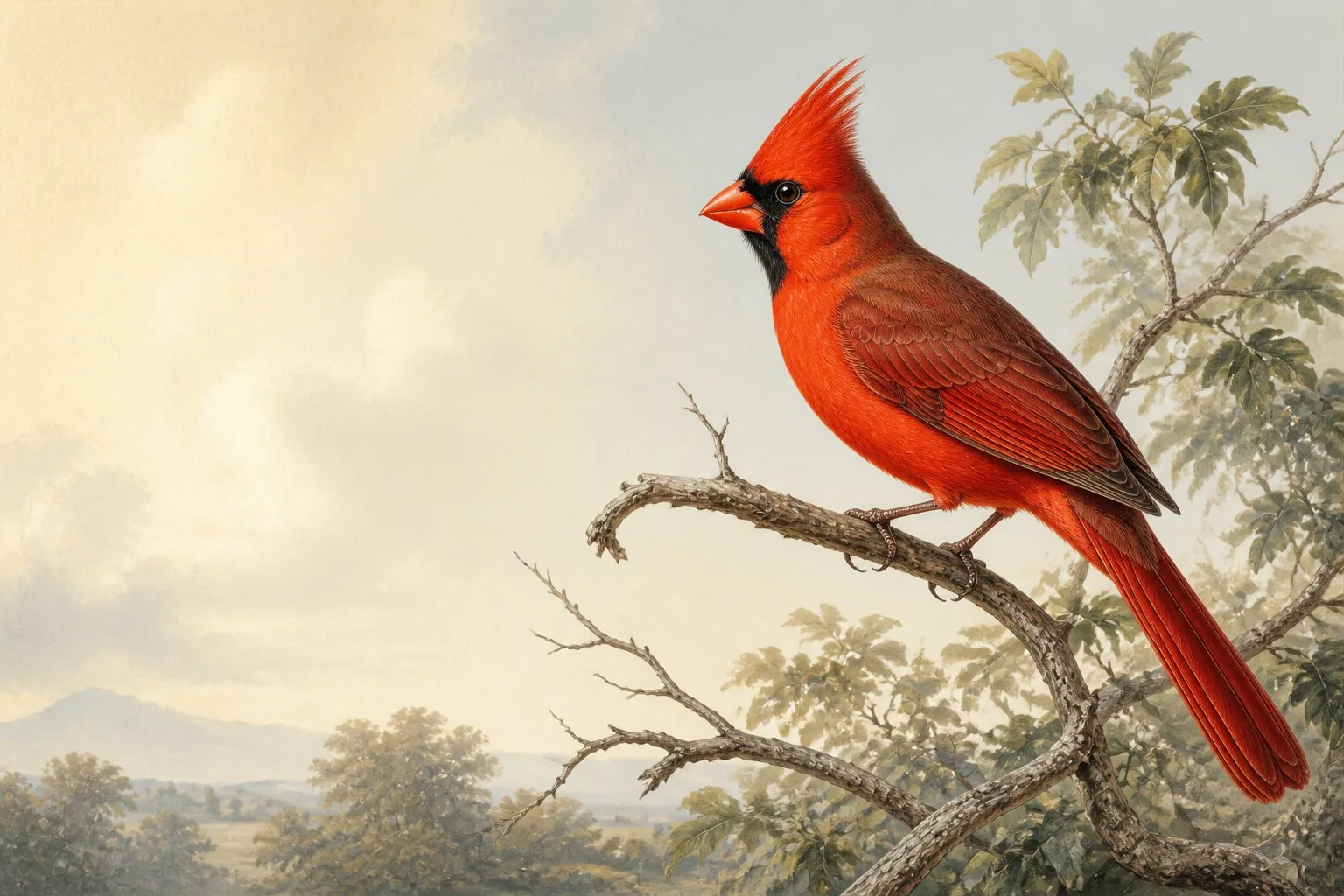
The permanent resident: Northern Cardinal
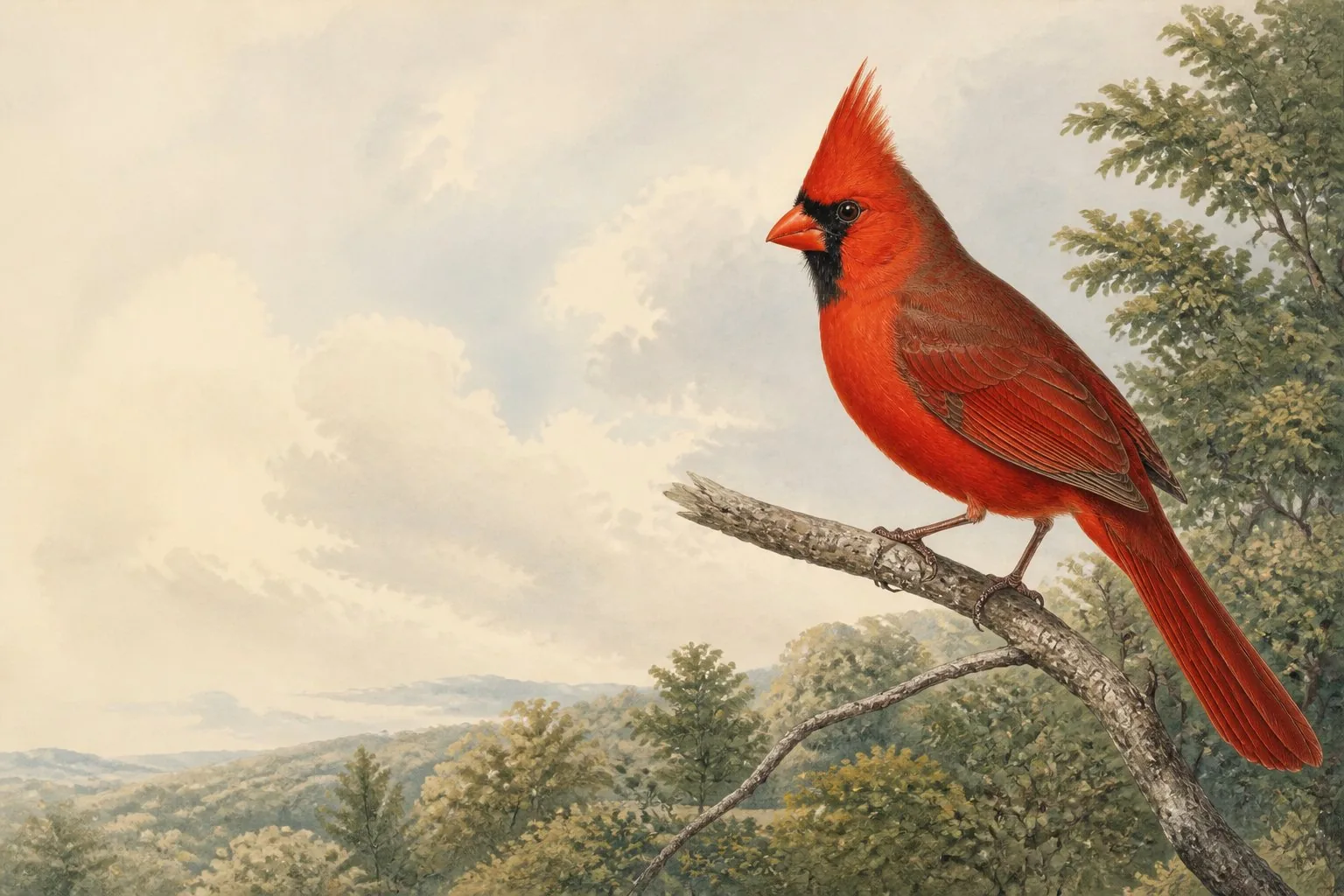
Cardinalis cardinalis is the most reliably seen red bird in Massachusetts in every month of every year. Cornell Lab’s All About Birds documents the species as common year-round across the entire state, concentrated at woodland edges, suburban gardens, and any thicket with decent berry cover.
The male’s red comes from carotenoid pigments in his diet - dogwood berries, wild grape, crabapple. He does not manufacture the color; he borrows it from the landscape. Females select mates partly on plumage intensity, which makes the August molt a costly preparation for the following spring.
Cardinals do not migrate and do not switch to a dull winter plumage. The bird at your feeder in January is the same bird that sang in April.
The forest fire of May: Scarlet Tanager
Piranga olivacea arrives in Massachusetts between late April and mid-May, coming north from South American wintering grounds. The male is brilliant red with solid black wings and tail. Nothing else in the state looks like him.
The Mass Audubon Breeding Bird Atlas found the species breeding in 81 percent of surveyed blocks statewide, up from 75 percent in the first atlas period. The stronghold is the forested interior - the Pioneer Valley, the Berkshire hills, and the central uplands where white oak and white pine grow together in stands large enough to hold a breeding territory. Atlas data show the species least common on Cape Cod and the Islands, where mature mixed woodland is scarce.
Despite that geographic stability, Audubon’s field research documents declining abundance in Massachusetts and the broader New England region. The tanager does poorly in small forest fragments - a woodlot under 20 acres may attract a singing male in May and fail to hold a breeding pair through the season. Arrive at the edge of a mature oak stand at first light in mid-May and listen before looking. The song is a burry, four-phrase sequence, the birds forage high in the canopy, and they are surprisingly hard to see. By late September, most have left. Males at that point have molted into greenish with black wings retained - an odd combination that confuses many autumn birders.
Partial-red residents: House Finch and Purple Finch
House Finch (Haemorhous mexicanus) is year-round across Massachusetts. Only the male carries color - a wash of red on the forehead, breast, and rump that varies from orange to nearly yellow depending on diet during molt. The entire eastern population traces to a 1940 release in New York, when a pet dealer selling the birds illegally as “Hollywood Finches” dumped his stock to avoid prosecution. Within 50 years their descendants had spread across the eastern seaboard.
Purple Finch (Haemorhous purpureus) is both a breeding bird in central and western Massachusetts and a winter visitor from farther north. Audubon describes the male’s color as “dull red on head and foreparts” - more a wine wash than anything sharply red. Tell the two finches apart by the female: the Purple Finch female has a strong dark whisker and a clear white eyebrow that House Finch females lack. Purple Finches nest in conifers in the interior of the state; their breeding range has contracted from the east, but they remain confirmed nesters in the right habitat.
The irruptive winter visitors: crossbills and redpolls
Three additional red-toned species appear in Massachusetts only when boreal seed crops collapse and birds are pushed south.
Red Crossbill (Loxia curvirostra) and White-winged Crossbill (Loxia leucoptera) follow cone crops across boreal North America and appear in Massachusetts pine and spruce stands when those crops fail. eBird records show irruptions on roughly five-to-15-year cycles. The Red Crossbill male is brick red; the White-winged Crossbill male is a cleaner pink-red with two white wing bars. Some winters bring good numbers; others bring none.
Common Redpoll (Acanthis flammea) is a small Arctic finch with a red cap and, in adult males, a pink-red wash on the breast. Redpolls are driven south by failures in the birch and alder seed crops of the boreal zone. The Finch Research Network notes a roughly biennial irruption pattern, and BirdCast researchers have observed that peaks have been less dramatic in recent years. In good winters, flocks appear at Massachusetts feeders and birch stands from December through March.