Free shipping to the US, Canada & Europe
State Guide
Idaho's mountain forests hold Red Crossbills year-round, but the bird you see today may be gone by October. Here is why, and what else turns red in Idaho.
April 9, 2024 5 min read
Walk into any lodgepole pine forest in central Idaho in July and you may hear a sharp, clipped call from high in the canopy, then see a flock of brick-red birds drop onto a cone cluster and work it apart with bills that look, at first glance, as if they were closed in a door.
They are Red Crossbills, Loxia curvirostra, and the apparently broken bill is the point. The crossed mandible tips are precisely shaped to wedge open conifer cones before the scales have dried and spread - the gap that other birds rely on. A crossbill can extract seeds from green cones in late summer, weeks before any other finch has access. The crossed bill is not an injury. It is an advance pass.
Idaho hosts more red-plumaged birds than most casual birders expect, from sapsuckers in the aspen groves near Sun Valley to House Finches in the parking lots of Boise. But the crossbill earns its own explanation, because it operates differently from every other bird on this list.
| Species | Red on the male | Where in Idaho |
|---|---|---|
| Red Crossbill | Brick-red overall | Mountain conifer forests, elevation 4,000+ ft |
| Cassin’s Finch | Rose-red crown and breast | Montane forest, spring through summer |
| House Finch | Red head, breast, and rump | Towns and suburbs, year-round |
| Pine Grosbeak | Rose-pink head and breast | Spruce-fir forests, higher elevations |
| White-winged Crossbill | Rose-pink to red | Irregular winter visitor, spruce stands |
| Red-naped Sapsucker | Red crown, nape, and throat | Aspen groves, spring through summer |
| Red-breasted Sapsucker | Solid red head and breast | Western Idaho drainages, year-round |
| Northern Flicker (red-shafted) | Red under-wing shafts | Open woodlands and suburbs, year-round |
Most of these birds follow predictable seasonal rules. Cassin’s Finches, Haemorhous cassinii, arrive at elevation in late spring and leave before October. The two sapsuckers, Sphyrapicus nuchalis and Sphyrapicus ruber, follow the tree phenology. The Northern Flicker’s red is visible only in flight and only on the western subspecies - though Idaho is squarely in its range.
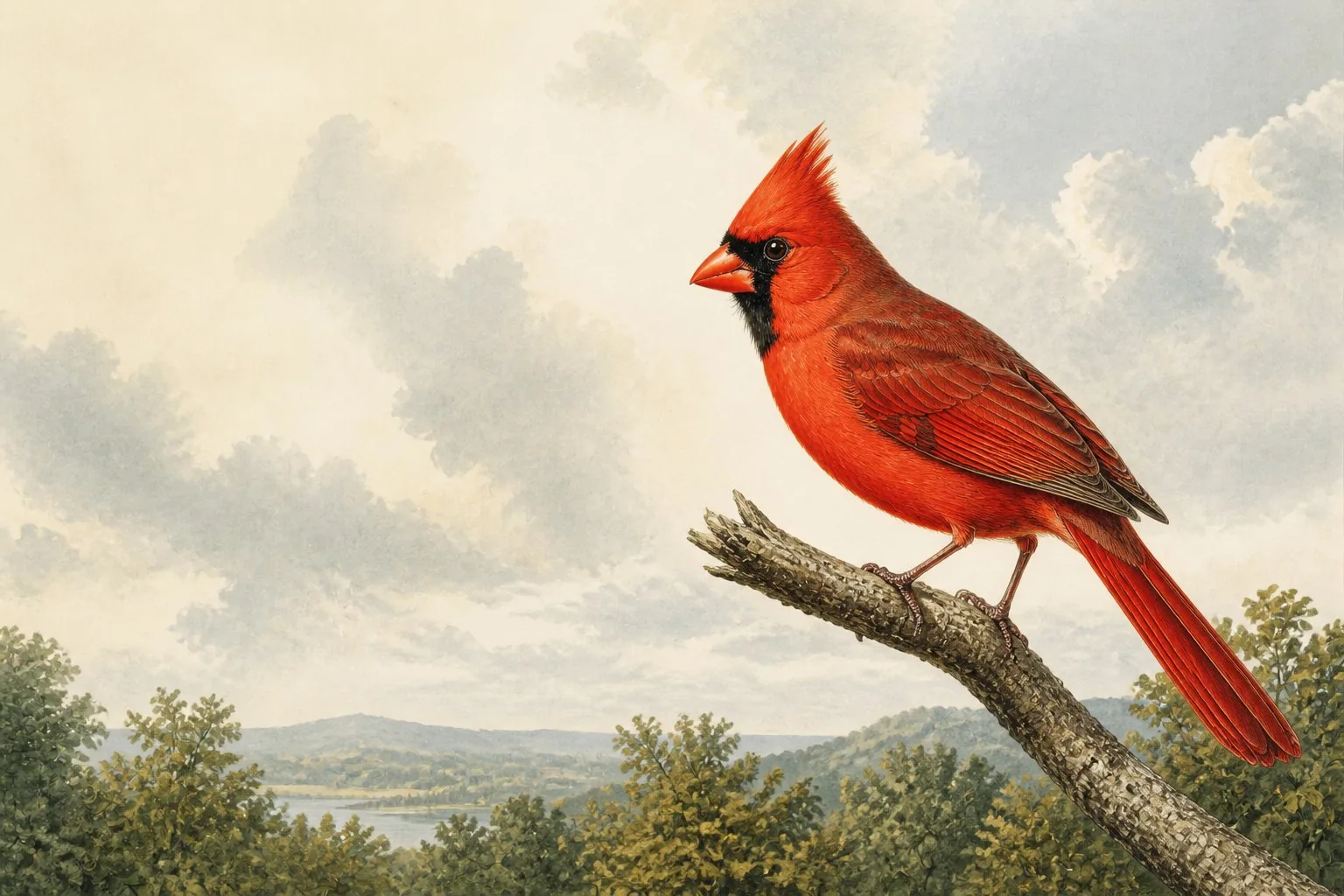
The House Finch is the most reliably red bird in Idaho if you do not leave town. Males vary considerably in brightness depending on the carotenoids available in their diet during the previous moult - the same mechanism that governs how red a Northern Cardinal becomes after each annual moult.
Red Crossbills do not have a territory. They have a continent. They go where the cones are, and the cones are never in the same place twice.
This makes them almost impossible to predict. A stand of lodgepole pines in the Sawtooth Range that held a hundred crossbills in August may hold none by November - not because the birds died, but because the cone crop in a Douglas-fir forest two states east turned out better. Long-term monitoring by the Cornell Lab and others has tracked crossbill flocks across thousands of miles within a single year. Idaho sits in the middle of this range and can be excellent or empty, depending on the year and the elevation.
The practical consequence: if you are driving into the mountains and you hear the chip call from a conifer canopy, stop. Crossbills rarely hold still for long, and what looks like a resident flock may be gone within a week. The call is a dry, metallic jip-jip-jip repeated in flight. Once you know it, you will hear it everywhere in good crossbill years and nowhere in lean ones.
Cassin’s Finch is the mountain counterpart to the House Finch of the lowlands, and the two are often confused where their ranges overlap at mid-elevation in spring. The simplest field mark is the crown: in the Cassin’s, the rosy-red cap is sharply defined, rising almost like a small crest above a streaked nape. The House Finch’s red bleeds messily into the brown of the forehead. Females of both species are heavily streaked and essentially identical at a distance.
The Pine Grosbeak, Pinicola enucleator, is the quietest of the group. Males are large - bigger than a starling - and move slowly through spruce-fir forests at the highest elevations. The Selkirk Mountains in northern Idaho hold them in winter, when they come down to feed on mountain ash and juniper berries.
The sapsuckers are easy to overlook as red birds because the red is only a bib and crown on an otherwise black-and-white bird. Red-naped Sapsuckers are aspen specialists; Red-breasted Sapsuckers take over in the wetter western drainages near Oregon. Red-shafted Northern Flickers carry their red hidden under the wing until they flush - at which point the underwing lights up salmon to brick-red across the whole forest floor.
The Sawtooth National Recreation Area and the forested drainages north of Coeur d’Alene are the most reliable areas for crossbills and grosbeaks. Cassin’s Finches follow the open ponderosa pine parks at mid-elevation. For sapsuckers, any aspens near a stream will do.
Idaho’s red birds are mountain birds. States further east - Ohio and Michigan among them - are dominated by the Northern Cardinal, which does not reach Idaho at all. The Cardinal’s western limit falls well into the Great Plains; in Idaho, the crossbill fills the red-bird role that the Cardinal plays everywhere else.
The Crossbill’s independence from calendar and territory is what makes it the right bird to think about in Idaho. It is not here because the season says so. It is here because the cone crop is, and when the crop moves, the bird moves with it.
As an Amazon Associate we earn from qualifying purchases. Linked products are ones we genuinely recommend.
 April 9, 2024
 5 min read