State Guide
Orange birds in Michigan: six species worth knowing
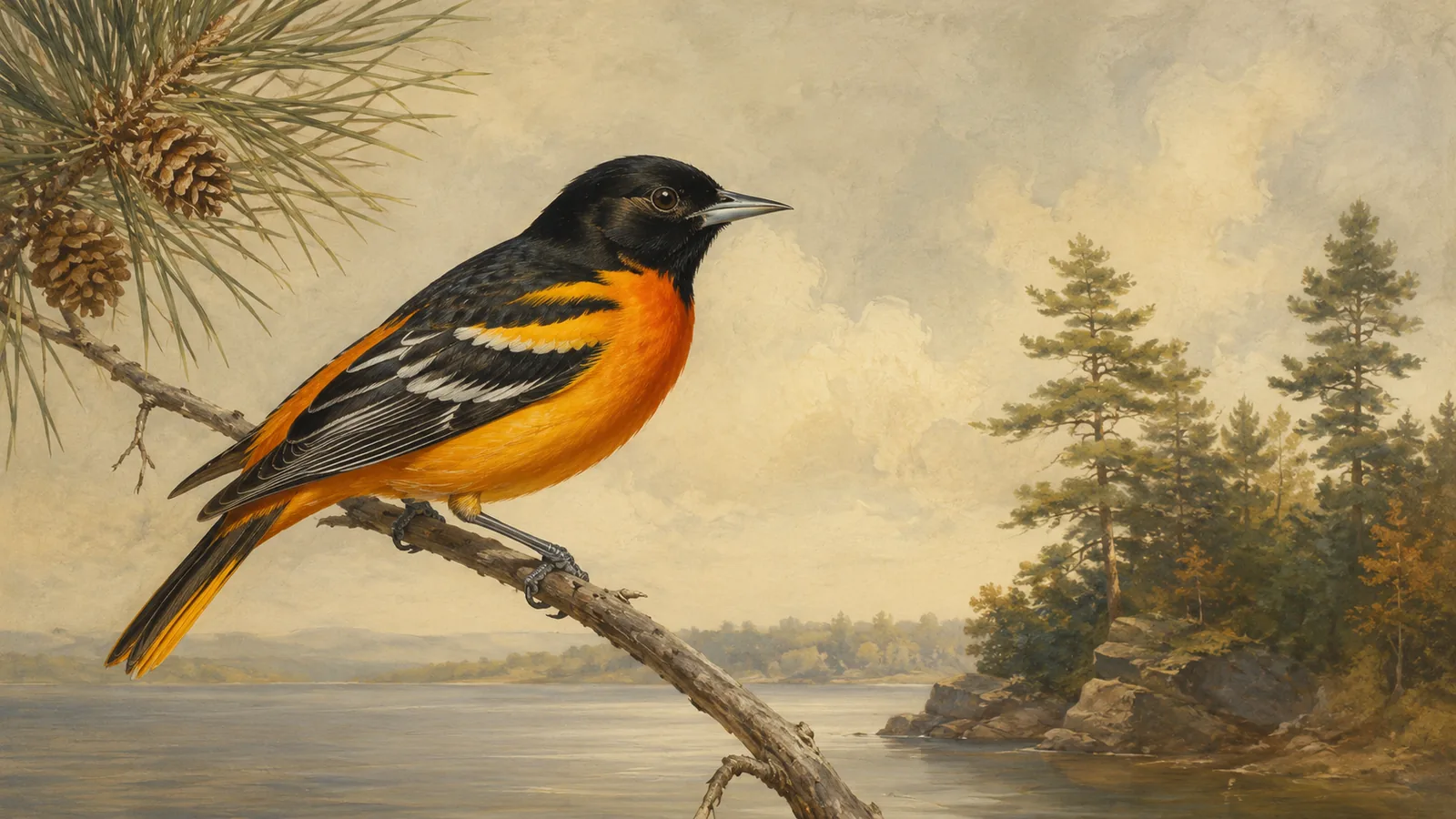
Walk a Michigan shoreline in early May and the first orange you notice is the Baltimore Oriole - a male in full black-and-orange plumage, announcing himself from an elm canopy with a clear, fluted whistle. He arrived days ago from Central America and is already claiming territory. He is not subtle about it.
Michigan hosts at least six species with genuinely orange plumage, spanning every season and most habitats - from a few ounces of warbler to the robin the state adopted as its own in 1931.
The state bird first
The American Robin (Turdus migratorius) is Michigan’s official state bird, adopted on April 8, 1931. The adoption followed a 1929 contest organised by the Michigan Audubon Society that drew nearly 185,000 votes; the full tallies, reported by Promote Michigan from the historical record, put the robin first with 45,541 votes, the chickadee second with 37,155, and the bluebird third with 17,024.
Its breast is orange-red, not the crayon-orange people sometimes expect. The back is gray-brown, the head dark, the bill yellow. At 8 to 11 inches (Cornell’s All About Birds), it is the largest orange bird on this list and the one you will see year-round in the Lower Peninsula.
The robin’s orange is in the breast only. Every other orange bird in Michigan places its color somewhere else.
The one everyone comes for
No Michigan bird draws more deliberate attention than the Baltimore Oriole (Icterus galbula). Audubon’s field guide calls the male “boldly marked black and orange” with no eastern counterpart - orange covers the breast, belly, shoulder patches, and rump, set hard against black on head and back. Females wear brown above with orange tinges below and two white wing bars.
The Baltimore Oriole is the only common Michigan bird where the male’s entire underside glows orange against jet black - at any distance, in any light, there is nothing else it could be.
Birdwatchinghq.com, tracking eBird data for the state, puts the arrival peak at mid-May and recommends feeders ready by May 10. Audubon notes fall migration begins with many southbound in July and August - a short window for a bird people drive to see. The female builds a hanging woven pouch nest; the Audubon field guide gives a typical height of 20 to 30 feet, with a range of 6 to 60 feet up, and an incubation period of 12 to 14 days for a clutch of four to five eggs.
How this range plays out in neighboring states: orange birds in Ohio and orange birds in Illinois.
The darker oriole
The Orchard Oriole (Icterus spurius) is the bird that throws people. The adult male is not orange in the familiar sense. Audubon’s field guide describes the color as “a deep - and stunning - burnt orange in full light,” but against his black hood it reads almost maroon until sun catches it. At 6.3 to 7.1 inches (per the Audubon field guide), he is noticeably smaller than the Baltimore. Audubon notes the species is most common in the midwestern and southern United States. Like the Baltimore, some are southbound by late July.
Two small warblers, two different shades
The American Redstart (Setophaga ruticilla) is a warbler that uses its color actively. The male - mostly black with red-orange patches on the sides, wings, and tail - fans his tail and drops his wings while hunting insects, making him conspicuous in ways most warblers are not. Audubon describes him as “mostly black with red-orange patches on wings, tail, and sides.” Females show the same pattern in gray and yellow. He breeds across the Great Lakes region in second-growth maples, birch, and aspen near water. See orange birds in New York for how the species shows up across the flyway.
The Blackburnian Warbler (Setophaga fusca) concentrates its orange in one place: the throat. Cornell’s All About Birds calls it “the only North American warbler with an orange throat.” The male’s throat glows orange-amber against black and white. It breeds in the Great Lakes region’s boreal coniferous forests; the Audubon field guide puts nests usually high in the canopy, sometimes reaching 80 feet, in spruce and hemlock. Most Michigan birders see it in May, when it pauses briefly at shoreline trap points during northbound migration.
The one you hear first
The Eastern Towhee (Pipilo erythrophthalmus) is a large sparrow whose orange is confined to the flanks. Audubon describes the male as having a “dark hood and rusty sides set off by white stripe down center of belly.” It stays low in brush piles and leaf litter at woodland edges. Michigan’s populations are migratory - present spring through summer, most often heard scratching in undergrowth before it is seen.
When to be out
Spring migration compresses most of these species into a five-week window, late April through the end of May. The robin is present every month of the year. The rest come and go on tight schedules, and the Baltimore leaves earlier than most people realise.
For a desert-climate comparison, see orange birds in Arizona. The Northern Cardinal field guide covers the cardinal, which placed fifth in that 1929 Michigan vote with 12,288 votes - and the cardinal-molting article explains why it looks rough every August.
The most significant orange bird in Michigan is not the rarest. It is the one that won a statewide election nearly a century ago and still arrives, on schedule, at every Michigan lawn in March.