Identification
Birds that look like Cedar Waxwings (the flock test)
The Cedar Waxwing is the only North American bird that travels almost exclusively in tight flocks of twenty to several hundred. A lone Cedar Waxwing is a relatively rare sight. A flock of sixty Cedar Waxwings descending on a fruiting hawthorn and stripping it in three minutes is a sight you will never confuse with anything else, because nothing else in North America moves through a landscape this way.
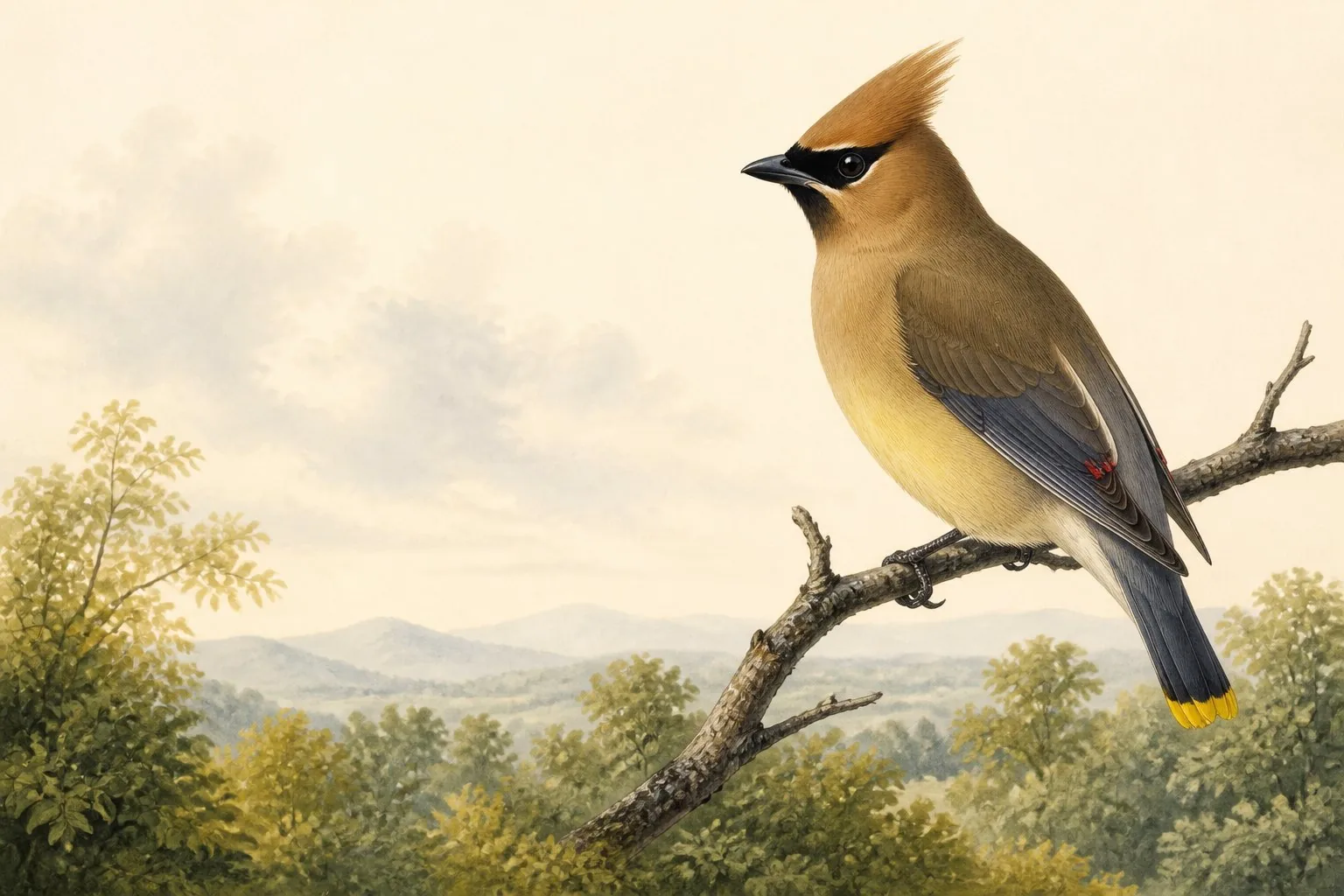
This is the easiest ID rule in the family: identify the flock, not the bird. The birds people confuse for waxwings are crested, berry-eating, similar in silhouette, but they do not travel in waxwing flocks. Once you have the flock you have the species. The mask, the yellow tail tip and the waxy red wing tips are just confirmation.
The actual lookalikes
| Species | Crest | Travel pattern | Where you see it |
|---|---|---|---|
| Bohemian Waxwing | Yes | Tight flocks of 50 to 500+ in winter | Winter only south of Canada, mostly the north tier of states |
| Phainopepla | Yes | Pairs, occasionally small loose groups | Desert mistletoe, US Southwest |
| Female Northern Cardinal | Yes | Solitary or pair | Continental US east of the Rockies |
| Pyrrhuloxia | Yes | Solitary or pair | US Southwest, mesquite scrub |
| Tufted Titmouse | Small | Small mixed-species winter flocks | Eastern US woodland |
The Bohemian Waxwing is the one genuine lookalike. It is also a waxwing, larger and chunkier than the Cedar, with a grey rather than yellow belly and rufous undertail coverts. Bohemians irrupt south from boreal Canada in winters where their northern fruit supply has failed. In an irruption year a Minnesota or Vermont birder can see a thousand Bohemians in a morning. In a normal year there will be none south of the boreal forest at all.
If you are seeing a waxwing in July anywhere south of the Canadian Shield, it is a Cedar. If you are seeing a flock of waxwings in February in Minnesota, you have to look at the belly.
The flock behaviour that ends the question
Cedar Waxwings do four things no other North American bird routinely does.
- They strip a fruiting tree in minutes. A flock will hit a hawthorn, mountain ash or crabapple and reduce it to bare branches in one visit. Single-bird foraging is unusual.
- They pass berries down a line of perched birds. A waxwing will pluck a berry and hand it to the bird next to it on the branch, which hands it on, which hands it on, until the last bird in the line eats. This is documented courtship behaviour. No other North American bird has the same trick.
- They get drunk. Late-winter berries ferment. A flock that has stripped a fermenting crabapple will fly badly, hit windows and occasionally die from acute alcohol poisoning. The behaviour is well-documented in citizen-science records. Cornell estimates dozens of cases per year reported in the United States.
- They are silent in flight. The contact call is a high, thin seeee that runs through the flock as it moves. No song.
If a small crested brown bird is sitting alone, it is probably a cardinal or a Pyrrhuloxia. If a small crested brown bird is part of a tight murmuring flock that is doing something coordinated to a fruiting shrub, it is a waxwing.
The non-waxwings
Female Northern Cardinal. Crest yes, berry-eating yes. But solitary or paired, never in waxwing flocks. Body shape heavier, bill conical and pink, no mask, no yellow belly.
Pyrrhuloxia. Like the female cardinal but grey, mostly seen in southwestern desert scrub. Solitary or paired. Yellow bill. No mask.
Phainopepla. Glossy black male (silver-grey female), red eyes, sleek crest. Found in desert mistletoe groves. Often confused at first glance because the silhouette is waxwing-like, but the colour is completely different.
Tufted Titmouse. Smaller crest, peach-grey body. Mostly travels with chickadees in mixed winter flocks rather than waxwing-style coordinated arrivals.
Why the waxy tips
The red waxy droplets at the tips of the secondary wing feathers are real, not just colour. They are concentrated carotenoid pigment that has been pushed into a small structural cap at the tip of the feather shaft. Their function is not fully settled. The leading hypothesis is sexual signalling: older birds carry more and brighter tips, and waxwings appear to use them in mate selection. Younger first-year birds often have few or no tips at all and tend to pair with each other.
The yellow tail tip is the same chemistry. In the 1960s and 70s some Cedar Waxwings in the Northeast began showing orange tail tips instead of yellow, a colour shift traced to the introduced honeysuckle berries the birds had begun eating. The pigment in the berry changed the pigment in the feather. The bird is, literally, what it ate last week.