Symbolism
The Blue Jay Does Not Mean What You Were Told
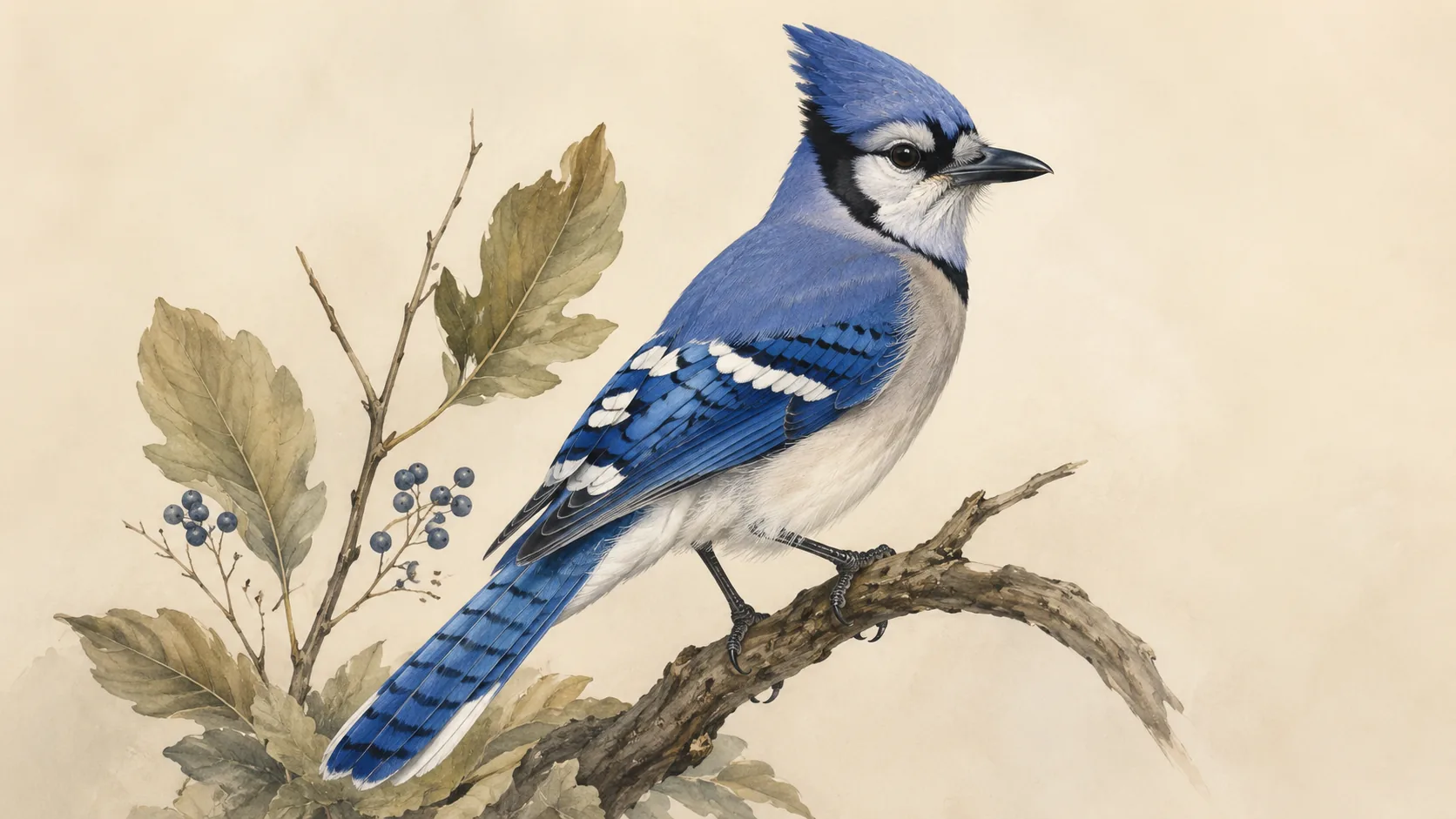
The blue jay is not a thief.
This matters because nearly every symbolic reading of the bird - bold, aggressive, deceptive, loud - rests on a reputation built from casual birdwatcher complaint rather than field study. The jay that chases songbirds from the feeder, mimics the hawk to clear the yard, ransacks other nests: each of these stories is either wrong, or right for reasons that change the meaning entirely. The symbolism built on a false character is a structure without a foundation. The actual bird is more interesting than the story it got saddled with.
What the Research Actually Found
Blue Jays have been accused of nest predation - raiding the eggs and nestlings of smaller birds - since at least the nineteenth century. The charge is repeated so often in popular writing that it has assumed the status of established fact.
The Cornell Lab of Ornithology examined it. Studies cited in Birds of the World found that Blue Jays accounted for less than one percent of observed nest predation events across multi-year surveys. The actual major nest predators are raccoons, snakes, squirrels, and domestic cats. Blue Jays destroy nests. So does everything else. Their share of the destruction is small.
The reputation appears to have formed from the jay’s visibility. They are large, loud, and startling. When a Blue Jay appears at a nest - even to investigate rather than to raid - it is conspicuous enough that the observer notices and remembers. The House Sparrow destroys far more nests in absolute numbers and almost never gets the moral censure.
This is not a defense of Blue Jays. They are not gentle birds. They are competitive, territorial, and perfectly capable of taking eggs when the opportunity presents. What they are not is the systematic nest-plunderer of popular imagination. The character is a projection. The symbolism that flows from it - deception, aggression, opportunism - is a projection’s shadow.
The Actual Ecological Role
Here is what Blue Jays actually do, documented.
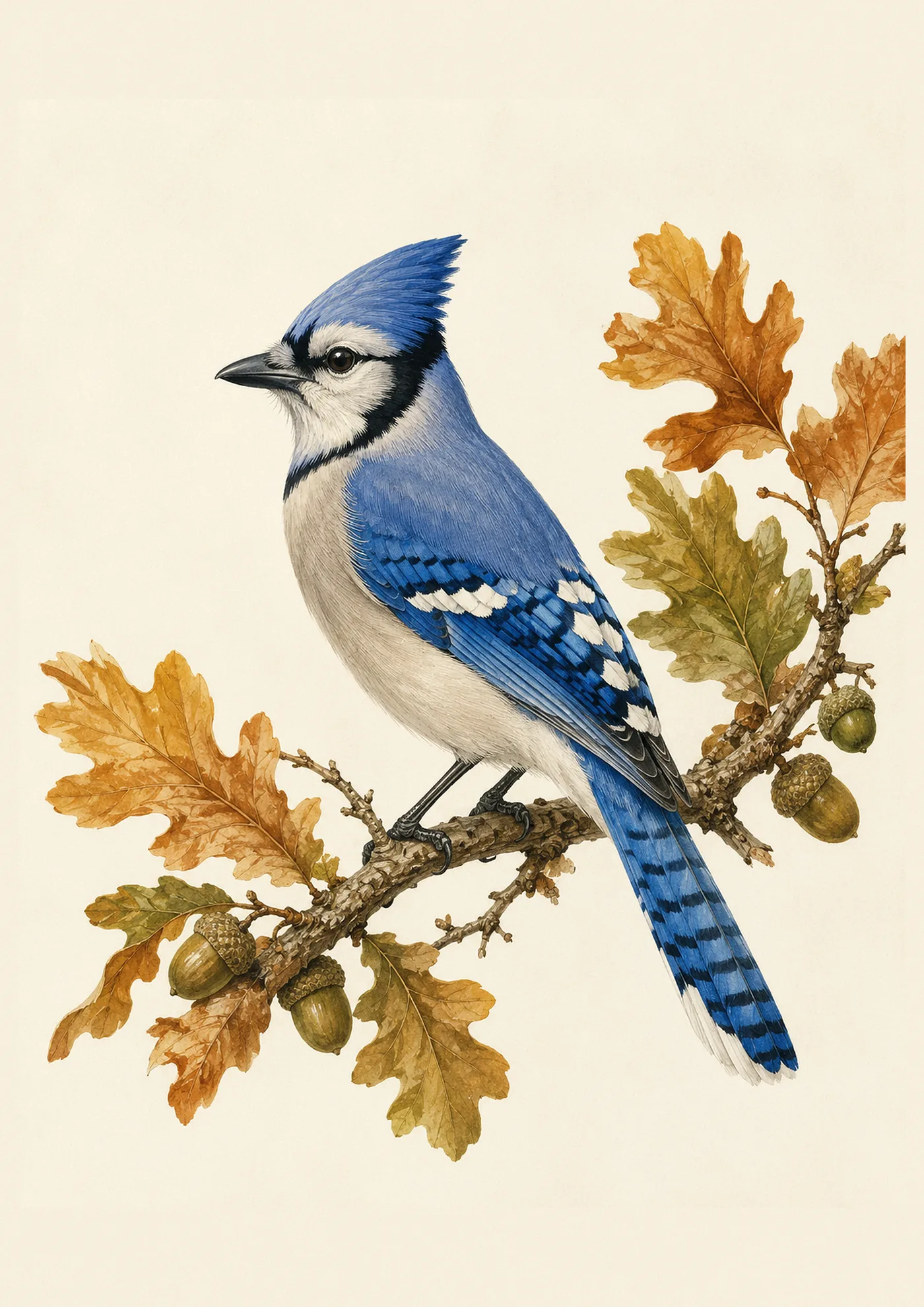
Each autumn, a single Blue Jay caches between three thousand and five thousand acorns. It carries them in a specialized pouch at the base of its throat - up to five at a time - and buries them individually, scattered across a territory that can extend several miles from the bird’s roost. It remembers most of them. Not all of them. The ones it forgets germinate.
After the last glacial maximum ended approximately twelve thousand years ago, the great ice sheets retreated northward and forest followed. The question ecologists have tracked is: how did oak trees spread so fast? Oak seeds are heavy. Wind does not carry acorns far. Squirrels cache and retrieve efficiently enough that their forgotten stores do not spread the species widely. The answer that the genetic evidence supports is Blue Jays. The distribution of eastern oak forest in North America tracks almost exactly with the territory the Blue Jay colonized during post-glacial reforestation.
Without Blue Jays, the eastern oak forest in its current distribution probably does not exist. The bird that cannot be trusted with your feeder built the forest you are standing in.
The Mimic and the Flock
The Blue Jay mimics the calls of Red-tailed and Red-shouldered Hawks so precisely that even experienced birders routinely check the sky when they hear one. The common reading is that the jay does this to deceive - to clear competitors from a food source by faking a predator alarm.
The evidence is not clean enough to support that reading. Ornithologists who have studied the behavior note that jays most often produce hawk mimicry in the presence of other jays, not when competing with other species for food. The call functions as social information within the flock: there is a hawk-shaped bird somewhere in this area, regardless of whether the mimic has actually seen one.
A bird that mimics an alarm call to update its own flock’s situational awareness is not being deceptive. It is being efficient. The information transfer is the point. That it also incidentally clears smaller birds from the feeder may be a side effect the jay is indifferent to.
The “thief who mimics the hawk to steal your food” narrative is tidier than the actual mechanism. It requires the jay to be smarter and more calculated than it probably is, in the service of making it more villainous.
What Indigenous Traditions Actually Say
Blue Jay appears as a significant figure in the oral traditions of several tribes of the Pacific Northwest, particularly in Chinook tradition, where the jay is a trickster figure. The trickster in indigenous narrative traditions is not a villain. This point is consistently missed by popular symbolism writers, who equate trickster with deceiver and assign the moral valence of the European picaresque.
The trickster in Chinook and in many other North American traditions is the figure who rearranges the world - who breaks rules in ways that create the conditions for change, who exposes pretension, who reminds the community that reality is more fluid than its conventions suggest. Coyote holds this role on the Great Plains. Raven holds it in Pacific Northwest coastal traditions. Blue Jay holds a version of it in Chinook narrative. The Anishinaabe associate the jay with quick intelligence and adaptability.
These are not the same as the bolt-and-run thief of the feeder-watching tradition. The trickster creates disruption that matters. The feeder thief just takes seeds.
Modern new-age and astrology content online attributes Blue Jay symbolism to: boldness, assertiveness, truth-speaking, loyalty, communication, intelligence. Some of this tracks loosely with documented indigenous readings - the intelligence and the adaptability. None of it cites a specific tradition, a specific document, or a specific date. It is the same mechanism as every other bird-symbolism aggregation site: real fragments assembled into a list that reads as ancient.
The Novel in the Title
Harper Lee’s To Kill a Mockingbird (1960) contains blue jays and mockingbirds, and popular reading sometimes treats the blue jay as the novel’s villain counterpart to the innocent mockingbird. Atticus Finch tells his children they can shoot all the blue jays they want, but it is a sin to kill a mockingbird.
The blue jay in that passage is not symbolic. It is a plot device. Lee is establishing the mockingbird’s innocence by contrast with a bird that is, in Atticus’s framing, permissible to kill - a nuisance bird, a noisy neighbor, something whose death is morally neutral. The blue jay is background. The mockingbird is the argument.
There is no formal symbolic tradition attached to the blue jay through that novel. What there is: a widely repeated misreading that makes the blue jay a secondary villain in a story that never meant it that way.
What Is Actually There
The honest accounting of Blue Jay symbolism: the documented indigenous trickster tradition is real, specific to the Pacific Northwest and Great Plains peoples whose territories the jay shares, and means something structurally different from what “trickster” implies in English. It is worth knowing separately from the aggression narrative.
Everything else - the deception, the boldness, the assertiveness, the truth-speaking warrior - is late-stage internet folklore assembled from the bird’s visual prominence and a false reputation. The nest predation story is exaggerated. The hawk-mimicry-as-deception story is probably wrong. The feeder-bully story is real but ordinary: every dominant bird displaces smaller ones.
What the Blue Jay actually did was plant the eastern United States.
The bird that built the oak forest, remembered four thousand individual seed caches, and figured out that a hawk call is useful social information before any naturalist worked out why: that bird acquired a reputation for petty theft.
It is worth knowing which one is standing at your feeder.