Free shipping to the US, Canada & Europe
State Guide
Oregon's Cascades split the state into two birding worlds. This guide covers every red-plumaged species, from crossbills to sapsuckers, and where to find them.
June 18, 2024 4 min read
Stand on the Pacific Crest somewhere above Crater Lake in July and listen for the crossed bill tearing into a whitebark cone. The sound is dry and precise, like a fingernail on cardboard. That is a Loxia curvirostra, the Red Crossbill - the most interesting red bird in Oregon, and the one that makes the state worth understanding as a birding geography.
Oregon’s Cascade Range does not just divide the state into east and west. It divides it into two different bird lists that share a border and almost nothing else.
The Cascades are not a backdrop. They are the mechanism. Every red bird you find in Oregon is either shaped by the moisture on the western slope or the cold dry air on the eastern side, and the two populations almost never overlap.
The Cascade crest creates a hard wall for moisture, temperature, and forest type. West of it: Douglas fir, red alder, mist. East of it: ponderosa pine, sagebrush, frost by September, and Malheur National Wildlife Refuge - one of the most productive birding sites in the American West. Red birds sort along this divide almost perfectly.
Red-breasted Sapsucker (Sphyrapicus ruber) is the emblematic red bird of the Pacific slope. Both sexes carry a full red hood from crown to breast. He drills neat rows of wells in alder and bigleaf maple, then returns to lap the sap. Year-round from the Rogue River Valley to the coast.
Anna’s Hummingbird (Calypte anna) holds the western lowlands year-round. The male’s gorget runs rose-red to magenta and shifts to black in poor light. He is the only hummingbird in North America that sings in winter, doing so in full throat from January onward.
House Finch (Haemorhous mexicanus) is everywhere west of the Cascades and in most towns east of them. The red on a male ranges from pale orange-pink to deep crimson depending on carotenoids available during moult - two males at the same feeder can look like different species.
Purple Finch (Haemorhous purpureus) is the bird people mistake for a House Finch until they look closely. The male’s raspberry wash covers the whole head and back, not just the face and breast.
Red Crossbill is the east-side headline. He is nomadic, following cone crops rather than fixed territories - a mountain ponderosa stand can go three winters without one and then hold a hundred. Long-term monitoring suggests Oregon supports multiple crossbill call types, and ornithologists still debate whether those types represent incipient species. The practical consequence: the crossbill you see this October may not return next year.
Cassin’s Finch (Haemorhous cassinii) replaces the Purple Finch above 4,500 feet on the dry eastern slopes. The male’s rose-red crown forms a sharp cap. He breeds in the montane forests of the Wallowas and the high Cascades east face.
Red-naped Sapsucker (Sphyrapicus nuchalis) works east-side aspen groves in spring and summer. He is closely related to the Red-breasted and the two hybridise in central Oregon where their ranges touch.
| Species | Red pattern | Side of Cascades |
|---|---|---|
| Red-breasted Sapsucker | Full red hood, both sexes | West |
| Red Crossbill | Males brick-red all over | East, irruptive |
| Cassin’s Finch | Rose-red crown cap | East montane |
| Purple Finch | Raspberry wash, head and back | West |
| House Finch | Red face and breast only | Statewide |
| Red-naped Sapsucker | Red crown, nape, throat | East, spring - summer |
| Anna’s Hummingbird | Rose-red gorget, male | West lowlands |
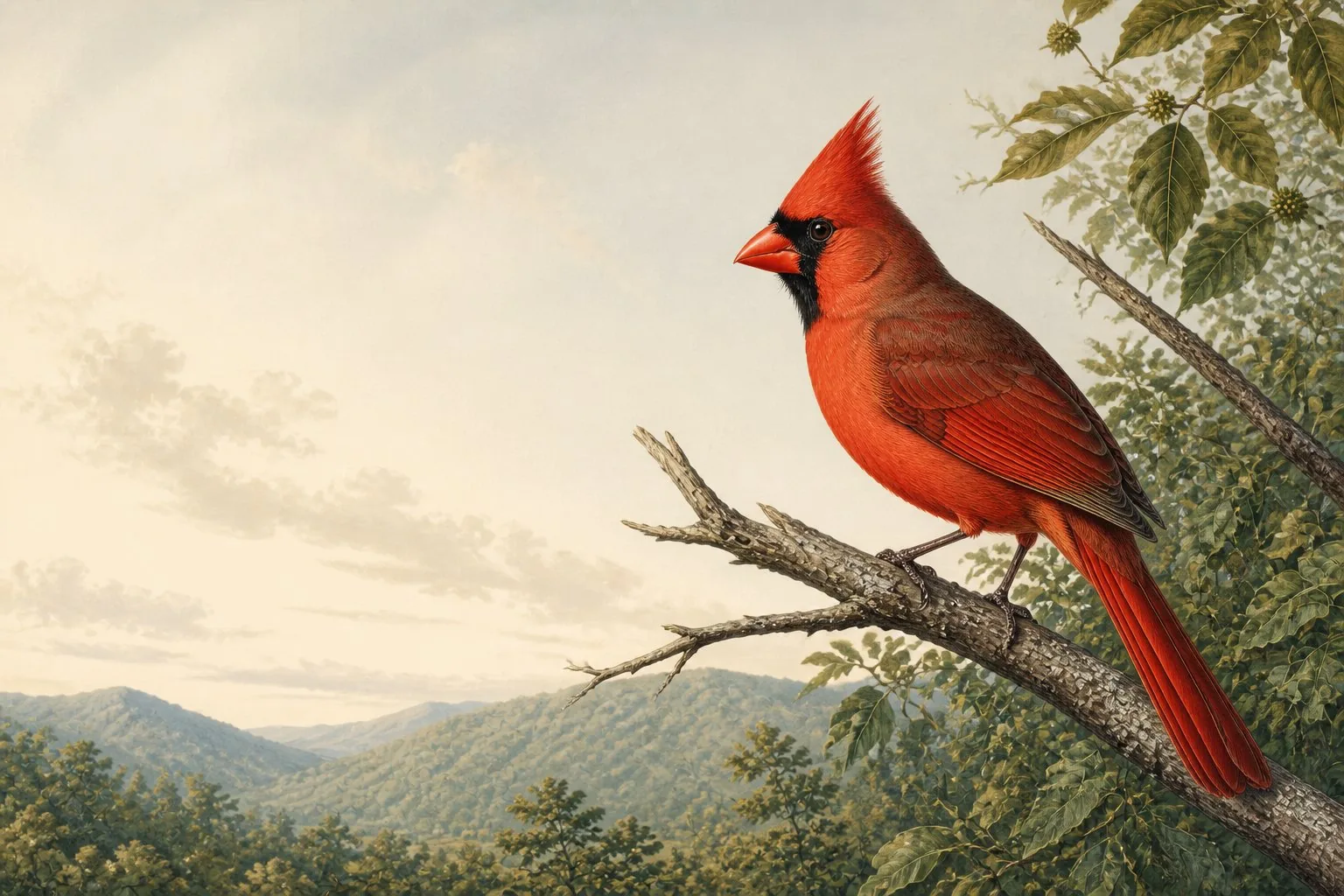
A note on the Northern Cardinal: Cardinalis cardinalis does not breed in Oregon. The Northern Cardinal is a bird of the east and the southwest. Occasional Oregon records are almost certainly escaped cage birds. Orange birds in Arkansas covers the cardinal’s actual western range edge, and orange birds in Illinois shows how the species integrates into a Midwest yard list.
Malheur NWR in the southeast has logged over 320 species across its wetlands and riparian corridors. For east-side finches and crossbills, the Wallowa Mountains and the ponderosa country around Bend are more productive. For west-side sapsuckers, any old-growth Douglas fir stand along the Rogue River will do. The Klamath Basin, where Pacific and Central flyways converge, is worth a day in autumn when finches and crossbills move through.
Late summer is when finch identification gets hard. A male House Finch in heavy moult shows ragged plumage and washed-out colour. A first-year Cassin’s Finch may lack the full rose crown. Young crossbills come in mottled brown-and-brick that looks nothing like the brick-red adult. When a red bird looks wrong, check the bill. The crossed mandibles of Loxia are diagnostic at any age, and no other Oregon finch shares that shape.
The Northern Cardinal moult post covers how moult shapes red plumage at the cellular level. The principle holds across species: the bird at your feeder in October is building toward what it will be in March. Oregon’s red birds are no different.
As an Amazon Associate we earn from qualifying purchases. Linked products are ones we genuinely recommend.
 June 18, 2024
 4 min read