Pets
When and How Do Toucans Sleep?
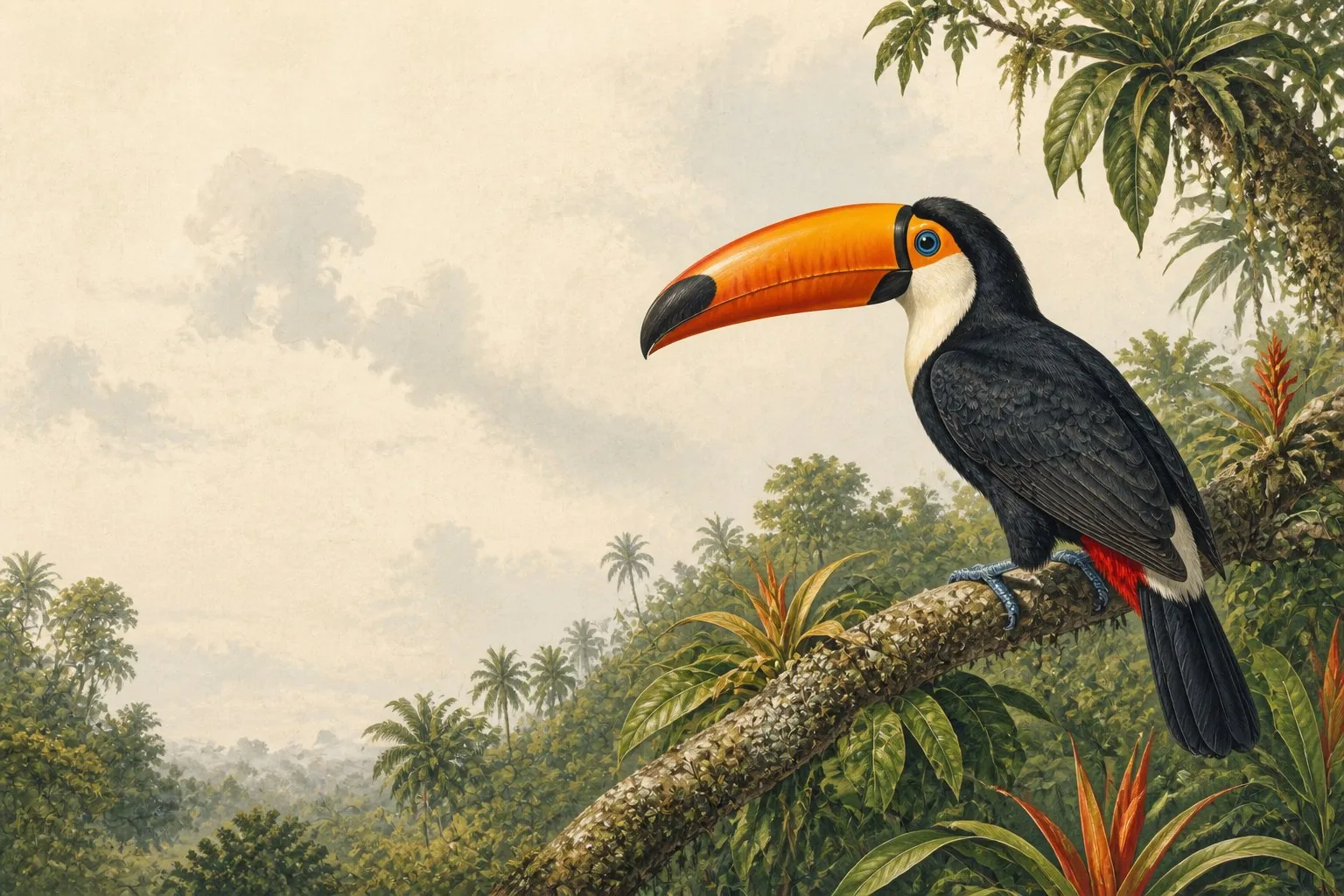
At dusk, a Ramphastos toco backs into a hollow in a rotted tree, turns its head until that orange bill rests flat along its back, and snaps its tail forward over its own crown. The bird, which moments ago was unmistakably a toco toucan, is now a compact ball of black feathers with a tail tip poking out the top. Walk past the tree and you would not give it a second look.
This is not merely a space-saving trick. It is one of the more sophisticated thermoregulatory behaviors recorded in a tropical bird, and the bill - which appears to be exactly the wrong thing to fold into a tight cavity at night - turns out to be the whole point.
The anatomy behind the posture
Toucans can sleep in a ball because they are built for it. The rear three tail vertebrae are fused together and connected to the spine by a ball-and-socket joint, an arrangement the ornithological literature describes as probably unique to the Ramphastidae family. That joint allows the tail to snap forward until it touches the head. The bill folds down onto the back between the fluffed body feathers. The tail covers the bill from above. The bird, which stands roughly 20 centimeters tall at the shoulder, occupies roughly half the space it would otherwise need. For animals that roost in cavities they did not excavate, compressing this far is what makes communal roosting possible.
The San Diego Zoo Wildlife Alliance documents toco toucans sleeping in hollowed-out tree trunks. The keel-billed toucan (Ramphastos sulfuratus), whose range runs from southern Mexico south through Central America to northwestern Colombia and Venezuela, roosts in cavities between three and 27 meters off the ground - mostly woodpecker-excavated holes or natural hollows in rotted trunks, since toucan bills are poor excavation tools. The Animal Diversity Web, citing Kricher (1989) and Beletsky (1998), records up to six keel-billed toucans sharing a single cavity, the floors of regularly used holes accumulating fruit pits from meals eaten before roosting. Smaller species take the narrower woodpecker holes. Larger species need the wider natural cavities that fungi and time open up in old growth.
The bill as a radiator - and what happens when you tuck it away
The standard account of why toucans sleep as they do - space conservation in crowded cavities - is true but incomplete. A 2009 study by Glenn Tattersall, Denis Andrade, and Augusto Abe, published in Science (Vol. 325, pp. 468-470), showed that the toco toucan’s bill operates as a “controllable vascular thermal radiator.” Using infrared thermography on six resting birds, the team demonstrated that toucans actively adjust blood flow into the bill, effectively turning up or turning down how much body heat they lose through it. The researchers concluded the toucan bill is, relative to its size, one of the largest thermal windows in the animal kingdom - rivaling the elephant’s ear.
The implication for sleep is direct. A bill left exposed to cool air all night would shed heat the resting bird cannot easily replace. Tucking it into the insulating mass of body feathers cuts that loss. The compacted sleeping posture reduces the bill’s surface area contact with the air at the same time as blood flow to the bill drops during rest. The bird’s heat budget improves considerably.
The bill that makes a toucan look impractical for sleep is the exact reason the bird is good at it.
Most of what gets written about toucan bills focuses on feeding reach and display. The Tattersall study repositions the bill as a thermal organ first - one that requires active management during the day and careful insulation at night. The sleeping posture is not incidental to having a large bill. It is a direct response to one.
Sleep schedule
Toucans are strictly diurnal. They begin foraging at fruiting trees shortly after first light and retire to roost cavities at dusk. Within the tropics, where day length stays close to 12 hours year-round, the schedule varies little across seasons. A keel-billed toucan in Panama sleeps on the same clock in January and July.
This matters practically for pet bird management. A captive toucan denied consistent darkness will show signs of disruption that are visible in the feathers - stress bars, faint horizontal lines across the feather vanes that form when feather growth is interrupted during poor sleep. The bars are a record of nights the schedule broke. Consistent 10 to 12 hours of darkness is not optional welfare enrichment. It is the baseline the bird’s physiology expects.
Unlike the species covered in how long does a parrot live, toucans do not adapt readily to variable sleep conditions. Their cavity-roosting instinct is fixed. Anyone weighing whether a toucan makes a good pet should start here. A captive bird without a dark, enclosed sleeping space will find a substitute and still show stress, because the space is only part of what the bird needs. The darkness and the schedule are the rest.
What the bill is made of
The bill is keratin over a lattice of thin bony struts filled with air pockets, which keeps the weight manageable while maintaining rigidity. It is not bone throughout and lighter than it looks. The internal structure bends enough to hold the sleeping angle for 12 hours and springs back by morning. First-time observers sometimes assume a sleeping toucan has injured its bill. It has not. The anatomy is built precisely for this.
Toucans are not close relatives of parrots - the two families solved frugivory independently and differently. What can parrots eat covers how a parrot’s diet and digestive physiology compare, and the contrast with toucan feeding ecology is instructive. Toucans are also permanent residents of their forest territories and do not migrate seasonally. Do toucans migrate or hibernate covers what they do instead across the year.
The closed loop here is worth holding. The bill shapes the feeding reach. It shapes the thermoregulation. And it shapes, in a way the 2009 Science study made measurable, how the bird has to arrange itself every single night. The toco toucan does not sleep the way it does despite its bill. It sleeps the way it does because of it.