Biology
Rocky Mountain Birds: How Elevation Sorts the Species
Drive up Trail Ridge Road in Rocky Mountain National Park on a morning in July and pay attention to what happens outside the window.
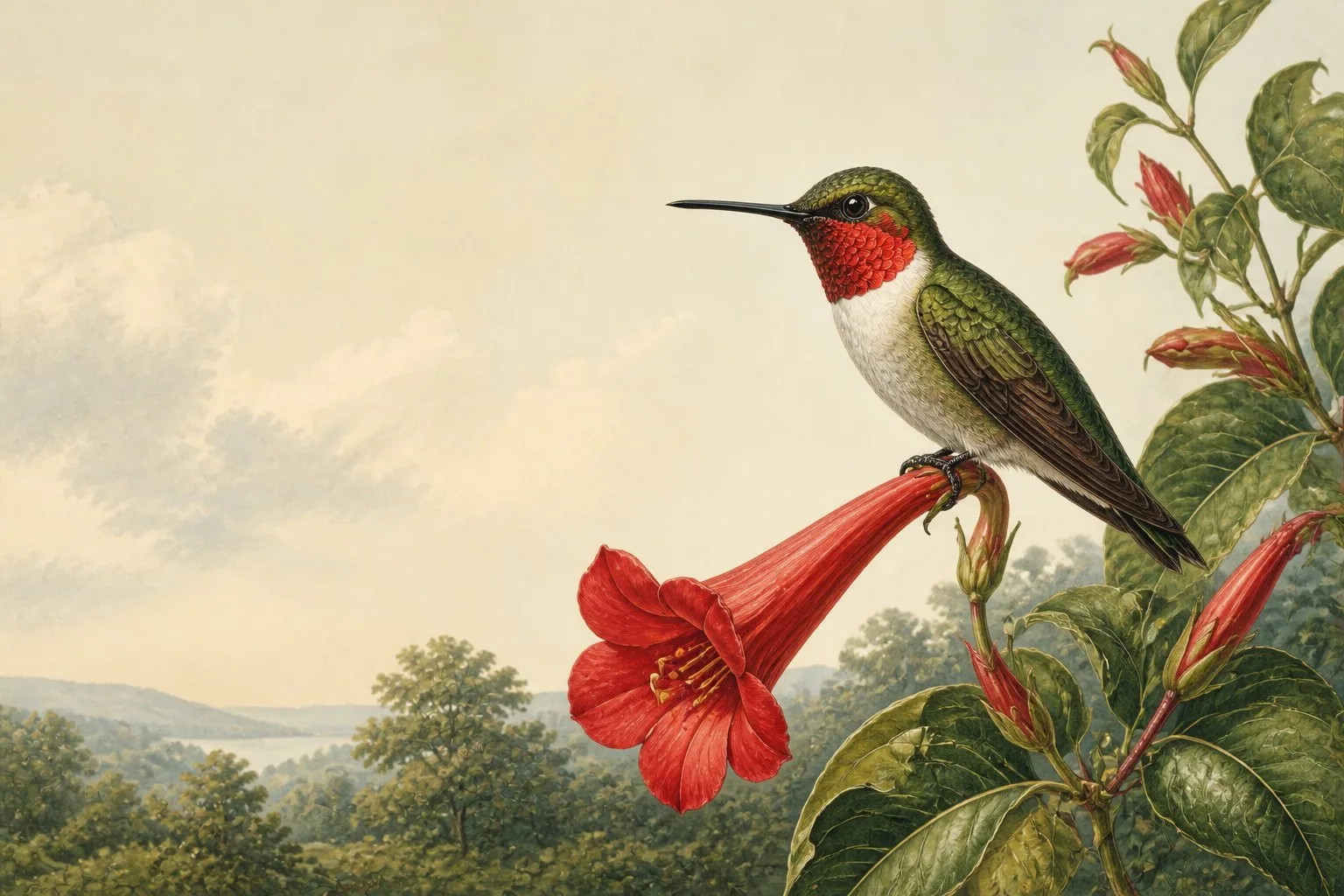
At the lower trailhead, around 9,000 feet, a Broad-tailed Hummingbird (Selasphorus platycercus) cuts across the parking lot trailing the metallic trill its wing produces. A Red-naped Sapsucker (Sphyrapicus nuchalis) works a row of aspens. A Warbling Vireo sings from somewhere in the canopy you cannot see. Then the road climbs. The aspens thin and give way to spruce. The spruce thin and give way to nothing. Above 11,500 feet the trees stop and the tundra opens. Up here a White-tailed Ptarmigan (Lagopus leucura) walks between boulders, and the sapsucker, the hummingbird, and the vireo are as absent as if you had crossed a state line.
The Rockies are not a single habitat with one bird community. They are five communities arranged vertically, each with its own cast of species and almost no overlap between them. Altitude does the sorting.
Why the zones stay distinct
Temperature drops roughly 3.5 degrees Fahrenheit for every 1,000 feet of elevation gain. At the same time, precipitation increases, wind speeds rise, and the growing season compresses. A bird adapted to sagebrush at 5,000 feet faces something close to subarctic conditions if it wanders to 12,000. Most do not wander.
The result is a tiering that ornithologists can map almost precisely.
| Elevation zone | Representative species | What drives the boundary |
|---|---|---|
| Sagebrush steppe (below 6,000 ft) | Greater Sage-Grouse, Sage Thrasher, Brewer’s Sparrow | Dominant shrub cover, aridity |
| Ponderosa pine (6,000 - 8,000 ft) | Pygmy Nuthatch, Lewis’s Woodpecker, Western Tanager | Open pine canopy, dry summers |
| Aspen / mixed conifer (7,500 - 9,000 ft) | Red-naped Sapsucker, Warbling Vireo, MacGillivray’s Warbler | Deciduous structure, shrub understory |
| Spruce-fir (9,000 - 11,500 ft) | Three-toed Woodpecker, Boreal Owl, Pine Grosbeak | Dense old-growth conifers, deep snow |
| Alpine tundra (above treeline) | White-tailed Ptarmigan, American Pipit, rosy-finches | No trees, exposed rock and sedge |
The boundaries are not perfectly sharp. Species like the Hermit Thrush (Catharus guttatus) range across two or three zones. But the core communities are more consistent with elevation than with longitude. The birds at Glacier National Park in Montana and the birds at Gila National Forest in New Mexico belong to different regional assemblages, but the ptarmigan above treeline in Montana and the ptarmigan above treeline in Colorado are doing the same thing in the same landscape.
The birds worth seeking by zone
The ptarmigan deserves its own sentence. It is the only bird species that lives above treeline in the Rockies year-round, turning almost entirely white in winter to match snow and returning to cryptic brown-and-buff in summer. Long-term monitoring by the Colorado Breeding Bird Atlas documented its breeding presence at elevations up to 14,000 feet. It does not migrate. It walks.
In the spruce-fir zone, the Three-toed Woodpecker (Picoides dorsalis) is the indicator species most likely to reveal whether a stand of forest has been through recent fire or beetle kill - it targets the soft wood of dead conifers so specifically that a flock working a hillside is practically a map of where the trees have died. The Boreal Owl (Aegolius funereus) hunts the same zone by night and remains underdetected because it calls mainly in February and March, when most visiting birders are not there.
At the ponderosa level, Lewis’s Woodpecker (Melanerpes lewis) is the one that stops people cold. It flies like a crow - slow, direct, with full wingbeats - and its plumage is so dark that the pink belly registers as wrong on first sight, the way a familiar word looks strange in a new font.
The single most important thing to understand about birding the Rockies is that you are not in one place. You are in five places arranged vertically, and moving between them takes less than an hour.
The hummingbird timing problem
Three hummingbird species use the mountain meadows and gardens of the Rockies during summer: the Broad-tailed, the Rufous (Selasphorus rufus), and the Calliope (Selasphorus calliope). Their timing is staggered in a way that matters if you are visiting.
Broad-tailed hummingbirds arrive earliest in spring and stay through summer at elevations up to 10,000 feet. Rufous hummingbirds are primarily southbound birds in the Rockies - most of what you see in July and August at a Colorado feeder is a Rufous on its way from breeding grounds in the Pacific Northwest. Calliope, the smallest hummingbird in North America, passes through at high elevation during the same southbound window but is easily missed against the more numerous Rufous.
If you maintain a hummingbird feeder at altitude in late July, you are likely running a fuel stop for Rufous migrants rather than hosting residents. That is a legitimate thing to do. It is also worth knowing which bird you are watching.
What the Rockies are not
The Rockies are often presented as one of the great birding destinations in North America, and they are, but the reason they are is not the number of species per unit area. The species list at Yellowstone is high because the park contains nearly all of the elevation zones described above within a single boundary - not because mountain habitats are uniquely productive. Alpine tundra, gram for gram, supports fewer bird individuals than almost any other North American habitat. It supports species found nowhere else at lower elevation, which is a different value.
The Greater Sage-Grouse (Centrocercus urophasianus) is not a mountain bird in the usual sense. It lives in the sagebrush steppe at the Rockies’ base and its presence on any list of “Rocky Mountain birds” is an artifact of the range’s geographic breadth rather than any affinity for altitude. The same goes for the Harlequin Duck (Histrionicus histrionicus) - a genuinely uncommon and spectacular bird, but one you will find on fast-moving mountain streams at low elevation, not in the mountains themselves.
The honest argument for visiting the Rockies is that nowhere else in the continental United States can you move from near-desert bird assemblages to subarctic ones in a single morning’s drive. That is a case worth making on its own terms, without inflating the species count.
If the ptarmigan above treeline in August is the definitive Rocky Mountain bird - and it is, in the sense that nothing else lives that specific life in that specific place - then it is worth noticing that it does not migrate and does not descend. It stays where the conditions are hardest, turns white, and waits. Most of the birds we admire in the Rockies are passing through. The ptarmigan is always there.