State Guide
Orange Birds in Oregon: Four Species Worth Knowing
Some time in mid-May, a male Western Tanager settles into a Douglas fir above a Cascade logging road and the forest changes character. He is the most vivid bird breeding in the Pacific Northwest - black wings, yellow body, and a head the colour of a lit match - and the combination is startling enough that first-time observers frequently assume they have misidentified the bird.
Oregon runs coast-to-high-desert in a few hundred miles, and that geography concentrates four genuinely orange birds in one state without much overlap. They share nothing except the colour. The thesis of Oregon’s orange bird list is not abundance; it is precision. Each species belongs to a specific landscape, and the state’s geography keeps them sorted.
Western Tanager
Piranga ludoviciana is a widespread summer resident throughout virtually all conifer forests of Oregon, according to the Oregon Department of Fish and Wildlife - Douglas fir and ponderosa pine, mature stands and older second-growth, from the Willamette Valley floor to above 8,300 feet in the Cascades. A few birds arrive by mid-April; most reach Oregon in mid-May and depart by early September for wintering grounds in Central America, from southern Mexico to northern Panama.
The male’s red-orange head is the field mark. The rest of him is bright yellow with black wings. Females are dull yellowish green - essentially invisible while nesting. Cornell’s All About Birds notes that the Western Tanager breeds farther north than any other tanager in North America, reaching Canada’s Northwest Territories at latitude 60 degrees. In Oregon, nesting is concentrated in stands with at least 70 percent canopy cover, and pairs raise a single brood per year, beginning in May.
They do not visit seed feeders. They hunt insects in the upper canopy - wasps, ants, beetles - and they drink at birdbaths during migration when they briefly appear in suburban yards. The Oregon Department of Fish and Wildlife notes they are most conspicuous during those migration passages, when they turn up in parks, orchards, and neighbourhoods far from their usual conifer forest.
Quick facts
Season in Oregon: Mid-April to early September Habitat: Open conifer forest, Douglas fir and ponderosa pine Diet: Primarily wasps, ants, beetles, and wood borers; berries in late season Status: Least Concern
Bullock’s Oriole
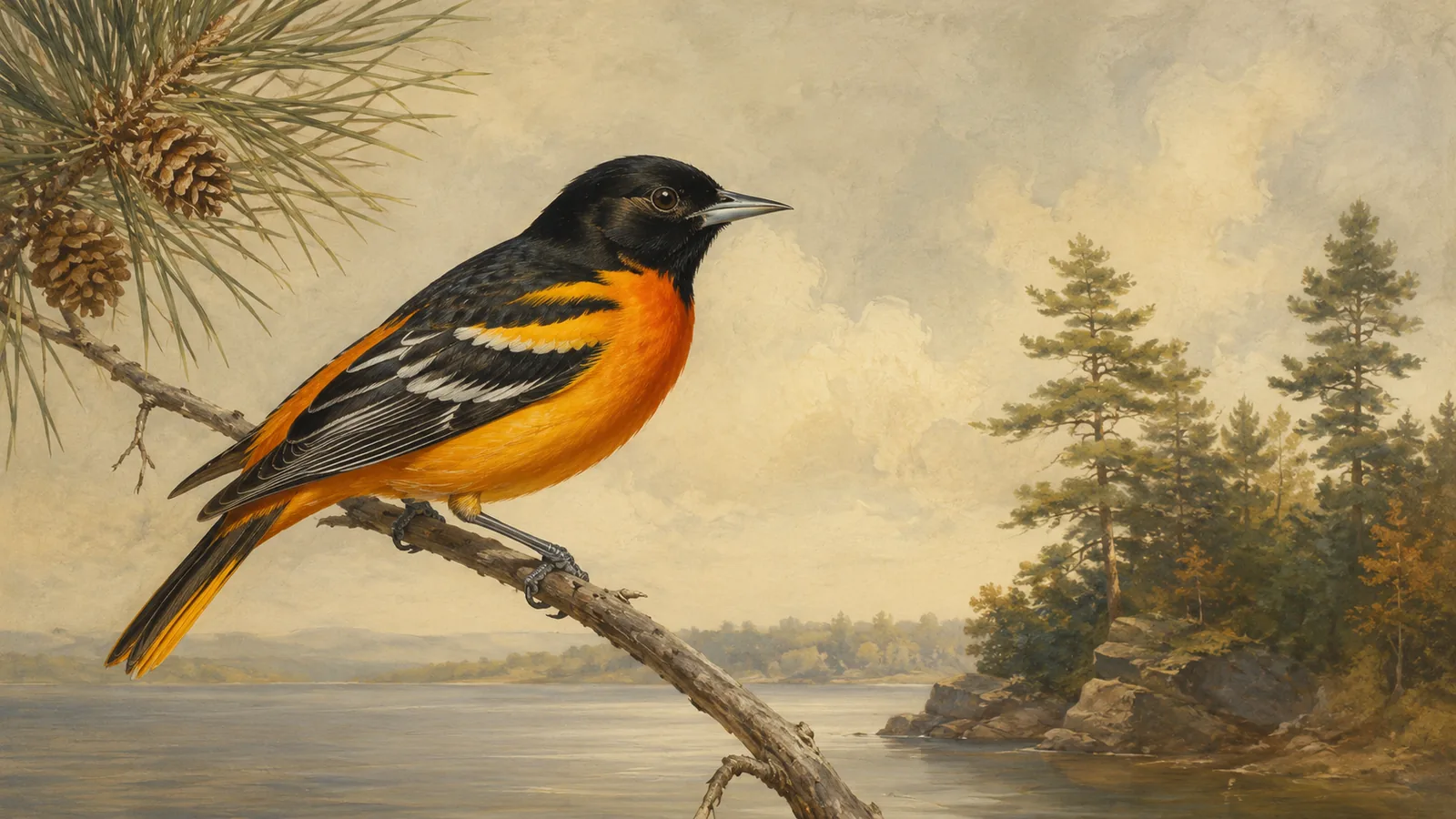
Icterus bullockii works the cottonwood corridors of eastern and southwestern Oregon. Adult males carry a bright orange face, breast, and underparts, offset by a black crown and back and a bold white wing patch. Audubon’s field guide puts the bird at 6.7 to 7.5 inches - roughly robin-sized - and it is the most immediately orange bird on this list, perching in open cottonwood crowns where the colour reads cleanly in full light.
Bullock’s Orioles arrive in spring and depart early. Audubon notes that many birds leave northern breeding areas by the end of July, which makes the window narrower than you might expect. The Oregon Department of Fish and Wildlife lists the species as a “rare to fairly common breeder” with the strongest populations in Jackson County’s Rogue Valley and along rivers in northeast Oregon.
Females build the nests alone. The architecture is notable: plant fibres, bark strips, and grass woven into a hanging pouch suspended from the tips of slender drooping branches, 10 to 25 feet above the ground, its rim fastened firmly to supporting twigs. The nest swings in wind without dislodging the clutch of four or five eggs. Incubation lasts about 11 days, and nestlings fledge around two weeks after hatching. The whole breeding attempt runs May through July across most of Oregon’s range.
The Bullock’s Oriole hangs its nest from the tips of slender drooping branches - a woven pouch suspended over a cottonwood-lined stream, engineered to swing in the wind without dislodging a clutch of four or five eggs. Audubon puts the estimated population at 7.4 million, with slight recent declines.
Quick facts
Season in Oregon: May through late July Habitat: Cottonwood groves, riparian woodlands, open farmsteads Diet: Insects, caterpillars, berries, nectar Status: Least Concern
Rufous Hummingbird
Selasphorus rufus is three inches long, weighs less than a nickel, and breeds farther north than any other hummingbird - up to south-central Alaska, according to Audubon. Oregon is part of its core Pacific breeding range. Spring movement comes up the Pacific lowlands early; fall migration swings back south through the Rockies, beginning in late June when adult males leave first, followed by adult females roughly two weeks later, then young birds of both sexes.
The male is unmistakably orange - bright coppery rufous on the back, crown, and flanks, with a throat that turns iridescent red in good light. Females carry a green back with an orange-buff wash on the sides. The Klamath Bird Observatory, which has studied this species’ migration through southern Oregon, has documented that young birds migrate more heavily through California than adults, suggesting the age groups run different routes south.
The Rufous Hummingbird is the only species on this list with a conservation concern. Audubon lists it as Near Threatened, with continuing population declines at roughly two percent per year. The causes are not fully settled, but the Klamath Bird Observatory notes that different age and sex groups may be affected differently by habitat loss and climate changes along the migration corridor - a complexity that makes population management difficult.
Quick facts
Season in Oregon: Spring through early fall; most visible in mountain meadows and forest edges Habitat: Forest edges, clearings, brushy second growth Diet: Nectar from red tubular flowers (paintbrush, columbine, penstemon); insects Status: Near Threatened
Varied Thrush
Ixoreus naevius does not migrate south for winter. It migrates down - from the high Cascades and Coast Ranges to the lowland forests and backyards of western Oregon, where it arrives in autumn and stays until spring. It is the orange bird of the rain.
The male carries an orange throat and eyebrow stripe, a dark breast band, and orange wing markings on a slate-blue back. Audubon describes the species as a bird of “dense, wet forest near the coast, in areas of fir, hemlock, and spruce with dense understory,” and the Oregon Department of Fish and Wildlife confirms it breeds throughout the Coast Ranges and in the Cascades. The ODFW describes the song - a single drawn-out minor-key whistle, then silence, then another at a different pitch - as piercing “fog and dense foliage” in a way that makes the bird hard to locate even when close.
It forages on the ground, tossing leaf litter aside to find beetles, ants, and caterpillars in summer, shifting to berries, wild fruits, and acorns in winter. Most Oregon birders encounter it as a winter feeder visitor, but it feeds on the ground beneath feeders rather than at them. For breeding birds, old-growth Sitka spruce and western hemlock along the coast in June is the correct address. The Varied Thrush is the species birders from Illinois or Michigan make deliberate trips to Oregon’s coast to find - it does not appear on Ohio’s orange bird list at all, and barely edges into Arizona’s desert checklist.
Quick facts
Season in Oregon: Year-round; breeding in Coast Ranges and Cascades, wintering in lowlands Habitat: Dense coniferous forest, wet coastal and montane stands Diet: Insects in summer; berries, seeds, and acorns in winter Status: Least Concern
When to look
| Species | Peak Oregon window | Best habitat |
|---|---|---|
| Western Tanager | Mid-May to August | Cascade Douglas fir, ponderosa pine |
| Bullock’s Oriole | May to late July | Cottonwood riparian, Rogue Valley |
| Rufous Hummingbird | Spring through July | Mountain meadows, forest edges |
| Varied Thrush | October to April (lowlands) | Coastal old-growth, wet forest |
The Varied Thrush is the one to commit to memory. Unlike the tanager or the oriole, it does not depart for Central America at summer’s end. It belongs to the fog and the hemlock and the wet ground in November. When it turns up at a Portland feeder in December, the bird is not lost; it has moved downhill, as it does every autumn, to wait out a season Oregon specialises in. That is a different kind of orange bird - not the summer arrival that brightens the high country, but the resident that makes February in the rain forest worth the drive.