Pets
Do Toucans Make Good Pets?
The bird at a wildlife rehabilitation centre in Brazil had arrived the previous week. Someone had fed it pellets designed for parrots. The pellets were fine for parrots. For a toucan, the iron content was enough to begin the slow accumulation in the liver that the World Small Animal Veterinary Association identifies as one of the most common causes of death in captive Ramphastidae. The bird looked healthy. It was not.
This is the central problem with toucans as pets: the danger is invisible until it is serious, and most of the people selling them do not mention it.
What a toucan actually is
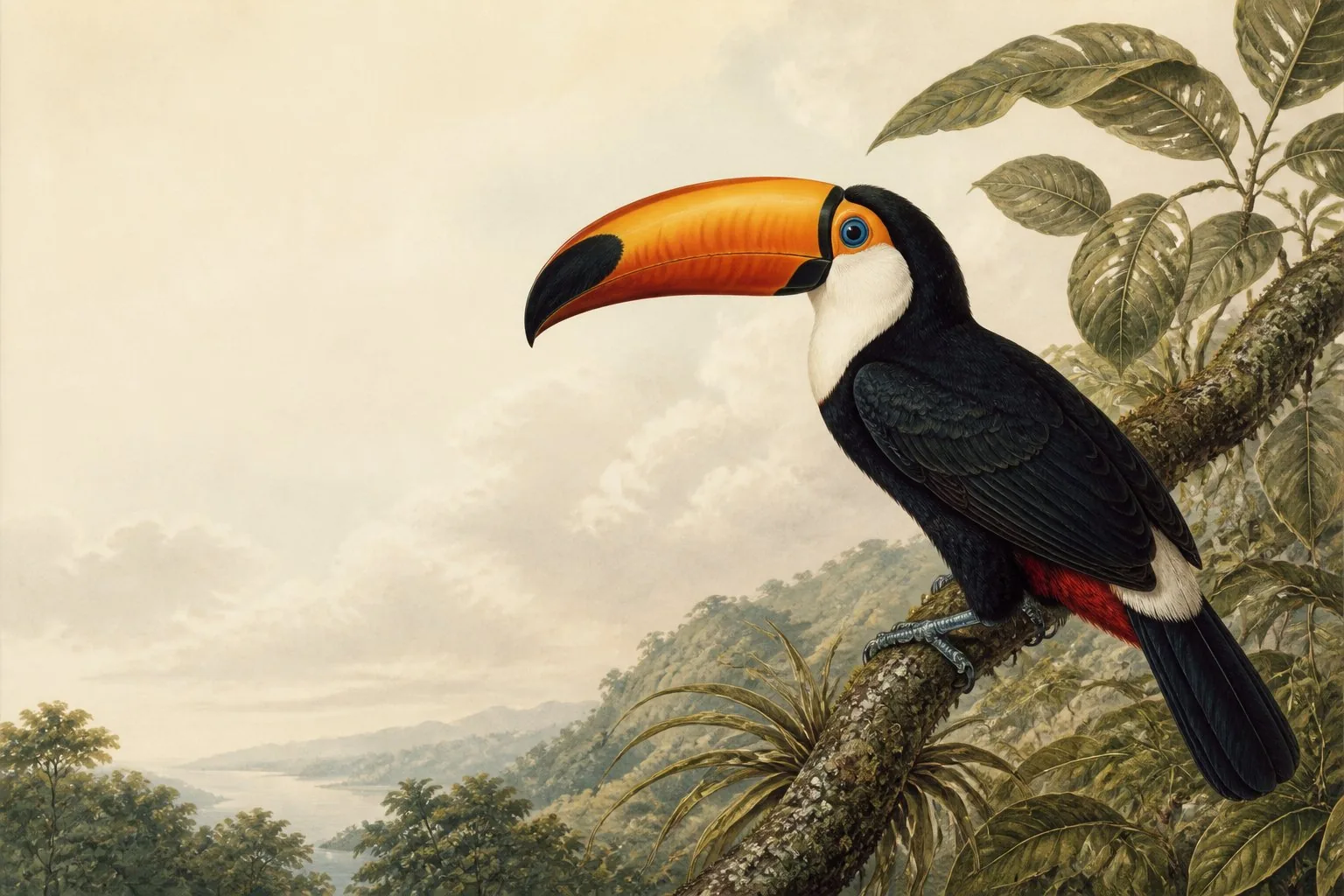
The family Ramphastidae contains over 40 species across five genera, all of them Neotropical - distributed from southern Mexico through Central America to northern Argentina. They are not parrots. They are arboreal frugivores adapted to a very specific nutritional environment: low-iron tropical fruit, eaten in large quantities, with quick gut transit. The Animal Diversity Web records the toco toucan (Ramphastos toco) - the largest species, averaging 61 cm and weighing up to 760 grams - reaching 20 years in the wild, but averaging closer to 18 years in captivity, largely because of diet-related disease.
The bill is real, and it does more than its size implies. A 2008 study on heat exchange in the toco toucan confirmed that the bill functions as a controllable thermal radiator: birds regulate body temperature by routing blood through the bill’s vascular network. It accounts for one-third of body length but only one-twentieth of body mass - hollow inside, a lattice of bony fibres covered in keratin. In the wild they use it to pluck fruit at the tip of a branch too narrow to perch on, to toss food to a mate during courtship, and to raid the nests of smaller birds. In an aviary it tips food into a bowl. The function does not disappear, but the use does.
Toco toucans are social birds. Wild individuals move in flocks of roughly six, nomadically following fruiting trees, according to the Animal Diversity Web. They are diurnal, arboreal, and loud. The PBS Nature fact sheet records that toucans travel in loose flocks of up to 22 individuals. They lay two to four white eggs in tree cavities excavated by other animals; both parents incubate for 15 to 18 days; chicks fledge in six to eight weeks. Sexual maturity comes at three to four years.
The iron problem
Toucans do not regulate iron absorption the way most birds do. When dietary iron is high, they absorb it anyway. The liver accumulates it. The clinical term is hemochromatosis, or iron storage disease, and it is documented as one of the most common causes of toucan mortality in captivity by the 2009 WSAVA congress proceedings on toucan husbandry and medicine.
VCA Animal Hospitals’ formal dietary guidance for toucans sets the safety threshold at iron content below 90-100 parts per million. The WSAVA proceedings place the optimal target at around 40 ppm. Many standard pelleted diets sold in pet stores run well above both figures. The disease presents late. By the time a captive toucan shows lethargy, laboured breathing, and fluid accumulation, the liver damage is usually extensive. LafeberVet’s clinical review of iron storage disease in birds confirms that liver biopsy is currently the only reliable way to evaluate iron status in a living bird before advanced symptoms appear.
Treatment exists: phlebotomy, deferoxamine chelation, strict dietary change. The WSAVA proceedings cite deferoxamine at 100 mg/kg daily for 110 days as one documented protocol. These are not procedures most general exotic-bird vets can manage. Finding a veterinarian with direct toucan experience outside a major metropolitan area is, across the available aviculture literature, consistently described as difficult.
The dietary restrictions compound the challenge. Citrus fruits and tomatoes are excluded because their organic acids increase iron absorption. Grapes, corn, beans, and peas are limited for the same reason. Avocado is toxic. VCA’s guidance excludes salty, oiled, canned, and starchy foods entirely. What remains is a specific roster of low-iron fresh fruit - papaya, banana, blueberries, melons, peaches - plus specialist low-iron pellets and occasional soft insects, maintained without interruption for two decades.
Iron storage disease is one of the leading causes of toucan mortality in captivity. It develops silently, requires specialist diagnosis, and is almost entirely a product of getting the diet wrong - which is easy to do because the safe margin is narrow and the symptoms appear only after the window for easy intervention has closed.
The legal reality
Toucans appear on CITES Appendix II, which means their international trade is regulated to prevent overexploitation. The US Wild Bird Conservation Act of 1992 prohibits import of CITES-listed exotic birds unless specific conditions are met - including captive-bred certification from approved facilities. Any bird sold in the United States should be domestically bred. State law is patchwork: some states permit ownership without restriction, others require permits, others ban exotic birds outright. Local zoning adds a further layer. Anyone considering a toucan needs to confirm their specific state and county requirements before purchase, not after.
What keeping one actually involves
A toucan hops and bounces between perches rather than climbing. Standard parrot cages are wrong for the body plan and for the need for horizontal flight distance. Specialist aviculture guidance starts aviaries at 3 metres in each dimension. Soft mesh enclosures are preferred over metal bars: toucans strike their bills when startled, and beak fractures are a documented consequence of metal-bar housing, per the WSAVA proceedings.
Toucans produce frequent, loose droppings - a consequence of a short digestive tract with no crop, designed for high-volume fruit throughput. VCA’s feeding guide notes they consume large volumes and produce droppings correspondingly often. There is no quiet phase. Cleaning is continuous.
Key facts
Lifespan: Up to 20 years in the wild; approximately 18 years in captivity (toco toucan, Animal Diversity Web)
Body length: 61 cm average for toco toucan; smaller aracari species from around 30 cm
Primary diet: Low-iron fruit; specialist low-iron pellets (target below 40 ppm iron); occasional insects
Conservation status: Toco toucan - Least Concern (IUCN); keel-billed toucan (Ramphastos sulfuratus) - Near Threatened (Cornell’s Birds of the World, 2020); yellow-browed toucanet - Endangered (IUCN)
Trade: CITES Appendix II; US Wild Bird Conservation Act 1992 restricts import
Enclosure minimum: 3 m x 3 m aviary (specialist aviculture consensus)
The conservation picture
The keel-billed toucan - the species from every cereal box - occupies tropical lowland forest from southern Mexico to northwestern Venezuela. Cornell’s Birds of the World classified it as Near Threatened following an assessment published March 2020. The toco toucan, listed as Least Concern by IUCN, is the most commonly kept species in captivity. The yellow-browed toucanet of Peru holds Endangered status, restricted to a small range fragmented by deforestation.
Habitat loss drives most of these pressures. The JRank Animals encyclopaedia notes that selective logging removes the large emergent trees that support the fruiting figs on which toucans depend, and that new roads through forest isolate populations because toucans will not cross wide open spaces. The bird in the pet trade and the bird losing ground in northern Peru are not the same species, but they are the same family, shaped by the same ecology.
The honest answer
Toucans are appropriate for experienced aviculturists with a purpose-built aviary, a reliable supply of low-iron produce, an established relationship with a vet who has actually treated ramphastids, and a commitment that runs to 18-20 years. Those conditions describe a small number of households.
The bird is not the problem. The problem is the gap between what a toucan requires - biologically, spatially, medically - and what most people seeking one have prepared for. That gap is where most captive toucans come to harm. If you are drawn to the bird because it is unusual and colorful, the better investment is probably supporting conservation of the Neotropical forests it belongs to.
If you want a genuinely social and trainable companion bird, reading about what parrots can eat gives a sense of how the care profile differs in ways that matter at the level of daily practice. If you do have the setup and experience for a toucan, how toucans sleep and whether they migrate or hibernate are worth understanding before the bird arrives. Wild behavioural patterns predict captive behavioural problems. And choosing the right enrichment for a bird that forages across a forest canopy in a flock of six is a question worth taking seriously before the animal is in the aviary, not after.
The bird in Brazil recovered. Low-iron diet, phlebotomy, months of chelation. Most captive toucans that reach that stage do not. The owners who keep them well are not the people who wanted an unusual bird. They are the people who specifically studied this one.