Biology
Are Hummingbirds Territorial?
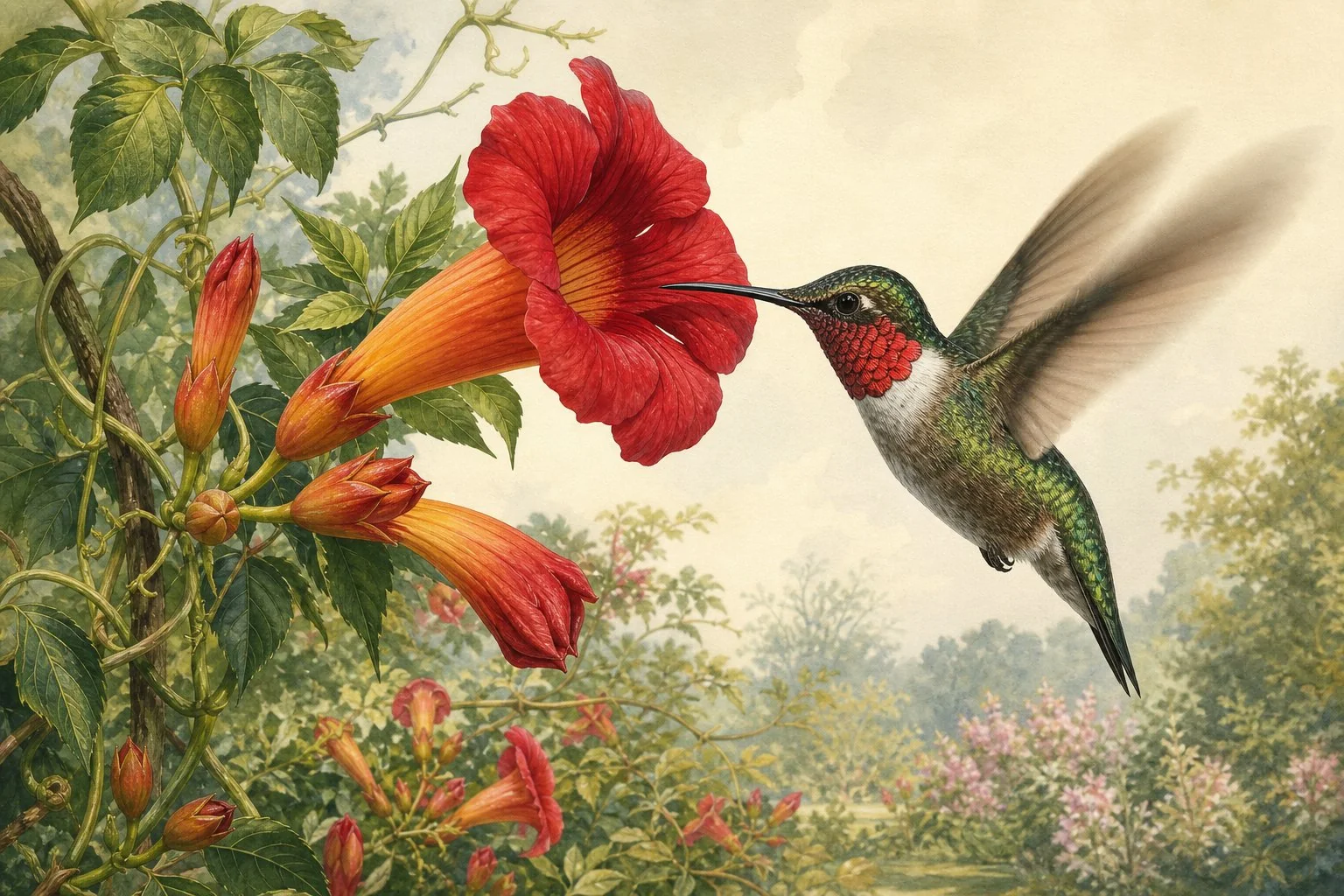
A male hummingbird settles on a thin branch, still for once, and watches a feeder. Another bird approaches. He is off the branch before the intruder finishes decelerating - a blur, a sharp chatter, and the rival is gone. He returns to the same branch. He waits. Within the minute, he does it again.
Hummingbirds are not aggressive by accident. They are aggressive because of arithmetic.
The energy equation
A hummingbird’s heart can beat at rates exceeding 1,200 times per minute during flight, according to ornithologist Scott Weidensaul, quoted in Audubon’s coverage of the subject. That metabolic demand is met almost entirely by sugar - the nectar in flowers and feeders. The problem is that any given patch of flowers produces only so much nectar in a day, and once depleted, the patch needs hours to recover. Weidensaul frames the evolutionary mismatch precisely: hummingbirds “evolved with small portion sizes, not all-you-can-eat buffets.” When you put a feeder in your yard, the bird responds to it the way its ancestors responded to a prime patch of wild cardinal flower - as a resource that must be protected.
This is why the aggression transfers so completely to artificial feeders. The bird is not confused. It is applying a strategy that kept its ancestors alive.
Who defends, and how
Both sexes defend feeding territories, and both defend them year-round. Cornell’s All About Birds documents that birds of all ages and sexes will chase intruders from food sources, with adult males responding most forcefully to rival males.
The escalation follows a recognisable pattern. First come the signals: tail fanning, gorget flashing, loud chattering. These are unambiguous - the defender is telling a rival it is unwelcome without risking the energy cost of physical contact. If the intruder holds its ground, the defender moves to plunge-dives and, if necessary, bill stabs and foot grabs. Challengers almost always retreat before it comes to that. Actual contact is expensive for both parties.
A study published in PLOS ONE tracked 88 individually tagged male Archilochus colubris - the Ruby-throated Hummingbird - across a 44-hectare grid with 45 feeders in Quebec over three breeding seasons. Researchers found that 16.9% of 2,459 observed feeder visits ended in a pursuit. Males who successfully monopolised a feeder averaged 19.29 visits there, against a random expectation of 7.88 - a concentration that held even as competitor numbers rose. The study also documented “a continuum in resource defense strategies,” with some males showing almost no territorial behavior while others excluded competitors strongly. Individual variation matters as much as species-level instinct.
The hummingbird at your feeder is not being territorial at you. It is running the only energy budget it has, and the math does not permit sharing.
The Rufous exception
Among North American hummingbirds, Selasphorus rufus - the Rufous Hummingbird - occupies a category of its own. At just 2.8 to 3.5 inches long and two to five grams, it nests farther north than any other hummingbird, reaching south-central Alaska, and migrates up to 3,000 miles on an elliptical route: north along the Pacific coast in spring, south through the Rocky Mountains each fall. At every stop along the way, it does the same thing. The American Bird Conservancy describes it as “a tiny warrior, readily attacking birds many times its size.”
Cornell’s All About Birds notes that Rufous birds will drive off Broad-tailed, Black-chinned, and Broad-billed hummingbirds that can be double their weight - and that this aggression holds even during the one to two week stopovers of active migration. The bird is not planning to stay. It is claiming a feeder or flowering shrub for exactly as long as it needs it.
The Rufous also shows a territorial asymmetry documented in the Wikipedia entry on the species: males defend areas with dense flower concentrations, using aggression to push females toward sparser patches. Females, in turn, defend larger territories at lower flower densities. Aggression shapes not just who eats, but where.
What this means at a feeder
A single feeder in an open location is easy to monopolise. One bird perches with a clear sightline to the port, and effectively the feeder feeds one bird. Audubon recommends hanging multiple feeders in widely separated or visually screened locations - around the corner of a house, behind a shrub, out of the monopolist’s sightline. When a bird cannot simultaneously defend two feeders, both get used.
Planting native nectar sources also helps. Hummingbirds defend larger territories when flowers are scarce and ease off when nectar is more distributed. A yard with red tubular natives provides the distributed small-portion environment the bird evolved to manage, rather than one irresistible target.
The bird driving off rivals is not a problem. It is a healthy bird running a strategy that has worked for millions of years. The strategy is just inconvenient for the bird you were rooting for.
If you are curious how another familiar backyard species handles territorial resources, cardinals have their own version of the calculus. For how birds maintain condition through physically demanding seasons, cardinal molting covers the cost side of that equation. And the social structures around groups of cardinals at a winter feeder turn out to be more organised than the hummingbird’s blunt exclusion.