Biology
Yellow Cardinals: The Enzyme That Didn't Fire
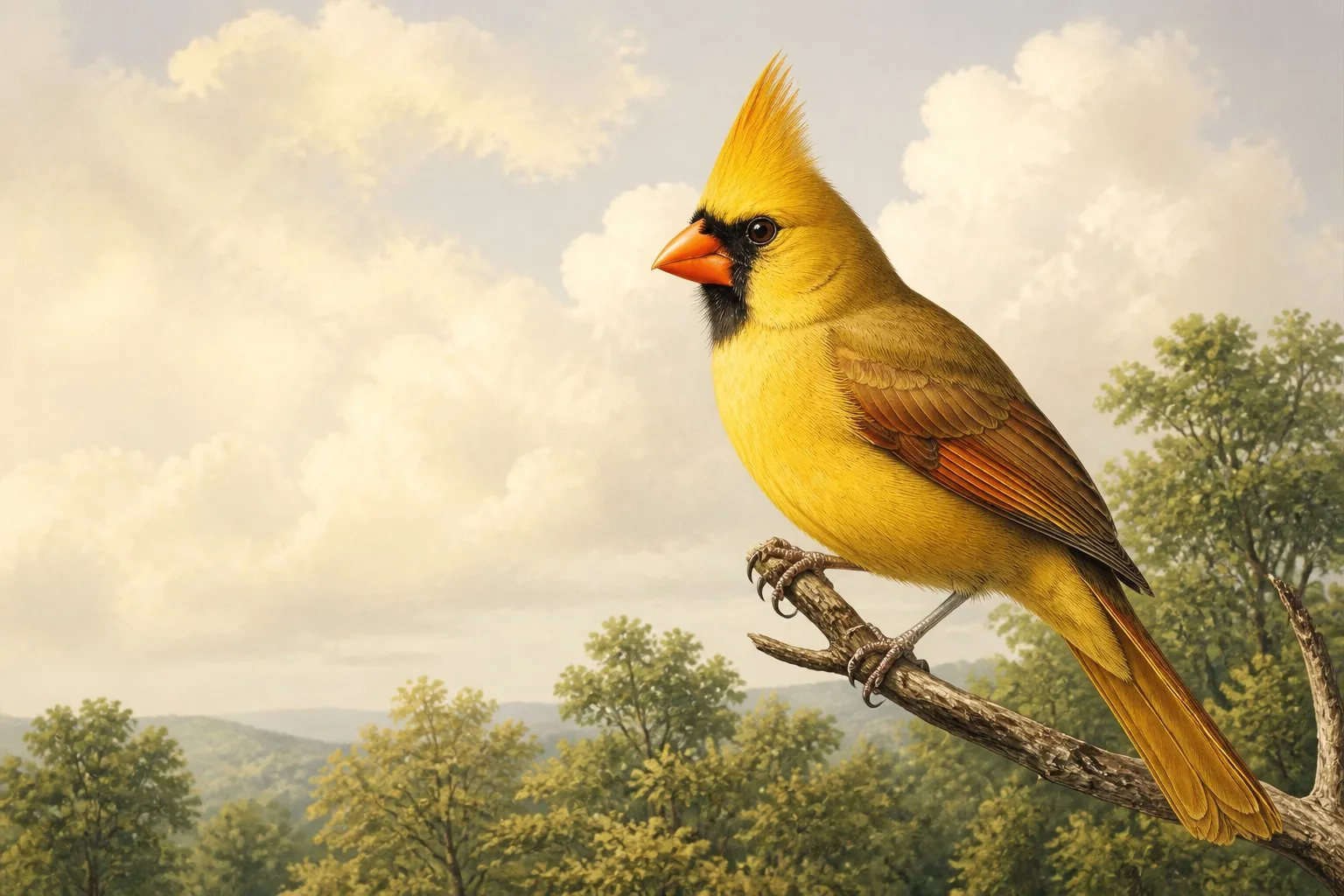
In late January 2018 in Alabaster, Alabama, a birdwatcher named Charlie Stephenson noticed something wrong at her feeder. The crest was right. The bill was coral pink. The black face mask was as sharp as any other male. But the body was gold instead of red - every feather that should have burned scarlet was the colour of turmeric.
She photographed it and the image circulated on Facebook. By mid-February, wildlife photographer Jeremy Black had documented the same bird. Geoffrey Hill, an ornithologist at Auburn University who had spent 40 years studying cardinals, confirmed to Audubon that he had never encountered a wild bird like it.
The yellow Cardinalis cardinalis is not a different species. It is the same bird, one enzymatic step short of red.
What actually goes wrong
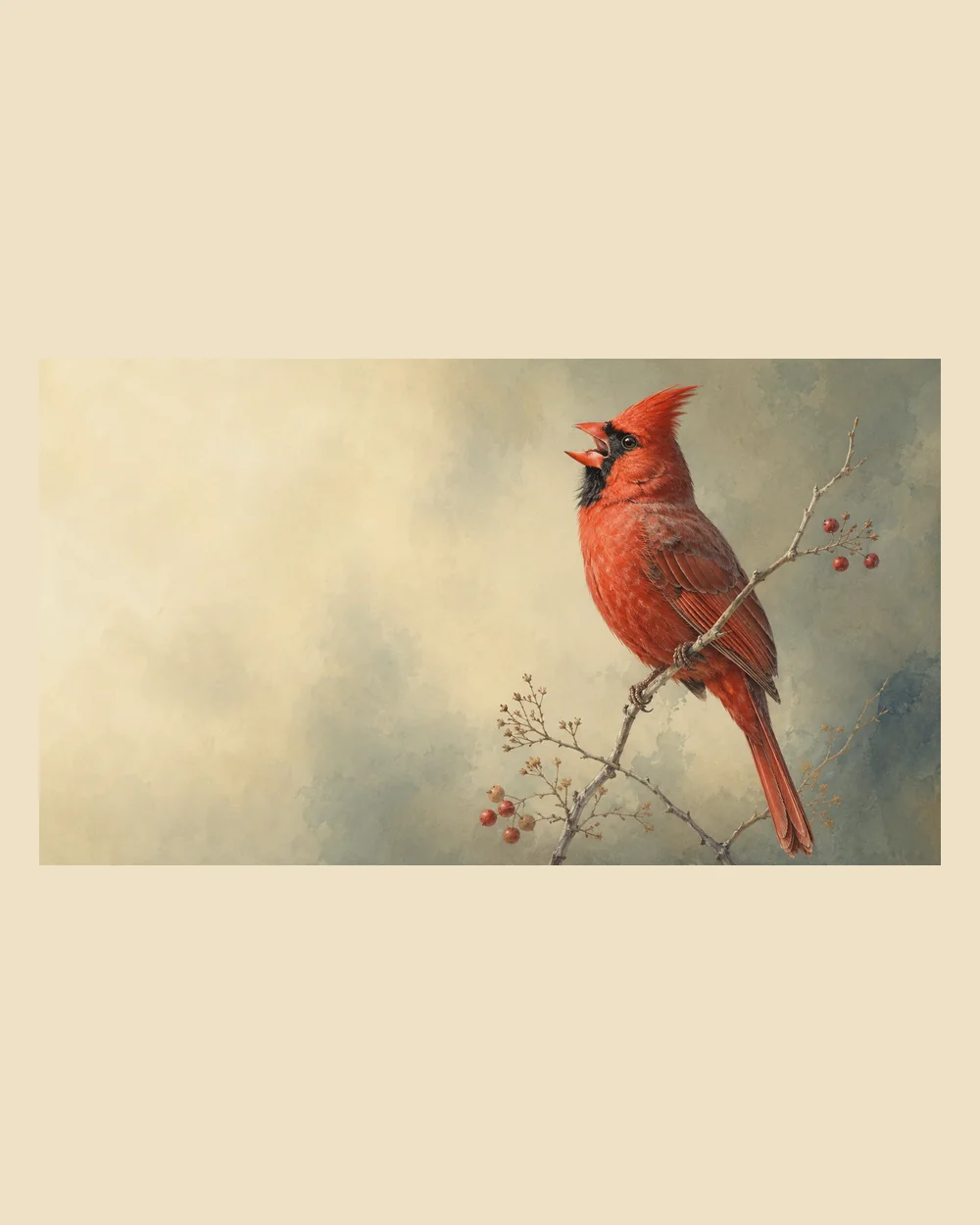
Cardinals do not manufacture red pigment. They eat it, or rather, they eat the raw materials and run the conversion in-house. Seeds and berries contain yellow carotenoid pigments. A cardinal’s body absorbs those pigments and then enzymatically oxidises them - adding keto groups at certain carbon positions - to produce the red and orange ketocarotenoids deposited in the feather barbs. The specific compounds in a normal male include canthaxanthin, astaxanthin, adonirubin, and alpha-doradexanthin.
In a yellow cardinal, that final conversion does not happen. A 2003 study by McGraw, Hill, and Parker published in The Condor analysed the feather pigments of a yellow cardinal specimen collected in Baton Rouge, Louisiana in 1989. They found the bird’s feathers contained lutein, 3’-dehydrolutein, and canary-xanthophylls - all yellow metabolic products - and none of the four red ketocarotenoids present in normal males. The total carotenoid concentration was within normal range. The bird was not pigment-deficient. The 4-oxygenase enzyme responsible for adding keto groups was blocked or absent, and the yellow substrate arrived from the diet, deposited unchanged.
A yellow cardinal is not missing colour. It is missing one reaction in a chain of reactions. Everything upstream of that step works exactly as it should.
How this differs from leucism and albinism
The distinction matters for identification. White cardinals arise from failures in a completely different pigment system - melanin production and deposition. Melanin controls the black face mask and the dark feather edges. Carotenoids control the red and yellow body plumage. The two systems run independently.
A yellow cardinal’s melanin pathway is intact. The face mask is black. The eyes are dark and normal. A different pigment quirk gets blamed for the blue cardinals people report seeing, which are something else entirely. Nothing about the bird signals gross ill-health at a glance. Geoff LeBaron of the National Audubon Society, who examined photographs of the Alabaster bird, noted that worn crest feathers and fraying wings might point to health stress. Hill read them as wear consistent with a normal winter bird and argued genetics was the primary cause. LeBaron told Audubon at the time that if the bird returned to Stephenson’s feeder the following winter, the genetic case would be strengthened.
Where sightings occur
Documented cases concentrate in the southeastern United States. Beyond the 2018 Alabama bird, a yellow cardinal has been observed repeatedly at a feeder in Port St. Lucie, Florida. Photographer Tracy Workman documented it on multiple visits and nicknamed it “Sunny.” The Fish and Wildlife Foundation of Florida covered the sighting. BirdNote cites xanthochromism - the term for yellow replacing an expected colour - as appearing only in a handful of cases per million bird sightings, with similar mutations recorded in House Finches and Red-bellied Woodpeckers.
The Project FeederWatch abnormal-plumage survey, which documented approximately 1,605 unusual-looking birds out of roughly 5.5 million bird records between 2000 and 2007, gives a sense of the baseline rarity of colour mutations across all feeder species combined. Yellow cardinals are a fraction of that already small category. The ordinary red bird is common enough that cardinals are not rare anywhere in their range, but the golden variant is a different order of scarcity.
The Northern Cardinal ranges across most of the eastern United States and into Canada and Central America, and the species is not endangered. A xanthochromic individual could arise anywhere within that range. Most confirmed sightings have happened in Alabama and Florida, but that may reflect where concentrated birdwatching populations have noticed and reported them.
Genetics and the female version
The mutation is recessive. Two parents carrying the gene without expressing it can produce a yellow offspring. This explains why yellow cardinals sometimes appear with no obviously yellow parent in the territory.
Both sexes are affected, but female yellow cardinals draw far less attention. A normal female Cardinalis cardinalis is already buff-brown with warm reddish tints rather than bright red - because she deposits carotenoids differently and at lower concentrations than the male. A female yellow cardinal is pale olive-yellow in place of that warm buff, a subtler shift that observers often miss entirely.
Yellow males hold territories and attract mates. Their song is identical to any other male’s. What is a group of cardinals called? They travel in loose flocks outside breeding season, and a yellow bird in that flock would be the first one anyone noticed. Whether female cardinals read yellow plumage as bright or simply as wrong is an unresolved question. Red plumage brightness in normal males signals carotenoid access and foraging quality. A male who cannot convert pigments at all presents an entirely different signal, and the research on cardinal molting and female mate choice has not addressed the yellow case directly.
The other bird with this name
There is a completely separate species called the Yellow Cardinal - Gubernatrix cristata - native to Argentina, Uruguay, and southern Brazil. It is yellow by design, not by mutation. The IUCN Red List classifies it as Endangered, under pressure from habitat clearance and trapping for the cage-bird trade. The two birds share almost nothing biologically and only share an English name by accident.
If you read about yellow cardinals in a South American conservation context, you are reading about Gubernatrix. If you are reading about one at a feeder in Alabama or Florida, you are reading about a mutant Cardinalis cardinalis.
If you see one
Photograph it and submit the record to Cornell’s eBird platform with a location and date. A clear image of the face mask and eyes alongside the golden plumage is enough to confirm xanthochromism and rule out diet-related colour shifts, which tend to be uneven and transient. A bird that returns to the same feeder across two winters, gold both times, is almost certainly carrying the genetic form.
Keep the feeder clean and stocked - the same discipline that applies to cleaning hummingbird feeders with vinegar applies here. A rare bird that finds a reliable food source has a reason to return.
The thing the yellow cardinal demonstrates, standing at a winter feeder looking like a canary that wandered into the wrong yard, is that the red male you feed every morning is only red because one enzyme fired correctly during every moult of his life. The yellow bird stopped there. Everything else - the crest, the mask, the bill, the territorial song, the preference for sunflower seed - is identical.