Pets
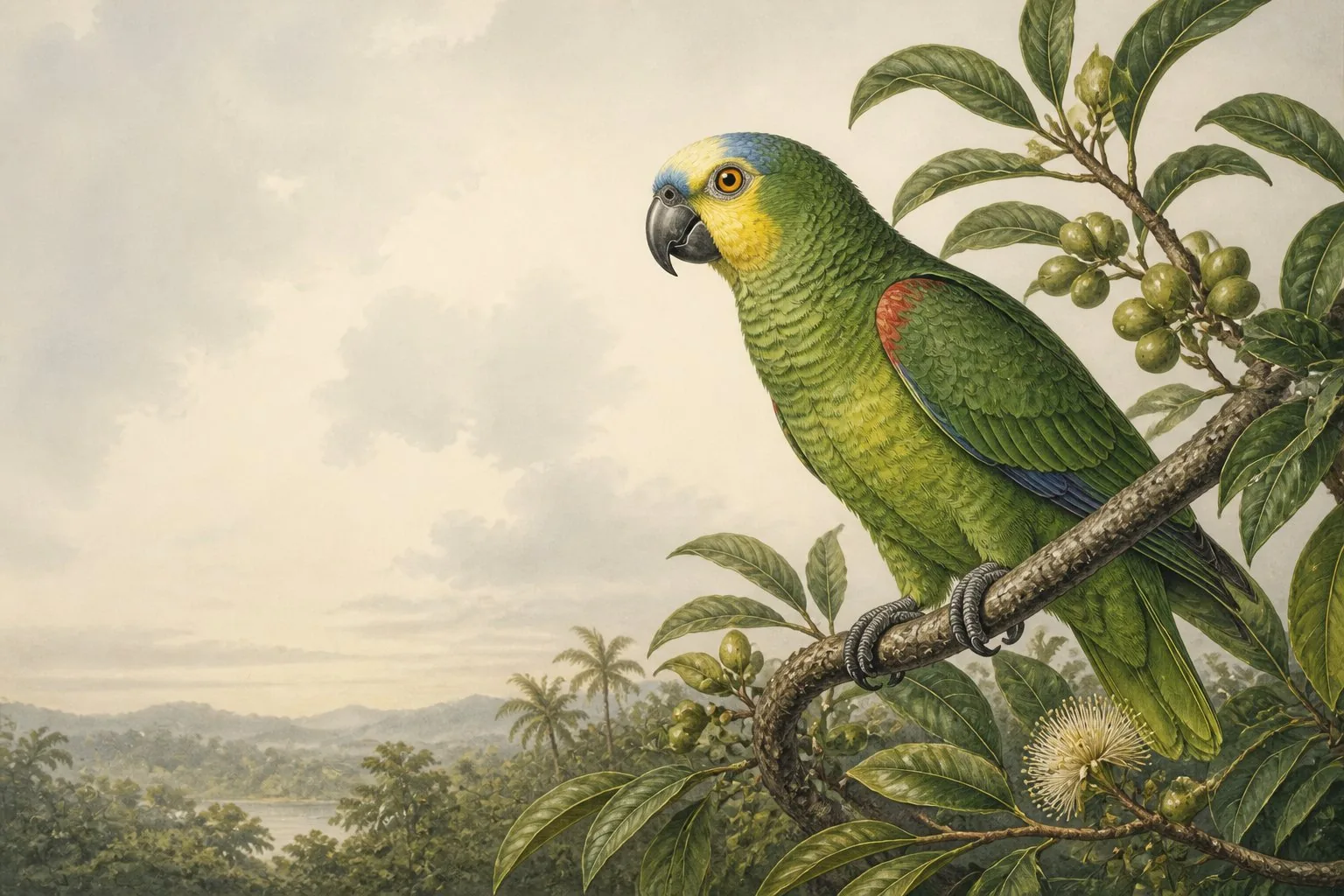
Types of Green Parrots: What Makes a Parrot Green
A male Eclectus roratus sits somewhere in the New Guinea rainforest and he is, without qualification, green. Bright, cool, emerald green. His mate, sitting two metres away, is red and purple. For over a century, European naturalists listed them as separate species. The plumage difference is that complete.
Most parrots are green. The question worth asking is why - and the answer changes how you read every species in the pet trade.
Green is not a pigment
This matters. Research published in the Journal of Experimental Biology found that green parrot feathers produce their colour through two separate systems running in parallel: a yellow psittacofulvin pigment laid into the feather barbs, and a nanostructured spongy layer beneath it that scatters light in the blue wavelengths. Neither system alone produces green. The yellow filters the blue; the blue underlies the yellow. Parrots are the only birds that synthesise psittacofulvin - every other bird that displays yellow relies on carotenoids from its food.
Damage either component and the bird shifts toward yellow or blue. This is precisely what happens in the albino and lutino mutations common in captive budgerigars. A lutino budgerigar - all yellow, no blue - has lost the structural scattering layer but kept the pigment. A sky-blue budgerigar has kept the structure but lost the yellow filter.
Green parrots are not green because of green pigment. They are green because yellow pigment and blue light-scattering happen, simultaneously, in the same feather barb - and the two components segregate independently in captive breeding.
This also explains why green works as canopy camouflage across the humid tropics. Dappled light shifts the apparent colour of a green object toward blue in shadow and yellow in direct sun. The nanostructure handles both without the bird doing anything.
Four species worth understanding
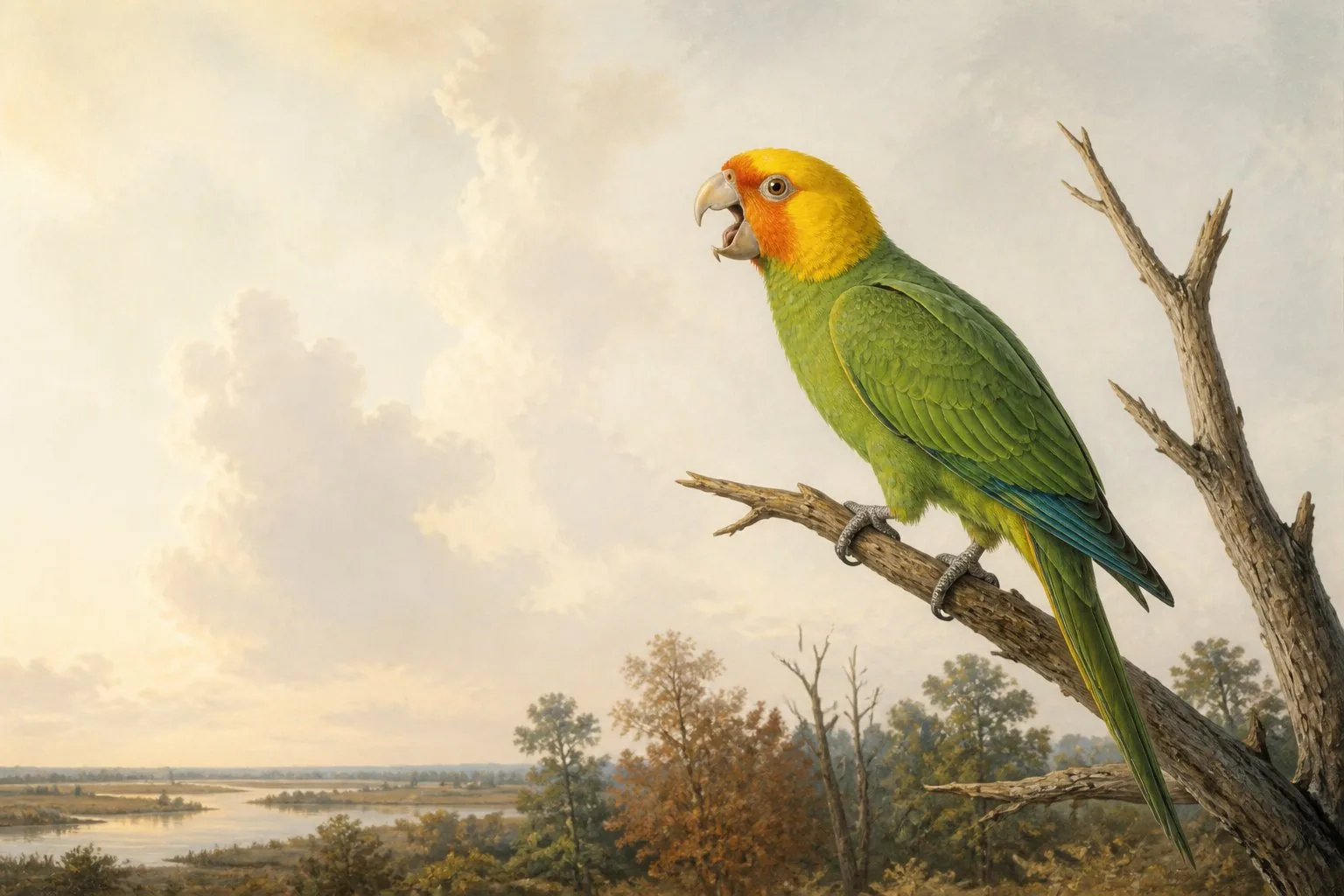
The pet trade narrows the field considerably. These are the green parrots most likely to turn up in a shop - or, in one case, on a city telephone pole. North America had its own green parrot once: the Carolina parakeet, green-bodied with a yellow-and-orange head, ranged across the eastern United States until it was hunted and cleared out of existence by the early twentieth century. Nothing native has replaced it.
Budgerigar (Melopsittacus undulatus)
The wild budgerigar is green and yellow - barred back, yellow face, green underparts - and native to the open grasslands and scrublands of interior Australia. Audubon’s field guide records the bird at 6.5 to 7.5 inches and 1 to 1.4 ounces. In the wild it is a nomadic flock bird, moving with seasonal rains across the arid interior to exploit seeding grasses. The IUCN lists the species as Least Concern.
The bird in the pet shop is almost certainly not green. A century of captive breeding has produced blue, white, yellow, and grey variants that bear no resemblance to the original. Escaped birds have established feral colonies along Florida’s west coast - the largest budgerigar population outside Australia in North America - where they occupy forests, woodlands, and urban habitats.
Green-cheeked Conure (Pyrrhura molinae)
Found across Bolivia, western Brazil, Paraguay, and northwestern Argentina, the green-cheeked conure occupies lowland woodlands and gallery forest at lower elevations, up through humid cloud forest to around 2,000 metres in the Andes. Six subspecies are recognised across that range. The plumage is dull brown on the crown, green on the cheeks and back, with a distinctive reddish belly and dark tail. Adults reach about 10 inches. The IUCN lists the species as Least Concern, though BirdLife International notes the population is declining due to deforestation.
Among conures, it has a reputation for being quieter than its relatives. This is relative - any parrot is loud compared to a canary - but it matters in an apartment. The green-cheeked conure is one of the more practical choices in the small-parrot category, which accounts for its prevalence in the trade.
For guidance on what any conure can safely eat, what parrots can eat is a useful starting point.
Monk Parakeet (Myiopsitta monachus)
Native to central Bolivia and southern Brazil south through central Argentina, the monk parakeet is also, as of the late 1960s, a resident of New York, Chicago, New Orleans, and coastal Florida. Audubon’s field guide records the bird at 11 to 11.8 inches and up to 4.9 ounces. Genetic analysis of US populations links them directly to escaped or released pet birds. The IUCN places the global population at around 20 million.
The monk parakeet is the only parrot that builds a stick nest rather than using a tree cavity. It constructs communal structures that individual pairs return to year after year, sometimes growing large enough on utility poles to cause power outages. This same behaviour is what allows them to survive Chicago winters - a communal nest retains heat in a way a hollow tree cannot. There is no evidence, per USDA assessments, that monk parakeets compete with or negatively affect native North American species.
Plumage is mostly green with a pale grey forehead and chest and blue visible in the outer wing in flight.
Pacific Parrotlet (Forpus coelestis)
The smallest parrot in common captivity, the Pacific parrotlet is native to western Ecuador and northwestern Peru, where it occupies dry forests, scrublands, and degraded former forest. Wild birds are green with a dusty grey cast and a bright green facial mask. Males carry blue on the wings, behind the eyes, and on the rump; females are plain green with subtler markings. The IUCN lists the species as Least Concern with a stable population, per Wikipedia citing the IUCN assessment.
In the wild, parrotlets live in flocks of 40 to 50, producing constant high-pitched chattering. In captivity, the same bird is notoriously territorial and is generally kept in pairs rather than with other species. The gap between flock animal and caged individual is wider here than in most parrots - something worth understanding before buying one. Choosing appropriate enrichment matters more than the cage size: how to choose age-appropriate bird toys covers the practical options, and a foraging puzzle that makes the bird work for its food channels that flock-foraging instinct better than an empty perch.
One link in this guide goes to Amazon. It points to gear we would actually put in front of a bird, and we earn a small commission if you buy through it.
A foraging puzzle toy is a sensible starting point.
The Eclectus case
Eclectus roratus ranges from New Guinea through the Solomon Islands to the tip of Australia’s Cape York Peninsula. Males measure 35 to 42 centimetres and display bright emerald green with red underwings and a yellow beak. Females are red with a royal blue underbelly and a black beak. Wikipedia notes that males and females were historically classified as separate species until the early 20th century - and that the species practices cooperative polyandry in the wild, where multiple males provision a single nesting female.
The reason this matters for keepers: the dietary needs of Eclectus parrots are unusual. In the wild they eat fresh fruit, flowers, and nectar. Eclectus parrots nesting 20 to 30 metres above the ground in New Guinea rainforest canopy are not eating seed-heavy diets. A captive Eclectus on primarily seeds develops nutritional problems that often present as behavioural issues, making the root cause easy to miss.
The IUCN lists the species as Least Concern, though the population is declining due to habitat loss.
What the choice involves
The colour of a parrot is the least informative thing about it. What matters is whether the social and behavioural profile of the wild bird matches what you can honestly offer. A monk parakeet needs the equivalent of a communal nest - structure, interaction, routine. A parrotlet from a 50-bird flock needs either a companion or significant daily time. An eclectus female has territory-holding instincts that do not disappear because she lives in a flat.
The nanostructure that makes these birds green took millions of years to develop. It is worth spending a few weeks understanding what else it comes with.
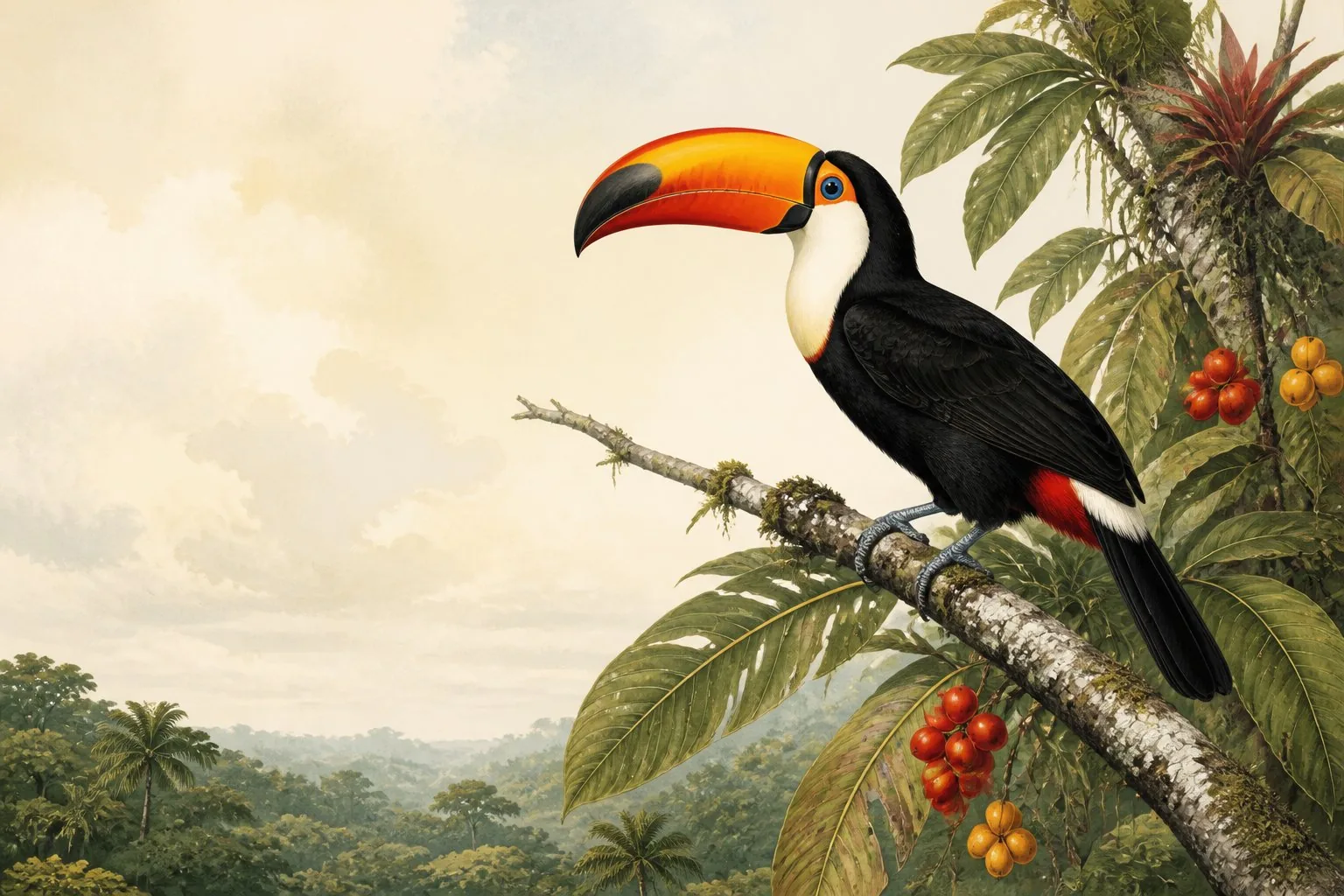
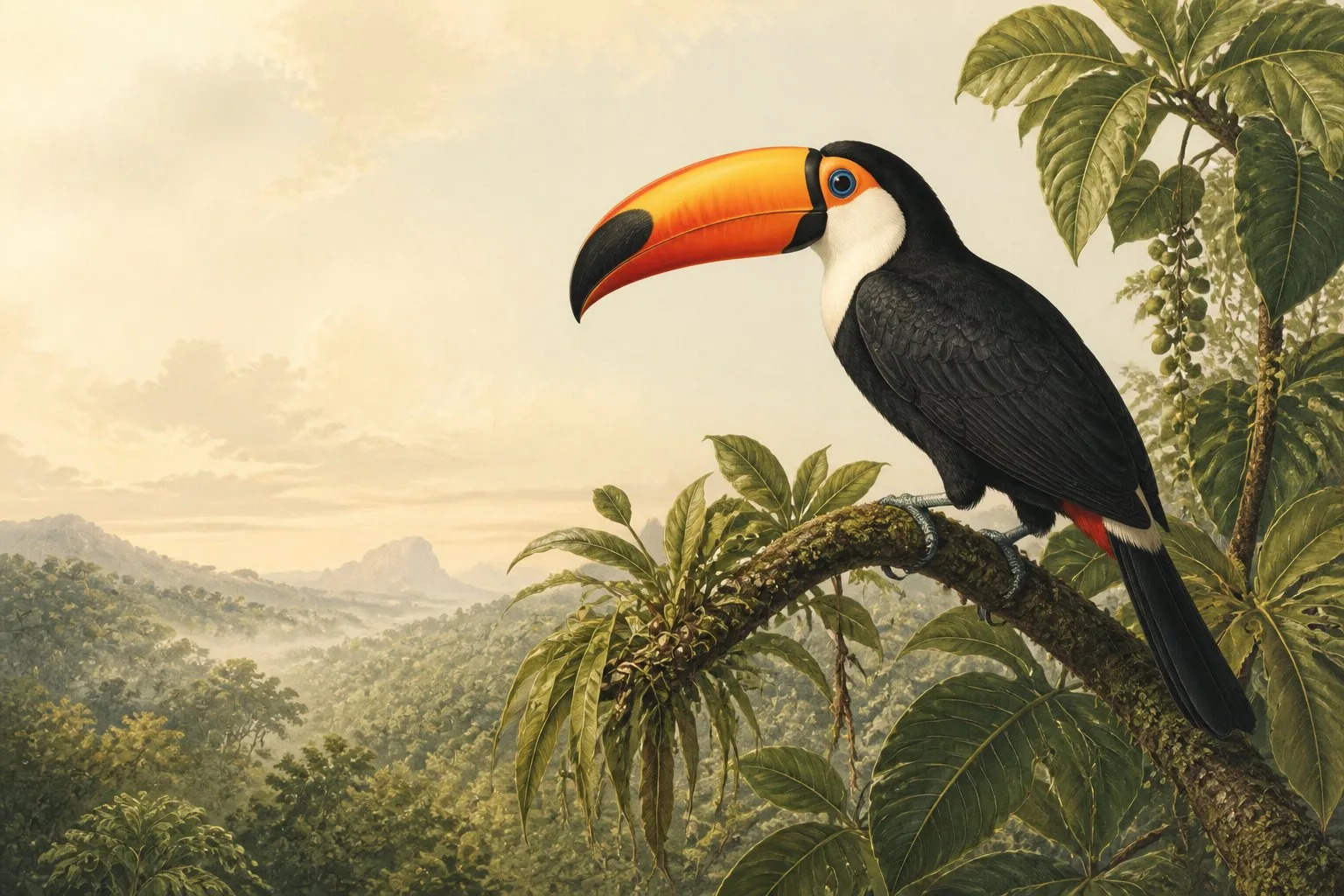
For a completely different perspective on how tropical birds manage their time, see when and how toucans sleep and whether toucans migrate. The comparison is instructive.