Symbolism
The cardinal at your window.
A red cardinal lands on your fence. A name comes to mind. Someone you loved. The two feel connected. There are three honest ways to read what just happened. All three are true.
Some say it's a visitor.
In the past twenty or thirty years, one belief about cardinals has spread so widely that for many North Americans it is the only meaning the bird carries. A red cardinal is a loved one returning to check in. It is the bird at the funeral, the bird on the day of the diagnosis, the bird that lands on the railing on the anniversary of the death.
The belief gathered around a small body of folk verse, most often the lines that begin Cardinals appear when angels are near. Variations of that poem have been traced to chain emails and greeting-card copy from the late 1990s onwards. No older source has surfaced. That does not make the belief false. It makes it ours - a folk tradition that crystallised in living memory and continues to do real work for people in grief.
The reason it took hold is partly the bird itself. Cardinals do not migrate. They are loyal to one small patch of land, often for life. They are also very red. So they show up at the same kitchen window, year after year, at the exact moments people are most likely to be looking out of one and thinking about somebody.
People look up. They notice. The bird arrives and is seen.
Some say it's a sign.
Older meanings exist. Most of them attach to the colour red and to the birds Europeans already knew, not to the Northern Cardinal in particular.
The bird's own name is the most direct trace. By the seventeenth century, English colonists in eastern North America had begun calling the brilliant red bird in their hedgerows a cardinal, reminded of the scarlet robes worn by Catholic cardinals back home. The clergy's title comes from the Latin cardo, meaning hinge - the figures on whom the church turned. The bird inherited the colour, the gravitas, and the name. It did not, as is sometimes claimed in the lore, come first.
In Cherokee tradition, a redbird appears in the story of the Daughter of the Sun, often retold as an origin tale for the sunrise. Several Indigenous traditions treat red birds as carriers of messages or as protectors. The specifics vary nation by nation, and the tellings belong to those communities rather than to a website that paraphrases them.
Seven US states have named the Northern Cardinal their state bird, more than any other species: Illinois, Indiana, Kentucky, North Carolina, Ohio, Virginia, and West Virginia. That weight of public preference is its own kind of meaning. People do not choose a bird as the emblem of their state unless something about it speaks to them.
The bird arrives. The story attaches. Both are real.
What it actually is.
A cardinal at your feeder is a male Cardinalis cardinalis doing his job. He is defending a patch of suburb, woodland edge, or hedgerow he has lived in since he first paired up. There are three biological facts about cardinals worth carrying with you.
They mate for life. The same male will feed the same female sunflower seeds beak-to-beak in spring courtship every year. The pair stays together through winter when many songbird species split up, and re-courts every spring on the same branch. If one dies, the survivor will eventually re-pair, but the year-round bond is the part that strikes anyone who watches them closely.
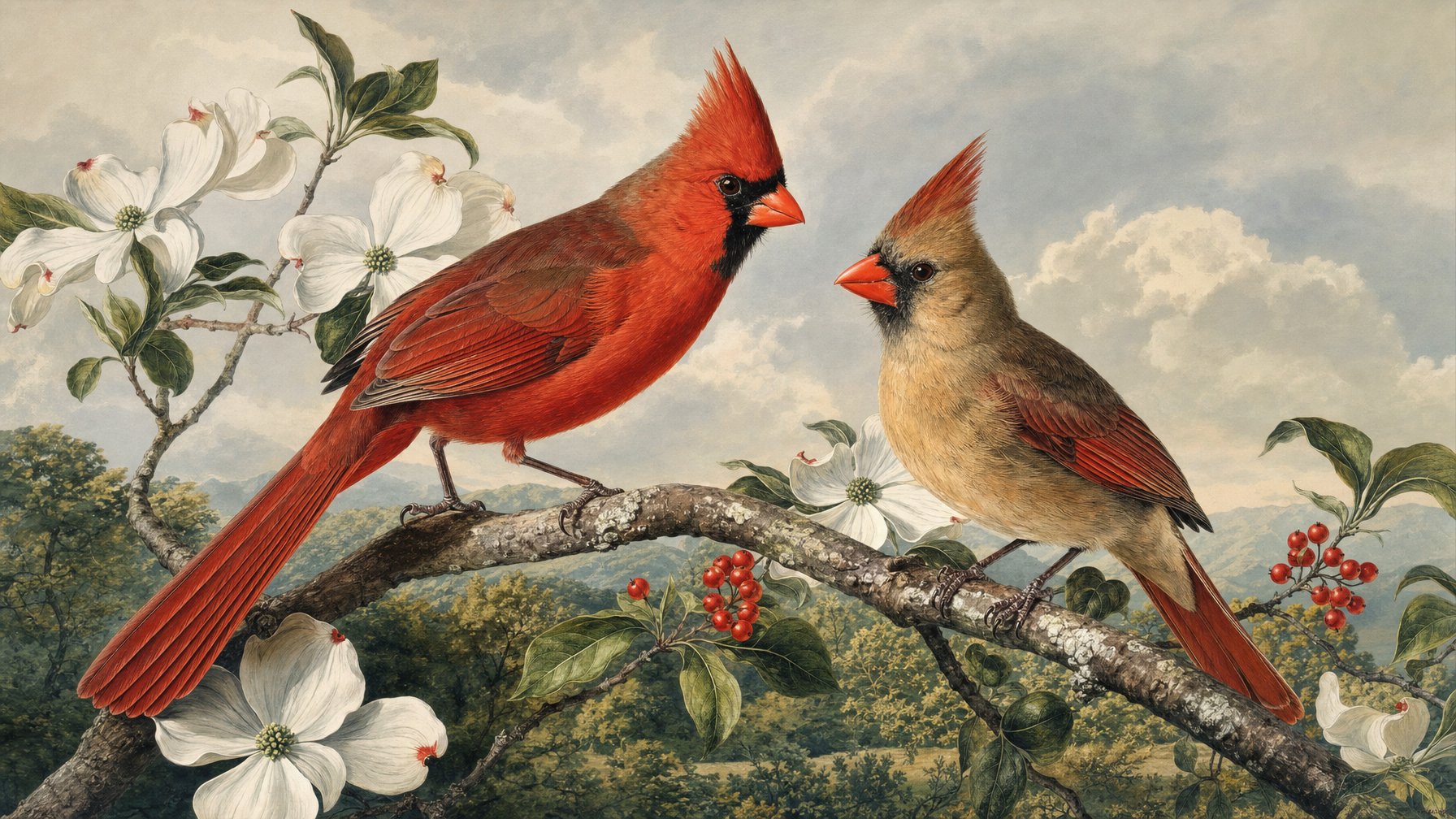
The female sings. Among North American songbirds, female song is the exception. Cardinal females sing back to males during nesting, sometimes in elaborate duets to coordinate feeding the young. She is a striking bird in her own right. Warm tan with rose-red shading, a coral beak, the same scarlet crest as the male, only quieter.
They are visible in winter because they do not leave. When the goldfinches have changed to dull olive, the warblers have flown to Central America, and the rose-breasted grosbeaks are months gone, the cardinals are still red. Snow does not disguise them. It sets them off.
All three are true at once.
The contemporary lore is real. It comforts millions of people and was earned, not invented. Someone began telling that story because the bird seemed to want one told.
The older meanings are real. The clergy gave the bird its name. The states chose it as their own. Cherokee storytellers gave it a role.
And the bird itself is real. Mated for life. Year-round resident. Female songbird. Red against snow.
You get to pick which reading means the most to you. Knowing all three deepens whichever you keep.
Bring this cardinal home. The fine-art plate of Cardinalis cardinalis on flowering dogwood is available as a digital download and as a museum-paper print.