Pets
The Puerto Rican parrot is not saved yet
In September 2017, Hurricane Maria crossed Puerto Rico and took most of the El Yunque wild flock with it.
The birds had been climbing back for four decades. Amazona vittata, the Puerto Rican Amazon, had touched 13 individuals in the 1970s - low enough that a single disease event, a bad nesting season, one poacher, could have ended the species entirely. Years of captive breeding, nest box placement, habitat protection, and releases had pushed the wild count toward several hundred. Then Maria hit, and the El Yunque population collapsed overnight. The Rio Abajo population in the karst hills to the west fared better - something close to 100 of 140 birds survived - and that fact alone is what kept the recovery from starting over from zero.
This is the part of the Puerto Rican parrot story that tends to get left out when the conservation headline runs. The headline is true: this is one of the most significant parrot recovery programmes in the world, a collaboration between the US Fish and Wildlife Service and Puerto Rico’s Department of Natural and Environmental Resources running more than four decades without interruption. The headline is not the whole picture.
What the bird is
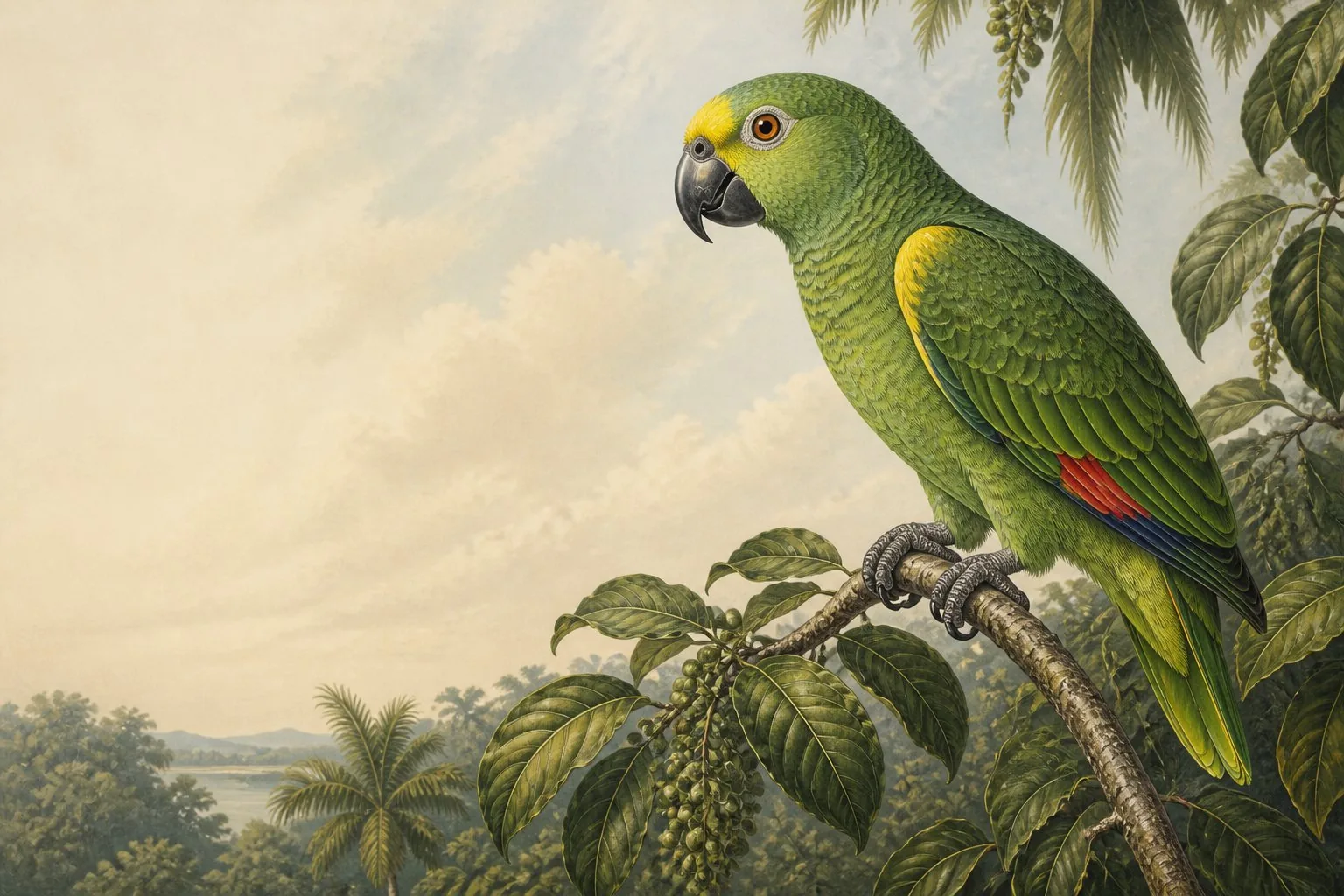
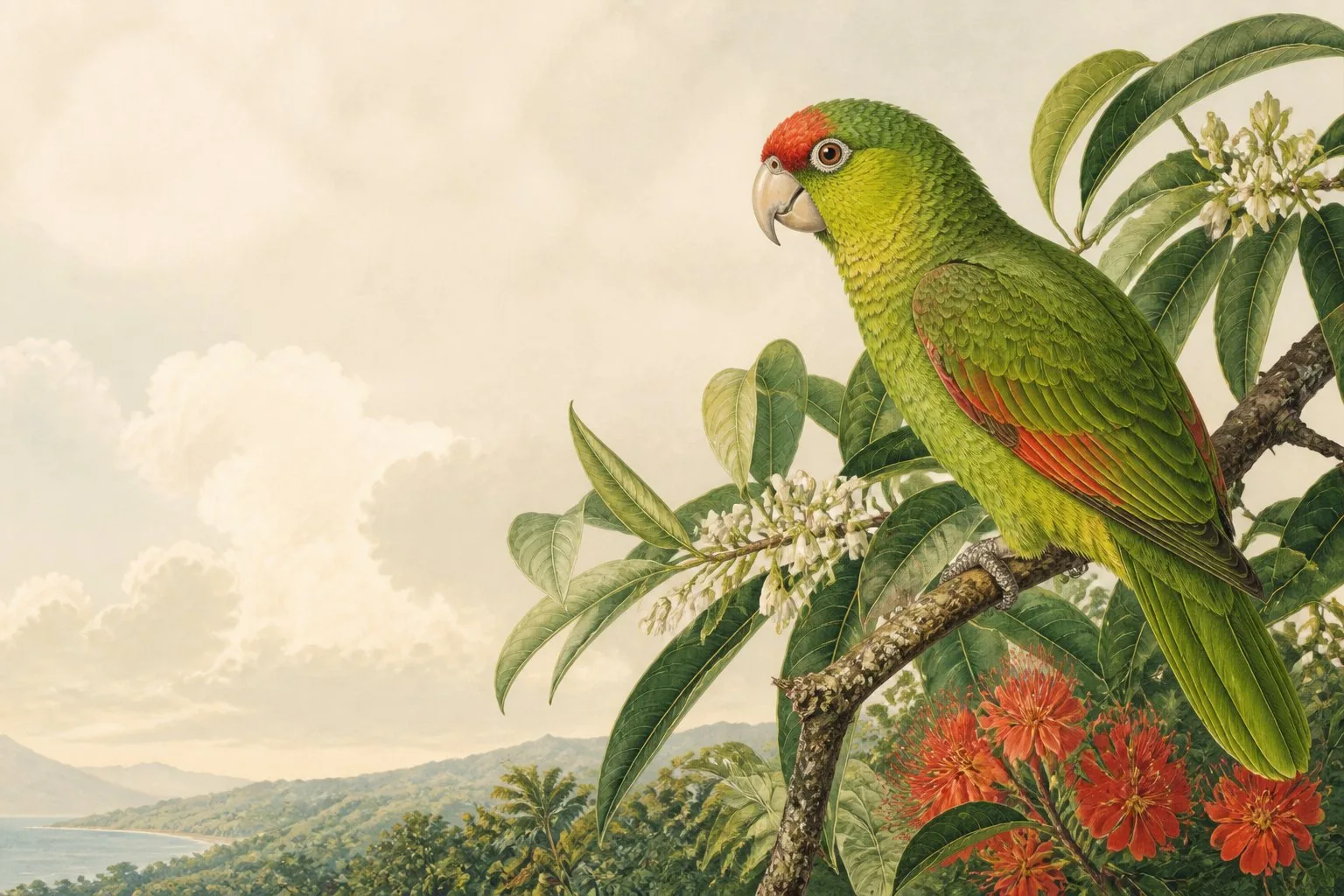
Scientific name: Amazona vittata Length: About 12 inches Plumage: Green, with a red forehead, blue primary feathers, and white eye-rings Diet: Seeds, fruit, and flowers from native subtropical forest trees Nest: Natural tree cavities in subtropical moist forest Clutch: Two eggs, incubated roughly 28 days Fledging: Around 12 weeks Maturity: Two to three years Wild lifespan: Up to 20 years
The bird is compact and loud. It flies ridgelines rather than peaks, hugging terrain in a way that seems more like navigation than flight. The red forehead is visible at distance. The blue in the primary feathers shows mainly in flight. It is monogamous, pairs raise young together, and both adults incubate. In the wild it depends almost entirely on old-growth cavities, which is why deforestation cut the population as fast and completely as it did through the mid-twentieth century.
Why 1,000 is not a comfortable number
When a species drops to 13 individuals, every subsequent gain looks like progress. Going from 13 to 1,000 is a genuine achievement. But a wild population of roughly 1,000 birds, distributed across two isolated forest sites on a Caribbean island directly in the path of Atlantic hurricanes, is not a species in recovery. It is a species in maintenance.
The distinction matters. A species in recovery is one where the population has stabilised across multiple sites, where natural recruitment consistently exceeds losses, and where the wild birds can sustain themselves without intensive human management. Amazona vittata is not there. The programme still supplements wild nests, manages nest boxes to compete with the invasive pearly-eyed thrasher for cavities, monitors individual birds, and keeps a captive population as insurance. Remove the programme and the trajectory likely reverses.
The gap between 13 birds and 1,000 is not as large as it looks when a single storm can close half of it in one night.
Maria demonstrated something that population models had already suggested: concentration is a vulnerability. Two forest sites is not enough. The Rio Abajo birds survived partly because karst forest drains and recovers differently from the ridgeline canopy of El Yunque, and partly because the geography put them out of Maria’s direct path. That was fortune as much as planning.
What keeps the programme going
The captive flocks held at El Yunque and Rio Abajo have produced more than 400 birds released into the wild since the programme began. The birds are not simply released and counted. They are monitored individually, and the data on which birds survive, which nest successfully, and which fail informs the next release cohort. This is slow, expensive, careful work. It has no finish line that anyone in the programme is currently naming.
Habitat is the long constraint. Invasive plant species compete with the native trees that Amazona vittata eats and nests in. Restoration is underway at both sites but subtropical forest does not return quickly. The birds that survive best in the wild are the ones whose territory contains old native trees, and old native trees take generations to grow.
The parrot as pet - why this matters to owners
The Puerto Rican parrot is federally protected and cannot legally be kept as a pet in the United States or Puerto Rico. This matters to mention plainly because Amazona vittata has historically been captured for the pet trade, and that pressure, alongside habitat loss, drove the original collapse.
If you keep an Amazon parrot - any of the roughly 30 species in the Amazona genus - the Puerto Rican parrot’s story is a useful frame for understanding what these birds need. Amazons are cavity nesters that bond for life, feed on a complex diet of native forest foods, and require more cognitive engagement than most owners anticipate. The wild birds forage across large territories, solve problems, and maintain social relationships across years. A captive Amazon that is bored, isolated, or on a nutritionally narrow diet shows it quickly. Understanding what parrots can eat and how to structure their environment around complexity rather than containment is the difference between a bird that thrives and one that doesn’t.
Choosing age-appropriate toys for captive parrots matters for the same reason. Amazons manipulate objects as part of how they process the world. Foraging toys, puzzle feeders, and objects with varied textures do some of the work that a forest canopy would do for a wild bird.
What the story is actually about
The Puerto Rican parrot survives because a small number of people decided in the early 1970s that 13 birds was not an acceptable ending. The programme that decision created has run continuously through hurricane seasons, budget cycles, and two political jurisdictions for more than 40 years. That is the thing worth saying directly.
The bird is not a conservation success story with a happy ending written. It is a conservation story still in progress, with a flock large enough to give it a plausible future and small enough that the future is not guaranteed. The difference between the El Yunque and Rio Abajo populations after Maria is the difference between one point of failure and two. The programme is now building toward a third site. That is the work.
If you read about tropical parrots and their patterns in the wild - including how and where species like toucans move seasonally, as covered in do toucans migrate or hibernate - the broader picture becomes clear: island endemic species are not buffered by range. Amazona vittata has nowhere else to be. Puerto Rico is the entire range, and the range takes a direct hurricane hit every few years. The only answer the programme has found is redundancy: more sites, more birds, deeper forest.
The parrot’s red forehead has been on the island for longer than any human settlement there. The question the programme is actually trying to answer is not whether the bird can survive. It has survived ice ages and sea level changes and forest succession and centuries of indigenous hunting. The question is whether it can survive us - the particular shape of pressure that arrived with European colonisation and has not let up since. So far, narrowly, it can.