Biology
Do Hawks Hunt at Night?
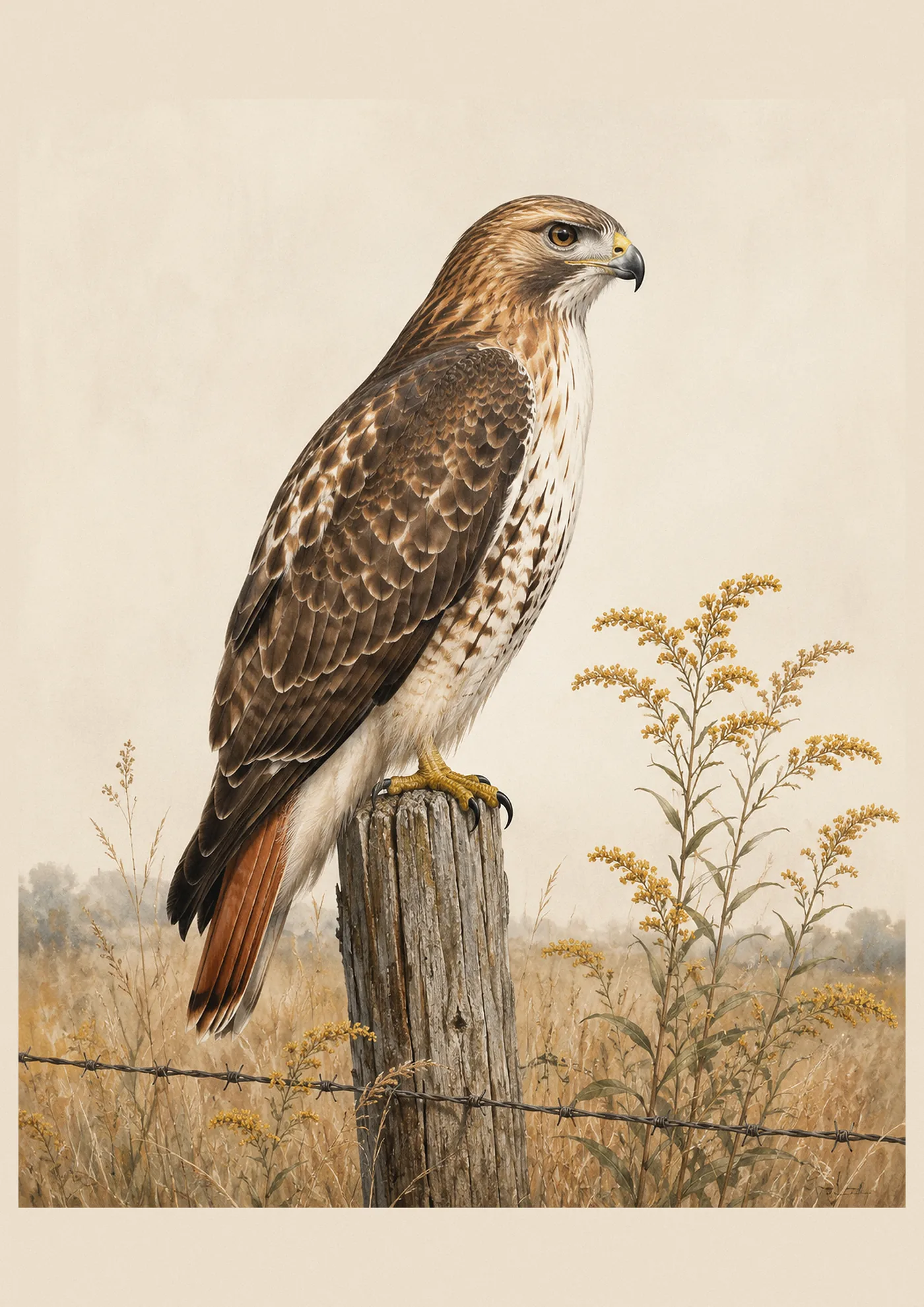
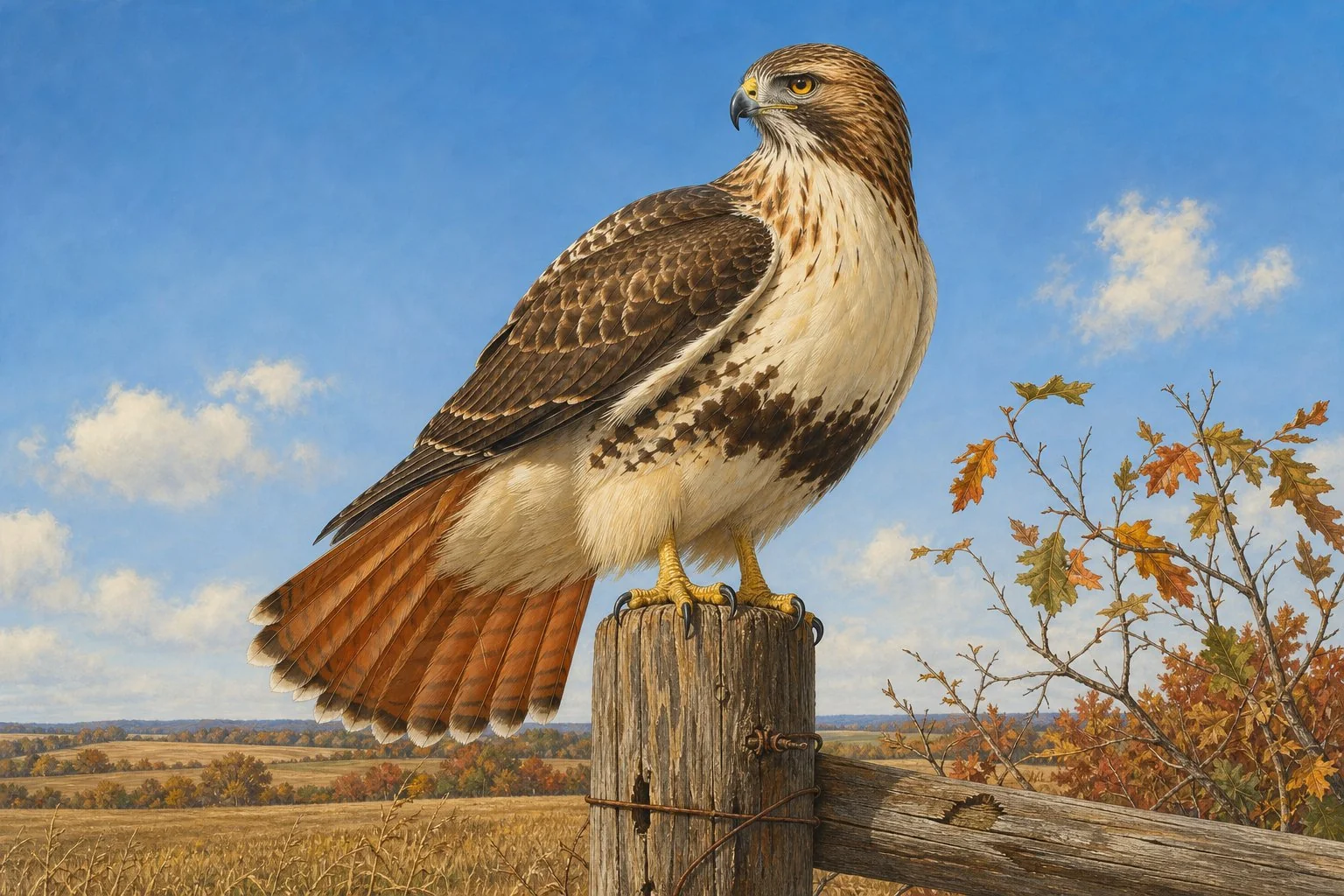
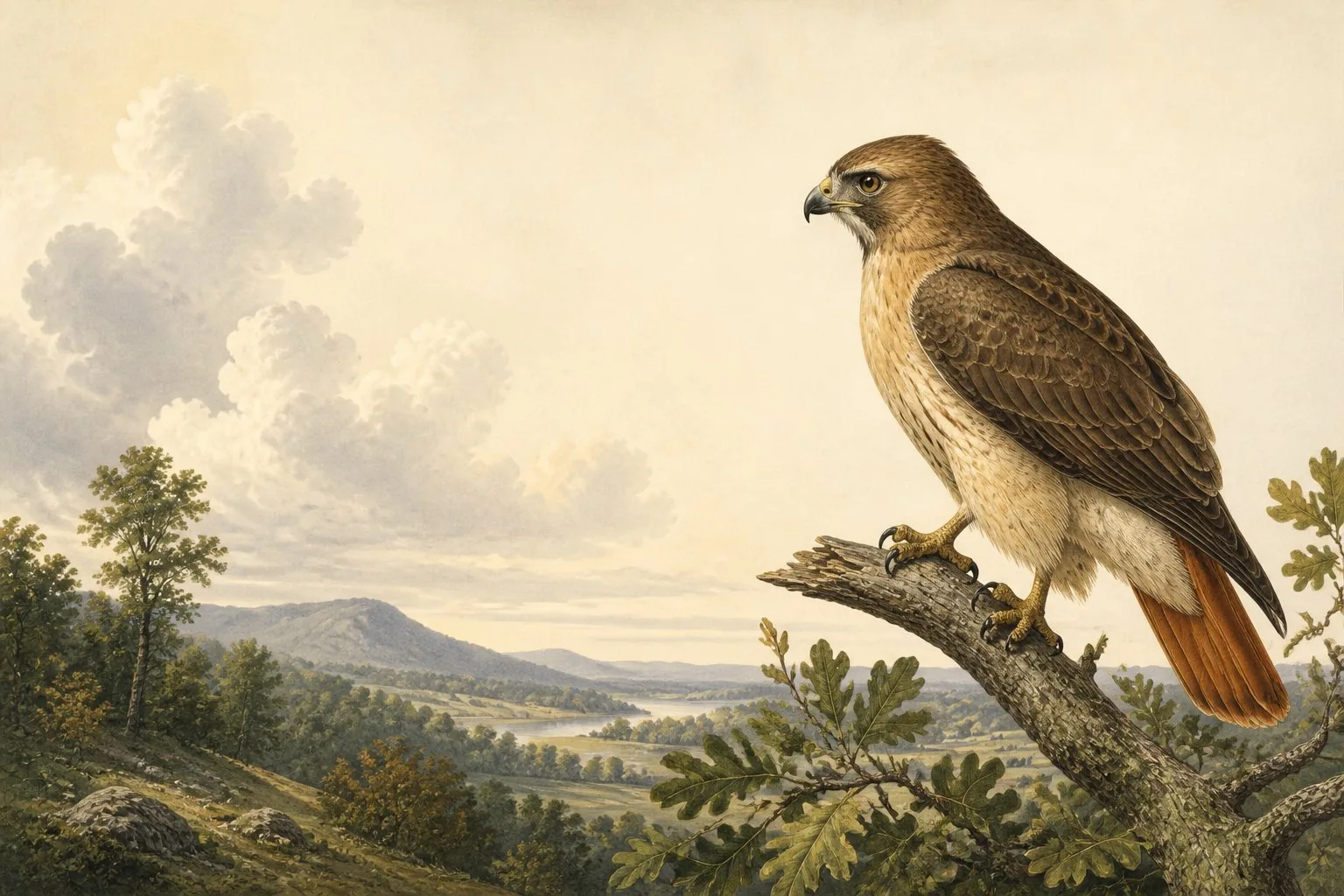
Watch a Red-tailed Hawk (Buteo jamaicensis) on a telephone pole at noon and you understand immediately what kind of animal it is. The head turns in small, precise increments. The eyes hold still while the world moves beneath them. This is a creature that hunts by seeing.
No. Hawks do not hunt at night. But that answer is less interesting than the reason, and the reason tells you something about how the sky was divided.
Built for daylight
A hawk’s eye contains a higher density of cone photoreceptors than almost any other vertebrate. Where a human sees one image, a hawk resolves fine detail across a wide field of view - enough to monitor a meadow while fixing on a single vole at the center. Vision this precise requires light. In low light, cones fail. The hawk’s extraordinary resolution collapses into ordinary darkness, the same as ours.
Owls solved the opposite problem. Their eyes are packed with rod photoreceptors tuned for dim light, and are so large relative to the skull that they cannot rotate at all - owls turn their whole head instead. An owl’s facial disc funnels sound to asymmetrically positioned ear openings, allowing it to triangulate a mouse moving under snow by hearing alone. A different tool for a different shift.
| Feature | Hawks | Owls |
|---|---|---|
| Active period | Daylight, sometimes dusk | Night, sometimes dawn |
| Primary sense | Vision | Hearing and low-light vision |
| Eye type | High cone density for resolution | High rod density for sensitivity |
| Flight sound | Audible | Near-silent (specialised feathers) |
The two guilds fill the same ecological role - both hunt rodents, both take birds, both patrol territories - but they do it on opposite halves of the clock. This is not competition but division. They rarely see each other.
The dusk window
A Red-tailed Hawk will sometimes hunt past sunset. Not long past, but into the fading light of the last 20 or 30 minutes - what birders call the ‘dusk window.’ This is opportunism, not adaptation. Voles and mice begin emerging as daylight fades, and a hawk that can still see has a narrow advantage before it cannot see at all.
When full darkness arrives, the hawk stops. It finds a roost - a dense tree, a barn ledge, a sheltered telephone pole - and sits until dawn. Calling an animal that extends its day by half an hour a “night hunter” would be like calling a person who reads by candlelight an insomniac.
A hawk that hunts at dusk is not becoming an owl. It is simply spending the last of the light.
The bird that caused the confusion
The Common Nighthawk (Chordeiles minor) is not a hawk. It is a nightjar - a member of a family so different from raptors that the resemblance ends at the name. Nighthawks hunt flying insects at dusk and dawn, zig-zagging low over fields and open water with a loose, buoyant flight that looks nothing like a hawk’s stoop. The name has confused people for two centuries. If you see something hawklike flying erratically at dusk, eating insects, it is almost certainly a nighthawk or a whip-poor-will - and neither is a raptor.
The exception that proves everything
The Harris’s Hawk (Parabuteo unicinctus) does not hunt at night, but it hunts in a way no other hawk does: in groups. Pairs and family units of two to six birds work the desert scrub of the American Southwest together, one flushing prey from cover while the others cut off escape routes. When the rabbit bolts, the pack is already in position.
Coordinated hunting is almost unknown among raptors. It works here because jackrabbits are large, fast, and difficult for a single bird to take reliably. If you want to understand why most hawks are solitary, watch what a Harris’s Hawk does with that problem.
What hawks actually do at night
They sleep. A roosting Red-tailed Hawk fluffs its feathers for insulation, tucks one foot up, and is still until first light. Hawks do not patrol at night, do not cache food, do not call from the darkness. A large bird calling at night, flying silently, or responding to squeaking sounds after dark is almost certainly an owl - not a hawk. For a sense of how differently songbirds are built from raptors, see are cardinals songbirds.
If something is taking birds from your feeder at night, it is an owl. If you hear a raspy scream after dark, it may be a Barn Owl - or it may be a fox. The Red-tailed Hawk’s famous scream, the one used for every eagle in every film, belongs to the daylight hours.