Biology
The African Fish Eagle: How a Cry Became a Continent's Voice
Watch a female Icthyophaga vocifer strike from a dead tree above the Okavango Delta and you understand why four countries have put this bird on their flags. She drops from her perch in a long, shallow arc, hits the surface without slowing, and lifts a tilapia clear of the water using talons fitted with short, sharp spines on the toe pads - called spiricules, a term used in the ornithological literature for this species - that grip slippery prey the way a climber grips ice. The whole thing takes less than three seconds.
The thesis of the African Fish Eagle is efficiency. Not power for its own sake. The bird hunts only what it needs - Animal Diversity Web’s species account records roughly half a pound of fish per day - and spends most of its hours on a perch, watching. Animal Diversity Web documents that only one in every seven or eight attempts ends in a successful catch. It has solved the problem of African waterways at a very low cost.
What it looks like
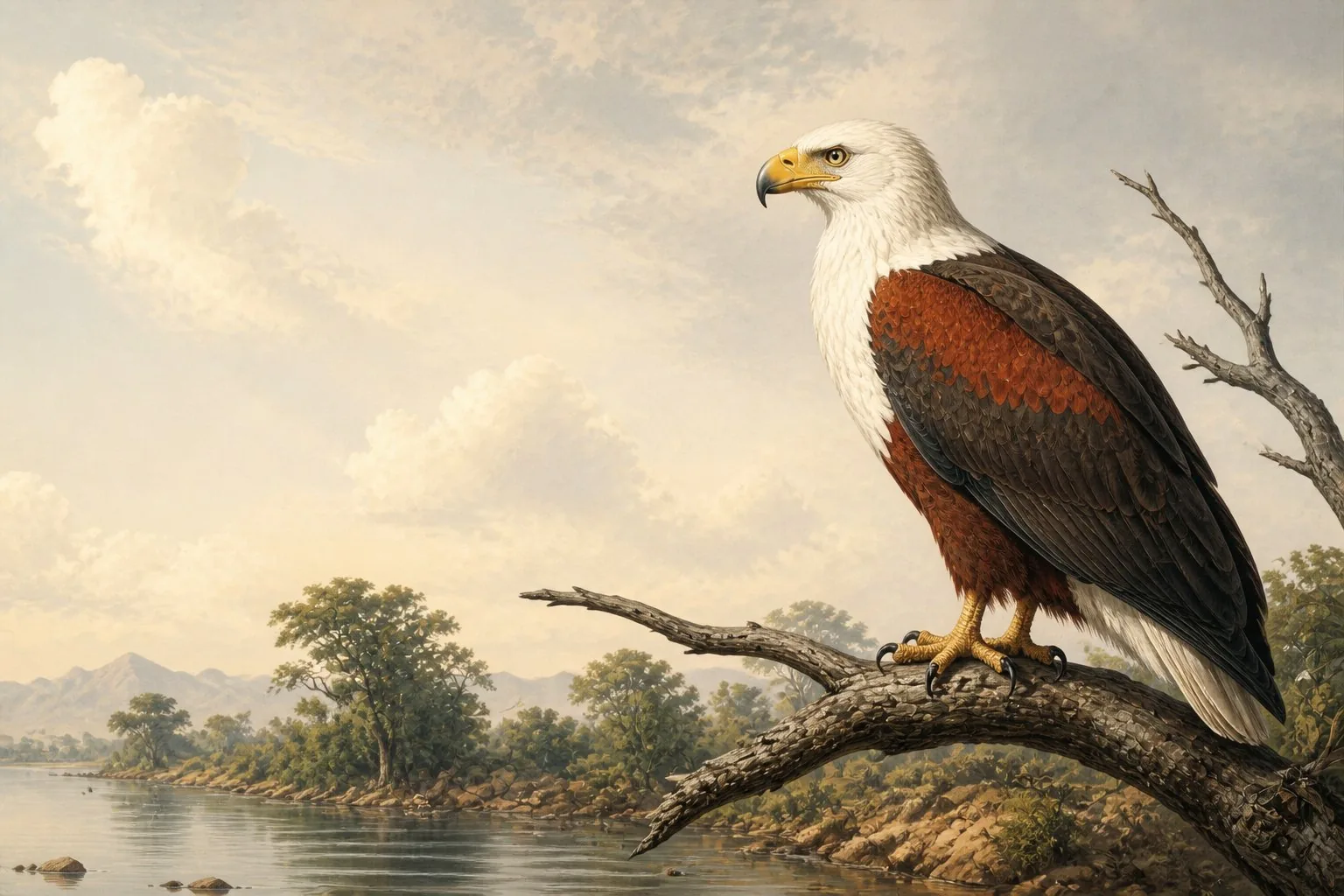
The adult bird is nearly impossible to misidentify in sub-Saharan Africa. White head, white chest, white tail. Dark chestnut body. Black primary and secondary feathers. Yellow cere and yellow feet. The Peregrine Fund’s species account describes the head as “milk-white” against a “chocolate brown back,” which is exact.
Females are 10-15% larger than males, as Animal Diversity Web documents. A large female weighs 3.2-3.6 kg with a wingspan reaching 2.4 m. Males run 2.0-2.5 kg and span roughly 2.0 m. Body length for both sexes falls between 63 and 75 cm. The size difference matters at the nest, where the female does most of the incubation and the male brings food.
Juveniles are unrecognisable as the same species. Brown overall, with scattered white patches on the chest and tail base, and a dull grey face. Full adult plumage takes around five years to develop, according to Animal Diversity Web - so every large brown eagle you dismiss along an East African river may be a fish eagle working through its adolescence.
Where it lives
The species occupies sub-Saharan Africa between 17 degrees N and 35 degrees S latitude - from Mauritania and Sudan in the north to South Africa in the south. Its requirement is simple: a large body of fresh water with fish near the surface and a tall perch nearby. Find the lake, the river, the reservoir, the coastal lagoon, or the estuarine swamp, and you will likely find the eagle.
Specific sites where observers reliably encounter the species include Lake Victoria, Lake Malawi, and the lakes of the East African Rift Valley. The Orange River along the South Africa-Namibia border holds breeding pairs. Wikipedia’s species entry, which cites BirdLife International sources, documents that adults are largely sedentary, moving locally only when water levels or fish availability shift.
Birds of the World at Cornell Lab of Ornithology records 89,806 eBird observations for the species - a figure that reflects both the eagle’s abundance and the density of birding activity across the continent. Animal Diversity Web estimates a total population of approximately 300,000 individuals. The IUCN lists the species as Least Concern, with a stable population trend supported by a range covering roughly 18.3 million km².
The African Fish Eagle is as close to an indicator species as sub-Saharan Africa has: its presence signals a functional aquatic ecosystem, its absence tells you something has broken.
How it hunts
The standard method is perch-and-swoop. The eagle selects a high, clear vantage - usually a dead tree overhanging water - and watches the surface below. When a fish comes within range, it launches in a low, fast glide and snatches the prey at the moment of contact. The spiricules on the toe pads handle the grip. The eagle does not dive below the surface.
Fish weighing up to around 1 kg are carried directly to a branch. When a fish proves heavier - Kemp and Marks in Birds of the World record catches up to 4.2 kg - the bird may skim the catch along the water surface toward the bank, or paddle to shore with its wings in what observers describe as a butterfly stroke. The Peregrine Fund notes it can carry fish up to roughly 2 kg in sustained flight. That ceiling is the reason the lifting-power myth collapses: no eagle is hauling off a dog.
The diet is broader than the name suggests. Documented prey includes waterbirds (ducks, coots, flamingos, cormorants), small reptiles, frogs, and small mammals. The species is also a confirmed kleptoparasite. Animal Diversity Web and a peer-reviewed study of shoebill kleptoparasitism in Tanzania (Tanzania Journal of Science, 2019) document fish eagles targeting Goliath Herons, hammerkops, marabou storks, shoebills, pelicans, and ospreys - specifically choosing species that have just landed a large, slow-to-handle fish. The tactic is deliberate and repeated.
Breeding
Pairs mate for life. Animal Diversity Web documents breeding during the dry season, when falling water levels concentrate fish near the surface. The breeding season across much of the range runs from June to August.
Nests are substantial structures built from dry sticks in tree forks or on rocky ledges, always close to water. Pairs maintain one or two nests and return to expand them each year. Animal Diversity Web records established nests at 120-150 cm in diameter and 30-60 cm in depth. The Peregrine Fund describes older nests reaching 6 feet long and 4 feet deep.
The female lays one to three white eggs with reddish speckles. Both parents incubate for 42-45 days. Chicks fledge at 70-75 days and remain dependent on their parents for up to three months after leaving the nest. Sexual maturity arrives at around four years. Animal Diversity Web gives a wild lifespan range of 16 to 24 years.
The call
The species name, vocifer, is Latin for “one who carries a voice,” and Daudin chose it in 1800 for a reason. The call - a ringing “weee-ah, hyo-hyo” or “heee-ah, heeah-heeah” - carries across open water better than almost any other bird sound in Africa. Animal Diversity Web documents that males pitch higher than females. Pairs duet, throwing their heads back and calling together, especially at the start of breeding season.
Four countries have made the fish eagle their national bird: Malawi, Namibia, Zambia, and Zimbabwe. It appears on the coats of arms of those nations plus South Sudan, and features on both the Zambian and Zimbabwean flags. Few African birds carry equivalent official weight across so many nations - which says less about politics and more about how consistently the bird shows up wherever people live near water. It is not a wilderness species requiring a special trip. It is a neighbour.
Taxonomy note
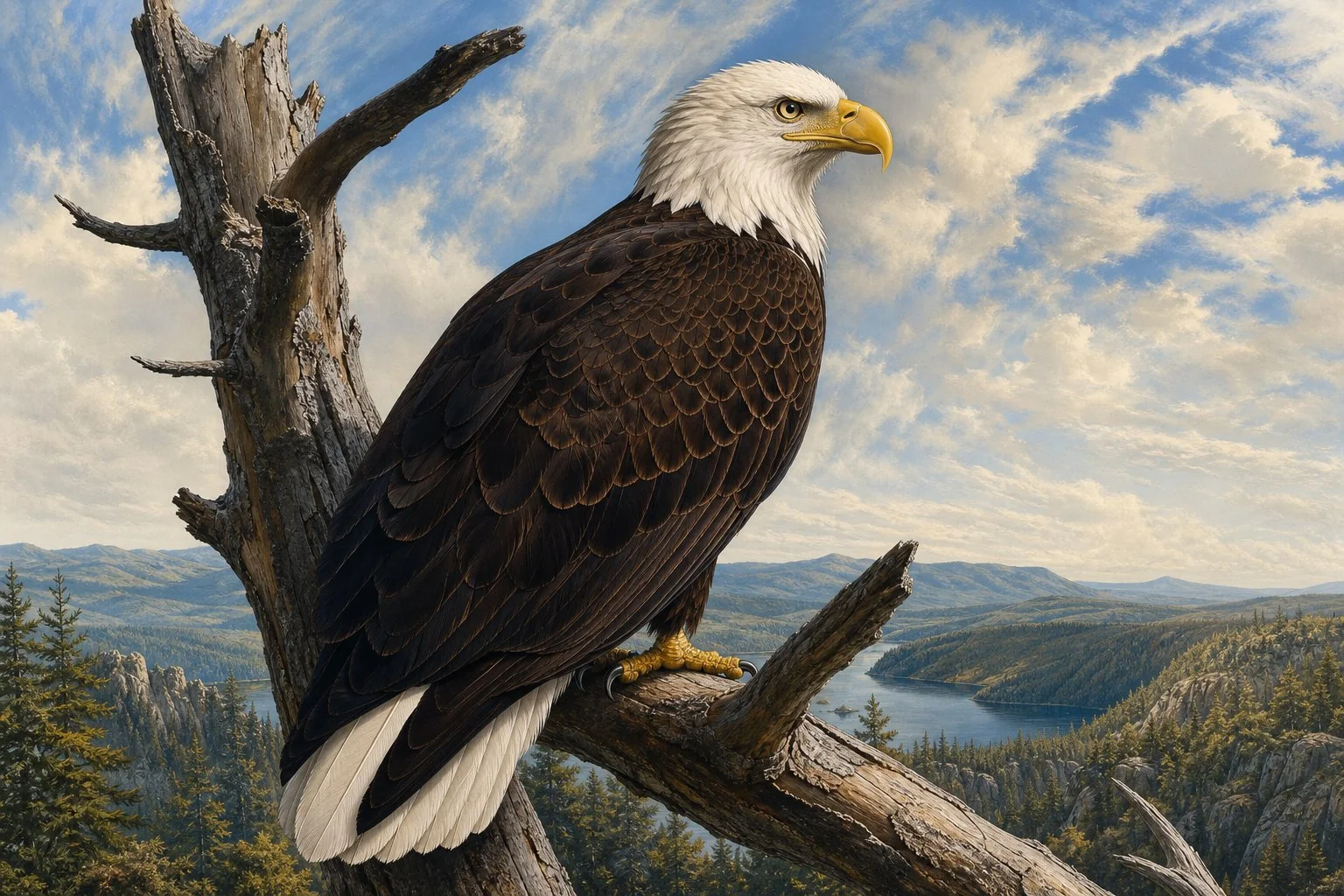
Birds of the World at Cornell Lab now places this species in the genus Icthyophaga rather than Haliaeetus, reflecting genetic work that separates the African and Asian fish eagles from the sea eagles proper. Its closest living relative is the Madagascar fish eagle (I. vociferoides). The resemblance to the Bald Eagle - white head, brown body - is convergent evolution, the same solution arrived at independently, not shared ancestry.
The threats the species faces are predictable for any fish-eating raptor: overfishing reducing prey density, pesticide and wastewater contamination bioaccumulating up the food chain, and the conversion of shoreline habitat for agriculture and development. None of these is presently driving a range-wide decline. The IUCN Least Concern rating holds. But it holds because the range is very large, and the lakes at its edges are under pressure that Northern Cardinals face in an entirely different landscape but for structurally similar reasons - habitat that looks fine from a distance and is quietly getting thinner.
The fish eagle did not become the voice of four nations because it is decorative. It became that because it is everywhere clean water exists, calling from the same dead tree it perched on yesterday, hunting with the same patient efficiency it has used for longer than the borders beneath it have existed.