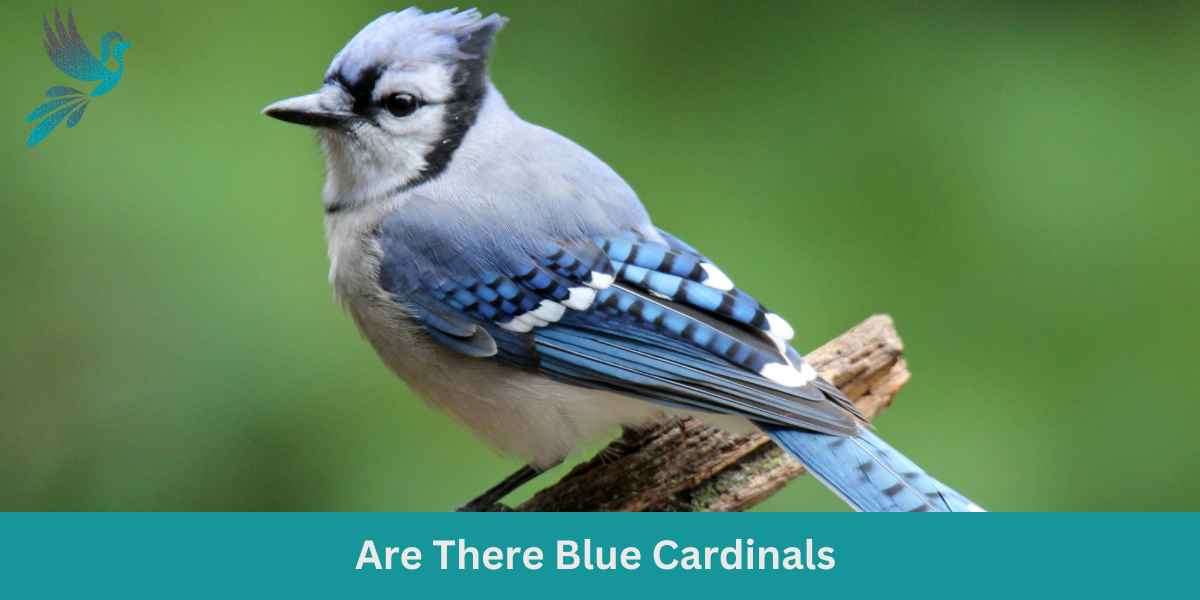
No. There is no such thing as a blue cardinal. If you have seen a blue bird with a crest in your garden, you have seen something else entirely - and it is probably more interesting than you think.
Cardinals get their colour from carotenoid pigments in their diet. These pigments can produce red, orange, and yellow. They cannot produce blue. A genetic mutation can turn a cardinal yellow or white, but never blue. The biology simply does not allow it.
What You Actually Saw
Four species regularly get mistaken for “blue cardinals” because they have crests, similar body shapes, or both:
| Species | Size | Crest? | Colour | Where found |
|---|---|---|---|---|
| Blue Jay | 25-30cm | Yes, prominent | Bright blue, white, black | Eastern and central N. America |
| Steller’s Jay | 30-34cm | Yes, tall and dark | Deep blue and black | Western N. America |
| Blue Grosbeak | 15-17cm | Slight | Deep blue with russet wing bars | Southern US in summer |
| Tufted Titmouse | 14-16cm | Yes, grey | Grey with peach flanks | Eastern US |
The blue jay is the most common culprit. It is roughly cardinal-sized, has a prominent crest, visits the same feeders, and is an unmistakable vivid blue. From a distance or in poor light, the silhouette looks remarkably like a cardinal.
Why Blue Feathers Are Different
Here is something most people do not know: blue feathers contain no blue pigment at all.
Red and yellow feathers get their colour from pigment molecules that absorb certain wavelengths of light. Blue feathers work completely differently. Their colour comes from the microscopic structure of the feather itself - tiny air pockets scatter light in a way that only reflects blue wavelengths back to your eyes.
This is called structural colour, and it is why:
- Blue feathers look grey or brown when backlit (the structure only scatters light in one direction)
- Crushed blue feathers lose their colour entirely (the structure is destroyed)
- Red and yellow feathers keep their colour no matter how you look at them
Cardinals do not have the feather microstructure needed for blue. They have the pigment chemistry for red. These are two completely different colour systems, and a bird cannot simply swap one for the other through mutation.
If you crush a blue jay feather, it turns brown. If you crush a cardinal feather, it stays red. That is the difference between structural colour and pigment colour.
How to Tell Them Apart
If you are unsure what you are looking at:
- Listen - Cardinals sing a clear, whistled “birdy birdy birdy” or “cheer cheer cheer.” Blue jays make harsh, loud “jay jay” calls and can mimic hawk sounds. The calls are completely different.
- Watch the tail - Cardinals have long, pointed tails. Blue jays have shorter, squared-off tails with white corners.
- Check the face - Male cardinals have a black mask around the beak. Blue jays have a black necklace across the throat.
- Body shape - Cardinals are rounder and more compact. Blue jays are sleeker and more upright.
Attracting the Real Thing
If you want actual cardinals in your garden:
- Black oil sunflower seeds - Their absolute favourite
- Platform feeders - They prefer open feeding surfaces to tube feeders
- Dense shrubs - Holly, dogwood, and juniper for nesting cover
- Water - A birdbath with moving water draws them in reliably
- Consistency - Feed at the same times. Cardinals are early risers and late feeders, often the first and last birds at the feeder each day