Biology
Can You Eat Cardinals?
No. And the law closes that question before the culinary one can open.
Cardinalis cardinalis - the Northern Cardinal - is protected under the Migratory Bird Treaty Act of 1918. That statute makes it unlawful to pursue, hunt, take, capture, kill, possess, sell, purchase, barter, import, export, or transport any covered bird without a valid federal permit. The American Bird Conservancy confirms that cardinals have been explicitly covered under the MBTA since its passage. Basic violations carry fines up to $15,000 and up to six months’ imprisonment. Killing a protected bird with commercial intent raises that to a felony.
The law also covers the bird’s parts. You cannot legally pick up a cardinal feather you find on the sidewalk. You cannot collect an empty nest after the breeding season ends. Feathers, eggs, and nests all fall inside the same statute as the living bird.
Why the MBTA covers a bird that does not migrate
The word “migratory” in the Act’s name is, as Audubon notes, largely symbolic. Today the law covers 1,026 species - nearly every native bird in the United States - and most of them are protected regardless of whether they actually migrate. The Northern Cardinal is a non-migratory year-round resident across its entire range. It does not leave for winter. It does not move south in autumn. A male at a feeder in central Virginia in February is the same bird that held the same patch of hawthorn in July. The MBTA protects him year-round regardless.
The reason the word stayed, and the reason the law exists at all, is historical.
What the markets did
An 1867 survey documented around 120 species of birds being sold openly in New York, Boston, and Philadelphia markets. Songbirds were among them. Robins went into pot pies. Thrushes appeared at high-end restaurants. Sparrows were sold in strings. Ornamental feathers - taken overwhelmingly during breeding season when plumage is at its finest - drove a trade that Audubon estimates killed around 200 million birds per year at its peak between 1870 and 1900.
The cardinal did not escape this era untouched. The American Bird Conservancy records that the Northern Cardinal was popular as a cage bird before federal protection arrived, with tens of thousands shipped to European markets as singing cage birds during the nineteenth century. By the early twentieth century the passenger pigeon was extinct, the Carolina parakeet was gone, and the snowy egret had been hunted almost to elimination for its breeding plumes. Congress passed the MBTA in 1918 to close the trade before the remaining species followed.
The Northern Cardinal is the official state bird of seven US states - Illinois, Indiana, Kentucky, North Carolina, Ohio, Virginia, and West Virginia - more than any other species holds that designation.
The bird itself
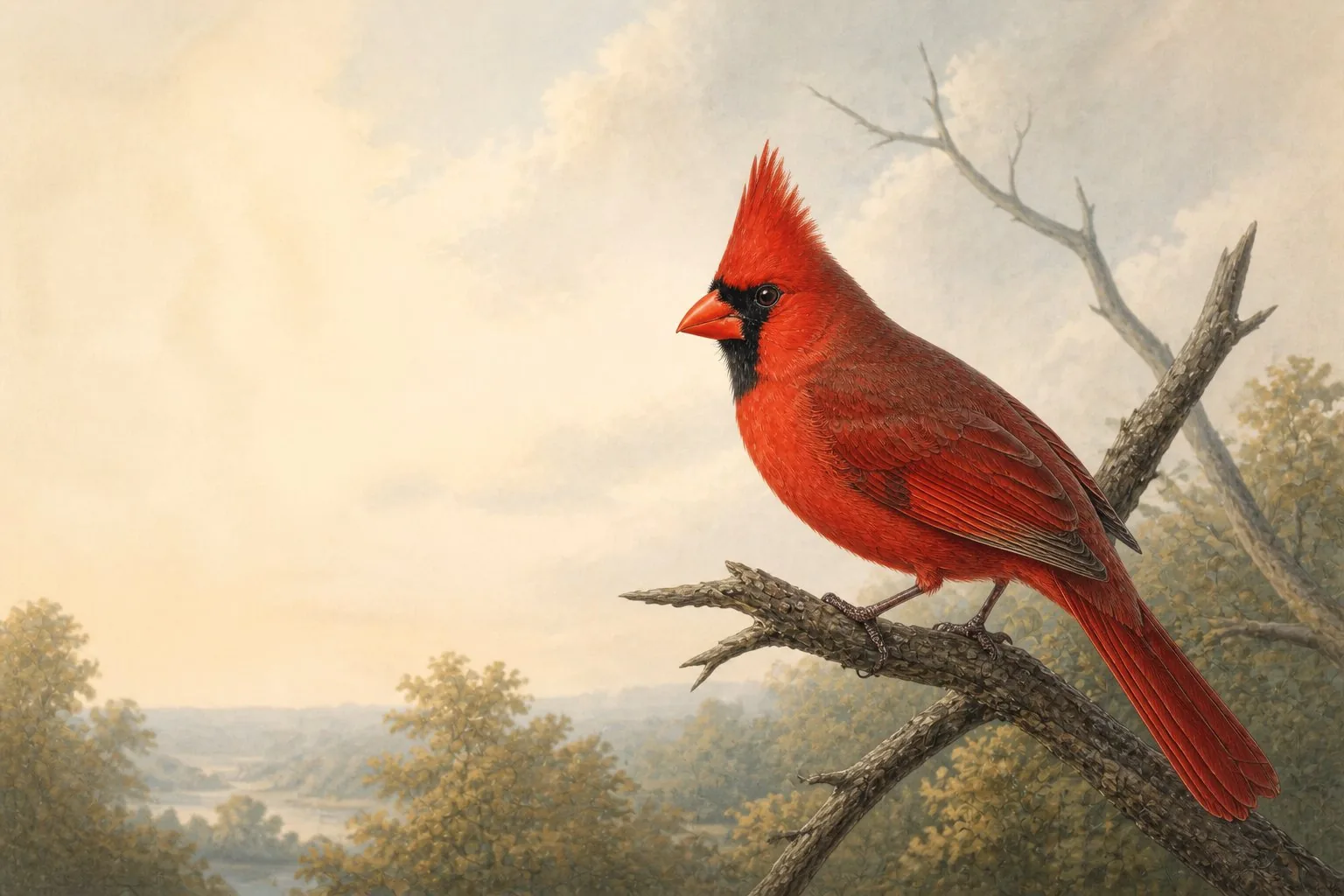
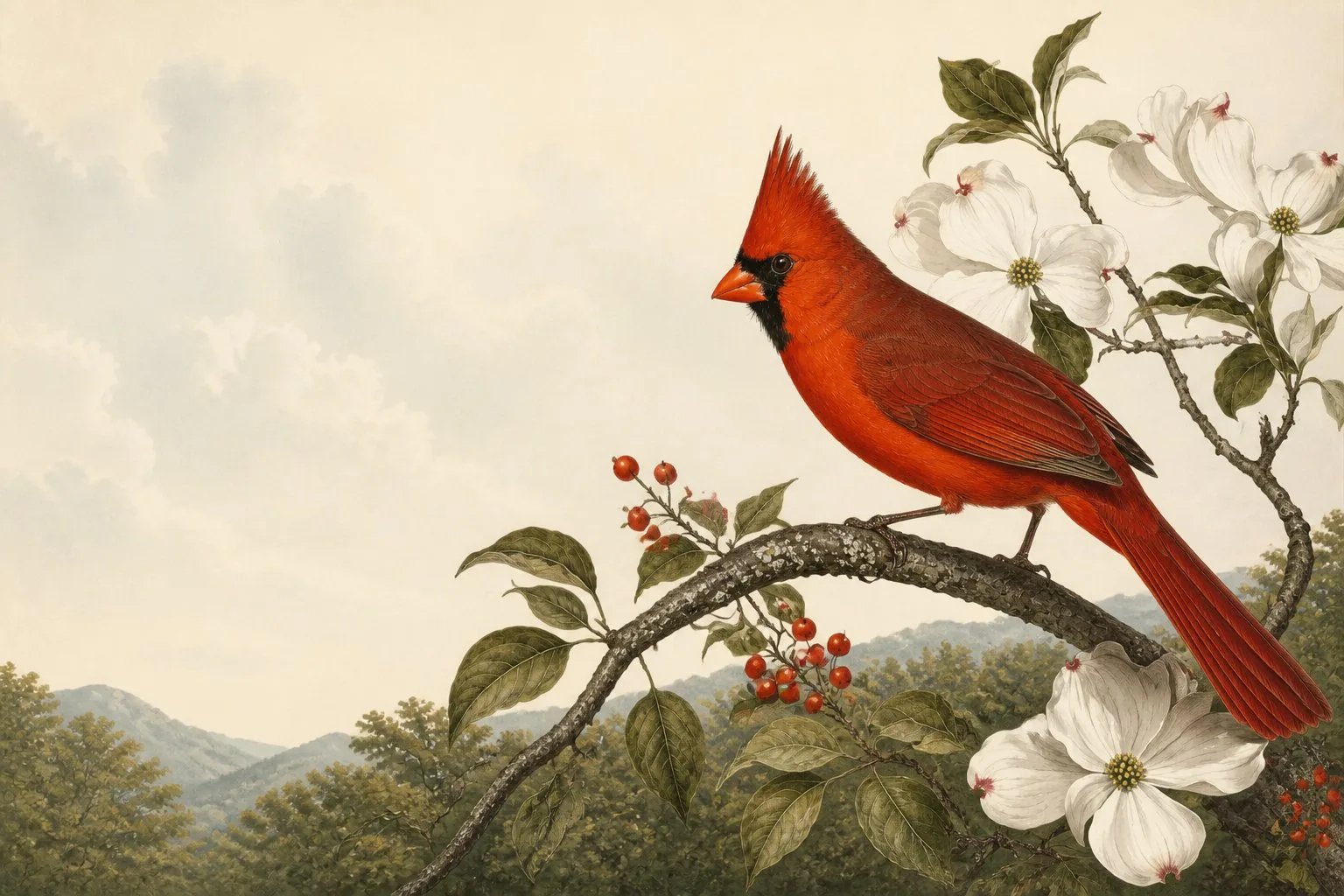
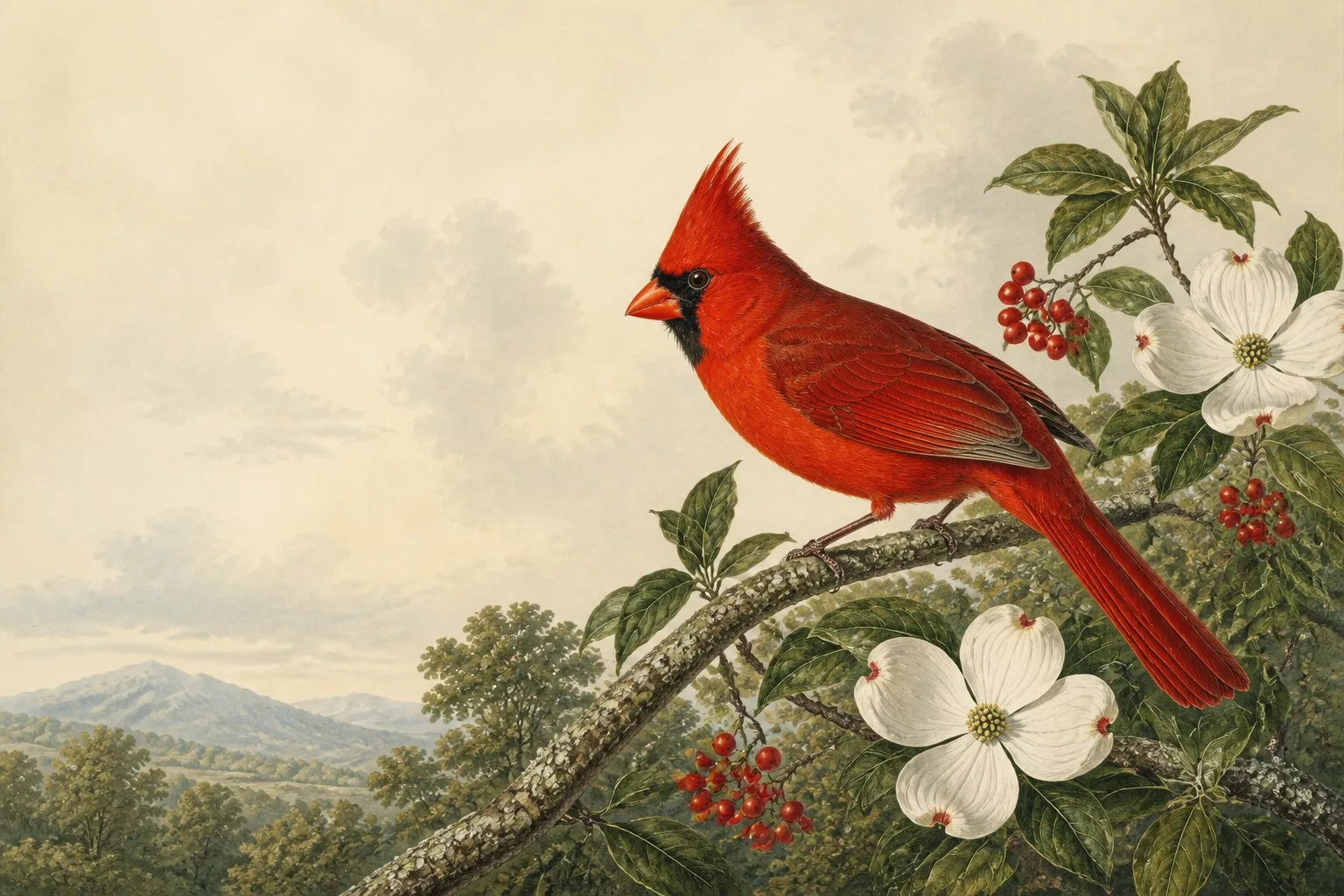
A male Northern Cardinal weighs between 1.5 and 1.7 ounces - roughly the weight of two sheets of printer paper. His plumage is brilliant red from bill to tail, with a prominent crest and a thick coral-pink bill built for cracking hard seeds. The female is duller, but she shares the crest and the same heavy bill, with buff and warm olive tones across the wings and breast. Both sexes hold their coloration year-round. The cardinal does not fade into a duller winter coat, which is part of what made it so prized in the cage-bird trade: the colour is permanent.
Audubon’s field guide lists the Northern Cardinal population at approximately 130 million birds across North America. The American Bird Conservancy places the figure at around 110 million, with a stable to increasing population trend. The IUCN classifies the species as Least Concern. The bird’s range has expanded northward over the past century - pushed by warming winters, suburban edge habitat, and the establishment of winter feeding stations. The cardinal now breeds regularly in southern Ontario and southern Quebec, range it did not reliably hold a hundred years ago.
None of that affects the legal status. Common or rare, the cardinal is covered.
The question behind the question
The MBTA does not distinguish between a scarce bird and an abundant one. It was not designed to rescue species already at the edge of extinction. It was designed to stop the systematic commercial exploitation of wild birds before that edge arrived. The passenger pigeon was once arguably the most numerous bird on the continent. Market hunting reduced it to zero in roughly 50 years. The Act’s architects understood that abundance is not a defense against organised killing. The legal wall was built in advance of the crisis, not after it.
For the cardinal, the wall came in time. For the passenger pigeon and the Carolina parakeet, it came too late. That asymmetry is the reason the question “can you eat it?” finds federal law at the door, long before nutrition enters the conversation.
For more on the species - its range, plumage variation, and year-round habits - the full field guide is the place to start. The rare pale or white-feathered individuals sometimes spotted at feeders are a separate phenomenon, covered in the piece on white cardinals. Questions about whether populations face any pressure are addressed in are cardinals endangered. The unusual mid-summer molting behaviour that leaves males temporarily bald is explained in cardinal molting. And if you run a water feature for birds alongside a seed feeder, cleaning it regularly with vinegar is the standard recommendation for keeping it safe.