Free shipping to the US, Canada & Europe
State Guide
Oklahoma holds three genuinely red bird species: a year-round resident, a summer breeder, and a vivid western outlier. Here is how to tell them apart.
June 15, 2024 4 min read
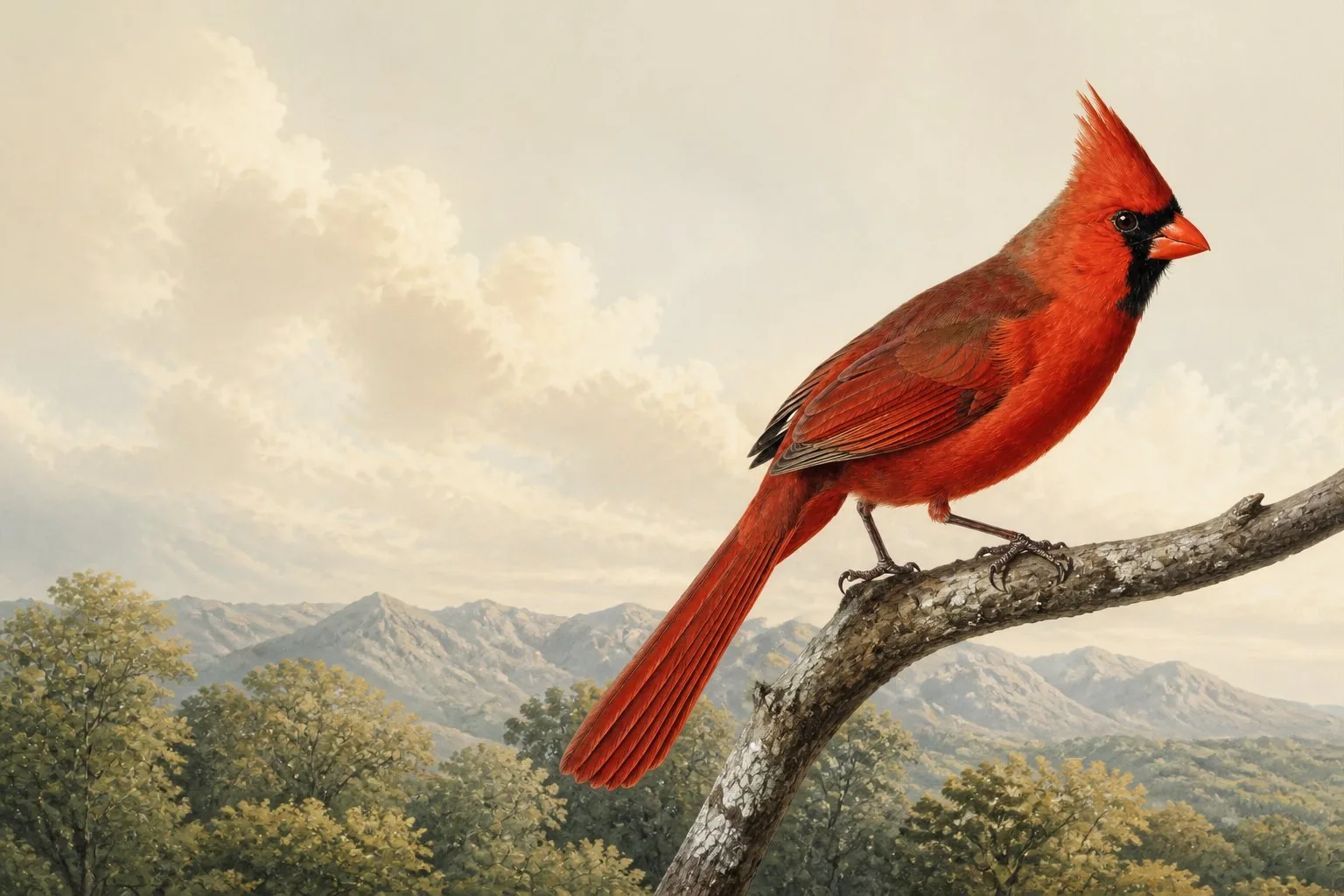
Pull up to any backyard feeder in Tulsa on a January morning and the bird on the tray will almost certainly be a male Northern Cardinal, red as a stop sign against grey bark. Drive four hours west to the Panhandle in summer and you may find a male Vermilion Flycatcher burning on a fence post beside a dry creek - a different red entirely. Oklahoma is one of the few states where both coexist within a single day’s drive.
The state straddles the boundary where eastern deciduous woodland meets the short-grass plains. That transition, roughly the 98th meridian running north to south through the state’s middle, is where eastern species thin out and western ones begin. Red birds follow this divide closely.
Cardinalis cardinalis is found almost statewide except the western half of the Panhandle, according to the Oklahoma Department of Wildlife Conservation, and he is a permanent resident wherever he occurs. No migration, no winter retreat. In January when most songbirds have either left or gone quiet, the male cardinal sings - a full-throated “cheer, cheer, cheer” that carries across a frozen yard.
The Oklahoma Department of Wildlife Conservation notes cardinals form winter groups of two to 15 birds, occasionally up to 40 at feeders during heavy snow. He feeds on the ground, preferring sunflower and safflower seeds, and his thick orange-red bill is built for cracking shells. Audubon’s field guide notes the female is among the more vocal female songbirds in North America - she sings from the nest to signal to the male when to bring food and when to stay away.
The male Northern Cardinal is the only crested red bird in North America. No other combination of all-red plumage and prominent crest occurs on this continent.
The cardinal molting guide covers what happens to that red plumage every August - and why the shabby-looking bird at your feeder is actually the healthy one.
Piranga rubra arrives in eastern Oklahoma in late April or May and departs by September or October. According to the Animal Diversity Web, eastern populations inhabit open woodlands of mixed oak and other hardwood trees. In Oklahoma that means the Cross Timbers and the Ouachita foothills. The Oklahoma City Audubon Society’s records confirm breeding westward “at least to Pontotoc County.”
The male Summer Tanager is the only entirely red bird in North America without a crest. Where the cardinal is bright cherry-red with a peaked head, the tanager runs rose-orange-red and has a rounder profile with a noticeably large pale bill. His diet sets him apart: the Animal Diversity Web documents that Summer Tanagers frequently raid wasp nests, attacking until the wasps abandon the structure, then consuming the larvae. He takes bees in mid-air as well - one of the few songbirds that actively seeks out stinging insects rather than avoiding them.
Pyrocephalus rubinus barely touches Oklahoma. Audubon’s guide to birding in Oklahoma places the species along the arid scrub road toward Black Mesa in the Panhandle, the far western end of the state where terrain shifts toward the Chihuahuan Desert. His primary North American range sits in Arizona, New Mexico, and Texas.
The male’s coloring works differently than the cardinal’s or tanager’s. His crown and underparts are scarlet-red, contrasted sharply against a black back and wings - where the cardinal’s red is uniform from crown to tail, the Vermilion Flycatcher’s red sits like a burning coal inside a dark frame. He favors streamsides and pond edges in arid country. Audubon estimates his global population at approximately 15 million, though Texas breeding surveys document recent declines.
House Finches (Haemorhous mexicanus) occur year-round across the Oklahoma Plains, males showing raspberry-red on the head, throat, and breast. Audubon’s field guide notes that their red, like the cardinal’s, derives from carotenoid pigments in the diet - a variable color rather than the clean wash of the tanager or cardinal. Purple Finches are winter visitors only, and less common in Oklahoma than House Finches.
If you want to see all three genuinely red species in a single Oklahoma trip - cardinal, tanager, flycatcher - you would begin in the Cross Timbers east of Oklahoma City and end at Black Mesa in Cimarron County. That is a long drive and a crossing of three distinct ecological zones.
Most visitors see only the cardinal. He is worth seeing carefully. The bird most people pass over as common is the only year-round crested red songbird on the continent, and he is singing in January when nothing else is. For how that red is built and rebuilt each year, the cardinal molting guide answers that in detail. For comparison with red and orange birds across the region, the guides to orange birds in Ohio, orange birds in Arizona, and orange birds in Illinois show how the mix shifts as you move away from Oklahoma’s transition zone. The Northern Cardinal print shows the male in winter light.
As an Amazon Associate we earn from qualifying purchases. Linked products are ones we genuinely recommend.
 June 15, 2024
 4 min read