Free shipping to the US, Canada & Europe
State Guide
Nebraska hosts four distinct red-bird stories: resident Cardinals, migrant tanagers, roving crossbills, and House Finches from two directions.
May 15, 2024 6 min read
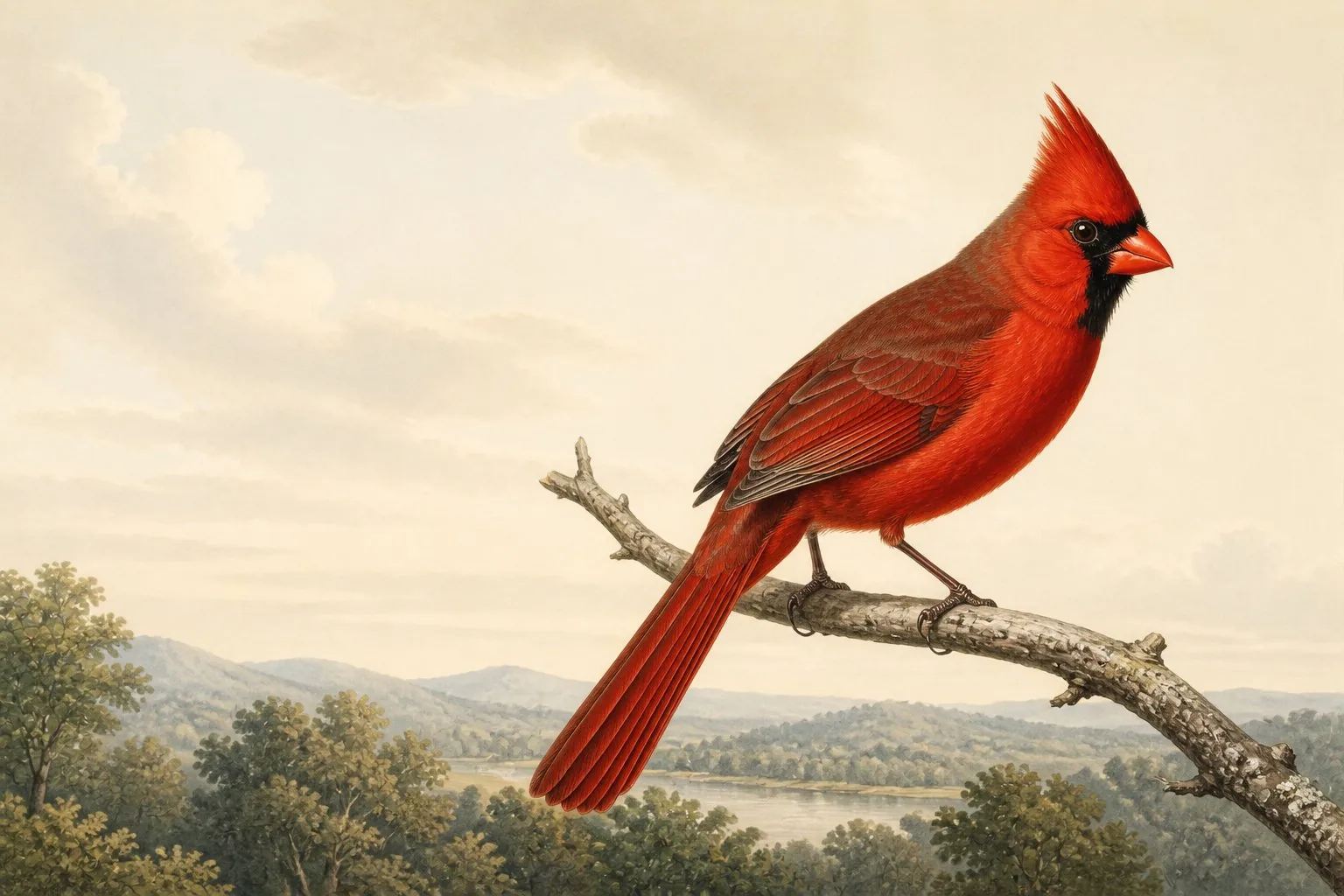
Stand at Fontenelle Forest on the edge of Omaha on a mid-May morning and you might see two red birds in the same oak. One has a crest and a coral bill and has been here all winter. The other arrived overnight from South America with jet-black wings and looks, briefly, unreal. The first is a Northern Cardinal. The second is a Scarlet Tanager. They share the tree and nothing else.
Nebraska is not the most obvious state for red birds, but it is among the most instructive. The state sits at a biological crossroads where eastern forest species, western grassland specialists, and boreal wanderers all have claims on the landscape. Four species define that crossroads clearly: the Cardinal, the Scarlet Tanager, the House Finch, and the Red Crossbill. Each one’s story is different. Understanding which is here and why teaches you more about Nebraska’s geography than any list of names.
Cardinalis cardinalis is the most widespread red bird in the state and the only one that never leaves. The Audubon Field Guide records it as a permanent resident, and the species sits firmly within its range in Nebraska’s eastern counties. He comes to feeders in January wearing the same red he wore in July. Cardinals do not moult into a dull winter coat - the red is structural, not seasonal.
That red is not made by the bird but absorbed through his diet. Research has confirmed that male Cardinals manufacture keto-carotenoids by metabolically transforming yellow and orange pigments - lutein, zeaxanthin, beta-carotene - ingested through food into the vivid colour deposited in growing feathers. A brighter male in spring was a better-fed male the autumn before, which is why females attend to it when choosing mates. The correlation is real and documented. See how the moult works in cardinals for a fuller account of that process.
Nebraska’s cardinal is, in practice, an eastern-corridor bird. The Platte River Valley carries them west into the interior of the state, the Niobrara River system extends them further north, but leave those corridors and the cardinal stops. The Sandhills in January belong to the House Finch. This matters for a birder who assumes the most common red bird in North America must be everywhere: in Nebraska, it is not.
The Northern Cardinal is Nebraska’s most reliable indicator of the eastern woodland biome. Where the river woodland holds, the cardinal holds with it. Where the trees thin, the cardinal retreats to the creek bottoms. The Great Plains do not suit him.
The Audubon Field Guide notes that the cardinal’s range has been “extending northward for decades,” now reaching southeastern Canada. The growth of towns, suburbs, and winter feeders across the eastern half of the country gave a southern species the edge-habitat and year-round food supply it needed. His presence at an Omaha feeder in February is, in part, a story about bird feeders changing a continent.
Piranga olivacea is the most startling bird in the Nebraska woods, and it passes through for only part of the year. Males arrive from wintering grounds in tropical South America by mid-May, crossing the Gulf of Mexico overnight, then moving north through the interior. The Audubon Field Guide describes breeding males as brilliant scarlet with jet-black wings and tail. Females are dull yellow-green with darker wings - effectively invisible in the canopy foliage where they nest.
Birds of Nebraska Online places the breeding range precisely: the species nests most reliably in the Missouri River Valley’s mature deciduous forest, in smaller numbers in the Niobrara River Valley west to western Brown and Keya Paha Counties, and in still smaller numbers in the Platte River Valley west to Dodge County. The species favours oaks. Fontenelle Forest in Omaha and Indian Cave State Park in Nemaha County are the two most consistently productive sites. Most individuals have departed by early October.
The Audubon Field Guide lists the Scarlet Tanager as Least Concern but notes it is “vulnerable to loss of habitat, on both summer and winter ranges,” and performs poorly in fragmented woodland. This is not a bird that tolerates small forest patches. A large, continuous stand of mature deciduous trees along a Nebraska river is one thing. A woodlot surrounded by corn is another. The tanager knows the difference.
Haemorhous mexicanus is the red finch most Nebraska birders see most often, and it arrived here from two directions. Birds of Nebraska Online records that the native western subspecies has long been a common permanent resident in the Panhandle, around Scottsbluff and Kimball County. The eastern population is a different story: derived from birds released on Long Island, New York in 1939, this population spread westward through the 1980s and established itself across the Missouri River Valley by 1990, with first confirmed breeding in Sarpy and Lancaster Counties in 1988.
Males show red on the eyebrow, forehead, throat, and breast - a raspberry wash that can shade toward orange or yellow depending on diet, since House Finches also depend on carotenoids for colour. The Audubon Field Guide estimates the total North American population at approximately 40 million. They track human settlement reliably: suburbs, farms, parks, canyon towns. In western Nebraska, where the native Panhandle birds dominate, the House Finch is the default red bird at the feeder in the absence of the cardinal.
Separating a male House Finch from a Purple Finch at a winter feeder requires attention. The Purple Finch - an irregular visitor to Nebraska from boreal forests in winter - carries a more saturated rose-red over the head and back, and the Audubon guide notes the female has “a much stronger face pattern than House Finch, including dark whisker and whitish eyebrow.” Purple Finches appear in Nebraska most often from October through March. In summer, they are gone entirely.
Loxia curvirostra does not follow a calendar. It follows cones. Birds of Nebraska Online confirms the Red Crossbill as a regular breeder on the Pine Ridge, Wildcat Hills, and in Scotts Bluff and Banner Counties, almost exclusively in ponderosa pine woodland. The same source notes that breeding numbers “vary markedly” depending on pine seed availability in a given year - nesting apparently occurs only when cone crops are moderate to high. Outside the Pine Ridge, the species appears as an irruptive winter visitor, moving south and east from northern forests when their own cone crop fails.
Males are brick-red to deep red-orange with dark wings. The crossed mandibles - twisted at the tip so the upper and lower bills pass each other - are designed to pry open conifer cones before the scales dry and spread. No other Nebraska bird eats quite this way. The American Bird Conservancy describes the crossbills as nomadic, travelling long distances across North America, Europe, and parts of northern Africa in search of the next productive cone stand.
The Red Crossbill at a Pine Ridge ponderosa is the structural opposite of the Cardinal at an Omaha feeder. One bird is sedentary, tied to river corridors and suburban feeders. The other is itinerant, specialised, and tied to the unpredictable productivity of wild forests. Both are red. Neither is a surrogate for the other.
Nebraska’s red-bird community is, in this sense, a geography lesson. The Omaha suburbs, the Missouri River bluffs, the Platte corridor, the Sandhills, the Pine Ridge - each habitat produces a different answer to the question of what red bird is here and why. The Northern Cardinal species page has full identification detail for the most common of them, and orange birds in Ohio and orange birds in Michigan show how these same families distribute differently in states where the Great Plains are not a factor. If the western tanager family interests you, orange birds in Arizona covers the warmer end of their range.
Where you stand in Nebraska is where the answer starts.
As an Amazon Associate we earn from qualifying purchases. Linked products are ones we genuinely recommend.
 May 15, 2024
 6 min read