State Guide
The orange birds of Maine and the brief window to find them
A male Baltimore Oriole arrives in a riverside elm in southern Maine in mid-May, and the window to find him has already started closing.
That is not an exaggeration. Maine Audubon documents that Icterus galbula returns to southern and central Maine in mid-May and that many individuals begin moving south again as early as July. A breeding season of roughly eight weeks - shorter than the same bird enjoys in Ohio or Illinois, both further from the range’s northeastern limit. If you want Maine’s orange birds, you work with a compressed calendar.
Maine’s orange birds run on one of the tightest seasonal schedules in the eastern range. Mid-May arrival and July departure leaves a window of roughly eight weeks - half what the same species holds in the mid-Atlantic states.
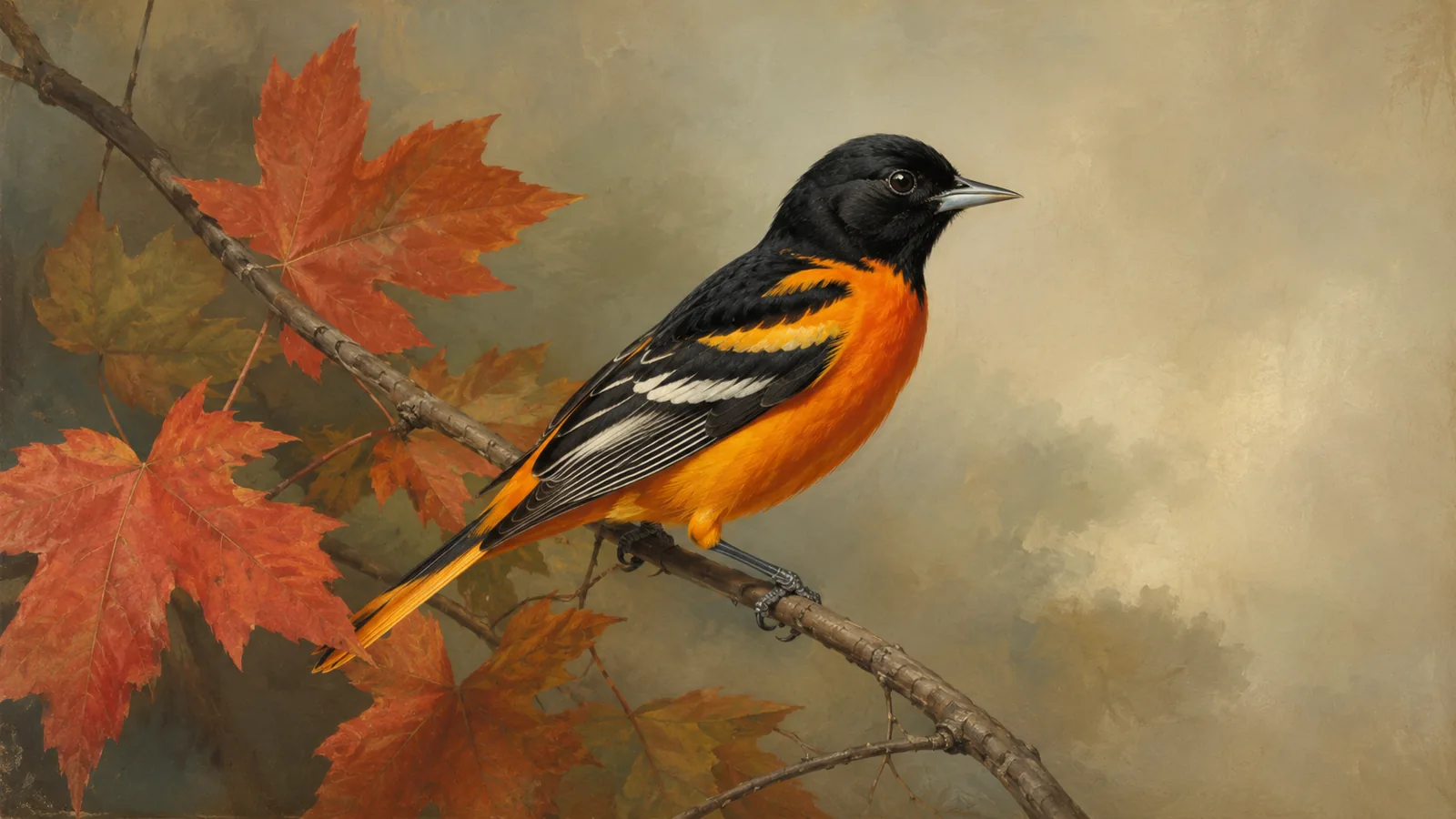
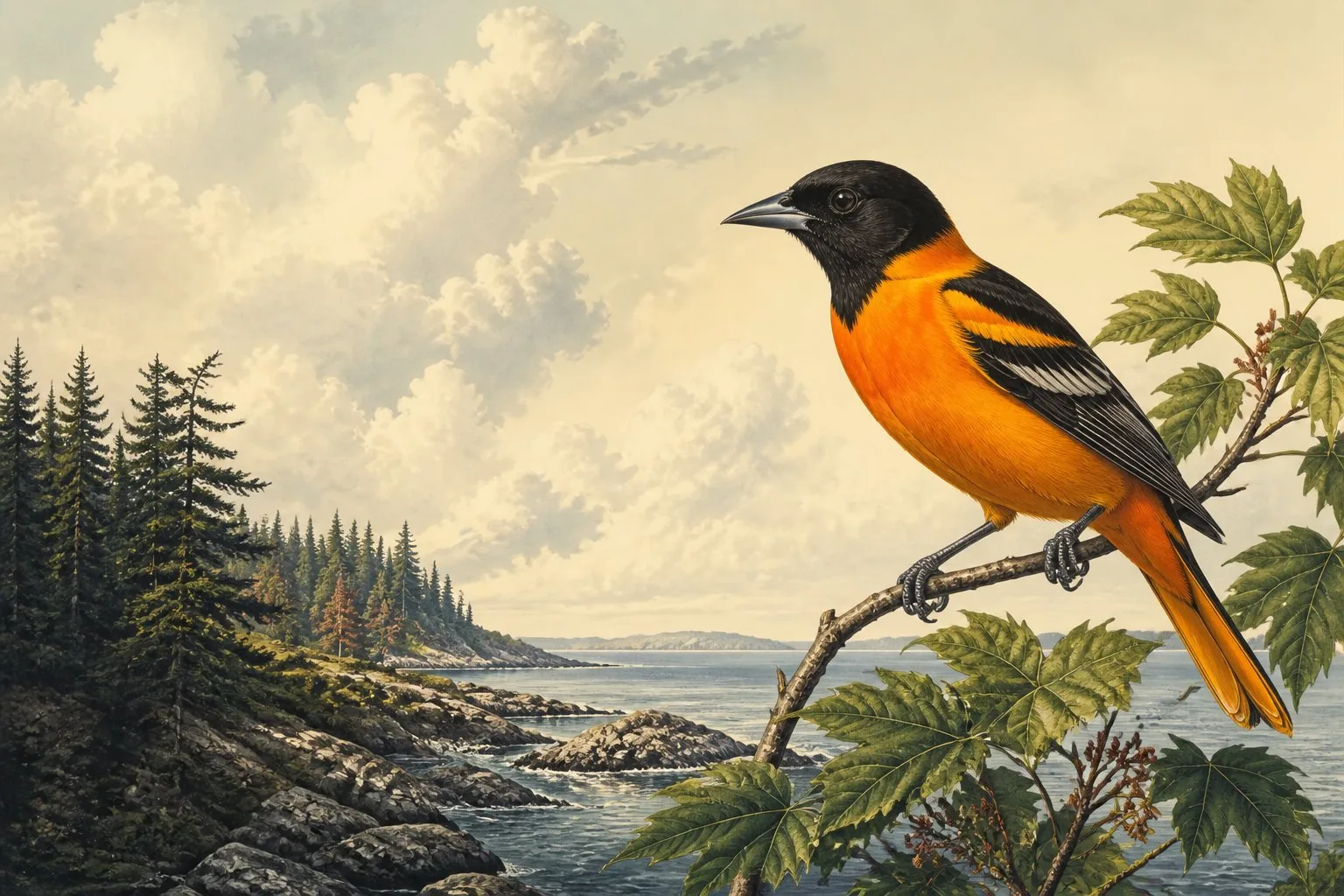
The Baltimore Oriole
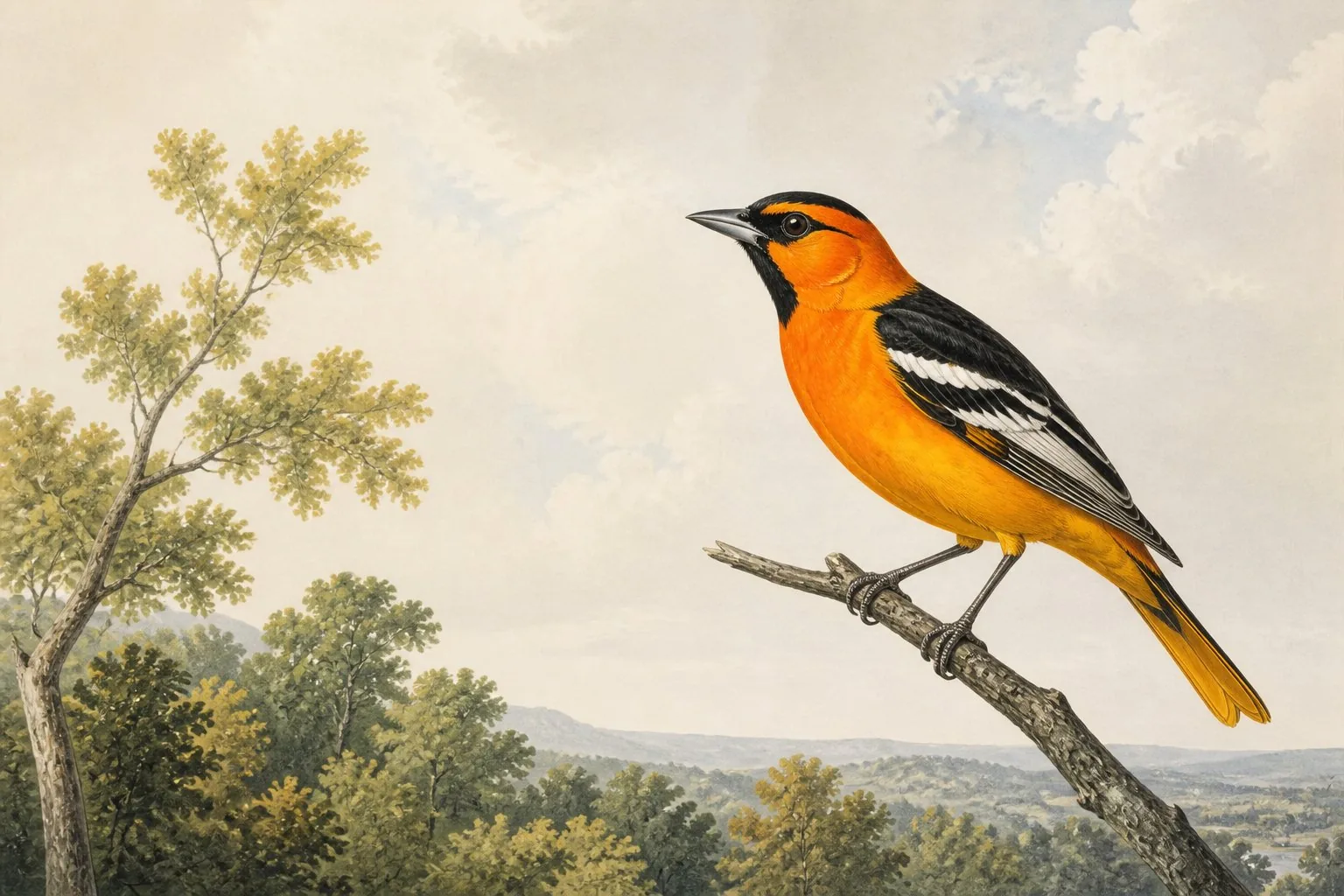
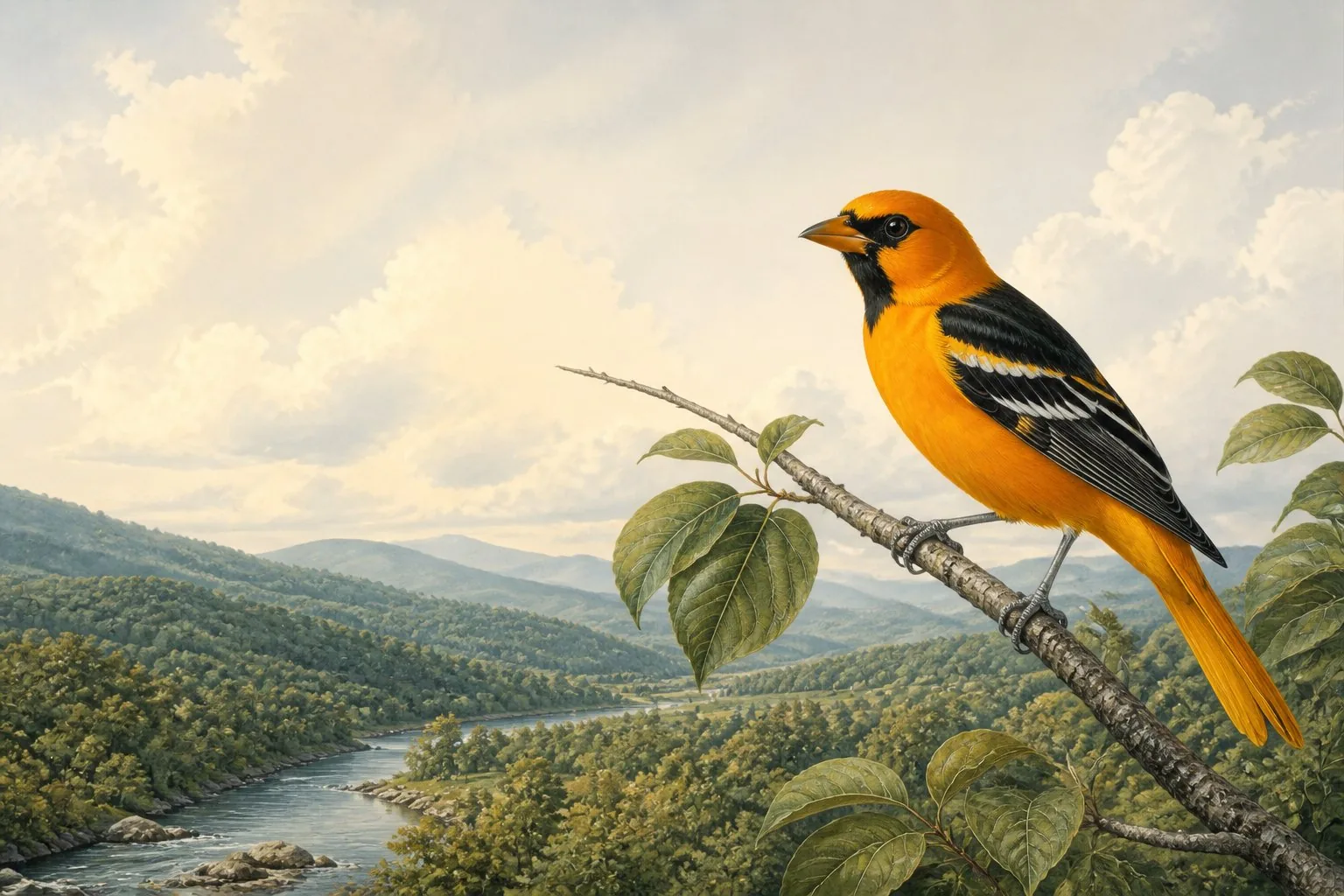
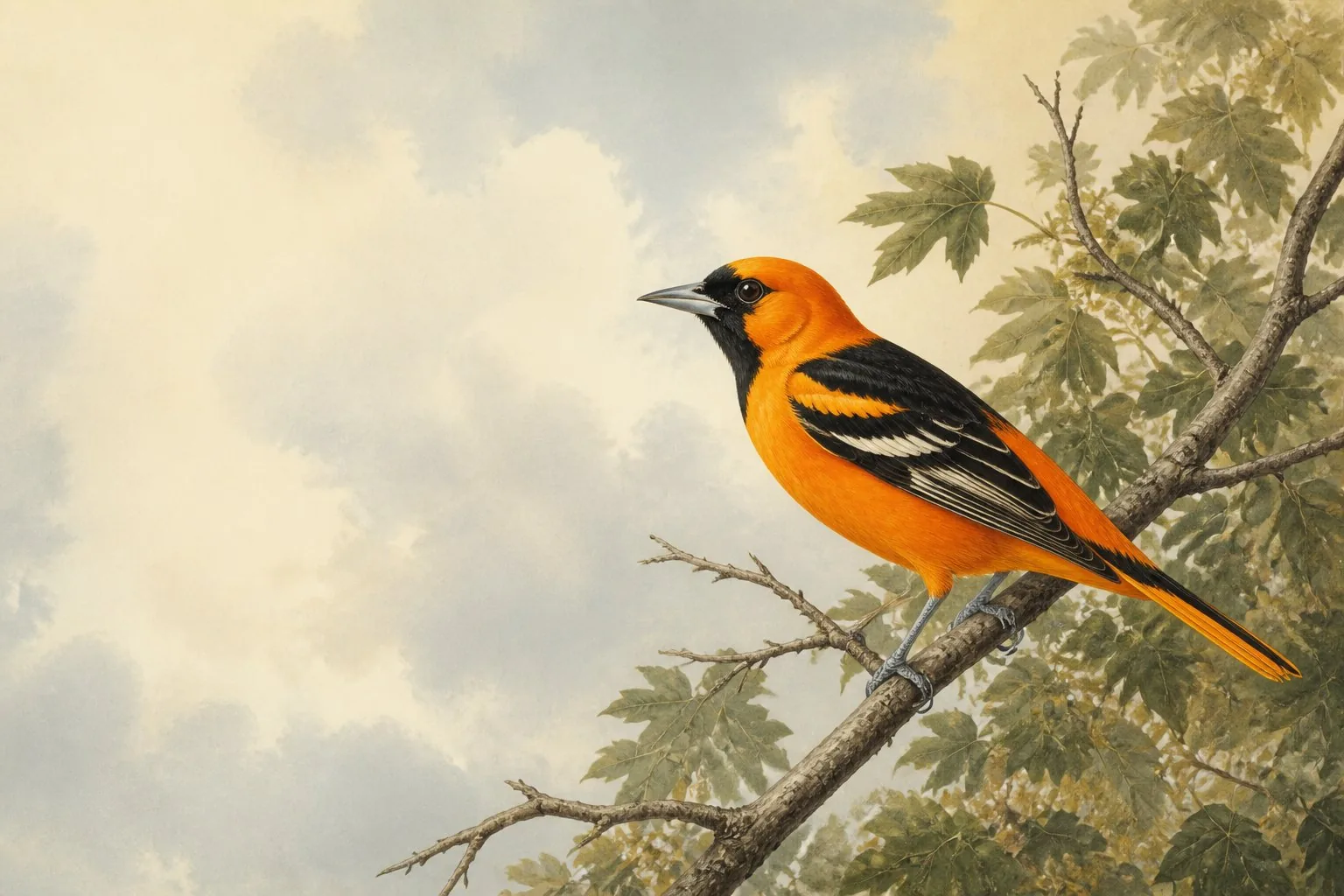
The adult male is black and flame-orange, a combination Audubon’s field guide describes as “unlike any other eastern bird.” He spends most of his time high in the canopy of deciduous trees, especially in floodplain forests, according to Maine Audubon - and his loud, clear whistling is usually what alerts you before you locate him in the leaves.
Nests go into elms, maples, and cottonwood poplars. The female builds a pendant pouch alone, winding long plant fibers around a branch to create the support strands, then weaving inward with rapid thrust-and-draw beak movements. Audubon’s reporting on oriole nest construction gives the build time as one to two weeks. The finished structure has three layers - flexible grass fibers for shape, woody fibers for strength, soft willow down as lining. These nests swing from high branch tips and remain visible long after the birds have gone south to their wintering grounds in Mexico and Ecuador.
That wintering range matters for timing. The bird has a long journey in both directions, and Maine birders who want an oriole at a feeder should put out orange halves and grape jelly - the preferred attractants noted by Maine Audubon - well before mid-May rather than after. Feeders set out by May 10 give a bird arriving in the first wave something to find. By late June the male’s territorial behavior winds down. By July some birds are already gone.
The American Redstart
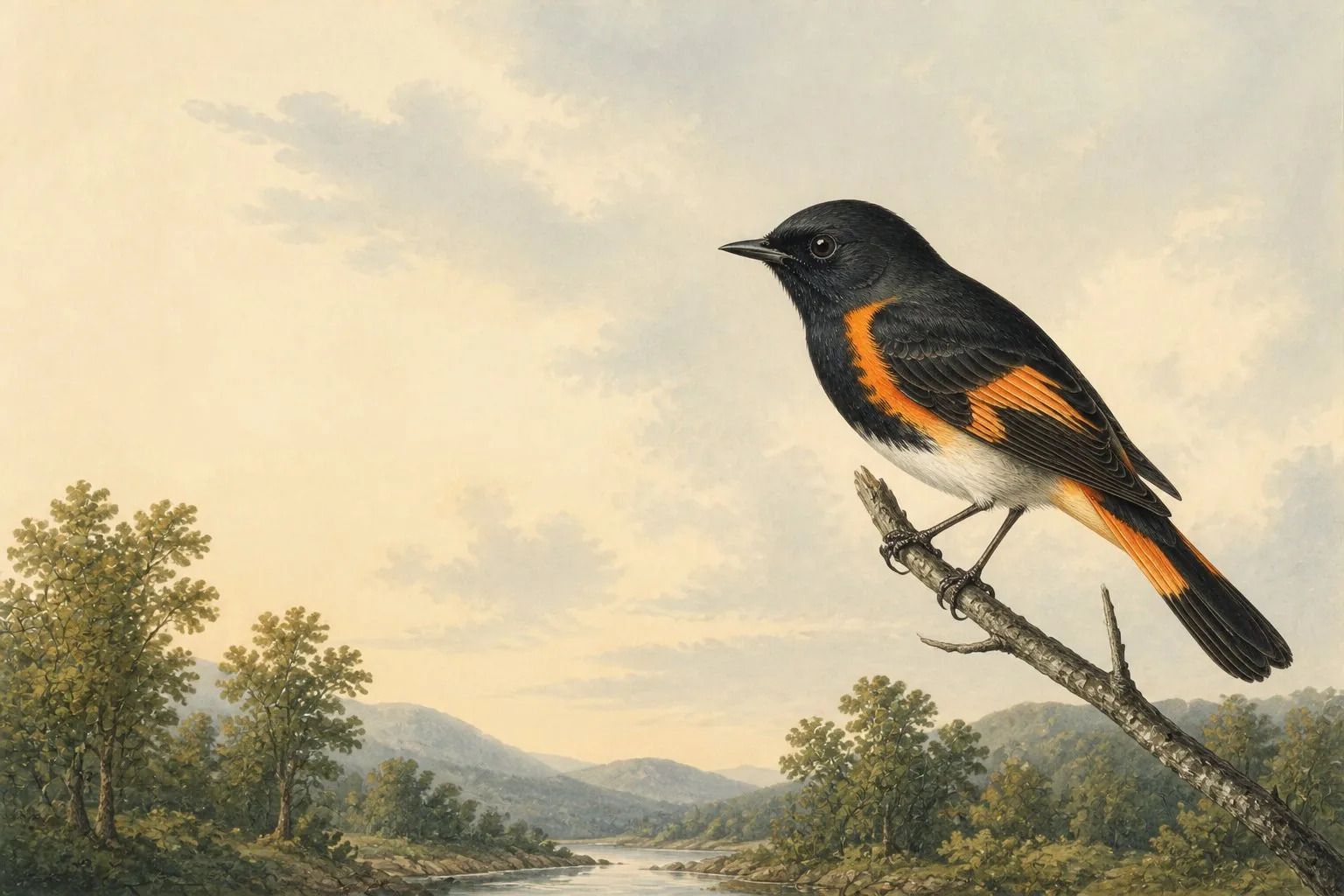
Smaller, faster, and more widely distributed across the state than the oriole, the American Redstart is the orange bird most Maine birders walk past without registering. Maine Audubon identifies Setophaga ruticilla as a breeding warbler here, present in moist, open deciduous and mixed woodland - forest edges, second growth, alder and willow thickets along streams. The male is coal-black with blaze-orange patches on the wings, sides, and tail. Females carry the same patches in yellow.
What separates the redstart from every other small bird in the Maine woods is the way it hunts. Cornell’s All About Birds documents the behavior precisely: the redstart fans its tail and droops its wings in a rapid flash, exposing the orange pattern to startle insects from foliage, then catches them mid-air. The tail-fan is both a feeding strategy and a field mark. Once you have watched a male redstart spin through a shrubby stream bank in June, using his own plumage as a flushing tool, you will not confuse him with anything else.
Migration for the redstart peaks in late September and the first half of October, Maine Audubon notes. It moves at night, and by mid-October the alder runs where it bred are empty.
The Northern Flicker
Colaptes auratus does not read as an orange bird on the ground. Perched on a dead snag or hopping across a lawn in search of ants, the yellow-shafted flicker of eastern North America looks brown and spotted, with a gray crown, a black chest crescent, and a red patch at the nape. But Audubon’s field guide describes the eastern form’s underwings as “bright yellow” - and in flight, with the bird bounding low over an open field, that color appears distinctly orange-gold against the sky.
Unlike the oriole and redstart, the flicker is a year-round Maine resident, not a migrant. Maine Audubon places it in open woodlands of all ages across the state. Audubon notes it eats ants more frequently than any other North American bird, which explains why it forages on the ground rather than on bark like most woodpeckers. The flash of its underwing in November or February - the same orange-gold as in June - is how you confirm the bird in any season.
Finding them
| Species | When | Where |
|---|---|---|
| Baltimore Oriole | Mid-May to July | Floodplain forest, tall elms and maples, older residential neighborhoods |
| American Redstart | May through early October | Moist woodland edges, alder thickets near streams |
| Northern Flicker | Year-round | Open woodlands, lawns, field edges |
The state’s most-cited sites for orange species hold up to scrutiny. Acadia National Park’s lower mixed-forest slopes hold redstarts reliably through July. Sunkhaze Meadows National Wildlife Refuge, north of Bangor, offers dense alder thickets where redstarts and flickers concentrate in late summer. For Baltimore Orioles specifically, Maine Audubon points to floodplain forest as the key habitat - riverside elms and cottonwoods in the southern and central counties are more reliably productive than boreal forest to the north, where the oriole simply does not breed.
For comparison with states that hold orange species across a longer season, see orange birds in Michigan and orange birds in Arizona.
The Baltimore Oriole’s nest - still hanging from a riverside elm in November, swinging in the wind with no bird in it - is the most useful reminder of what Maine’s orange season amounts to: a brief, specific window that rewards people who pay attention to dates as much as to plumage. The Northern Cardinal manages to be red all year; the oriole cannot. That difference is what makes the oriole’s May arrival worth marking on the calendar.