Pets
How to Introduce Toys to a Fearful Bird
You place a new toy on the cage floor on a Tuesday morning and by Tuesday afternoon the bird is crouched at the opposite end, feathers flattened, refusing to eat. You remove the toy. The bird relaxes. You have just confirmed, in the clearest possible terms, that you do not understand how your bird sees the world.
A caged parrot is a prey animal with a prey animal’s nervous system. Every unfamiliar object is assessed for threat before it is assessed for interest. The toy you placed in the cage was not a toy to your bird - it was an unknown entity inside the one space the bird cannot escape. The panic response is correct, from the bird’s point of view. Almost every failed toy introduction comes down to the owner’s timeline overriding the bird’s.
The method that works requires you to move on the bird’s schedule, not yours.
Why gradual exposure works
Systematic desensitisation - presenting a feared stimulus in increasing doses over time - works reliably in birds for the same reason it works in most animals. The nervous system learns that a stimulus predicts nothing bad, and the threat response fades. Each step must be small enough that the bird stays calm throughout. One step too fast and you reset the clock. Pair each step with a high-value treat and the process runs faster: the bird is learning not just that the toy is harmless, but that the toy predicts something good.
The six-step introduction
| Step | Action | How long |
|---|---|---|
| 1. Show from distance | Place the toy on a table across the room where the bird can see it | 1 - 2 days |
| 2. Move closer | Bring the toy to within 1 metre of the cage | 1 - 2 days |
| 3. Place beside the cage | Set the toy on top of or next to the cage, outside the bars | 1 - 2 days |
| 4. Hang outside the bars | Attach the toy to the outside of the cage | 1 - 2 days |
| 5. Place inside the cage | Put the toy inside, away from perches, food, and water | Ongoing |
| 6. Observe without intervening | Let the bird approach on its own terms | Days to weeks |
Give the bird a favourite treat at every step - immediately after you place the toy, while the bird is still processing the change. You are building one association: toy moves closer, good thing happens. Most birds accept a new toy within two weeks at this pace. Rescue birds may take longer.
One step at a time, treats at every step, and the bird decides when to interact. Rushing creates setbacks that take weeks to undo.
Reading the bird at each step
You need to know whether the bird is afraid or merely curious. Fear and curiosity can look similar from across the room.
Fear signs: fluffed feathers, crouching low on the perch, moving to the far side of the cage, refusing to eat, hissing, alarm calling, or lunging if you move the toy.
Curiosity signs: leaning toward the toy, head tilting, eye-pinning (pupils rapidly dilating and contracting - seen in parrots), a cautious forward stretch of the neck, touching the toy briefly then retreating.
If you see any fear signs at a given step, go back one step and stay there for another two to three days. Do not push through fear. A bird that is frightened is not learning that the toy is safe - it is learning that being near the toy is miserable.
Choose the right first toy
The toy itself matters as much as the introduction method. For anxious birds, start with something quiet, soft, and small.
| Toy type | Why it works for fearful birds |
|---|---|
| Soft cotton or fleece | Non-threatening, absorbs your scent easily, no sudden movement |
| Plain cardboard or paper | Familiar texture, quiet, satisfying to shred for confidence |
| Small wooden beads on cord | Gentle movement, chewable, no loud noise |
| Leather strips | Natural texture, calm to grip, nothing that rattles or clangs |
Avoid mirrors, bells, and anything reflective or noisy as a first toy. These are fine for a confident bird. For a nervous one, a mirror produces a territorial response and a bell produces unpredictable sound - two things that can tip a cautious bird back into full threat mode. Save them for later, once the bird has a working relationship with toys in general.
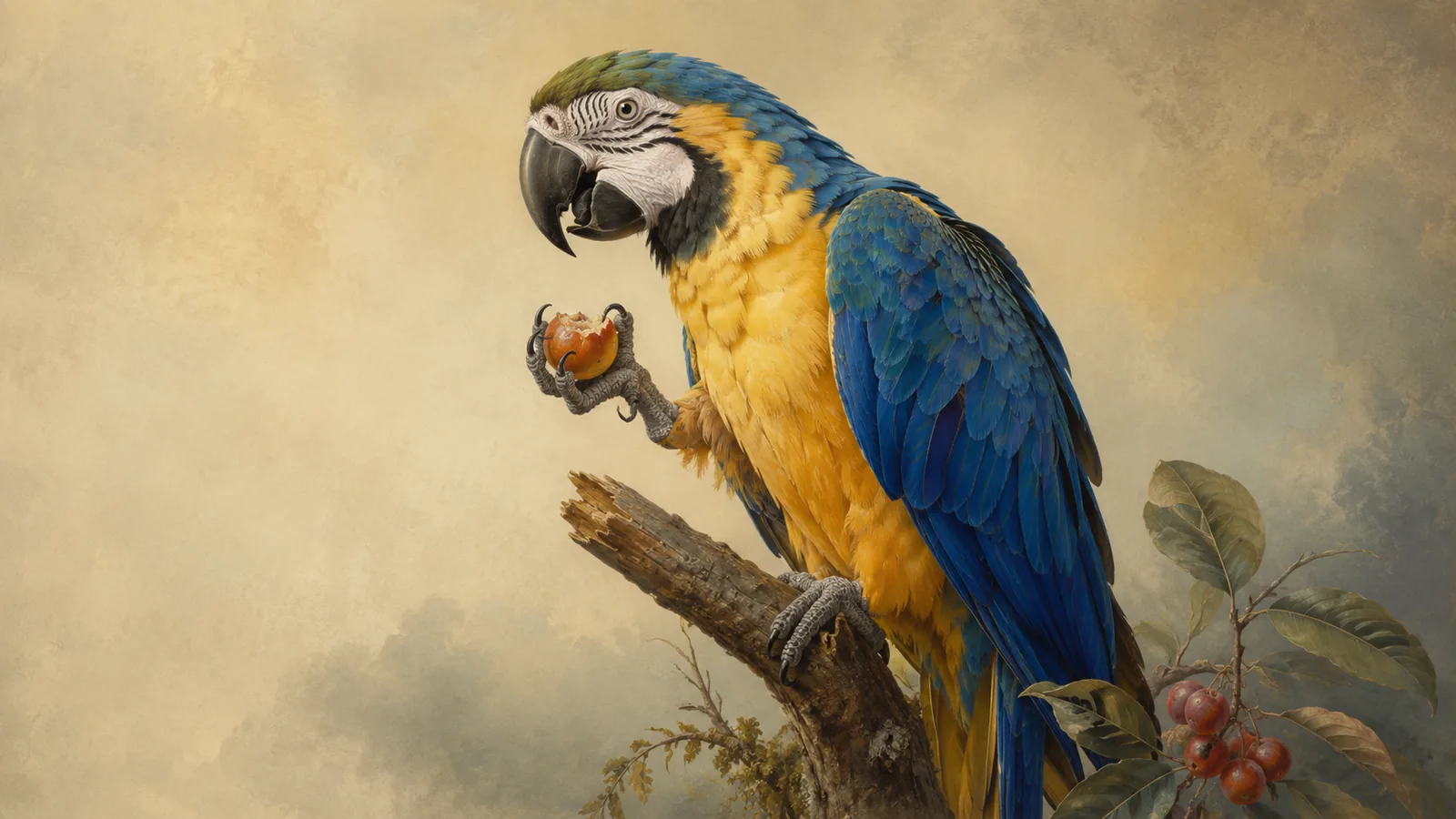
A highly intelligent species such as the African Grey parrot is often the most cautious of all with new objects, so the gentle-first-toy rule matters most for birds like these.
For guidance on matching toy complexity to your bird’s age and confidence level, see how to choose age-appropriate bird toys.
Common mistakes that reset progress
Most introductions fail for one of five reasons:
- Toy placed directly in the cage on day one. The bird’s safe space is invaded by an unknown object. Panic is the response and trust takes time to rebuild.
- Multiple new toys introduced at once. The bird cannot habituate to three novel stimuli simultaneously. One toy at a time, one week between introductions.
- Forcing interaction. Pushing the toy toward the bird, holding it up to the cage, or placing it near the bird’s face does not speed up acceptance. It teaches the bird that the toy and your hands together are dangerous.
- Placing the toy near food or water. The bird avoids eating and drinking rather than approach the threat. Dehydration and hunger add stress on top of fear.
- Removing the toy the moment the bird looks anxious. This rewards the fear response. The bird learns that alarm behaviour makes threats disappear. Instead, put the toy back one step and stay there.
Two small techniques that help
Handle the toy yourself where the bird can watch. Pick it up, examine it, set it down. Your bird watches you constantly. If the toy is safe for the flock leader, the assessment changes.
Rub the toy on your clothing before the first placement. Familiar scent lowers novelty and gives the bird one fewer unknown to process.
None of this is species-specific. A timid budgie and a hand-shy scarlet macaw both relax on the same schedule: small steps, treats, and the bird in control of the pace.
One link in this guide goes to Amazon. It points to gear we would actually put in front of a bird, and we earn a small commission if you buy through it.
For the broader picture of keeping a pet bird well-stimulated, what parrots can eat and its enrichment context are worth reading alongside this.
The longer view
A bird that has learned to accept new toys has learned something more general: that novel things can be investigated rather than fled from. The fourth toy goes in faster than the first. The eighth faster than the fourth. What you are building is not just a bird that plays - it is a bird with a lower baseline fear response, which makes every other part of keeping it easier.
The bird refusing to eat on Tuesday, because of a toy three inches from its bowl, is capable of becoming the bird that spends 20 minutes working a foraging toy apart. The distance between them is patience applied in the right direction.