Any tall bird standing in water gets called a heron. But egrets, bitterns, cranes, storks, ibises, and spoonbills all share that wetland silhouette - and telling them apart comes down to neck shape, bill type, and behaviour.
Quick Comparison
| Bird | Size | Bill | Key difference from herons |
|---|---|---|---|
| Great Egret | 90-100cm | Yellow, dagger-like | All white. Black legs. Same family as herons. |
| Snowy Egret | 56-66cm | Black, thin | Smaller. Black bill, yellow feet (“golden slippers”). |
| Cattle Egret | 46-56cm | Short, yellow-orange | Stocky. Follows livestock. Buff plumes in breeding. |
| Little Egret | 55-65cm | Black, thin | Black legs, yellow feet. Europe, Asia, Africa. |
| Reddish Egret | 68-82cm | Pink with black tip | Dances and spins while hunting. Two colour morphs. |
| American Bittern | 58-85cm | Yellowish, straight | Brown streaked plumage. Points bill skyward to hide. Deep booming call. |
| Least Bittern | 28-36cm | Yellowish, straight | Tiny. Clings to reed stems. Rarely seen in the open. |
| Black-crowned Night-Heron | 58-66cm | Heavy, dark | Stocky, short-necked. Black cap. Active at dusk and night. |
| Yellow-crowned Night-Heron | 55-70cm | Heavy, dark | Bold white cheek stripe on black face. Eats crabs. |
| Sandhill Crane | 80-120cm | Straight, pointed | Red forehead. Flies with neck straight out (herons fold theirs). |
| White Stork | 100-115cm | Heavy, red | White with black wings. Straight neck in flight. Europe. |
| Glossy Ibis | 48-66cm | Long, curved down | Dark metallic plumage. Curved bill unlike any heron. |
| Roseate Spoonbill | 71-86cm | Flat, spoon-shaped | Pink. Sweeps flat bill side to side through water. |
The Neck Rule
The single most useful trick for separating these birds:
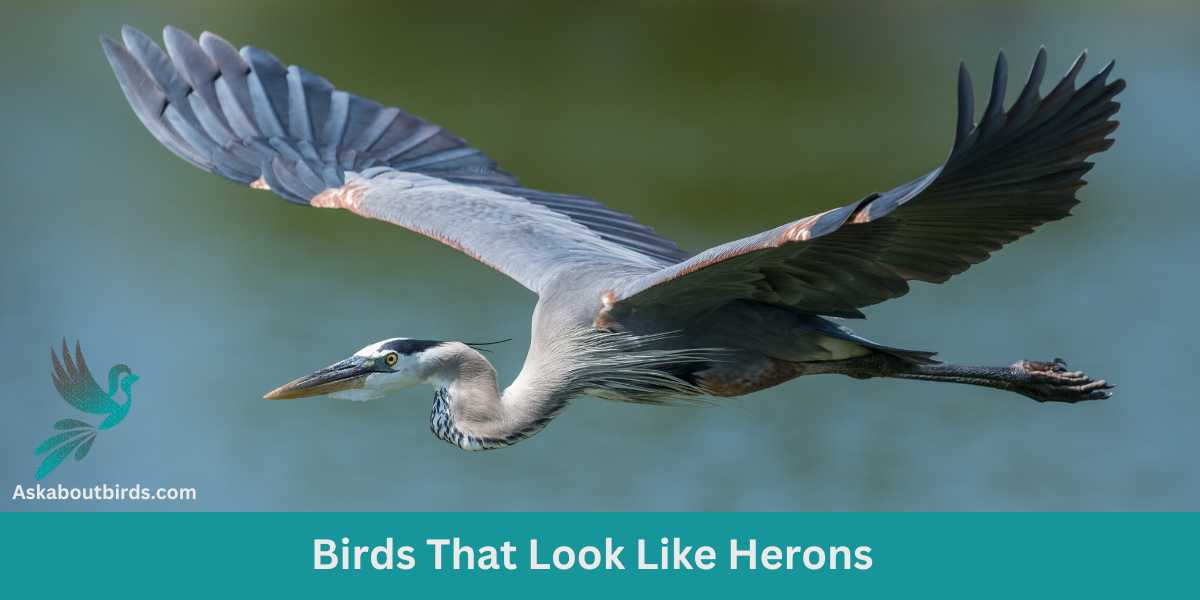
- Herons and egrets fold their necks into an S-shape in flight
- Cranes, storks, ibises, and spoonbills fly with necks straight out
If the bird retracts its neck while flying, it is a heron or egret. If the neck stays extended, it is something else.
Egrets Are Herons
There is no scientific distinction between herons and egrets. Both belong to the family Ardeidae. “Egret” is simply the name given to the white species that grow ornamental plumes during breeding season. All egrets are herons, but not all herons are egrets.
Heron vs Crane
The most common confusion in North America is Great Blue Heron vs Sandhill Crane. Both are large and grey, but:
- Great Blue Heron - Blue-grey, yellow bill, S-shaped neck in flight, solitary hunter at water’s edge
- Sandhill Crane - Grey, red forehead, straight neck in flight, feeds in open fields in large flocks
Heron vs Bittern
Bitterns are herons, but they are the secretive, camouflaged branch of the family. American Bitterns stand in reeds with their bill pointed straight up, relying on their brown-streaked plumage to blend in. Their deep, resonant “pump-er-lunk” booming call carries across marshes but the bird itself is almost impossible to spot.
If you hear a deep, rhythmic booming from a marsh that sounds like someone blowing across a bottle, it is an American Bittern. You will hear them long before you ever see one.