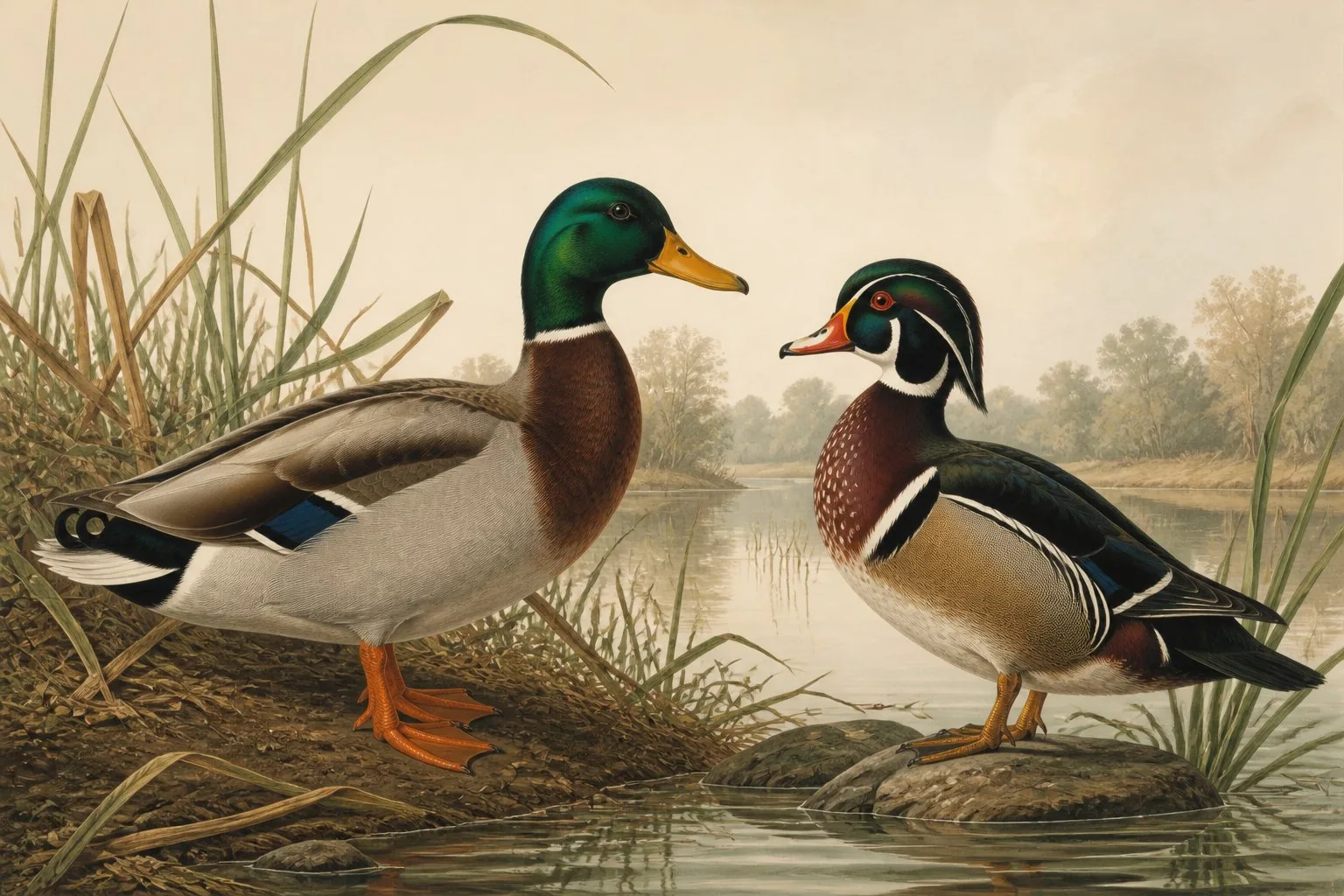
Quackety Quack Discover 11 Birds That Look Like Ducks
From your local park to vast wetlands, the sight of birds gliding effortlessly across the water is a familiar one. But not all that quacks and waddles is a duck!
Join us as we spread our wings and embark on a journey to discover eleven amazing birds that, at first glance, you might mistake for our friendly, feathered, quacking counterparts
Birds That Look Remarkably Like Ducks
Here are some bird species that can appear remarkably similar to ducks:
Similarities
-
Compact body and relatively small size can resemble a duck at a distance.
-
Both have relatively short tails that are often hidden.
Differences
-
Distinguished by its stout bill marked with a black band (or ring), unlike a duck’s flat bill.
-
Less colorful than most ducks, mostly brownish-gray in color.
Similarities
-
Comparable in size to many duck species.
-
Rounded body silhouette can resemble a duck when swimming.
Differences
-
Distinctive white bill and forehead shield contrast with a duck’s bill.
-
Has lobed toes instead of the webbed feet seen in ducks.
Similarities
-
Similar in size and shape to some duck species.
-
Both have short tails and strong wings.
Differences
-
Darker plumage, less varied than the multicolored mallard.
-
Shows a small, stubby bill compared to the broader bill of a duck.
Similarities
-
In flight or swimming, its silhouette might be mistaken for a large duck.
-
Both species possess strong wings.
Differences
-
Longer neck and hooked bill distinguish it from ducks.
-
Holds wings out to dry, a behavior not seen in ducks.
Similarities
-
Comparable in size to many duck species.
-
Both have rounded body shapes.
Differences
-
Exhibits a distinct red and yellow bill and forehead shield.
-
Shows a white line along its side, unlike ducks.
Similarities
-
Size and streamlined body shape can resemble a duck at a distance.
-
Both have strong, solid bodies.
Differences
-
Pointed bill, often held pointing slightly upwards, differs from a duck’s bill.
-
Striking black and white plumage in summer is unlike most ducks.
Similarities
-
Long body in water might resemble a duck at a glance.
-
Both species have relatively short tails.
Differences
-
Long neck and pointed bill distinguish it from ducks.
-
Displays a contrasting black-and-white color pattern.
Red-necked Grebe


| Feature | Measurement |
|---|---|
| Scientific Name | Podiceps grisegena |
| Length | 13-17 inches |
| Wingspan | 32 inches |
| Weight | 800-1600 grams |
The Red-necked Grebe (Podiceps grisegena) is a striking waterbird known for its distinctive appearance and exceptional diving abilities.
Appearance: During the breeding season, these medium-sized grebes display a vibrant combination of colors, with a captivating red neck and a sleek black cap atop their heads. The rest of their plumage features shades of gray, complemented by a white facial patch and striking red eyes. With their pointed bills and lobed feet.
Diet: Inhabiting a wide range of freshwater environments such as marshes, ponds, and lakes, Red-necked Grebes are opportunistic carnivores with a diverse diet. Their menu consists of small fish, aquatic invertebrates, and occasional amphibians, and they might even consume some plant material.
Reproduction: During the breeding season, they construct floating nests anchored to vegetation or debris, where the female lays a clutch of 3 to 5 eggs. Both parents actively participate in incubating the eggs and raising the downy, precocious chicks, showcasing their dedicated parental care. Though not globally threatened, local populations can be at risk due to habitat loss and human disturbances to their breeding sites.
Similarities
-
Rounded body shape and size can resemble a large duck when seen at a distance.
-
Both have sturdy bodies and strong wings.
Differences
-
Long neck and pointed bill distinguish it from ducks.
-
Its reddish neck during breeding season differs from duck coloring.
Eared Grebe


| Feature | Measurement |
|---|---|
| Scientific Name | Podiceps nigricollis |
| Length | 10-13 inches |
| Wingspan | 16-20 inches |
| Weight | 200-500 grams |
The Eared Grebe (Podiceps nigricollis) is a small, water-dwelling bird species found primarily in North America, parts of South America, and some regions of Europe and Asia.
Appearance: During the breeding season, adults have a striking black cap on the crown of their heads, which contrasts with their white cheeks and neck. The rest of their plumage is mainly gray with a slight reddish-brown hue on the neck and sides during this period. They have a distinctive red eye, which adds to their overall appearance. Outside of the breeding season, their plumage becomes more subdued, with less contrast and a grayer appearance.
Diet: The diet of Eared Grebes (Podiceps nigricollis) mainly consists of small aquatic invertebrates, fish, and plant matter. As highly skilled divers, they forage for food underwater, using their lobed toes to propel themselves effectively through the water.
Reproduction: Eared Grebes construct floating nests made of plant materials anchored to emergent vegetation near the water’s edge. They are colonial nesters, often forming large colonies with other waterbirds.
Similarities
-
Compact, rounded body might resemble a duck when swimming.
-
Similar size to many duck species.
Differences
-
Displays distinctive tufts of feathers (‘ears’) behind the eyes in breeding season.
-
Dark in color with a sharp, pointed bill, unlike most ducks.
Black-necked Grebe


| Feature | Measurement |
|---|---|
| Scientific Name | Podiceps nigricollis |
| Length | 10-13 inches |
| Wingspan | 16-20 inches |
| Weight | 200-500 grams |
The Black-necked Grebe (Podiceps nigricollis) is a small waterbird belonging to the grebe family, found in various freshwater and brackish water habitats across Europe, Asia, and parts of Africa.
Appearance: The Black-necked Grebe is a striking bird with distinct breeding and non-breeding plumages. During the breeding season, adult Black-necked Grebes have a striking appearance, with a black crown and nape that extends down the back of their neck, contrasting with their creamy-white face and throat. Their cheeks are dark, and their sides are chestnut-brown. They have red eyes and a thin, slightly upturned bill. The rest of their plumage is predominantly black.
Diet: They are highly skilled divers and swimmers, capable of remaining submerged for extended periods while foraging for small aquatic prey. Their diet primarily consists of small fish, aquatic invertebrates, and aquatic vegetation.
Reproduction: Black-necked Grebes are solitary birds outside of the breeding season, although they may gather in loose groups or small flocks during migration or in areas with abundant food resources. During the breeding season, pairs form and build floating nests in dense vegetation near the water’s edge. The nest is a floating platform made of aquatic vegetation, anchored to emergent plants.
Similarities
-
Rounded body shape can resemble a duck when swimming.
-
Similar size to many duck species.
Differences
-
Black neck and pointed bill contrast with duck features.
-
Shows bright red eyes, unlike most ducks.
Horned Grebe


| Feature | Measurement |
|---|---|
| Scientific Name | Podiceps auritus |
| Length | 12-15 inches |
| Wingspan | 20-24 inches |
| Weight | 350-500 grams |
The Horned Grebe (Podiceps auritus), also known as the Slavonian Grebe, is a small waterbird species found in North America, Europe, and parts of Asia. It is known for its striking breeding plumage and distinctively “horned” golden tufts of feathers behind its eyes.
Appearance: During the breeding season, the Horned Grebe displays vibrant and eye-catching plumage. Its head and neck are mostly black, with a white patch on the face just below the eye. The most distinctive feature is the golden “horns” or tufts of feathers that extend back from the eyes, giving the bird its common name. The upperparts are mainly black, while the underparts are white.
Diet: Their diet consists mainly of small fish, aquatic invertebrates, and some plant matter. During the breeding season, Horned Grebes build floating nests made of aquatic vegetation, anchored to submerged plants or emergent vegetation near the water’s edge.
Reproduction: The female lays a clutch of several eggs, and both parents take turns incubating the eggs and caring for the chicks. After hatching, the chicks ride on their parents’ backs to stay safe and warm.
Similarities
-
Similar size to many ducks.
-
Rounded body shape can resemble a duck when swimming.
Differences
-
Displays ‘horns’ of feathers in breeding season, unlike ducks.
-
Reddish neck and dark back contrast with typical duck coloring.
FAQS on Duck Like Birds
What bird looks similar to a duck?
The American Coot (often called a mud hen) often looks similar to a duck due to its comparable size and the fact that it is often found in the same aquatic habitats. However, unlike ducks, coots have a white bill and chicken-like feet, lacking the webbing found in duck species.
What is a small water bird that looks like a duck?
The Grebe are small aquatic birds that can easily be mistaken for a duck. With its compact, streamlined body, short tail, and pointed bill, it shares many physical characteristics with ducks, but grebes display a distinct diving and swimming behavior.
What bird looks like a duck but bigger?
The Canada Goose (which are migratory birds) can often be mistaken for a larger version of a duck. It shares a similar body shape and aquatic habitat with ducks, but the Canada Goose is larger and has a distinctive black head and neck with a white chinstrap marking. Alternatively a brown pelican (that eats yellow perch) can often be mistaken for diving ducks.
What other bird looks like a coot?
The Gallinule, specifically the Common Gallinule, often looks similar to a Coot. Like the Coot, the Common Gallinule has a ‘duck-like’ appearance and is found in wetland habitats. However, Gallinules are distinct with their red and yellow bill and a line of yellow along the leg.
What is the difference between a dabbling duck and a diving duck?
Dabbling ducks, often referred to as “puddle ducks,” feed primarily at the water’s surface or by tipping forward to reach slightly below. Notably, they have a light body structure which allows immediate takeoff from the water. In contrast, diving ducks submerge completely underwater to forage, their diet often includes fish and shellfish. Due to their heavier bodies, they require a running start for takeoff.
What is a migratory bird that look like ducks along the Pacific Coast?
Some migratory birds that resemble ducks along the Pacific Coast include the Pied-billed Grebe, the American Coot, and the Common Loon. Each of these species has certain features that may lead observers to mistake them for ducks.