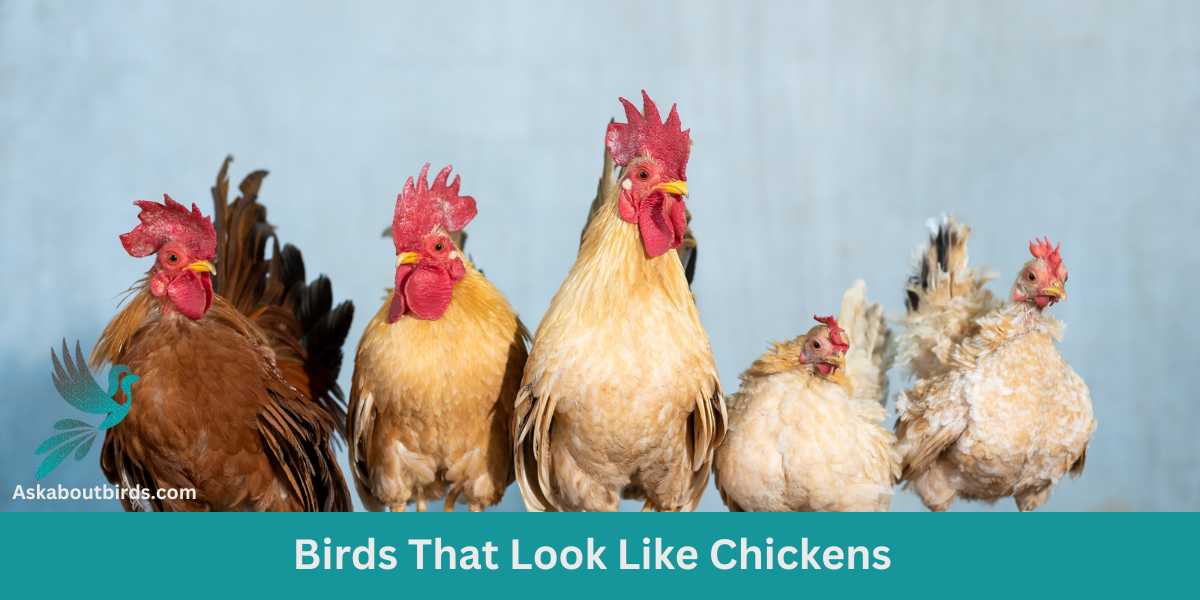
Domestic chickens belong to the order Galliformes - ground-dwelling, heavy-bodied birds with strong legs and short, rounded wings. Dozens of wild species in this order look remarkably chicken-like. Here are 21 of the most common.
The Full List
| Bird | Size (length) | Region | Key feature |
|---|---|---|---|
| Wild Turkey | 90-112cm | North America | Much larger than a chicken. Fan-shaped tail display. |
| Ring-necked Pheasant | 50-90cm | Introduced worldwide | Males have iridescent copper/green plumage, white neck ring. |
| Ruffed Grouse | 40-48cm | N America forests | Brown/grey camouflage. Drums with wings on logs. |
| Greater Prairie-Chicken | 40-45cm | Central US grasslands | Elaborate booming courtship display with inflated neck sacs. |
| Northern Bobwhite | 20-28cm | Eastern US | Small. Distinctive “bob-WHITE” call. Brown and white markings. |
| Gambel’s Quail | 25-28cm | SW US deserts | Forward-curving topknot plume. Grey with chestnut flanks. |
| Scaled Quail | 25-30cm | SW US, Mexico | Blue-grey “scaled” breast pattern. White-tipped crest. |
| California Quail | 24-27cm | Pacific coast | Black forward-curving plume. Brown and grey. State bird of California. |
| Plain Chachalaca | 50-58cm | S Texas, C America | Olive-brown. Extremely loud calls. Long tail. |
| Helmeted Guinea Fowl | 50-58cm | Africa (domesticated worldwide) | Grey with white polka dots. Bald head with bony casque. |
| Rock Ptarmigan | 33-38cm | Arctic, alpine | White in winter, mottled brown in summer. Feathered feet. |
| Black Grouse | 40-55cm | Europe, Asia | Males glossy black with red eyebrow. Lyre-shaped tail. |
| Blood Pheasant | 38-43cm | Himalayas | Red face and breast streaking. Grey-green body. |
| Blue-eared Pheasant | 80-90cm | China | Dark blue-grey. Red face patch. White ear tufts. |
| Copper Pheasant | 78-84cm | Japan | Coppery chestnut. Very long barred tail. |
| Green Pheasant | 60-90cm | Japan | Iridescent green breast and mantle. Japan’s national bird. |
| Crested Fireback | 70-84cm | SE Asia | Blue-black body, chestnut belly, yellow crest (males). |
| Crestless Fireback | 63-74cm | SE Asia | Dark with metallic green/purple sheen. No crest. |
| Siamese Fireback | 60-80cm | SE Asia | Grey with red facial skin and long curved tail. |
| Swinhoe’s Pheasant | 60-79cm | Taiwan | Dark blue-purple with white back patch and red face. |
| Edward’s Pheasant | 58-65cm | Vietnam | Dark blue-black. Critically endangered. |
Grouse and Ptarmigan
Grouse are the wild chickens of northern forests and tundra. Ruffed Grouse in particular look and behave like wild chickens - they are round, ground-dwelling, and forage by scratching through leaf litter.
Rock Ptarmigan go a step further, turning completely white in winter for camouflage against snow. Their feathered feet act as snowshoes - an adaptation no chicken has.
Quail
Quail are essentially miniature chickens. They are the same basic shape - round body, short wings, strong legs - but scaled down to 20-30cm. Northern Bobwhites, Gambel’s Quail, and California Quail are the most common North American species, each found in different habitats.
The Wild Turkey is the ancestor of all domestic turkeys. Benjamin Franklin famously argued it should be the US national bird instead of the Bald Eagle, calling the eagle “a bird of bad moral character.”
Pheasants
Pheasants are the most visually spectacular chicken relatives. Males often have extraordinary plumage - iridescent greens, coppers, blues, and reds - while females are brown and camouflaged. The Ring-necked Pheasant, introduced from Asia, is now one of the most widely distributed game birds in the world.
Guinea Fowl
Helmeted Guinea Fowl look like chickens wearing polka-dot suits. Originally from Africa, they are now kept worldwide as pest control birds - they eat enormous quantities of ticks and insects. Their loud alarm calls also make them effective “watchdogs” on farms.