Pets
Bird Enrichment Beyond Toys
A parrot that screams all morning is not misbehaving. It is bored and has nothing else to do.
Feather plucking, cage aggression, obsessive pacing - these are almost never personality flaws. They are what happens when a creature designed to spend the majority of its waking hours solving problems for food gets handed a full bowl and left in a room. The toy industry has taught bird owners to think about this backwards. We reach for a new rattle, a new rope, a new mirror. The object is not the point. The question is whether the bird has to work.
In the wild, parrots and their relatives spend most of their day - estimates from field observations put it at 60-80% of active hours - searching, probing, cracking, peeling, and extracting food. A cage with a ceramic dish full of pellets eliminates every part of that in one move. A bored bird is not being difficult. It is filling its day the only way left available to it.
This is the single most useful reframe in pet bird keeping: enrichment is not about the objects you provide. It is about whether the bird has to earn its food.
A few of the links in this guide go to Amazon. They point to gear we would actually put in front of a bird, and we earn a small commission if you buy through them.
Start with foraging, not toys
Foraging is the foundation. Everything else - toys, training, social time - sits on top of it. If a bird is not foraging, the other enrichment categories are patches on a structural problem.
The simplest version costs nothing. Wrap a portion of the day’s pellets loosely in unbleached paper so the bird has to tear into it. Hide a piece of fruit inside a cardboard tube. Scatter food across the cage floor instead of piling it in a bowl. The bird does not know or care that the puzzle is simple. The act of solving it is the point.
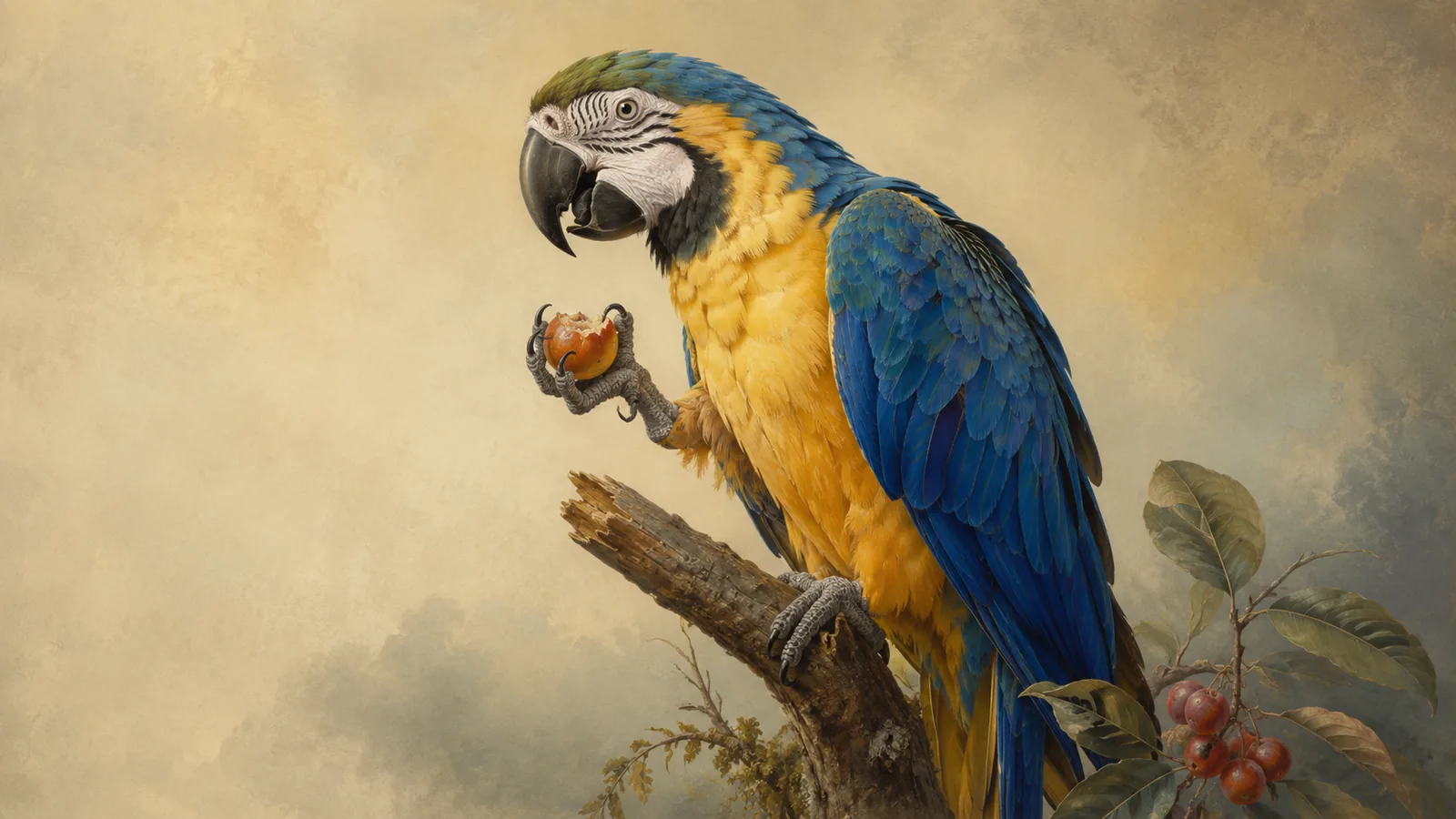
Once the bird has learned that food can come from anywhere, raise the difficulty. Tuck treats inside paper cups folded shut. Use a commercial foraging toy that requires the bird to slide, rotate, or pry a door open. Change the method every few days - the novelty of a new approach matters as much as the challenge itself. A scarlet macaw will tear through a simple paper wrap in seconds, so a big parrot needs the puzzle pitched harder than a budgie does. A bird toy chosen for the right developmental stage will last longer and stay interesting longer than one the bird solves in an afternoon.
The bird that plucks its feathers is often the bird that has nothing to do between eight in the morning and the time you come home. Foraging does not just fill time - it restores the rhythm a cage removes.
Training is enrichment you do together
Clicker training is one of the most underused tools in pet bird keeping. Most owners know it exists and assume it is for teaching tricks. It is also cognitive exercise, a way to tire a bird’s mind without asking anything of its body, and one of the most effective bond-building activities available.
Target training is where to start. Teach the bird to touch a target stick with its beak on cue, marking the moment with a clicker, and reward with a small piece of fruit or a seed. Five minutes of this is mentally equivalent to a much longer stretch of passive cage time. Once targeting is solid, step-up and step-down follow naturally. Speech and mimicry - where the species allows for it - engage auditory processing in ways that no toy can replicate.
Keep sessions short. Five to 10 minutes is enough. End on a success, never on a refusal. Consistency over weeks matters far more than any single session’s duration.
The species table is a starting point, not a prescription
Different birds have different cognitive needs, and the gaps between species are wide.
| Species | What boredom looks like | What helps most |
|---|---|---|
| African Grey (Psittacus erithacus) | Feather plucking, self-mutilation | Complex foraging puzzles, rigid routine, speech training |
| Cockatoo | Screaming, separation anxiety | Maximum out-of-cage time, foraging, predictable schedule |
| Amazon Parrot | Aggression, excessive vocalisation | Social interaction, foraging, singing sessions |
| Cockatiel | Feather condition decline, lethargy | Gentle handling, whistling interaction, another bird |
| Budgerigar | Repetitive behaviour, bar-chewing | Multiple perches, another budgie, foraging scatter |
The African Grey parrot is worth singling out. It is among the most cognitively demanding parrots kept as pets - ornithologists who have studied the species in captivity put its problem-solving capacity in a different category from most other parrots. A Grey with nothing to do will find ways to cope that owners find distressing and vets find expensive. The solution is not more toys in the cage. It is more problems to solve before lunch.
Safety that cannot be skipped
Flight time in a bird-safe room is the best physical exercise you can offer. A bird gym or play stand outside the cage gives the bird a second territory and a reason to leave voluntarily.
Two safety points override everything else. Non-stick cookware releases fumes at high heat that can kill a bird within minutes. This is not a fringe scenario. Scented candles, air fresheners, and certain cleaning sprays carry the same risk. The bird’s respiratory system is built for sensitivity, not suburban kitchens.
Frayed rope toys and loose small parts should leave the cage the moment they appear. A toe caught in a fraying rope is an emergency.
The measure is behaviour, not inventory
Good enrichment is not a cage full of objects. It is a bird that spends its day doing things - searching, pulling, cracking, learning. If the bird is foraging for at least part of its food, getting daily out-of-cage time, and has some training or close interaction built into the week, you are ahead of most. If it is sitting on the same perch all morning with a full bowl in front of it, the next toy will not fix what the foraging arrangement already isn’t.
A well-enriched parrot is quieter than most people expect. That is not a coincidence.
For more on building a cage environment that supports natural behaviour, see the guide on choosing age-appropriate bird toys. If you keep toucans or other non-parrot exotics, the rest and activity patterns in when and how toucans sleep and whether toucans migrate or hibernate give context for what normal looks like for species outside the parrot family.