State Guide
Orange Birds in Virginia: The Six Species Worth Knowing
Stand at a Virginia Piedmont forest edge on a May morning and you may see three shades of orange within thirty minutes - a Baltimore Oriole carrying nesting material toward an elm, a male Eastern Towhee scratching in the leaf litter below a thicket, and an American Redstart fanning its tail in the understorey. The state’s Atlantic Flyway position, its coastal plain, Piedmont, and Appalachian ridges each draw different species at different times. Orange is not one bird’s colour here.
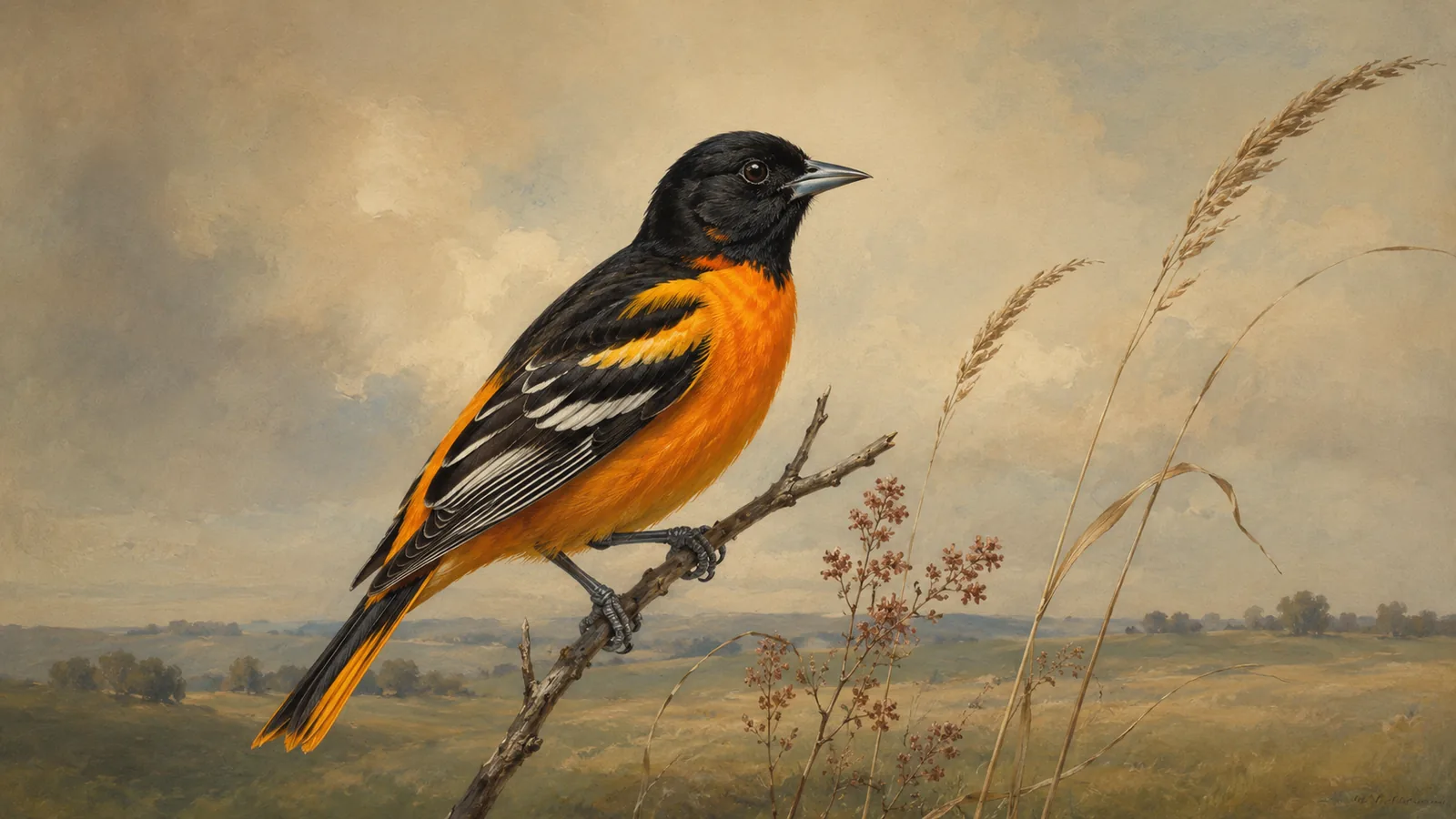
The Baltimore Oriole
Icterus galbula is the one most people picture when they think of orange birds in the American East. The Audubon Society describes the male as “flaming orange and black” - the same two colours on Lord Baltimore’s 17th-century coat of arms. The black is absolute: hood, back, wings. The orange saturates the breast, belly, and shoulders, with one white wing bar as the only break.
Baltimore Orioles arrive in Virginia in early May, males first. They favour open deciduous woodlands, forest edges, and suburban yards with mature elms or sycamores. The Northern Virginia Bird Alliance lists Great Falls Park, Dyke Marsh, and Algonkian Regional Park as the most consistent sites. The female builds the nest alone - a hanging pouch suspended from slender outer branches, woven from plant fibers and strips of bark. Most birds are gone from Virginia by August.
The Orchard Oriole
Icterus spurius is the oriole most visitors miss because his colouring is deep chestnut rather than chrome orange - burnt sienna on the underparts and shoulders, set against a black head and back. Cornell’s All About Birds places him as smaller than the Baltimore and darker overall.
Cornell notes Orchard Orioles arrive on Virginia breeding grounds by late May and depart as early as mid-July - one of the shorter summer residencies of any American songbird. They breed in open woodlands along river edges, in pastures with scattered trees, and in orchards.
The American Robin
Turdus migratorius is Virginia’s most familiar orange-breasted bird. The Audubon Field Guide describes the chest as “brick-red” - a warm, earthy orange-red rather than the sharp flame of an oriole. Robins are year-round Virginia residents, but the population is not static: in winter they leave open lawns and gather in wooded areas with berry crops. The flock moving through a holly stand in December and the bird pulling a worm from your April lawn may both be Virginia robins, but not the same ones.
The Eastern Towhee
The male Pipilo erythrophthalmus wears a sooty black hood and back, white belly, and warm rufous-orange flanks. He is a year-round Virginia resident in brushy thickets, overgrown fields, and forest edges with dense understorey. His call - a rising tow-hee - is typically the first sign of presence. The orange on a towhee is never visible from above; you have to watch him work the leaf litter with both feet to see the flanks at all.
Virginia’s orange birds are not all one thing: the oriole is a canopy dweller on a tight schedule, the towhee is a year-round ground bird that never quite leaves the understorey, and the Blackburnian Warbler is a migrant most birders see only by craning upward into hemlock branches for thirty seconds in late April.
The Blackburnian Warbler
Setophaga fusca carries a “flaming-orange throat” - the only North American warbler with that colouring on adult males. Cornell’s All About Birds notes the species breeds along the Appalachians from New York to northernmost Georgia, with hemlocks the most likely host tree in mixed forests. The Blue Ridge falls within their breeding range. Outside the mountains, they pass through Virginia as migrants in April-May northbound, and again in August-September. They feed near the tops of tall conifers, often 30 or more feet up, which makes them easy to miss.
The American Redstart
Setophaga ruticilla is the most theatrical of the group. Males are coal-black with vivid orange patches on the sides, wings, and base of the tail. They fan that tail in quick flicks - the Audubon Society notes this flash of colour startles insects into the open, where the bird catches them mid-air. In Virginia, Redstarts breed in open-canopy deciduous forests and forest edges, often near water, and pass through in larger numbers during migration. Many are heading south by August.
The Piedmont river corridors are the most productive zones for both oriole species. At Chincoteague and Kiptopeke State Park on the Eastern Shore, Redstarts and Blackburnian Warblers accumulate during April and May, concentrated in a way they rarely are in the interior.
Virginia is varied enough that this list is not exhaustive - Barn Swallows carry an orange-buff belly and Northern Flickers flash orange under the wings in flight. But these six are the ones whose orange is structural rather than incidental. The Northern Cardinal - Virginia’s state bird - is absent here because its colouring is red, not orange, though the two blur in certain light. The cardinal molting piece examines what that red costs the male every August.
The Baltimore Oriole in an elm at Great Falls Park in May is not incidentally orange. He is orange because there is no other way to be a Baltimore Oriole.